
Kevin Park.hl
1.5K posts


Kevin Park.hl retweetledi

Friendly reminder to those who own hype and have made considerable amounts of money now dunking on other companies.
Let’s not be smug and alienate future users of the platform. An exchange that is not growing is an exchange that’s dying.
Hyperliquid is for EVERYONE.
English
Kevin Park.hl retweetledi

.@VitalikButerin on why a 1,000-year lifespan wouldn't get boring:
"Even if we lived to 1,000 years old, we're not gonna get bored. We're gonna keep creating new worlds for ourselves."
"Everything around us, the people, the world, changes so much over 10 years that it almost might as well be a death and a rebirth."
"15 years ago, it was normal for close friends to not talk to each other for days. Doesn't that sound crazy now?"
"In the first 20 years of your life you're a learner, a consumer. You're someone playing games that other people set up for you. One of the big transitions as you grow up is getting into more of a role of actually being the one that has to create and define and contribute to the games yourself."
@sodofi_ @binji_x
English
Kevin Park.hl retweetledi

It's a companion to Machines of Loving Grace, an essay I wrote over a year ago, which focused on what powerful AI could achieve if we get it right: darioamodei.com/essay/machines…
English
Kevin Park.hl retweetledi

i think the cognitive load of dev work has increased
before AI, a lot dev work was manually typing out variables, if statements, function calls etc. Not trivial but not super demanding
now AI's completely automated that, so we're left with the hard stuff:
- testing. So much testing now. Anytime AI ships sometime we have to test it to ensure that it not only works, but doesn't break/regress anything prior
- making decisions. Thinking about what to build, whether to include this feature or that feature, is mentally draining. There's often no black or white right answer so you're constantly internally debating
- multitasking, handling 2+ trains of thoughts at once. I recently moved from 1 claude code on 1 project -> 2 claude codes on 1 project (2 diff branches). Your focus and concentration required almost doubles
So yeah.. coding w/ AI definitely got easier.. but in a sense it also got harder 😭
English
@thsottiaux @doublemover still getting a lot of stream disconnections
English

@doublemover Situation is mostly recovered. We are continuing to monitor but traffic is back and healthy.
English
Bro @doublemover. Believe it or not we got paged and are at it since 1am. Shuffling capacity and bringing more compute online. Should be back to normal shortly.
doublemover@doublemover
Brooooo @thsottiaux what is this crap it's 4am I'm tryin to have fun
English
Kevin Park.hl retweetledi


Kevin Park.hl retweetledi

Kevin Park.hl retweetledi

Heads up everyone.
Seems the .fi registrar is likely compromised.
The .fi name servers were updated overnight to point back to the attacker.
While we still have access to the account it appears someone internally is coordinating. the dns has been moved away from the parking domains the attacker has been using.
The domain is registered with regery, if anyone else is using them, consider this your wake up call.
Be vigilant always.
English


S&P Dow Jones Indices and trade[XYZ] have joined forces to launch the first official S&P 500 perpetual contract, available exclusively on Hyperliquid.
For 69 years, the S&P 500 has been a defining reference point for global finance. Until now, access to that benchmark has been shaped by market hours, intermediaries, and geography. Today, that changes.
The S&P 500 perp is now available 24/7/365, anchored by the official index data required for deep liquidity and institutional confidence at scale.
SPDJI helped define modern indexing. They are stewards of an iconic benchmark, the standard against which portfolios across the globe are measured. We are honored to bring that legacy on-chain.
Trade[XYZ] is bringing the world's most iconic assets towards a future of global, continuous markets — a future powered by Hyperliquid.
English
Kevin Park.hl retweetledi

CFTC @ChairmanSelig laid out an exciting roadmap for the Commission's top priorities at @MilkenInstitute's Future of Finance 2026 today:
"I view Project Crypto as a historic initiative between the agencies to upgrade and modernize our rules and regulations and future-proof them for technologies like crypto...."
"Many of the firms want to move onchain. The prior administration drove a lot of these firms and the liquidity offshore. The perpetuals markets are a great example of this. We've had perpetual futures contracts in crypto assets for a very long time[,] but they've developed offshore[.] We've got to bring that back to the United States. We need to have that liquidity here in the U.S...."
"We're working towards getting perpetual futures, true perpetual futures, not long-dated contracts, here in the U.S. within the next month or so.... We're also working towards onchain markets, so we're looking to have clear guidance as to what sort of digital wallets would implicate our regulations. The prior administration really went after firms that were just offering software products...."
"We're also working towards regulations that accommodate onchain software systems, so decentralized finance protocols and other types of blockchain networks.... We're going to make sure it's very clear as to what implicates the CFTC's regulations and what doesn't, and to the extent that an onchain software system or front-end does implicate our rules or regulations, we're modernizing and future-proofing those rules so that there's a place for all of that."
HPC applauds Chairman Selig's forward-thinking approach to regulation and stands ready to support his crucial work ensuring that decentralized markets for perpetual derivatives thrive in the United States. 🇺🇸
English

Kevin Park.hl retweetledi

Focus is probably even more important now than taste
AI will 10x your productivity but it will simultaneously hit you with weapons-grade nerdsnipes that consume 90% of your time
English
Kevin Park.hl retweetledi


Kevin Park.hl retweetledi
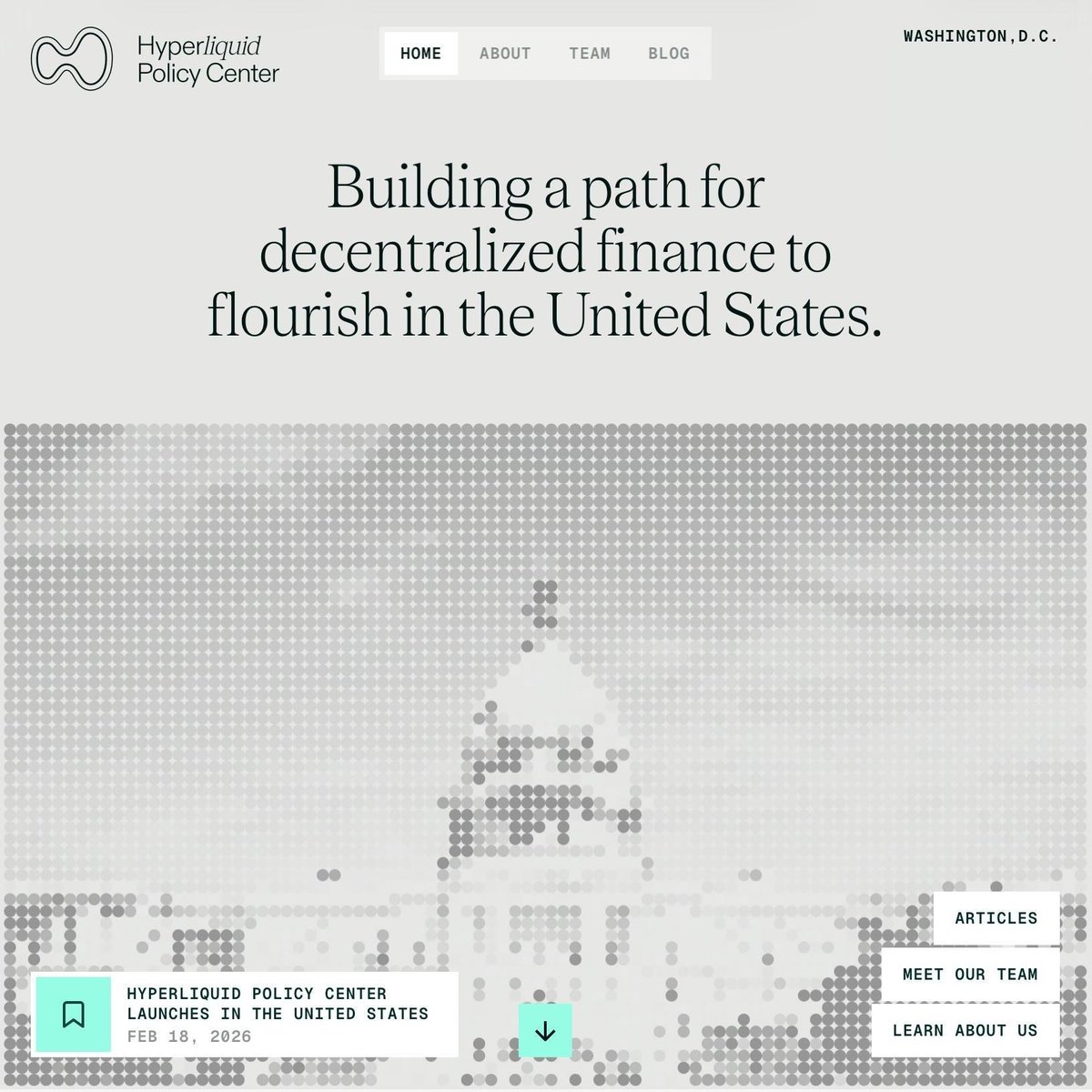
We are Hyperliquid Policy Center.
HPC is a research and advocacy nonprofit focused on advancing a clear path for decentralized finance to thrive in the USA.
We will introduce policymakers to @HyperliquidX and bridge the gap between law and next-generation market infrastructure.
English
Kevin Park.hl retweetledi

The only question of 2026 is whether you want to looksmaxx/ ascend or master agentic coding tools
English
Kevin Park.hl retweetledi

There have recently been some discussions on the ongoing role of L2s in the Ethereum ecosystem, especially in the face of two facts:
* L2s' progress to stage 2 (and, secondarily, on interop) has been far slower and more difficult than originally expected
* L1 itself is scaling, fees are very low, and gaslimits are projected to increase greatly in 2026
Both of these facts, for their own separate reasons, mean that the original vision of L2s and their role in Ethereum no longer makes sense, and we need a new path.
First, let us recap the original vision. Ethereum needs to scale. The definition of "Ethereum scaling" is the existence of large quantities of block space that is backed by the full faith and credit of Ethereum - that is, block space where, if you do things (including with ETH) inside that block space, your activities are guaranteed to be valid, uncensored, unreverted, untouched, as long as Ethereum itself functions. If you create a 10000 TPS EVM where its connection to L1 is mediated by a multisig bridge, then you are not scaling Ethereum.
This vision no longer makes sense. L1 does not need L2s to be "branded shards", because L1 is itself scaling. And L2s are not able or willing to satisfy the properties that a true "branded shard" would require. I've even seen at least one explicitly saying that they may never want to go beyond stage 1, not just for technical reasons around ZK-EVM safety, but also because their customers' regulatory needs require them to have ultimate control. This may be doing the right thing for your customers. But it should be obvious that if you are doing this, then you are not "scaling Ethereum" in the sense meant by the rollup-centric roadmap. But that's fine! it's fine because Ethereum itself is now scaling directly on L1, with large planned increases to its gas limit this year and the years ahead.
We should stop thinking about L2s as literally being "branded shards" of Ethereum, with the social status and responsibilities that this entails. Instead, we can think of L2s as being a full spectrum, which includes both chains backed by the full faith and credit of Ethereum with various unique properties (eg. not just EVM), as well as a whole array of options at different levels of connection to Ethereum, that each person (or bot) is free to care about or not care about depending on their needs.
What would I do today if I were an L2?
* Identify a value add other than "scaling". Examples: (i) non-EVM specialized features/VMs around privacy, (ii) efficiency specialized around a particular application, (iii) truly extreme levels of scaling that even a greatly expanded L1 will not do, (iv) a totally different design for non-financial applications, eg. social, identity, AI, (v) ultra-low-latency and other sequencing properties, (vi) maybe built-in oracles or decentralized dispute resolution or other "non-computationally-verifiable" features
* Be stage 1 at the minimum (otherwise you really are just a separate L1 with a bridge, and you should just call yourself that) if you're doing things with ETH or other ethereum-issued assets
* Support maximum interoperability with Ethereum, though this will differ for each one (eg. what if you're not EVM, or even not financial?)
From Ethereum's side, over the past few months I've become more convinced of the value of the native rollup precompile, particuarly once we have enshrined ZK-EVM proofs that we need anyway to scale L1. This is a precompile that verifies a ZK-EVM proof, and it's "part of Ethereum", so (i) it auto-upgrades along with Ethereum, and (ii) if the precompile has a bug, Ethereum will hard-fork to fix the bug.
The native rollup precompile would make full, security-council-free, EVM verification accessible. We should spend much more time working out how to design it in such a way that if your L2 is "EVM plus other stuff", then the native rollup precompile would verify the EVM, and you only have to bring your own prover for the "other stuff" (eg. Stylus). This might involve a canonical way of exposing a lookup table between contract call inputs and outputs, and letting you provide your own values to the lookup table (that you would prove separately).
This would make it easy to have safe, strong, trustless interoperability with Ethereum. It also enables synchronous composability (see: ethresear.ch/t/combining-pr… and ethresear.ch/t/synchronous-… ). And from there, it's each L2's choice exactly what they want to build. Don't just "extend L1", figure out something new to add.
This of course means that some will add things that are trust-dependent, or backdoored, or otherwise insecure; this is unavoidable in a permissionless ecosystem where developers have freedom. Our job should make to make it clear to users what guarantees they have, and to build up the strongest Ethereum that we can.
English