Thaisa

3.1K posts

Thaisa banner
Thaisa

Thaisa

@thaisa_sb

Supermassive Black Holes Hunter, premio L’Oreal/UNESCO For Women in Science 2015, membro ABC, TWAS, pesq. 1A - CNPq, Comenda Nacional do mérito Científico 2018

Porto Alegre, Brazil Katılım Nisan 2013
265 Takip Edilen9.1K Takipçiler
Sabitlenmiş Tweet
Thaisa
Thaisa@thaisa_sb·
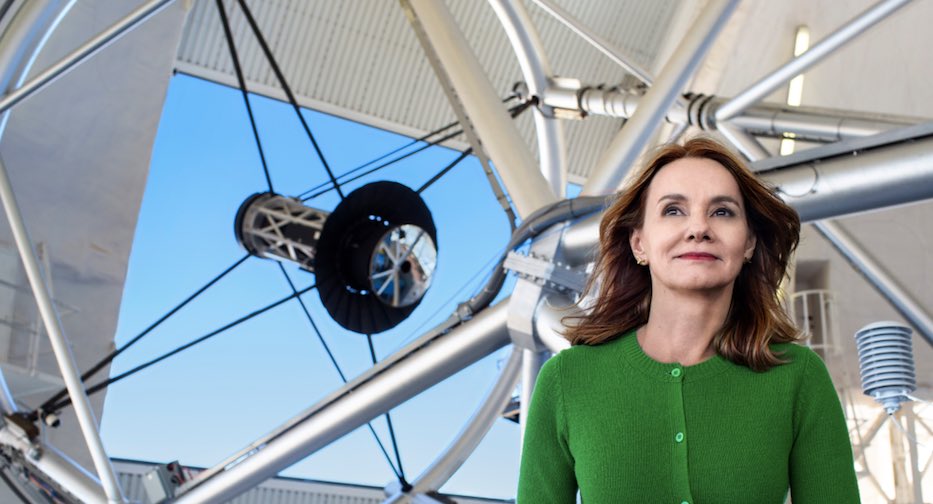
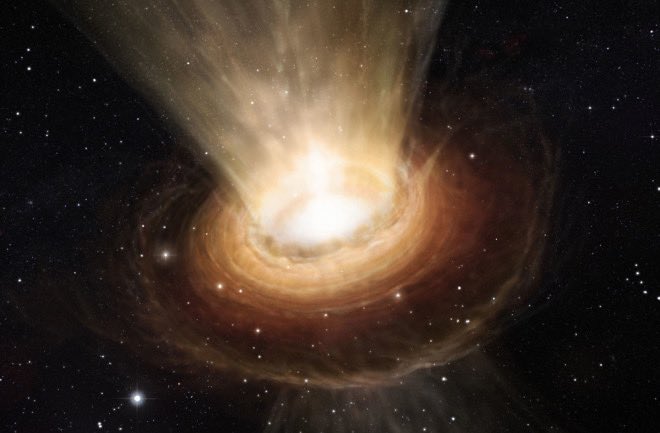
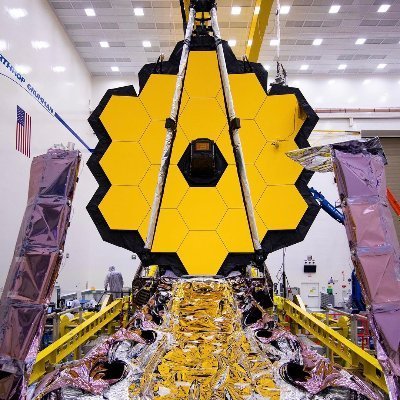
Apresentando-me para quem chegou aqui recentemente: sou a astrofísica Thaisa Storchi Bergmann, e estudo a interação entre os buracos negros supermassivos e suas galáxias hospedeiras a partir de observações com telescópios na Terra e no espaço. #buracosnegros #ciencia #astronomia
Thaisa tweet mediaThaisa tweet mediaThaisa tweet media
Português
19
38
706
0
Thaisa
Thaisa@thaisa_sb·
E se a gravidade for quântica? E o campo gravitacional e tecido do espaço-tempo não forem contínuos, mas tiverem “estados quânticos”! Esta é a teoria da gravitação quântica, que poderia explicar melhor as condições extremas do Big Bang! #bigbang #gravidade #quântica #universo
Erika @ExploreCosmos_

Quantum gravity is an attempt to unify two frameworks that currently describe the universe in incompatible ways: quantum mechanics, which governs particles and fields at microscopic scales, and general relativity, which describes gravity and the structure of spacetime on cosmic scales. Each works extremely well in its own domain, but when pushed into extreme conditions, such as those that existed at the very beginning of the universe, they break down or contradict each other. The problem becomes most evident when we try to describe the Big Bang. General relativity predicts that if you rewind the universe far enough, everything collapses into a singularity, a point of infinite density and temperature where the equations stop making physical sense. This is usually interpreted as a sign that the theory is being used outside its valid range rather than a literal description of reality. At those earliest moments, quantum effects should dominate, but we do not yet have a theory that consistently includes both quantum physics and gravity. Quantum gravity aims to provide that missing description. Instead of treating spacetime as a smooth, continuous fabric as in Einstein’s theory, many approaches suggest that spacetime itself may have a discrete or quantum structure at extremely small scales. In that regime, gravity would not simply be the curvature of a smooth geometry but something that also follows quantum rules, possibly involving fundamental units or excitations, like gravitons or more abstract structures depending on the model. Recent work explored in the article focuses on a specific framework called quadratic quantum gravity, which modifies Einstein’s equations so they remain well-behaved at very high energies. In this picture, the early universe does not necessarily begin with a problematic singularity. Instead, the physics of gravity itself, when properly extended into the quantum regime, could naturally describe the universe’s initial state and even generate features like the rapid early expansion without needing additional hypothetical fields. If such ideas are correct, quantum gravity would not just fix a mathematical inconsistency; it would fundamentally change how we think about the origin of the universe. The Big Bang would no longer be a boundary where physics stops, but a phase that can be described within a deeper, unified theory. It could also provide testable predictions, for example through subtle signatures like primordial gravitational waves, offering a possible path from speculation to empirical science. 👉 share.google/TOpQkQl5W4Dwzm…

Português
0
3
14
603
Thaisa
Thaisa@thaisa_sb·
10% da energia gerada na acreção de matéria ao buraco negro de Cygnus X-1 sai em jatos de partículas. É a primeira vez que isto foi medido, e se valer de forma geral, permite avaliar impacto dos buracos negros no Universo! #buracosnegros #astronomia #espaço #universo
Department of Physics at University of Oxford@OxfordPhysics

New research in Nature Astronomy confirms that black hole jets carry 10% of infalling energy, providing a vital anchor for modeling galaxy evolution and cosmic feedback. Read the full article via link in bio or visit physics.ox.ac.uk/news/telescope…

Português
1
0
11
203
Thaisa
Thaisa@thaisa_sb·
Qual é o planeta mais estranho do Sistema Solar? Todos! Inclusive a Terra: cada planeta com aspectos únicos mas muito diferentes entre si! #sistemasolar #astronomia #planetas #espaço #ciencia
Erika @ExploreCosmos_

Trying to identify a single “weirdest” planet in the solar system quickly becomes a matter of perspective, because each world is extreme in a different physical sense. Jupiter dominates in terms of scale and internal physics: it is not a solid body but a deep atmosphere of hydrogen and helium that transitions into exotic phases, including liquid metallic hydrogen, and it generates a magnetosphere so vast it would dwarf the apparent size of the Moon if it were visible to the eye. Mercury is equally counterintuitive but for orbital and thermal reasons, rotating three times for every two orbits around the Sun, producing unusual solar motions in its sky, while at the same time hosting both scorching daytime temperatures and permanently shadowed craters cold enough to trap ice. Farther out, Neptune challenges expectations by combining extremely low temperatures with an internal energy source strong enough to drive the fastest winds in the solar system, reaching supersonic speeds. Mars appears exaggerated in its geology, with the largest volcanoes and canyons relative to its size, and even its atmosphere behaves differently, producing bluish sunsets due to dust scattering rather than the reddish tones typical on Earth. Uranus is perhaps one of the most disorienting cases, essentially tipped onto its side, leading to seasons that last decades and a magnetic field that is both tilted and offset from its center, likely the imprint of a major collision early in its history. Saturn adds another layer of strangeness by being less dense than water and surrounded by an extensive ring system that looks massive but actually contains relatively little material when considered in total mass. Framed this way, “weirdness” is not a single measurable property but a reflection of the different physical processes that shaped each planet, from orbital dynamics to atmospheric physics and interior structure. If the criterion shifts from extreme properties to uniqueness, then Earth becomes the most unusual of all: it is the only known planet with active plate tectonics, it has a disproportionately large Moon that stabilizes its rotation, and it is the only place where life is known to exist. The conclusion is not that one planet is definitively the strangest, but that the solar system is a collection of distinct extremes, each highlighting a different way in which planetary evolution can diverge. 👉 share.google/WVXAjY84kOHpzw…

Português
0
0
7
354
JAMES WEBB
JAMES WEBB@jameswebb_nasa·
Entre dez brasileiros(as) de reconhecimento global, qual deles melhor sintetiza a essência, ou ‘aura’, do Brasil diante do mundo?
JAMES WEBB tweet media
Português
1.6K
132
2.7K
970.9K
Thaisa
Thaisa@thaisa_sb·
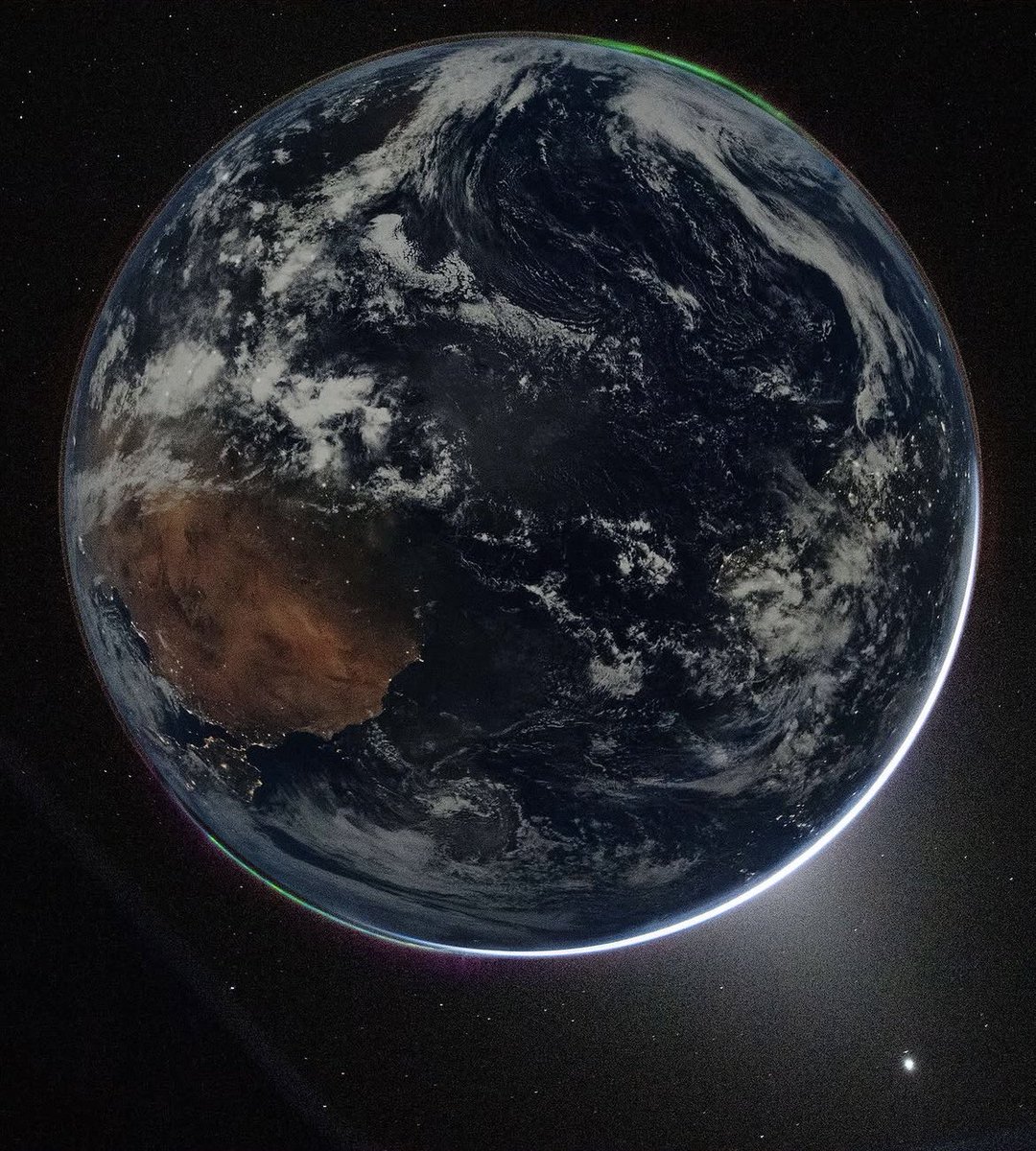
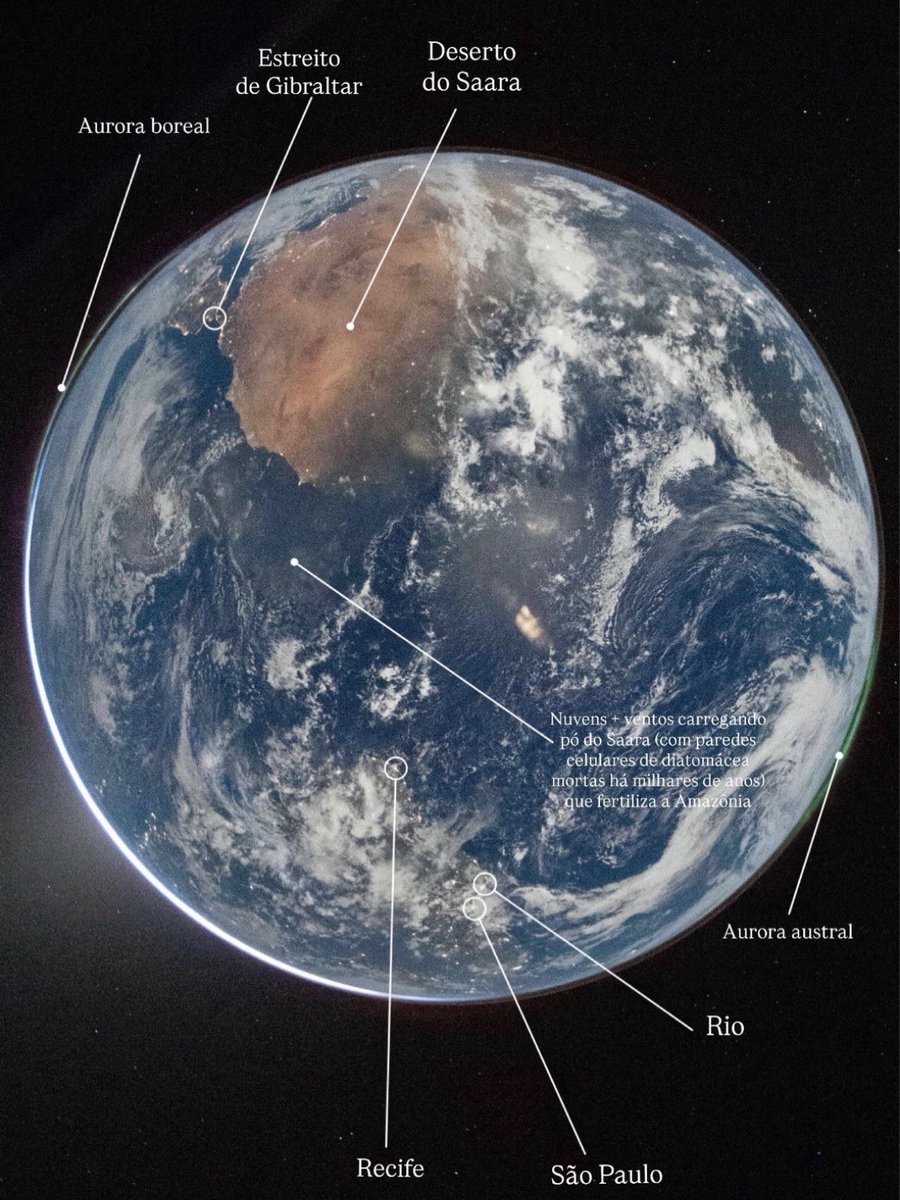
Minha imagem favorita da Terra porque: 1) Brasil aparece com destaque; 2) Polo Sul fica para cima e Norte para baixo (mais sentido para nós no Hem. Sul)! 3) Noite na Terra, ver auroras Austral e Boreal! Imagem da Artemis II processada por Andrew J. Steele #artemisii #terra
Thaisa tweet media
Português
3
0
19
456
Thaisa
Thaisa@thaisa_sb·
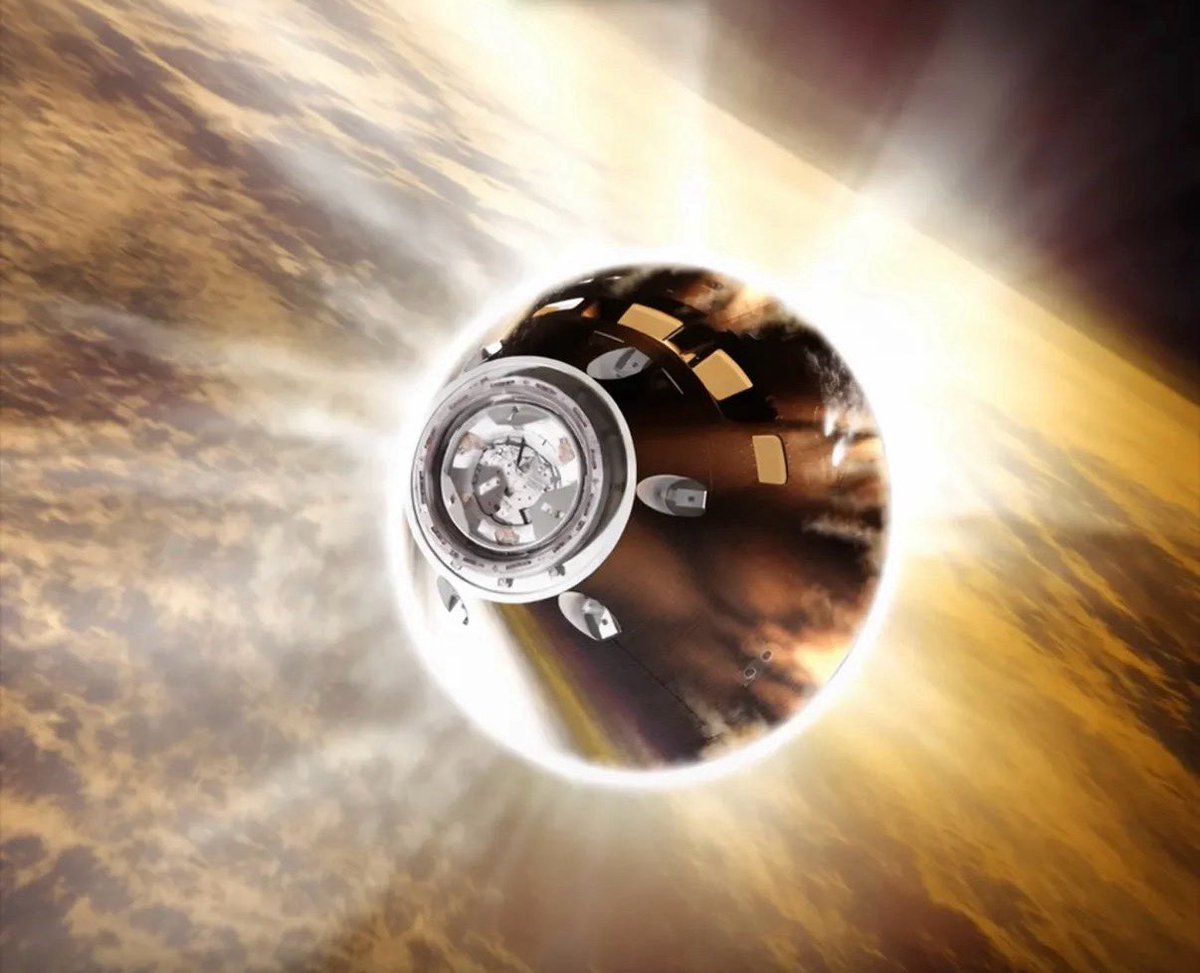
Artemis II: Amanhã fim da tarde ocorre mais perigosa parte da missão: O módulo da tripulação entrará na atmosfera a 40 mil km/h e atingirá temperaturas de milhares de grau, até splashdown” no mar da Califórnia. Ilustração: Spaceeves #artemisII #lua #terra #astronomia #espaço
Thaisa tweet media
Português
0
1
4
193
Thaisa
Thaisa@thaisa_sb·
Novo estudo sugere que os planetas rochosos do Sistema Solar - Mercúrio, Vênus, Terra e Marte se formaram a partir de dois anéis orbitando o nosso Sol jovem, é não de um único disco protoplanetário! #sistemasolar #planetas #astronomia
Thaisa tweet media
New Scientist@newscientist

Our solar system’s rocky planets – Mercury, Venus, Earth and Mars – may have formed from two rings around the young sun, rather than a single disc #Echobox=1775288317" target="_blank" rel="nofollow noopener">newscientist.com/article/252050…

Português
0
1
10
398
Thaisa
Thaisa@thaisa_sb·
Nebulosa do Caranguejo: supernova que explodiu há quase 1000 anos atrás, sendo visível durante o dia, de tão luminosa! Suas camadas e externas são observadas expandindo até hoje! E no centro um pulsar - estrela de nêutrons em rotação! #pulsar #supermova #astronomia #espaço
HUBBLE@HUBBLE_space

🆕 A return to the Crab Nebula 🦀 Nearly 1000 years ago, astronomers saw something blazing in the sky – a supernova so bright it was visible in daylight. Today, astronomers continue to watch its remnant (the Crab Nebula) evolve. 1/3

Português
0
0
16
517
Thaisa
Thaisa@thaisa_sb·
O Sol veio de região mais central da Via Láctea? É o que este trabalho sugere! Só a distâncias do centro como a atual foi possível surgir a vida, pois, mais próximos do centro, estaríamos submetidos a muito mais radiação e partículas danosas à vida! #vialactea #astronomia
NAOJ@prcnaoj_en

Release: We are Not Alone: Our Sun Escaped From Galactic Center Together with Stellar “Twins” This discovery sheds light on the evolution of our Galaxy, particularly the development of the rotating bar-like structure at its center. nao.ac.jp/en/news/scienc…

Português
0
2
13
456
Thaisa
Thaisa@thaisa_sb·
O maior mapa tridimensional do Universo de 9 a 10 bilhões de anos atrás, a partir da emissão de Hidrogênio ionizado por estrelas jovens. É a chamada “Teia Cósmica”, que mostra como a mstéria se distribuía nesta época do Universo. #astronomia #energiaescura #cosmicweb #universo
Erika @ExploreCosmos_

Astronomers have produced the largest three-dimensional map ever created of hydrogen light from the early universe, offering a new way to observe structures that were previously too faint to detect. The map was constructed using data from the Hobby-Eberly Telescope Dark Energy Experiment (HETDEX), a large survey designed to study how galaxies formed and how the large-scale structure of the universe evolved over cosmic time. Instead of mapping only bright, individually detectable galaxies, the project focused on the faint glow emitted by hydrogen gas throughout space roughly 9 to 11 billion years ago, a period when the universe was experiencing its peak era of star formation. The key signal used in the study is Lyman-alpha radiation, a specific wavelength of ultraviolet light emitted when hydrogen atoms are energized by nearby stars. In the early universe hydrogen was abundant and widely distributed between galaxies, so this emission forms a diffuse background glow that traces where matter was located. Rather than identifying each galaxy separately, astronomers used a technique called line intensity mapping. This approach measures the combined light from entire regions of space, allowing scientists to detect both visible galaxies and extremely faint sources such as small galaxies and intergalactic gas clouds that normally fall below the detection limits of traditional surveys. To build the map, researchers analyzed more than 600 million spectra collected by the HETDEX instruments and processed the enormous dataset using large supercomputing resources. The resulting reconstruction reveals a vast network of structures across the universe, including dense regions where galaxies cluster together and extended filaments of gas that trace the cosmic web. Because hydrogen gas follows the gravitational distribution of matter, mapping its faint glow effectively outlines the large-scale architecture of the universe during one of its most active phases of galaxy formation. One of the important outcomes of the work is that it allows astronomers to observe structures that were previously invisible. Traditional galaxy surveys tend to detect only the brightest galaxies, leaving large gaps in our understanding of how matter is distributed between them. By measuring the collective light of hydrogen gas and faint galaxies, the new map fills in these missing pieces and provides a more continuous view of cosmic structure. It also allows researchers to compare observations with cosmological simulations, helping test models of how galaxies formed and how matter assembled into the filamentary network seen in the universe today. Beyond its immediate scientific results, the project demonstrates a methodological shift in cosmology. Instead of cataloging discrete objects one by one, astronomers are increasingly mapping the universe as a continuous field of light and matter. This strategy allows surveys to probe much larger volumes of space and capture the diffuse components of the cosmos that were previously overlooked. The new hydrogen map therefore acts as both a scientific dataset and a proof of concept for future experiments that will attempt even more detailed three-dimensional maps of the universe across different wavelengths. By revealing a vast “sea of light” produced by excited hydrogen gas and faint galaxies billions of years ago, the map provides a clearer picture of how matter was distributed when galaxies were rapidly forming. In doing so, it opens a new observational window on the large-scale structure of the universe and offers astronomers a powerful tool for studying how the cosmic web emerged from the relatively smooth conditions that existed after the Big Bang. 👉 share.google/QItHz7oD3r1UYp…

Português
0
2
10
399
Thaisa
Thaisa@thaisa_sb·
Galáxias não são ilhas isoladas no Universo. Imagens profundas como esta mostram que elas continuamente capturam nuvens de gás, resquícios da “teia cósmica” que originou as galáxias nos seus “nós”! #astronomia #Andromeda #ciencia #galaxias #universo
Erika @ExploreCosmos_

What we usually recognize as the Andromeda Galaxy is only its bright stellar disk, but in reality M31 extends far beyond that familiar spiral shape. Surrounding it is an enormous and extremely faint environment dominated by hydrogen gas, part of what we call the circumgalactic medium. This extended halo reaches hundreds of thousands of light-years into space, making the true physical size of the galaxy much larger than what is visible in ordinary photographs. The reddish structures seen in very deep images trace ionized hydrogen, commonly detected through H-alpha emission. This light is produced when hydrogen atoms are energized by ultraviolet radiation, coming from massive stars, past episodes of star formation, shock heating, or even the diffuse extragalactic radiation field, and then recombine, releasing a characteristic red glow. The emission is extraordinarily faint, close to the detection limits of modern imaging, which explains why these clouds were only clearly identified in the last decade despite Andromeda being one of the most photographed objects in the sky. These hydrogen clouds are not passive material. They are part of the galaxy’s baryonic cycle. Some of the gas has been expelled from the disk by supernova explosions and stellar winds, while other portions likely originate from intergalactic gas slowly accreting onto Andromeda or from smaller satellite galaxies that have been gravitationally stripped during past interactions. Over cosmic time, this reservoir can cool and fall back toward the disk, helping to sustain future star formation. The structures also preserve dynamical history. Filaments and diffuse streams of gas are thought to be linked to gravitational encounters with companion galaxies such as M32 and M110, leaving large-scale gaseous signatures similar to the stellar streams observed in galactic halos. In this sense, the hydrogen surrounding Andromeda acts as a record of past mergers and interactions. Perhaps the most striking implication is scale. Observations with ultraviolet spectroscopy have shown that Andromeda’s gaseous halo is so extended that it nearly overlaps with the halo of the Milky Way. The space between our galaxies is therefore not empty but filled with extremely tenuous gas belonging to the Local Group environment. Seen this way, the faint hydrogen clouds reveal that a galaxy is not just a luminous island of stars. It is a dynamic system continuously exchanging matter with its surroundings, growing, recycling gas, and evolving through interactions that unfold over billions of years.

Português
0
0
11
411
Thaisa
Thaisa@thaisa_sb·
Matéria escura fria: modelo mais bem sucedido até hoje para reproduzir a distribuição da matéria visível no Universo. Na ilustração: os filamentos cósmicos do modelo chamado Lambda CDM. #astromia #universo #espaço ciência #materiaescura
Erika @ExploreCosmos_

Cold Dark Matter (CDM) is a central component of the standard cosmological model used to describe the composition, evolution, and large-scale structure of the Universe. The term cold refers to the fact that the particles constituting this form of matter possessed very low thermal velocities compared with the speed of light at the time when cosmic structures began to form, meaning they were non-relativistic. The term dark indicates that these particles do not interact appreciably with electromagnetic radiation: they neither emit, absorb, nor scatter light, and therefore cannot be observed directly. Their presence is inferred solely through their gravitational effects. Within the ΛCDM framework, cold dark matter accounts for approximately 27% of the total mass–energy content of the Universe, while ordinary baryonic matter contributes about 5% and dark energy roughly 68%. This partition is tightly constrained by observations of the cosmic microwave background, large-scale galaxy clustering, gravitational lensing, and the expansion history of the Universe. CDM provides the dominant gravitational backbone upon which all visible cosmic structures are built. A defining role of cold dark matter is its control over structure formation. Because CDM particles move slowly and interact weakly, they preserve small primordial density fluctuations rather than erasing them through free streaming. The free-streaming length of CDM is therefore very short, a direct consequence of either a relatively large particle mass or a production mechanism that yields low velocities in the early Universe. This allows gravitational collapse to occur efficiently on small scales. Structure formation proceeds hierarchically, in a bottom-up manner: small dark matter halos form first and subsequently merge to produce larger systems such as galaxies, galaxy groups, and clusters. On the largest scales, the gravitational evolution of cold dark matter naturally produces the filamentary network known as the cosmic web. Dark matter forms interconnected filaments, sheets, and dense nodes, acting as a gravitational scaffold. Ordinary matter flows into these potential wells, where it cools, condenses, and forms stars and galaxies. The observed distribution of galaxies closely traces this underlying dark matter structure, providing strong empirical support for the CDM paradigm. From a particle-physics standpoint, cold dark matter is assumed to be non-baryonic and effectively collisionless, interacting with ordinary matter primarily through gravity. Proposed particle candidates include weakly interacting massive particles (WIMPs), axions, and other beyond-Standard-Model entities, although no candidate has yet been confirmed experimentally. A broad experimental program continues, encompassing direct detection, indirect searches, and collider experiments. Despite its success on large and intermediate scales, cold dark matter has historically faced challenges on sub-galactic scales. Two of the most discussed are the cusp–core problem and the missing satellites problem. Numerical simulations of collisionless CDM predict steep central density cusps in dark matter halos, while observations of dwarf and low-surface-brightness galaxies often suggest flatter, core-like density profiles. Similarly, simulations predict many more small satellite halos around galaxies like the Milky Way than the number of observed luminous satellites. Crucially, many cosmologists now regard these tensions as likely consequences of baryonic physics rather than evidence against cold dark matter itself. Energetic feedback from baryonic processes, such as repeated supernova explosions or activity from central black holes, can redistribute gas within galaxies and dynamically heat the surrounding dark matter. This process can flatten initially cuspy density profiles into cores, potentially resolving the cusp–core discrepancy. Likewise, many low-mass dark matter halos may simply be unable to retain gas after reionization or strong stellar feedback, preventing star formation altogether. These halos would exist but remain effectively invisible, naturally addressing the missing satellites problem without altering the fundamental properties of dark matter. Cold dark matter remains the most robust and successful framework for explaining the formation and evolution of cosmic structure across a vast range of scales. Its gravitational influence is firmly established, and many apparent small-scale discrepancies may be reconciled through improved modeling of baryonic processes. The fundamental nature of the dark matter particle itself, however, remains one of the most important open questions in modern cosmology and astroparticle physics.


Português
0
0
6
391
Thaisa
Thaisa@thaisa_sb·
Feliz Ano Novo! Com saúde e mais ciência, como nesta imagem espetacular do Telescópio Vera Rubin. Missão: conseguir mais verba para as Universidades e Ministério da Ciência e Tecnologia! Pelo menos o que o congresso cortou do orçamento! #astronomia #ciencia #verarubin #universo
Thaisa tweet mediaThaisa tweet media
Português
1
0
11
415
Thaisa
Thaisa@thaisa_sb·
Feliz Natal! para todos amigos e amigas do X! Com a clássica imagem de NGC2264, a 2500 anos-luz, região na Via Láctea formando novas estrelas. Imagem composta de raios-X do Chandra @nasachandraxray e do astrofotógrafo Michael Clow. #astronomia #natal #ciencia #espaço #universo
Thaisa tweet mediaThaisa tweet media
Português
0
1
12
655
Thaisa
Thaisa@thaisa_sb·
Faz um ✌️para apoiar dedicar 2% do PIB para a Ciência e Tecnologia no Brasil! Explico no vídeo! #ciencia #tecnologia #MCTI
Português
1
2
8
238