Thariq Jacoby

558 posts

Thariq Jacoby banner
Thariq Jacoby

Thariq Jacoby

@thariqij

Katılım Mart 2014
280 Takip Edilen31 Takipçiler
Sabitlenmiş Tweet
Thariq Jacoby
Thariq Jacoby@thariqij·
Descobri que eu sou um tulpamante e a minha tulpa é o cônego Leão Hartmann
Português
0
0
0
183
Thariq Jacoby
Thariq Jacoby@thariqij·
@comedyzin Eu sempre achei similar a desfiles de moda. A exigência absurda pelo padrão estético é, essencialmente, a mesma que faz modelos sofrerem de desnutrição, bulimia, sas coisas.
Português
1
0
6
288
comedi
comedi@comedyzin·
as caras chamando fisiculturismo de esporte o negócio não é um concurso de beleza?? tem todo o trabalho ai a competição é subir no palco pra ver quem é mais bonito
Português
12
11
400
7.8K
Miguel Nicolelis
Miguel Nicolelis@MiguelNicolelis·
@ProudSocialist I co-inventes the modern field of brain-machine interfaces in the late 1990 with John Chapin. This guy is simply selling non-sense as he always does in every field he touches.
English
14
38
1K
10.8K
Power to the People ☭🕊
Power to the People ☭🕊@ProudSocialist·
This is wild. Elon Musk is now pushing his Neuralink brain implants by proclaiming they give you “cybernetic superpowers.” When something sounds too good to be true, it usually is. I don’t want artificial intelligence or a chip in my brain. I just want to be human.
English
592
490
1.8K
90.6K
Thariq Jacoby
Thariq Jacoby@thariqij·
tu denuncia racismo nessa plataforma, que o IMBECIL do elon musk transformou na sua incelândia particular, e recebe a resposta no minuto seguinte
Thariq Jacoby tweet media
Português
0
0
0
9
Thariq Jacoby
Thariq Jacoby@thariqij·
@pangramlabs I'd even say that the persistence of false negatives is your raison d'etre
English
0
0
2
324
Pangram Labs
Pangram Labs@pangramlabs·
We're not perfect! Especially with custom instructions, we sometimes miss AI-generated text. We err on the side of false negatives in service of our industry-leading false positive rate. It's a trade-off, but in practice, the occasional false negative can be annoying, whereas a positive has the capacity to harm a person's reputation (and ours). That said, false negatives still indicate room for improvement, and it's something we'll continue to work on.
Florian Brand@xeophon

just asked gpt 5.5 pro for a draft of a blog and i quite liked its style threw it into @pangramlabs and...

English
8
4
204
30.7K
Anish Moonka
Anish Moonka@anishmoonka·
Shakira played a free show on Copacabana beach last night to a crowd of 2 million. Rio's city government paid $4 million to put it on. The city is expecting around $155 million in return. The whole thing is a tourism program called "Todo Mundo no Rio," which means "Everyone in Rio." Every year through 2028, the city books one massive pop star for a free show on Copacabana. The city built it to fill hotels in May. That month sits between Rio's two peak tourism windows, and bookings would otherwise dip. The first two years proved the model. Madonna's 2024 show pulled in 1.6 million people, and the local economy got about $60 million out of it. Lady Gaga came in 2025, drew 2.1 million, and brought in $109 million. Both weekends, the city's hotels were packed. Shakira is on track to top them both. Rio's economic office is projecting around $155 million in spending at hotels, restaurants, taxis, and shops, plus another $250 million worth of news coverage worldwide that the city would otherwise have to buy through ads. About 310,000 of last night's crowd flew or drove in from outside Rio. Airline bookings to the city were up 80% the week of the show compared to the same week in 2024. Hotels were full. When the previous mayor was asked whether spending public money on a free Lady Gaga show was a good idea, he didn't dance around it. Yes, he said. He'd done the same for Madonna. The reason was simple: the shows fill the hotels and the restaurants, and the tax money rolls in. 2 million people is about the population of Paris. They were all standing on a 4-kilometer (2.5-mile) stretch of beach. The setup ran 16 video and audio towers down the coast so the back rows could still see and hear. The city is generating roughly $40 of economic activity for every $1 of public money it puts in. They're doing it again in 2027.
2000s@PopCulture2000s

over 2 million people for shakira at copacabana 🇧🇷

English
185
2.7K
26.4K
2.3M
Thariq Jacoby retweetledi
Mushtaq Bilal, PhD
Mushtaq Bilal, PhD@MushtaqBilalPhD·
> be Alexandra Elbakyan > be born in Kazakhstan in 1988 > start coding at 12 > hack your internet provider at 14 > hack MIT Press at 16 to download neuroscience books you can't afford > get a CS degree from Satbayev University > intern in neuroscience at Georgia Tech > speak at Harvard on brain-computer interfaces > notice researchers can't read the papers they need > notice academic publishers charging $30 a paper > notice peer reviewers worked for free > notice editors worked for free > notice universities funded the research with billions of dollars of public money > build Sci-Hub in 2011 > upload nearly every paywalled research paper ever published > give it away for free > get sued by Elsevier > get hit with a $15 million judgment > don't give a flying f*ck > keep Sci-Hub up > get domain after domain seized > register a new one > keep Sci-Hub up > get investigated by the US Department of Justice > don't give a flying f*ck > get accused of working for Russian intelligence > don't give a flying f*ck > have the FBI subpoena your iCloud > get named one of Nature's ten people who mattered in science > get a parasitoid wasp named after you > get a deep-sea snail named after you > get the Electronic Frontier Foundation Award for Access to Scientific Knowledge > become a legend
Mushtaq Bilal, PhD tweet media
English
243
6.9K
34.7K
2M
Thariq Jacoby retweetledi
sudox
sudox@kmcnam1·
ZXX
58
350
1.5K
73.8K
Thariq Jacoby
Thariq Jacoby@thariqij·
@imetatronink Is there any plausibility for this claim that Iran is not politically unified, but rather struggling internally between moderate and authoritarian forces?
English
0
0
0
279
Will Schryver
Will Schryver@imetatronink·
This will age very poorly. Bookmark and review this post at the upcoming summer solstice.
James E. Thorne@DrJStrategy

Food for thought. Iran Is Not Winning. It Is Unraveling. The prevailing narrative on Iran has it almost perfectly reversed. We are told that Tehran is winning a war of wills in the Gulf and that Donald Trump is gambling recklessly with the world’s most sensitive chokepoint. In reality, Iran is not consolidating strength; it is managing decline. And Trump’s play on the Strait of Hormuz has quietly forced energy markets to reprice security—tilting the balance decisively toward the Americas, and away from Europe, Asia and China. The Islamic Republic no longer resembles a confident revolutionary project. With the old clerical core leadership shattered, power has splintered between a camp that recognises a deal with the outside world as the only path to survival and the Islamic Revolutionary Guard Corps, a class of military dictators with guns, patronage networks and a rational fear that any genuine settlement will ultimately throw them overboard. This is not a unified strategy at work; it’s infighting, paranoia, a fragmented system in late-stage decay, crumbling under pressure. Into this fragmentation, the White House has introduced a form of calibrated coercion too often caricatured as impulsive. Around the Strait of Hormuz, Washington has threatened disruption without fully triggering it, forcing shipowners, insurers and policymakers to absorb a hard truth: dependence on vulnerable, seaborne Middle Eastern barrels is not a passing inconvenience but a structural risk. Iran can harass tankers and jolt day-to-day sentiment; it cannot rebuild a broken economy on sporadic shocks to global shipping. And the world must deal with the end of Pax Americana! The underlying playbook is anything but novel. Sun Tzu’s insistence that “all warfare is based on deception”, Machiavelli’s counsel that a ruler must manipulate appearances and exploit factionalism, and Alfred Thayer Mahan’s argument that sea power and control of chokepoints shape the fate of nations are not museum pieces. They are, in this case, the operating code. Trump’s opaque signalling, deliberate use of disinformation and visible but limited naval posture in and around Hormuz amount to a modern, Mahanian use of sea power as economic statecraft. Energy markets are already adjusting. Tankers are head to the Gulf of America. In a world where a single strait can a risk to economies is Europe and Asia, without ever being fully closed, assets tied to secure basins and diversified export routes deserve a premium. The Americas sit in an enviable position: vast, politically stable hydrocarbon resources, multiple pipelines and ports, and no dependence on a distant maritime chokepoint controlled by adversaries. By contrast, Europe, much of Asia and China find themselves downstream of vulnerabilities they do not control and regimes they cannot stabilise, exposed to shipping routes that can be threatened faster than alternative supply can be mobilised. All of this plays out against a domestic backdrop in Iran that looks less like revolutionary vigour and more like fear. A state that cannot safely keep its internet on, that must rely on public brutality to deter dissent, is not projecting confidence. It is signalling weakness, to its own citizens as much as to its rivals. Winston Churchill once remarked that “in war, resolution; in defeat, defiance; in victory, magnanimity; in peace, goodwill.” Iran’s leadership offers only defiance, without realistic prospects of victory or peace. The uncomfortable conclusion for those still insisting that Tehran is “winning” is that what they are observing is not the rise of a regional hegemon, but the protracted, strategically exploited unwinding of a brittle regime at the centre of an overexposed energy system.

English
21
77
655
29K
Thariq Jacoby
Thariq Jacoby@thariqij·
@max_spero_ @keysmashbandit Not at all, but with the right mechanisms of transparency and accountability, that could potentially work. Private owners will not report to anyone other than investors
English
0
0
0
17
Thariq Jacoby
Thariq Jacoby@thariqij·
@max_spero_ @keysmashbandit Considering that control of the AI r&d and its ensuing instrumentalization are social strategic assets (I believe so), do you think we'd be safer with the public ownership of AI? The implications of private ownership of such divisive technology are troubling @max_spero_
English
1
0
0
53
Max Spero
Max Spero@max_spero_·
Unfortunately there is widespread learned helplessness around government assistance. Nobody expects the government to help as millions of jobs disappear. And OpenAI isn't benevolent enough to implement UBI. They first need to pay back the 500 billion dollars they raised from investors, with a healthy multiple. Competition between OpenAI and Anthropic might even drive prices such that there is no massive profit to be gained from AGI. We could have two massive companies both selling AGI at-cost in a way that vaporizes jobs. Despite how well-meaning AI researchers are, I think there are going to be massive second order effects that are out of their control. Things could go poorly even if every individual involved wants to make the world a better place.
English
4
0
43
1.5K
Guri Singh
Guri Singh@heygurisingh·
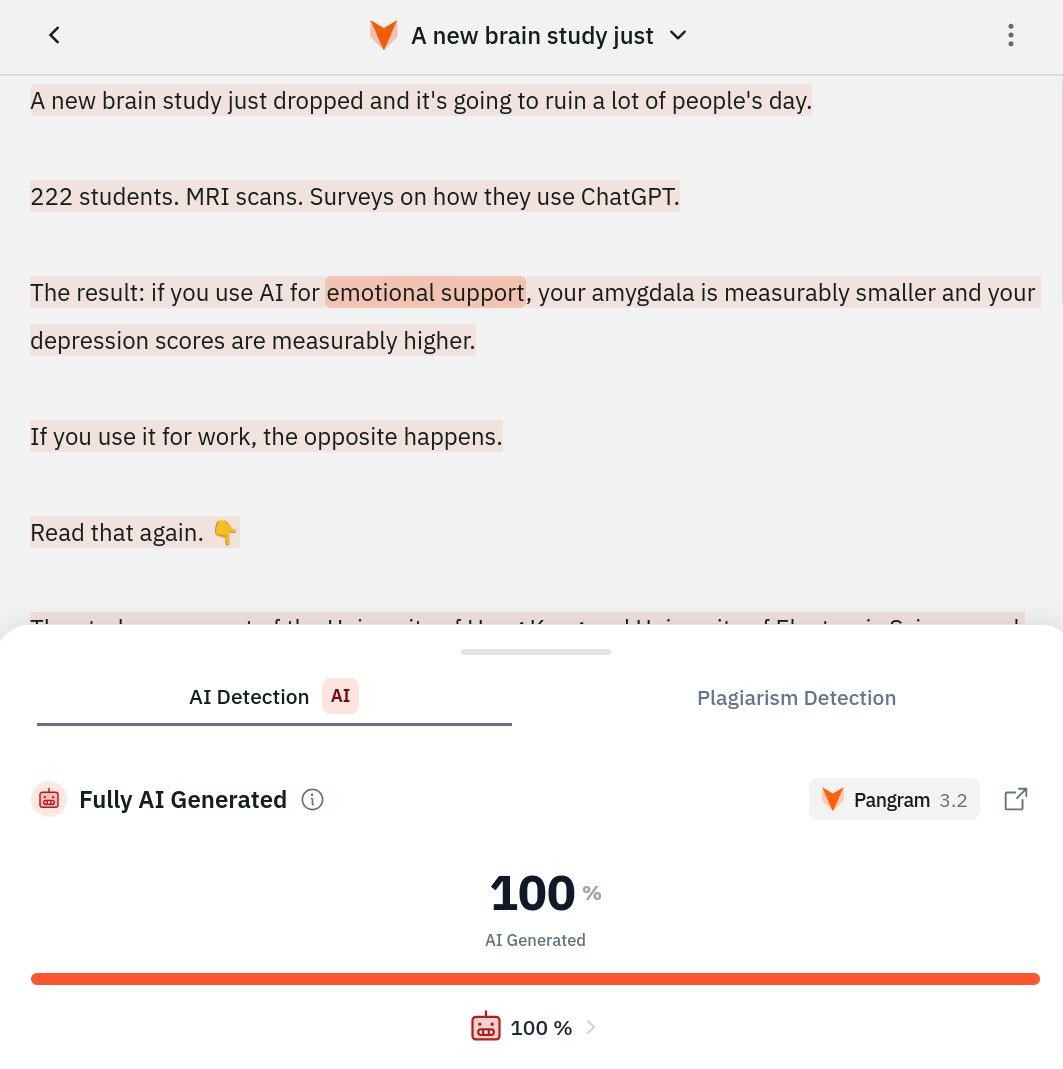
A new brain study just dropped and it's going to ruin a lot of people's day. 222 students. MRI scans. Surveys on how they use ChatGPT. The result: if you use AI for emotional support, your amygdala is measurably smaller and your depression scores are measurably higher. If you use it for work, the opposite happens. Read that again. 👇
Guri Singh tweet media
English
12
20
87
9.7K
Thariq Jacoby retweetledi
ElBuni
ElBuni@therealbuni·
En polonia, unos jabalies se colaron en un barrio y se fueron perseguidos por un robot
Español
1.7K
11.7K
122.6K
18.6M
Kanjun 🐙
Kanjun 🐙@kanjun·
Twitter’s algorithm is optimized for addiction, not for us. We deserve better. We’re releasing Bouncer today so you can take back control of your feed. Describe what you don't want, and Bouncer removes it. It’s free, doesn’t collect your data, and will be open source soon.
English
212
290
3.1K
588.3K
Thariq Jacoby retweetledi
Elias Jabbour 🇧🇷 🇱🇧 🇵🇸
O que está ocorrendo agora no Irã Nesse exato momento os alvos estão concentrados na indústria petroquímica do Irã. O prazo de Trump não é blefe e busca reorganizar os preços do petróleo e derivados - com efeitos positivos à economia dos EUA na medida em que internalizam efeitos de encadeamento da indústria petrolíferia. O imperialismo usa a guerra para destruir forças produtivas externas e assim reorganizar, a la MAGA, a indústria estadunidense. Ao Brasil cabe repensar COMPLETAMENTE sua estratégia interna e sua inserção externa. Com essa estratágia nova revelada com os presentes ataques ao Irã, o nosso país deverá passar em breve por um processo de luta existencial.
Português
26
247
2.6K
75K