
RankUp

123 posts

RankUp banner
RankUp

RankUp

@theRankUp

RankUp's agentic SEO content system turns your product and industry knowledge into unique, search-optimized content that convinces AI to promote your offerings.

Katılım Şubat 2025
2 Takip Edilen14 Takipçiler
RankUp retweetledi
Georg Richard Aare
Georg Richard Aare@AareGeorg·
Automate SEO Strategy [Topical Map] with @theRankUp's AI Agent We built an AI agent that creates a complete SEO content strategy for you. It tells you what topics to cover, in what order, and why. It’s what SEO specialists call a topical map. In this video I show how it works. - - - Other videos referenced: RankUp Agent Brain and Knowledge Base demo: youtu.be/tiqgs6DE3zU?si… RankUp Agentic Content Writing workflow walk through: youtu.be/1q0Bx_7CxJs?si…
YouTube video

YouTube
YouTube video
YouTube
English
0
1
2
11
RankUp retweetledi
Georg Richard Aare
Georg Richard Aare@AareGeorg·
Improve Your Content Performance in AI Search with AI Agents We built an agentic content improvement system that audits your content based on performance each month and suggests refinements that can then be orchestrated and executed by AI agents. In this video I show how it works. - - - Other videos referenced: RankUp SEO content strategy (Topical Map) AI agent: youtu.be/RJp8E3RqOUY?si… RankUp Agent Brain and Knowledge Base demo: youtu.be/tiqgs6DE3zU?si… RankUp Agentic Content Writing workflow walk through: youtu.be/1q0Bx_7CxJs?si…
YouTube video
YouTube
YouTube video
YouTube
YouTube video
YouTube
English
0
1
2
31
RankUp retweetledi
Georg Richard Aare
Georg Richard Aare@AareGeorg·
How to Use a Knowledge Base to Write Unique SEO Content FAST We built a system that learns about your business and industry, then feeds that information to an AI agent that writes your SEO content. We call this system the RankUp Knowledge Base. With this system, you don't have to spend time and effort re-teaching the AI about your business, debunking industry myths, etc., allowing you to create unique SEO content at scale. In this video I show how it works. RankUp Agentic Content Writing workflow walk through: youtu.be/1q0Bx_7CxJs?si… RankUp Agentic Content Improvement System demo: youtu.be/e_TwWfAm2LQ?si… RankUp SEO content strategy (Topical Map) AI agent: youtu.be/RJp8E3RqOUY?si…
YouTube video
YouTube
YouTube video
YouTube
YouTube video
YouTube
English
0
1
2
44
RankUp retweetledi
Georg Richard Aare
Georg Richard Aare@AareGeorg·
Introducing RankUp🪄 - The Agentic SEO Content System Have you ever watched a competitor rank higher and thought: "Their product is not even that good..." Or tested ChatGPT for who it would recommend and watched it promote someone else? Or you’ve seen people share screenshots on LinkedIn of their organic traffic growth exploding, but you have no idea how they pulled it off? Maybe you've tried to do SEO, hire agencies or use AI writers. But got no results. And still not sure what actually works. You know your product is better. But you don't have a way for AI to know you are better. If any of that sounds familiar, here's what's actually going on: You don't have an intelligent SEO content system. It's the reason most businesses never get enough traffic from search, or they get it, but then it drops off a cliff. It’s also why they fail to convert brand visibility into sales. And every month without a system, competitors pull ahead. They're ranking. They're getting cited by AI. And so, the gap widens. At some point, it feels like organic will never work for your business. But it's not your industry. It's not your team. It's not your budget. It's that there's no system making it work. But… If you HAD a system that: → Mapped your entire content strategy → Created content that only you could write → Improved content continuously → Got smarter with every piece created → and adapted your strategy based on performance data ...it would be almost IMPOSSIBLE to not see results. The problem is, building this system yourself is extremely difficult: 1. you'd need to understand how SEO works, 2. how to build AI agents, 3. capital for all the necessary tools, testing and running the system, 4. and a shit ton of time and patience. Building this won't take weeks or months, it's years and much longer if you aren't building it full-time. You could also try to hire people to build it for you, but in that case you need even MORE capital. And good luck with finding developers who actually understand how to do SEO, not just sprinkle some keywords and fix page speed. That's exactly why we built @theRankUp. RankUp is an agentic SEO content system that handles your SEO content end-to-end, from strategy to writing to content improvement, using a team of specialised AI agents and your product and industry knowledge. Here's how it works ⬇️ (p.s. if you want to learn more, visit: rankup.so)
English
0
1
2
72
RankUp retweetledi
Georg Richard Aare
Georg Richard Aare@AareGeorg·
How to create High-Quality SEO content FAST with AI agents We built an agentic SEO content writing system that creates unique, search-optimized content fast, using your product and industry knowledge. In this video I show how it works. - - - Other videos referenced: → @theRankUp SEO Content Strategy (Topical Map) AI Agent: youtu.be/RJp8E3RqOUY?si… → @theRankUp Agent Brain and Knowledge Base demo: youtu.be/tiqgs6DE3zU?si… → @theRankUp Agentic Content Improvement System demo: youtu.be/e_TwWfAm2LQ?si…
YouTube video
YouTube
YouTube video
YouTube
YouTube video
YouTube
English
0
1
2
42
RankUp retweetledi
Georg Richard Aare
Georg Richard Aare@AareGeorg·
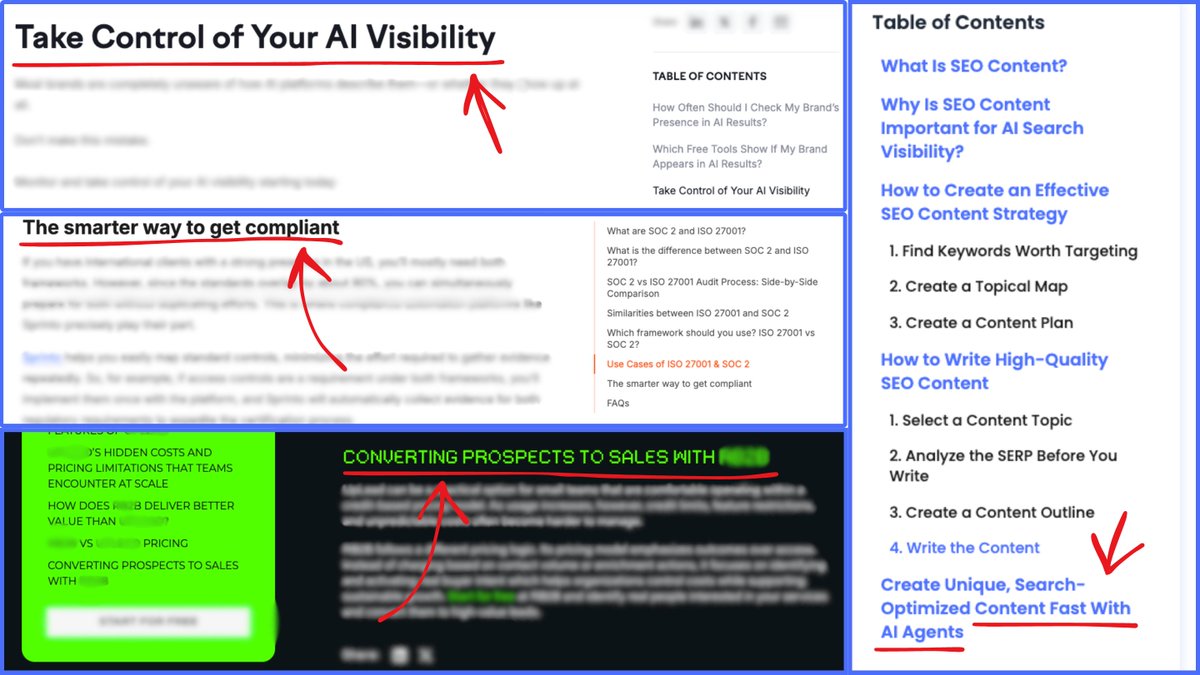
Ever seen this section at the end of a blog/article? I call this a CTA section. The CTA section is your chance to get readers to take the next step in your funnel after reading your content. It bridges the content they just read and the specific action you want them to take. But most CTAs don't do that. They're lazily written Hail Marys. "oh yeah we have this tool that does this. If you want it, do this." Sure, you'll convert some people that way. But only the ones whose pain is already big enough that any halfway decent solution works. The more skeptical prospects, the ones you actually need to win over, move past it like it never existed. Here are the 4 principles I follow when writing CTA sections that convert skeptics into booked calls: → Present a solution to a related problem. Don't pitch everything you do. Just the thing that helps with what they came here for. → Show, don't tell. People trust what they can see more than what they're told. Show customer results, show a video of your product in use, whatever it is that you offer, prove that what you are promising is a reality. → Make the next step clear and give a reason to take it. Otherwise, readers will be confused about what to do next and won't see a reason to take action. → Communicate how you're different. The CTA should reinforce what makes your approach better than anything the reader has seen. Want to see these principles in action? I recently published an article on how to write SEO content that ranks, AI favors, and converts. This workflow is what I’ve used to earn an average of $1,000 per article over the last 2 years writing SEO content for businesses. You can read it here: rankup.so/academy/how-do… In Step 5 of the article, I break down how I wrote the CTA of that same article which has booked me 12 demos in 11 days since its publication. Hope this was useful!
Georg Richard Aare tweet media
English
0
1
3
34
RankUp retweetledi
Georg Richard Aare
Georg Richard Aare@AareGeorg·
Your content doesn’t rank or get cited because your outline SUCKS. Outlines dictate what you write, that’s why they’re crucial. After writing 200+ SEO content pieces over the past 2 years, I realized the content that didn’t rank or get cited usually made at least one of the following mistakes in its outline: 1. Didn't cover all the necessary topics 2. Included too many unnecessary topics (making the post clunky) 3. Covered topics in the wrong order 4. Had headings that weren't optimized for search Here’s why they matter: If the outline doesn't cover the right topics, the reader isn't getting what they came for and they'll bounce - no matter how good the copy. If it covers too many unnecessary topics, it gets more expensive for search engines to serve your content and forces readers to filter out what doesn't matter, disrupting their flow. If your outline covers topics in the wrong order, the reading experience suffers and it takes search engines longer to confirm your content is relevant. And if your headings aren't optimized for search, search engines struggle to understand what each section covers, making featured snippets and AI citations much less likely. To help you avoid the mistakes I've made, here are the best practices I follow when creating an outline: 1. Title (H1) → Put your target keyword as close to the start as possible. Google gives more weight to the words that appear first in your title when figuring out what your page is about. → Keep it under 60 characters so it doesn't get cut off in search results. → Signal relevance immediately. The searcher should know within a second that your page matches what they're looking for. → Give them a reason to pick yours over the rest. 2. Core topics (H2s) and subtopics (H3s) → Order sections by what the reader wants to know next. This keeps them in a flow and ensures the most important topics get covered early. → Use questions as headings when possible. It makes it easier for AI to retrieve and cite your content. → Start with a verb when a heading describes an action. This signals to AI that the section covers how to do something, making it easier to retrieve when users ask about that action. → Cover all topics that more than half of the top-ranking pages include, if relevant to your content angle. Google sees those topics as part of a complete answer. 3. CTA → Describe an action, outcome, or feeling your audience desires. This pulls them toward the CTA instead of pushing a sale. → Communicate your differentiator in delivering that action, outcome, or feeling. You're likely not the only one promising it, show why your approach is different. Hope this was useful! P.S. I published an article on how to write SEO content that ranks, AI favors, and converts. This workflow is what I’ve used to earn an average of $1,000 per article over the last 2 years writing SEO content for businesses. You can read it here: rankup.so/academy/how-do…
Georg Richard Aare tweet media
English
0
1
2
39
RankUp retweetledi
Georg Richard Aare
Georg Richard Aare@AareGeorg·
“How does creating SEO content make my business money?” In real estate, there’s a saying: You make money when you buy, not when you sell. In SEO, I’d argue something similar: You make money when you choose what to write about, not when you write it. To explain what I mean: If you sell cold email software, but you write about sales in general, it’s going to be much harder to connect your product to a topic like: “How to prepare for sales calls” …than if you target cold email topics from the start, like: → How to write cold emails → Best cold email tools To be clear: I’m not saying copywriting doesn’t matter. Of course it does. But you can’t write about random topics, get no sales, and then conclude that “SEO content doesn’t work.” One misconception I see a lot is that people think they need some magical CTA in their content for it to convert. I disagree. After writing hundreds of SEO content pieces, I’ve found there’s rarely a conversion difference between fancy CTAs and straight-to-the-point ones. Because the real conversion doesn’t happen in the CTA. It happens in the core content. If you don’t communicate value clearly, trust stays thin. And expecting someone to read one informational post and convert is unrealistic for most prospects. The real game is getting people to read more of your content until they believe you understand their problem and your solution is the right next step. This applies to both in-body CTAs and CTA sections, but especially the in-body ones. CTA sections are a bit different. A good CTA section can massively impact conversions because they give readers context. Not only do they tell what to do next, they help the reader understand what you do and how it relates to what they just read. This context is critical, because most people reading the content will likely be hearing about you for the first time. Even if you mention your solution in the article, they often still don’t understand what you do well enough to take action. Here are the 4 principles I follow when writing CTA sections: → Don't pitch everything you do. Just the thing that helps with what they came here for. → Show, don't tell. People trust what they can see more than what they're told. → Make the next step clear and give a reason to take it. → Communicate how you're different. The CTA should reinforce what makes your approach better than anything the reader has seen. TL;DR In 2026, SEO content makes you money when you choose topics that are tightly connected to your core offer and your CTA clearly connects the topic to your solution. Hope this was useful! P.S. Yesterday I published an article on how to write SEO content that ranks, AI favors, and converts. This workflow is what I’ve used to earn an average of $1,000 per article over the last 2 years writing SEO content for businesses. You can read it here: rankup.so/academy/how-do…
Georg Richard Aare tweet media
English
1
1
4
41
RankUp retweetledi
Georg Richard Aare
Georg Richard Aare@AareGeorg·
In the last 2 years, each SEO article I've published has made an average of $1,000 in revenue. Here are my 11 rules for SEO copywriting: 1. Ask "what's next?" After someone reads your direct answer a.k.a your first paragraph, what question pops into their head? Use that to guide what details, examples, analogies, etc to add. 2. Put "if" statements in the second part of the sentence. Lead with the main idea, then add the condition. 3. Qualify the instances. Add descriptive details that specify and distinguish what you're discussing. Precision helps readers understand exactly what you mean and signals authority to search engines. Example: "There are reasons to update old content" → "There are 3 critical reasons to update old content: keyword decay, outdated statistics, and broken links." 4. Use the same part of speech in listings. Keep grammatical structure consistent across list items. Parallel structure aids readability and helps search engines parse your content. Example: Instead of "Research keywords, writing headlines, and to optimize images," write "Research keywords, write headlines, and optimize images." 5. Use relevant entities and semantically related words. Specific terminology helps search engines understand the exact subject of your content, making your page more likely to appear for the right searches. Example: Instead of "I hired someone to manage my social media accounts," write "I hired a social media manager to handle content scheduling and engagement." 6. Keep one idea per sentence. Simple sentence structures help search engines extract answers faster. Faster extraction signals your content efficiently satisfies the query. Readers grab the main point faster, too. 7. Keep it value-dense. Every sentence should earn its place. Cut it, if you can remove it without disrupting the flow or leaving the idea incomplete. A well-written piece of content is like a well-made burrito. 8. Include your unique insights. Add your own data, opinion, or first-hand experience whenever possible. This is what makes your content stand out. 9. Use certain tone. Avoid uncertain phrases like "might," "could be," or "try to" because search engines and LLMs trust confident statements more. 10. Write directly to the reader. Use second person (e.g. "you") as if you're talking to them, not describing things to a third party. This makes the content feel like it's written for them specifically. 11. Mix up formatting. Use bullet points, numbered lists, and short paragraphs (max 4 lines on desktop) to make content easier to scan and consume. Hope this was useful! P.S. Last Friday I published an article on how to write SEO content that ranks, AI favors, and converts. This is the EXACT workflow I’ve used to earn an average of $1,000 per article over the last 2 years writing SEO content for businesses. You can read it here: rankup.so/academy/how-do…
Georg Richard Aare tweet media
English
0
1
3
50
RankUp retweetledi
Georg Richard Aare
Georg Richard Aare@AareGeorg·
Do articles and blogs still work for SEO? It depends on the topic. Articles and blogs work great for topics where searchers want a human take. For example: - how to [X action] - best [Y thing] for [Z usecase/person] - [Brand A] vs [Brand B] - [Brand A] competitors But simple informational keywords like "what is SEO" aren't worth prioritizing anymore. LLMs like ChatGPT can often answer those queries well enough that the searcher never needs to click a website. That said, I’m not saying you should completely discard them. I just wouldn't recommend making them a priority. Creating content for simple informational keywords can still help your site build credibility and show expertise in your niche to improve overall site rankings and increase how many citations you get from AI search. To make topic evaluation easier, in RankUp you can see an AI Replacement Risk % for each keyword (see screenshot). This score shows how likely AI is to fully answer the query on its own without the searcher needing to visit a website. - Higher % = AI can likely handle the query alone - Lower % = searchers will likely need to click through for a complete answer Hope this was useful! P.S. Yesterday I published an article on how to write SEO content that ranks, AI favors, and converts. This workflow is what I’ve used to earn an average of $1,000 per article over the last 2 years writing SEO content for businesses. You can read it here: rankup.so/academy/how-do…
Georg Richard Aare tweet media
English
0
1
2
31
RankUp retweetledi
Georg Richard Aare
Georg Richard Aare@AareGeorg·
I sleep. My team of SEO AI agents create content. ChatGPT promotes my business. Money = Yes Life = Good Want good life? Check this out: rankup.so
English
0
1
1
41
RankUp retweetledi
Georg Richard Aare
Georg Richard Aare@AareGeorg·
You can now do SEO for a site in almost ANY language with @theRankUp! Doesn't matter if it's Hindi, Estonian or Chinese. (weird combo of languages I brought up, I know😅)
English
0
1
1
47
RankUp
RankUp@theRankUp·
@AareGeorg Fuck it, I want this too TOPICAL
English
1
0
1
31
RankUp retweetledi
Georg Richard Aare
Georg Richard Aare@AareGeorg·
Introducing @theRankUp's Topical Map a.k.a... The Autonomous SEO Content Strategy Builder If you don’t know, then a topical map is a structured content roadmap that connects your keywords/content topics. It shows what to publish first and how everything connects through internal linking. This is how the top SEO experts in the 🌎 build content strategies. (Shoutout to @KorayGubur, from whom I learned this approach.) But building a topical map manually takes days, weeks — sometimes months. That’s time you could have spent creating content. And that’s assuming you already know how to create a topical map. If you’re not an SEO expert, you’d need months (often years) of practice and testing to do this properly. Essentially you'd need to become an SEO professional. So the real question is: “Do I want to become an SEO expert or do I just want to rank, get leads, and grow my business using the fastest path possible?” If it’s the latter, RankUp’s Topical Map is your fastest path to an SEO content strategy that actually works. To create your topical map, you barely have to do anything. Just provide your input and confirm your business offerings and priorities during onboarding. Then Magnus, RankUp’s SEO strategist AI agent, handles the rest: 1. Builds the initial Topical Map structure 2. Runs keyword research 3. Fills out the topical map with content topics 4. Prioritizes topics to cover first This takes roughly 30–60 minutes, depending on niche size. Once it’s done, you can see: - Every topic to write about - How each topic connects - The recommended publishing order Here’s how RankUp's Topical Map structure/hierarchy works: Level 1: Central topic - the core topic of your site from which everything branches out. Level 2: Branches and core product/service topic Each branch represents a major product or service you offer. These branches extend from the central topic. Each branch has a core product topic, the main keyword for that product, feature, or service, which you'd target with a product/feature/service page. Level 3: 2 pillar topics (per branch) These support the core product topic and act as major sub-hubs: - Commercial pillar: Represents competitor comparisons, reviews, etc content topics - Informational pillar: Represents educational content topics. Level 4: Supporting topics Subtopics that support each pillar and strengthen topical authority. For every topic, you can see its priority score and the reasoning behind it. Magnus also creates something called the Golden Strategy Path — the exact order in which you should create content. If everything looks good, just create a content plan with Magnus and you can start creating content! See RankUp’s agentic SEO system in action here → rankup.so. P.S. To celebrate the launch of the Topical Map, we’re giving a limited number of people free access until Monday, January 26. To get selected: ✅ React to this post ✅ Comment “TOPICAL” ✅ Repost to move up the line
English
25
20
23
3.4K
RankUp retweetledi
Georg Richard Aare
Georg Richard Aare@AareGeorg·
5 reasons why we’re keeping @theRankUp founder-ONLY for as long as possible: 1. It eliminates bureaucracy so decisions happen instantly and execution moves as fast as possible. 2. Customers talk directly to us, creating the fastest possible feedback loop between users and the business. 3. Customers know they’re working with people whose incentives are fully aligned with their success, because our success depends directly on theirs. 4. Agentified sales, marketing, and product teams allow us to execute faster and more cost-effectively than traditional human teams. 5. With minimal people management and meetings, more time can be funneled into customer success, product quality, and distribution. How do we know this is currently the right path? We know this is the right path because of feedback like this from our customers:
Georg Richard Aare tweet media
English
0
1
2
42
RankUp
RankUp@theRankUp·
POV: You Have an Agentic SEO Content Creation System
English
1
0
1
62