
Sabitlenmiş Tweet
eeb
5.7K posts


eeb
@the__eeb
Freedom is the Future | @SpiritDao Member.
Katılım Kasım 2021
1.9K Takip Edilen4.3K Takipçiler


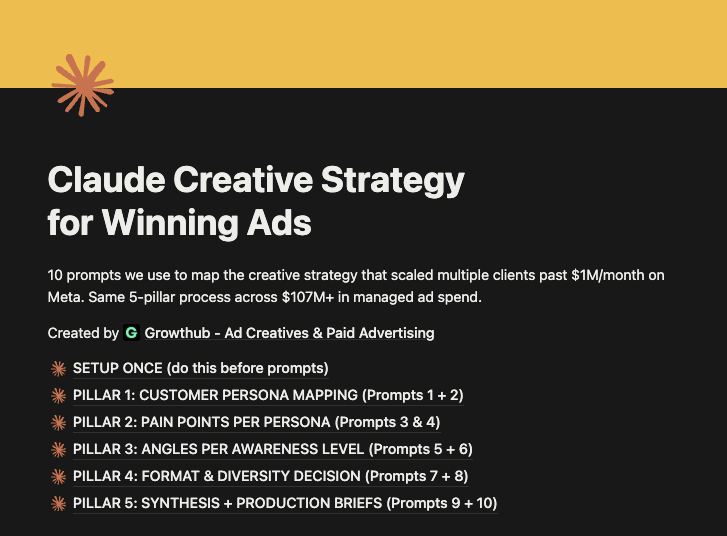
Claude is INSANE for ad creative strategy.
I've built a file with 10 prompts that map your entire creative strategy in 30 minutes.
The same 5-pillar process we used to manage $107M+ in ad spend last year.
Personas, pain points, awareness levels, formats, analysis.
Inside the mini-guide:
- The 10 prompts
- The 5-pillar strategy map template (Notion-ready)
- Worked examples
Want a copy? Like + Comment "MAP" and I'll send it over ASAP
(Must be following)
English

@xydotdot this is almost entirely unrelated but did you see meta's TribeV2
tech modeled to predict what's going to glue your monkey brain to your phone based on brain activity
x.com/fuckgrowth/sta…
f*ckgrowth@fuckgrowth
English

Thoughts...
In times like this, I can’t help but think about the gap between what our tools have become and what we have remained.
Technology compounds because it stores progress.
A machine does not wake up insecure, vain, tribal, resentful, horny for status, desperate for belonging, or eager to lie to itself. It simply inherits the last improvement and builds from there.
Humans do not work that way.
Every person is born again into the same ancient psychological cage, and whatever civilization gains on the outside has to fight its way back into each new mind from zero.
That is why our tech keeps evolving while our behavior still feels prehistoric. We have better instruments, faster systems, and more sophisticated language, yet the underlying creature using all of it still runs on fear, ego, imitation, domination, envy, appetite, and the endless hunger to matter in the eyes of others.
I actually think this is the deepest source of modern confusion.
People see technological acceleration and assume human elevation came with it. It did not.
Knowledge scaled.
Power scaled.
Reach scaled.
BUT...Human substance did not scale with the same force, because character does not compound automatically, wisdom does not upload itself into the nervous system, and discipline does not arrive through innovation.
Inner development is still manual labor.
It is slow, painful, humiliating work, and most people, in any century, avoid it. That is why I would bet that the distance between a mind like Nietzsche’s and the average person is wider than the distance between a chimpanzee and that same average person.
The tragedy of humanity is that our ceilings are extraordinary, but our default settings never upgrade.
English

Claude Code + Shopify AI is f*cking cracked 🤯
Shopify just dropped an official AI Toolkit that connects Claude Code directly to your store.
One prompt → Claude reads your products, rewrites your descriptions for AI shopping, and pushes the updates live. All from the terminal.
All inside Claude Code.
Perfect for DTC brands on Shopify who are still manually editing product pages, writing descriptions in Google Docs, and copy-pasting into the Shopify admin one product at a time.
Claude Code + the Shopify AI Toolkit fixes the entire workflow:
→ Install the official Shopify plugin in Claude Code
→ Authenticate to your store
→ Claude reads your entire product catalog
→ Rewrites every description to be optimized for AI shopping
→ Pushes the updates directly to your store automatically
→ Validates every API call against Shopify's official docs before executing
No Shopify admin tab-switching.
No copy-pasting from a Google Doc.
No hiring a copywriter to rewrite 50 product pages.
What you get:
→ Claude Code connected directly to your live Shopify store
→ Product descriptions optimized for how ChatGPT, Gemini, and Perplexity recommend products
→ Bulk updates across your entire catalog from a single prompt
→ Full access to Shopify's GraphQL API — products, themes, inventory, orders, everything Claude can read and write
→ An official plugin built by Shopify that auto-updates as new features ship
I put together a full playbook with the plugin install, the store authentication walkthrough, 5 DTC workflows to run on day one, and the exact prompts I used.
Want it for free?
> Like this post
> Comment "SHOP"
And I'll send it over (must be following so I can DM)
Shopify@Shopify
the Shopify AI Toolkit is here manage your store with your favorite agent Claude Code, Codex, Cursor, VS Code, and more
English
Anthropic just shipped Claude Managed Agents 🤯
Here's how any DTC brand can deploy one in a single afternoon:
Cloud-hosted, always-on agents that pull your Meta + GA4 + Shopify data, write a daily performance brief, and post it straight to Slack every morning before you're out of bed.
Perfect for DTC brands and agencies who are sick of logging into 4 dashboards every morning, exporting CSVs, and trying to piece together what actually happened yesterday.
Here's the 4-hour onboarding path:
→ Hour 1: Create your first agent via the API — model, system prompt, MCP tools (Meta, GA4, Shopify, Slack)
→ Hour 2: Spin up the cloud environment the agent runs inside
→ Hour 3: Run a test session, verify the Slack brief posts correctly, tighten the system prompt
→ Hour 4: Wire up a daily cron schedule, set your spend limits, walk away
By 5pm you're done.
By tomorrow morning, you have a brief in Slack written by an agent that knows your brand.
No CSV exports.
No dashboard tab hell.
No "let me loop in our data person."
What this builds you:
→ A cloud-hosted agent Anthropic runs for you, not something you babysit on your Mac
→ Daily performance briefs posted to Slack every morning before you sit down
→ Tool access to your real accounts with scoped permissions and full audit logs
→ A foundation to build 4 more specialist agents on top of (creative reviewer, competitor monitor, review digester, weekly exec brief)
→ Pricing that costs less per month than a single Klaviyo seat
I put together the full onboarding playbook: the Claude Platform setup, the MCP connection steps, the system prompt for your first agent, and the spec for 4 more agents to build next.
Want it for free?
> Like this post
> Comment "AGENTS"
And I'll send it over (must be following so I can DM)
Claude@claudeai
Introducing Claude Managed Agents: everything you need to build and deploy agents at scale. It pairs an agent harness tuned for performance with production infrastructure, so you can go from prototype to launch in days. Now in public beta on the Claude Platform.
English
I just built a Claude Code skill that ships 50 static ad concepts to my desktop every morning 🤯
Feed it your reviews, your winning ads, and your top comments → it studies what's working → generates 50 fresh static ad concepts in your brand voice while you sleep.
All inside Claude Code.
Perfect for DTC brands and agencies who are still briefing designers, waiting 3 days for 4 mediocre options, and burning hours in Canva trying to keep up with creative volume.
If you're running Meta Ads in 2026, you already know the math — the brands that win aren't the ones with the best single ad, they're the ones testing 20-50 new concepts per week. Most teams ship 5 if they're lucky.
This skill solves it:
→ Drop in your customer reviews, top comments, and winning ad screenshots
→ The skill studies what hooks, angles, and pain points are actually converting
→ Pulls from a library of 15 proven DR templates (us vs them, stat callouts, review cards, testimonial stacks, headline ads)
→ Writes 50 new concepts in your brand voice every morning on a schedule
→ Fires the prompts to Nano Banana 2 for finished images
→ Drops everything into a dated folder on your desktop, ready to upload to your CBO
No briefing designers.
No 3-day turnarounds.
No starting from scratch every Monday.
What you get:
- 50 fresh static ad concepts every single morning
- Concepts grounded in your real customer language and winning ads
- 15 proven DR templates baked in, customized to your brand
- Scheduled to run while you sleep — wake up, pick winners, upload
- One skill file you install once and use forever
Built 100% in Claude Code.
I put together a full playbook with the skill file, the 15 templates, and the exact setup to get this running on a schedule.
Want it for free?
> Like this post
> Comment "STATICS"
And I'll send it over (must be following so I can DM)
English
@DemAzuki @animecoin Sad to see unhinged unemployed arc come to a close
Hate to see her leave love to watch her go type vibe
English

today im joining Animecoin Foundation as Ecosystem Growth Lead.
my mission: accelerate ecosystem growth, partnerships, and execution across all @animecoin initiatives, including Animechain integrations.
im doing this for one reason: i believe Animecoin has something rare. real community, real builders, real passion. we just need aligned effort and relentless execution.
my mandate: help builders win across everything we touch. if you build on Animechain youll feel the difference. im all in on this.
if you're a builder, founder, or creative who wants to build where culture actually matters my DMs are open.
lets build the anime internet.
Dem

English
Is specialization dead ?
You specialized because time and capital were limited and expertise required both.
Going deep was how you manufactured scarcity.
The deeper you went, the harder you were to replace, and the longer your knowledge stayed relevant, the more your return compounded, because the job moved slower than the person.
Depth only works if the environment does not outrun the specialist.
AI makes expertise lose duration.
The frontier now advances outside the individual, updating continuously while the person remains fixed.
As domain knowledge, synthesis, and pattern recognition are externalized into systems, depth stops being a durable moat.
The value of knowing more inside a narrow lane dissipates as the baseline rises for everyone at once, so the constraint shifts from who invested the most years to who can adapt, integrate, and redeploy fastest.
In that environment, extreme specialization becomes fragile because the leverage it creates has a shorter life cycle than the time it took to build.
English
Been marketing for 10 years and this is the first time that somethings come along that makes me feel like if I don’t get proficient quick I’m doomed.
kind of exciting kind of sad
I’m an optimistic guy but I’ve been leaving hard into AI doomerism handful of weeks
Imma make though - will you?
Cody Plofker@codyplof
I now 100% agree with @TaylorHoliday thata lot of roles are converging and best in class performance marketing programs will be able to be ran by 1-2 high agency people in the next 6-12 months. I think it will go in this order: 1. Ecom / CRO / Dev 2. Retention 3. Media Buying 4. Influencer Creative will either be last or will not happen fully as there will always be the the desire for real, non AI content (That will get much stronger due to AI). I'm losing sleep over this. If you work in one of these departments, I would take note and do everything you can to learn the new skills needed.
English
@RiceRiddler More Easter eggs if you’re Latin - so you just missed the equivalents
English


imagine being mogframed while jestermaxxing
now fortify your mind against this type of psychic attacks, nobody should make you imagine nonsense words
English
@therahulissar tried to use "connect with us" on your website and either I'm dumb or it's not working as it should - just so you know
English

Facebooks Creator Marketplace is going to be one of the biggest competitors for TikTok Shop this year.
We actively use it to both source creators that are approved and find trends of creative in the platform.
If you allocate just 10% of your research time to see what trends are working for you industry and replicating those in your ads I can guarantee you'll find new top performers within the month.
English

i was paying 13 ind*an VAs $3,800/mo for handling my entire instagram operation
last week i fired all of them and replaced them with claude code ($20/mo)
productivity 10x’ed
results TRIPLED
let me show why this is the FUTURE of work:
THE INITIAL SITUATION
three of my VAs did content creation ($300 each)
they did everything
wrote posts and hooks
were even on stand-by for any trends
three more VAs handled outbound ($300 each)
this included scraping leads and sending dms
they were doing a solid amount
made me A LOT of money
another 3 VAs were handling dm responses ($300 each)
this was mainly inbound but included other things
especially those annoying giveaways
then i had 2 VAs ($300 each):
1. monitoring engagement
2. managing accounts
3. posting content
boring stuff
one VA was STRICTLY on analytics ($300)
she was supposed to come up with plans
she also told others where content lacked
then my FINAL VA was on coordination ($300)
basically a manager
won’t get too into depth
you get the idea lmao
in total this ran me $3,800/mo
THE PROBLEMS:
SPEED:
- vas take 2-6 hours to respond
- miss leads constantly
- time zone differences kill momentum
QUALITY:
- broken english in dms
- generic responses
- no personality
- obvious it's outsourced
MANAGEMENT:
- constant supervision needed
- training takes weeks
- turnover every 3-4 months
- always hiring replacements
SCALABILITY:
- want to 2x output? hire 13 more vas
- now managing 26 people
- costs $7,800/month
RELIABILITY:
- vas get sick
- take holidays
- internet goes down
- "family emergency" every other week
MISTAKES:
- send wrong dms
- mess up follow-ups
- forget instructions
- need constant correction
THE BREAKING POINT:
november revenue: $48k
december revenue: $52k
vas asking for raises
"cost of living increase"
"been here 4 months"
meanwhile:
missing leads
slow responses
making mistakes
i said fk that
THE DISCOVERY:
found claude code
$20/month subscription
can write actual code
can automate workflows
can handle everything
decided to test it
shipped like 15 apps…
THE EXPERIMENT:
gave claude code one week
to replace all of them
the prompt:
"build me a system that:
- creates and schedules posts
- monitors instagram dms
- reads incoming messages
- qualifies based on criteria
- responds like a human
- books calls automatically
- logs everything to spreadsheet"
okay obviously i went way more in-depth than that haha
but that’s the general overview
took 9 hours to build
THE RESULTS
CONTENT CREATION
old way (3 vas):
- brainstorm ideas: 2 hours
- write posts: 3 hours
- create captions: 1 hour
- 1 post = 6 hours
- cost: $900/month
new way (claude code):
- feed it my best posts
- analyze what works
- generate 30 posts in 10 minutes
- refine in 5 minutes
- 30 posts = 15 minutes
- cost: $20/month
180x faster
$880 cheaper
DM OUTBOUND
old way (3 vas):
- scrape leads: 2 hours
- personalize messages: 4 hours
- send dms: 2 hours
- 200 dms/day
- cost: $900/month
new way (claude code):
- automated lead scraping
- ai personalization at scale
- automated sending
- 2,000 dms/day
- cost: $20/month
10x volume
$880 cheaper
DM RESPONSES
old way (3 vas):
- monitor dms: constant
- craft responses: 10 min each
- 40 convos/day max
- cost: $900/month
new way (claude code):
- monitors 24/7
- instant responses
- unlimited convos
- cost: $20/month
unlimited scale
$880 cheaper
ACCOUNT MANAGEMENT
old way (2 vas):
- schedule posts manually
- monitor engagement
- respond to comments
- cost: $600/month
new way (claude code):
- automated posting
- automated engagement tracking
- automated comment responses
- cost: $20/month
fully automated
$580 cheaper
ANALYTICS
old way (1 va):
- manually compile data
- create reports
- send weekly
- cost: $300/month
new way (claude code):
- real-time dashboard
- automated reports
- instant insights
- cost: $20/month
real-time vs weekly
$280 cheaper
COORDINATION
old way (1 va managing 12 others):
- daily check-ins
- quality control
- problem solving
- cost: $300/month
new way (claude code):
- all systems run automatically
- no coordination needed
- no management overhead
- cost: $0 (included in $20)
$300 saved
THE TOTAL SAVINGS:
old: $3,800/month
new: $20/month
savings: $3,780/month
THE CONCLUSION:
fired 13 vas and cut costs by 90%
output went up 10x
quality went up 60%
revenue went up 2.2x
saved $3,920/mo
freed 36 hours/month
eliminated management headaches
all with $20/month ai subscription
it was hard to connect the APIs
the creation process was a headache
but now i’m free to do whatever tf i want
that’s not the point though
the point is that THIS IS THE FUTURE
ANYONE with 0 code experience can ship this in weeks
and literally replace a multi 4-figure team
this is pure arbitrage
pure leverage
if i was a VA i’d be scared
- adrian
P.S. follow + comment “IG” in the giveaway below to grab a doc on how i did this
Adrian Solarz@adriansolarzz
i just REPLACED my 13 ind*an VAs with a $20/mo claude code subscription… this prints me $50k/mo by automating my ENTIRE IG ecosystem content, DM sending, replies... claude code does it all for me like + comment "IG" for a doc on how to set it up (must be following + RT for priority access)
English
Many rightfully talking about security concerns with this.
If you want to give clawd “some” access to your inbox without giving it all the keys just give it its own address and set it up as a forwarding address from your main email.
Can read all your emails without the extra access involved.
Nozz@NoahEpstein_
English