This one actually made me pause.
Scientists built a robot made of liquid.
Not flexible.
Liquid.
It can split, merge, squeeze through tiny spaces, and then re-form.
When it breaks, it heals itself.
No motors.
No joints.
No rigid body.
I’ve spent years thinking about AI as the brain of machines.
This feels like the first glimpse of something else.
A body that does not have a fixed shape.
Today it’s millimeter-scale.
Tomorrow, it’s medicine moving through the body, or machines exploring places nothing solid can reach.
That thought excites me.
And honestly, it unsettles me too.
So here’s the question.
When machines no longer have a stable form, what does “control” even mean?
#AI#Robotics#SoftRobotics#Innovation#Technology#FutureOfWork
Other structural considerations for engine placement include the fact that aft-mounting or above-wing engines require reinforcement. This is easily resolve by one or more of the following solutions:
- Carbon-fiber composite fuselage strengthening for engine pylon support.
- Active vibration control systems to reduce flutter effects.
- Titanium-reinforced nacelle mounts to handle thermal and aerodynamic loads.
The circulating image from the X plane had me wanting to research other X planes that we may not know of or have heard of yet. Below is a thread on the one I have found most interesting, and what I would do to make it even better:
It is on a highly eccentric orbit with a low perigee dipping into the upper atmosphere, rather than attempting to aerobrake at the high altitudes of its apogee.
A highly eccentric orbit would allow the X-37B to:
- Conduct operations in HEO (e.g., reconnaissance, signals intelligence, space-based experiments).
- Use the atmosphere to slow down at perigee and gradually adjust its orbit without large propellant burns.
- Reduce its apogee over multiple passes, shifting from HEO toward a more circular orbit.
At highly elliptical orbits with an apogee in HEO (e.g., >10,000 km), the atmosphere would be far too thin for significant drag. Even at 500–600 km, atmospheric drag is minimal—true aerobraking typically requires altitudes below ~150 km. Thus, for aerobraking to be effective, the X-37B must be dipping into the denser part of the upper atmosphere, suggesting its perigee is likely within 80–150 km while its apogee remains much higher in HEO.
This kind of HEO-to-LEO aerobraking maneuver would allow for:
- Prolonged operations at high altitudes.
- Stealthy orbital adjustments without major burns that adversaries can track.
- Energy-efficient altitude reduction, gradually circularizing into a more stable orbit.
If the X-37B is making orbital shifts via atmospheric interactions, it becomes harder to track using conventional satellite tracking systems. This aerobraking technique could be useful for deploying assets from HEO into LEO in a covert, fuel-efficient way.
@SpaceForceDoD I wonder if it's on a highly eccentric orbit that drops to LEO? I imagine the atmosphere would be too sparse at HEO to perform significantl aerobraking
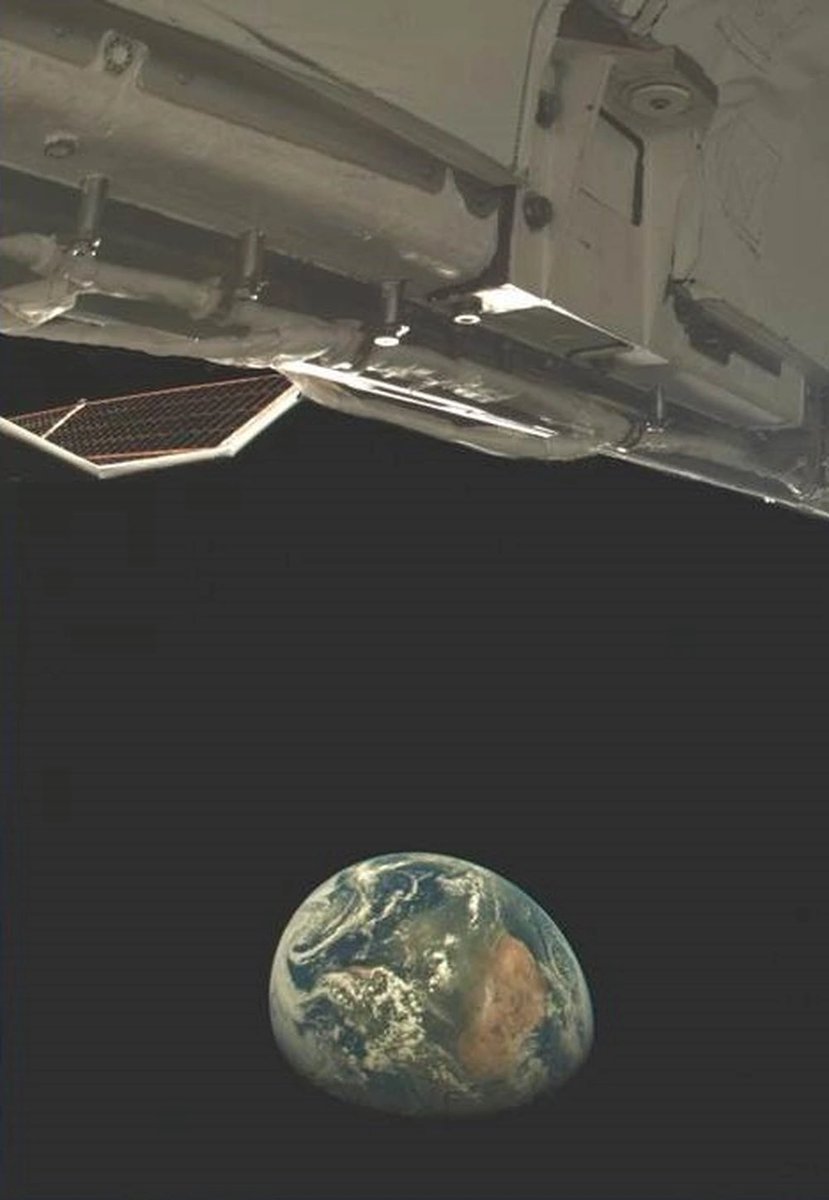
An X-37B onboard camera, used to ensure the health and safety of the vehicle, captures an image of Earth while conducting experiments in HEO in 2024.The X-37B executed a series of first-of-kind maneuvers, called aerobraking, to safely change its orbit using minimal fuel.
Aerobraking involves a spacecraft dipping into the upper layers of an atmosphere, using the drag force to slow down, before exiting back to a higher altitude. Over multiple passes, this process reduces the spacecraft’s apoapsis (highest point of orbit) while maintaining perigee (lowest point) within the upper atmosphere.
The spacecraft starts in a highly elliptical orbit with a large difference between apogee (high point) and perigee (low point). The spacecraft then lowers its perigee so that it briefly skims the upper atmosphere at each orbit. Atmospheric drag reduces velocity slightly but does not cause re-entry.
After aerobraking, the spacecraft exits the atmosphere and completes another orbit. The apoapsis is gradually lowered while perigee remains stable. Over dozens to hundreds of passes, the spacecraft continuously loses energy, shifting into a lower and more circular orbit.
Once the orbit is sufficiently lowered, the spacecraft can use small thrusters to finalize a stable orbit.
Instead of using thrusters for orbit adjustments, the X-37B could exploit atmospheric drag, extending its operational time. Even at high altitudes, air molecules can cause significant heat buildup due to friction. The X-37B’s heat shield is likely designed for controlled aerobraking. If perigee is too low, the spacecraft risks entering uncontrolled reentry. If too high, aerobraking is ineffective. Repeated high-speed passes through the atmosphere could stress the vehicle’s structure over time.
Aerobraking has been widely used in interplanetary missions but rarely for Earth-orbiting military vehicles. Some examples include Mars Odyssey (2001) which used aerobraking to reduce orbit insertion fuel costs. Venus Express (2014) conducted controlled aerobraking in Venus' atmosphere, and the Mars Reconnaissance Orbiter (2006) used aerobraking to lower its orbit into an ideal observational position.
The X-37B has been tracked by amateur satellite observers at 330 km to 450 km (205 mi to 280 mi) during some missions. There is some speculation that the X-37B may be capable of reaching up to 805 km (500 mi) based on analysis of its Delta IV-class launch vehicle capabilities. Given that it is a spaceplane optimized for extended-duration missions, it likely has the ability to adjust altitudes within its fuel constraints, allowing for variations in orbit depending on mission objectives.
For reference, the space shuttle typically operated at 160 km to 600 km (100 mi to 370 mi). The International Space Station (ISS) orbits at ~408 km (253 mi), and the Hubble Space Telescope is positioned at ~547 km (340 mi).
The X-37B has an extremely advanced propulsion system, including a Hall-effect thruster, which allows station-keeping but is unlikely to facilitate large altitude changes. The vehicle's heat shielding and aerodynamics limit how deep it can re-enter the atmosphere, influencing operational altitude. It has also completed missions lasting over 900 days, requiring a stable, fuel-efficient orbit.
My best estimate for its maximum successfully tested altitude is likely between 600 km and 1,000 km (373 mi – 621 mi). The X-37B has been launched on the Atlas V 501 and Falcon 9, both capable of delivering payloads to altitudes exceeding 1,200 km (746 mi). These rockets provide sufficient energy for the X-37B to reach an altitude far beyond its commonly observed operational range (330 km – 450 km).
Some reports indicate that the X-37B has been involved in experiments related to radiation exposure at higher altitudes, suggesting at least temporary excursions into higher orbits (above 800 km). NASA’s interest in autonomous orbital adjustments and long-term spaceplane endurance implies that high-altitude stability tests (near 1,000 km) would be valuable.
The X-37B itself does not have large onboard propulsion systems (like a significant bi-propellant stage) to perform major orbital insertions after launch, meaning a direct injection by the launch vehicle would be required for a high-apogee HEO insertion. It is unlikely to be able to return to LEO after an HEO mission unless it has an additional kick stage, but I think this is pretty likely it does at this point in the program.
Falcon Heavy could enable direct injection into HEO or even cislunar space. Maybe go review / read up on launch counts and see just how easily they could have done a covert mission and claimed it was just intentionally blown up or what have you.
Vulcan Centaur, which is up and coming, would also be capable of launching to MEO/HEO and could be a future option.
Earlier today, the U.S. Space Force quietly released the first ever in-orbit photo from Boeing’s X-37, a highly secretive reusable robotic spacecraft fielded by the DOD.
The image, taken on the X-37B's seventh mission, high over the African continent, shows the blue marble.
The only known sources capable of accelerating particles to such energies include an active galactic nuclei (AGN) jet, supermassive black holes (SMBHs) with extreme magnetic fields, gamma-ray bursts (GRBs) from hypernovae or neutron star mergers, or an ultra-high-energy cosmic ray interactions with the cosmic microwave background (CMB).
The GZK limit (around 50 EeV for cosmic rays) suggests that particles traveling intergalactic distances should be degraded in energy due to interactions with the CMB. If this neutrino traveled from a distant galaxy, how did it retain such an extreme energy without energy loss? The observed neutrino does not appear to match expectations for secondary neutrinos from ultra-high-energy cosmic ray interactions.
Neutrinos interact only weakly, meaning cross-section calculations for neutrino-nucleon interactions at these energies are uncertain.
If sterile neutrinos exist (hmm xD), they could propagate differently, avoiding expected energy losses. Some quantum gravity models suggest that space-time itself could slightly alter particle speeds at extreme energies. Other models propose that the universe harbors ultra-heavy particles (∼10²⁵ eV scale) that occasionally decay into ultra-high-energy neutrinos.
Finding its trajectory could indicate whether it aligns with an AGN, a GRB, or another known cosmic event.
If no astrophysical counterpart is found, exotic sources become more likely.
IceCube, Fermi-LAT, LIGO, and other observatories will check for gamma-ray bursts, gravitational wave events, or cosmic rays coinciding with the neutrino.
A lack of correlation suggests non-standard origins.
IceCube and ANTARES data should be reanalyzed to check for other ultra-high-energy neutrinos that might hint at an unexplored high-energy astrophysical process.
This detection has the potential to redefine our understanding of neutrino physics and the high-energy universe. If linked to AGN or GRBs, it could indicate a new class of ultra-powerful astrophysical engines.
If no astrophysical source is identified, it could point to physics beyond the Standard Model—possibly evidence of sterile neutrinos, dark matter decay, or Lorentz invariance violation.
If similar events are found, it could signal an unexpected process in cosmic ray-neutrino interactions.
This is one of the most mysterious neutrinos ever detected, and its explanation could either confirm existing astrophysical theories or break our current understanding of fundamental physics.
The most energetic neutrino ever observed just smashed into the Mediterranean and left a signal that was picked up by the K3Mnet neutrino telescope 2400m under the sea
At the moment we don't really know where this neutrino came from, nor should it really be there.
🧵1/10