

Will Hull
473 posts

Incredible.
Will Hull@thechillwill16
@_BenLee The Marrow of Modern Divinity was very helpful for me in this regard, though admittedly a combination of the Republication it teaches and general thoughts about assurance being of the essence of faith (as Heidelberg says), both of which WCF rejects, made me into a Lutheran.
English
@RScottClark @heidelcast @herron_luke @Jerrsosaved Is there a resource to which you can point me about how Nomism is tied into this issue? I have seen Nomism blamed for various theological issues, but I am not well read enough to understand what that means exactly.
English


He is correct and is following the Reformed Orthodox on this
English
@_BenLee The Marrow of Modern Divinity was very helpful for me in this regard, though admittedly a combination of the Republication it teaches and general thoughts about assurance being of the essence of faith (as Heidelberg says), both of which WCF rejects, made me into a Lutheran.
English

The realization came to me slowly as I studied the Reformed Confessions, especially the Heidelberg. I was an anxious mess, feeling like I couldn’t “desire God” enough, have enough joy, etc. What a relief to discover high octane, full force gospel in the Reformation.
R. Scott Clark@RScottClark
People are discovering (again) that John Piper teaches "final salvation through works." His language. He's been teaching this for decades. Yes, he makes our good works the instrument of our alleged final salvation. He always has. He has repeated this in sermons, in articles, in the Bethlehem elders doctrinal statement, and DGM has tweeted it. Seeing this for the first time can be a shock. You're not alone. Others have been through the same cycle (shock, denial, acceptance). Start with the sources section and go from there. heidelblog.net/2017/10/resour… @ParamountChurch @Heidelblog01 @heidelcast @HeidelbergRefo1
English
@Calvinreformed Are you uncomfortable calling her the Mother of God, Theotokos?
English

Signs you may be secretly drawn to Roman Catholic or Orthodox tradition: excessive love for Mary, discomfort calling her merely the mother of Jesus, excessive admiration for church buildings, and preferring church uniformity over unity in truth.
English
@MattTestifies If you think the true and living God threatened to kill Emma Smith if she refused to accept Joseph Smith’s practice of polygamy in Doctrine and Covenants 132 51 ff., and that that is an inspired prophetic utterance, you’re truly on your way to hell to join your false prophet.
English

@thechillwill16 @Drocula3 It shows what a regenerated heart looks like.
English
In Lutheranism (and Augustine), regeneration is one thing and election is another. It makes me think - why did God regenerate someone who is going to give up their faith in the first place?
English
@Calvinreformed @Drocula3 The parable of the sower doesn’t say their faith was false/not real, just that it had no root, wasn’t well established. But they did believe.
English
@Drocula3 @thechillwill16 Jesus said they have no root. “These are the ones sown on rocky ground: the ones who, when they hear the word, immediately receive it with joy. And they have NO root in themselves.” The Reformed view affirms the apostasy of those with false faith.
English
@Drocula3 @Calvinreformed That’s a good point. I think 1 John is all about maintaining fellowship with the Apostles, who are in fellowship with God (from epistle intro). It’s clear the “they” who went out are false teachers by the immediate context. “They [false teachers] went out from us [the Apostles].”
English

@thechillwill16 @Calvinreformed And in your aforementioned 1 John 2:19, “not” somehow means “never.”
English
@Drocula3 @Calvinreformed 100% agreed. Parable of the sower is not in favor of Calvinism, unless Calvinists employ their classic word-redefinition move, so that “believe” doesn’t mean believe, like when they say “is” doesn’t mean is, “all” doesn’t mean all, “world” doesn’t mean world, etc.
English
@Calvinreformed @thechillwill16 The parable of the sower is proof of apostasy. The seed on the rocky soil believed and then fell away. If you believe you are a believer. Believers are saved. Sola Fide
English
@cum_granosalis @DrJordanBCooper I’m ignorant on Barth’s work, but everything Ive seen about his adultery with his assistant leads me to dismiss him as worth reading. Why bother with the theology of an unrepentant adulterer? We all sin, but Barth seemed to actively work to integrate his sin into his daily life.
English

Jordan, you, in passing, made the claim that some of the mediating theologians were more orthodox than Barth. That's part of your post whether you like it or not. You calm down.
I've read 2/3 of the CD and almost have completed the read through. And then been immersed in the Barth studies area for at least the last 20 years (also with some publication on him). Either you're misremembering your reading of Barth, or you haven't really read as much as you claim; or your superimposing secondary readers onto Barth.
I may have misremembered what you have stated in the past in re to how much of Barth you have read. Even so, you conclude that reading him is a waste of time. You've made these grandiose assertions about Barth's theology without ever explaining with substance what makes Barth's theology a waste of time; or non-orthodox for that matter. Which brings us full circle: in what way are the mediating theologians more orthodox than Barth. If you didn't want to defend such a sweeping generalization then don't make one next time.
English
Cooper makes an “authoritative” assertion about the non-orthodoxy of Barth, and also acknowledges he hasn’t read him at any length. Not serious. But this is how almost all of Barth’s so-called critics have engaged with Barth; they haven’t!
Dr Jordan B. Cooper@DrJordanBCooper
I've been doing a dive into the "mediating theologians," who attempted a path between Schleiermacher and more traditional orthodoxy. It's been quite an interesting journey thus far, which has dispelled some preconceived biases about these thinkers. They aren't fully orthodox, no, but they also aren't absolute subjectivists. In fact, they aren't really "subjectivists" at in the sense in which we generally use the term. It is an interesting part of theological history that we generally ignore, perhaps due to the difficulty of their prose. We tend to jump from Schleiermacher to Barth, as if Barth was somehow the first to attempt a synthesis between Liberalism and orthodoxy, which is just not the case. In fact, these thinkers seem much closer to orthodoxy than Barth, and if you can patiently work through the terminology, they actually have a coherent set of beliefs. And just to give a note to those who will inevitably jump on me about this: I read broadly, and love the history of ideas. Reading does not mean endorsement.
English
@Heidel_bro1563 “If Abraham had seen the kindness God shows by speaking and associating with us through the daily ministry in Baptism and in the Lord’s Supper, he would have died from wonderment and joy.”
—Martin Luther, Lectures on Genesis
English

“It is wrong to hold that the sacraments of the New Law differ from those of the Old Law in point of their effective significance”
-Martin Luther

English
@LeniterFortis @LocalBateman Came here to find this image or else post it myself lol
English



@DrJordanBCooper Oh I see. Thanks Dr. Cooper, I’m a longtime listener!
English

@thechillwill16 I mean the broader tradition of the Synodical Conferences. There are uniquenesses of LCMS and WELS which were not present in the General Council, Iowa Synod, Buffalo Synod, and others.
English
Since people sometimes miss this, I am not in the LCMS, and the Synodical Conference does not represent the entirety of Lutheranism.
English
@RRT5ON1996 As I said I agree with the situational nuance, as long as we aren’t misstating the Synod’s official position.
English

@thechillwill16 ..the heightened awareness of this. Which avoids more errors overall AND leads to better opportunities for sharing our differences which leads MORE to our church
English
@RRT5ON1996 I agree with nuance in practice. I had a non-WELS friend call me from a warzone last month, with whom I prayed.
I appreciate what you’re doing brother. Just a bad look to say “hey this is what WELS believes!” and continually miss the mark.
English
@thechillwill16 I chose this church bc it’s their emphasis on conserving what we have & the abundance of caution that goes along with it. It helped us not fall prey to the stuff LCMS did. I’d rather be a bit too stringent in doctrine & leave nuance w/practice (largely understood by all I’ve met)
English
@RRT5ON1996 I’m a lay person as well, not officially WELS yet. But I have studied this issue.
It is explicitly not “in principle… for *public* displays.” Unit means UNITY, all, every. The UNIT concept is for every instance of fellowship, not just the public ones.
English
@thechillwill16 Yeah I mean, I made this tweet w/out clarifying I’m laity and not speaking on behalf of the whole of WELS. I’ll prob delete and redo just to avoid confusion. There’s doctrine & then practice. The unit concept in principle is in the confessions for public displays.
English
@RRT5ON1996 Pg 201 “At other times, we might be present in situations that involve matters of life and death… Christian love makes room for the possibility of exceptional cases. Yet exceptions do not change the basic principles.”
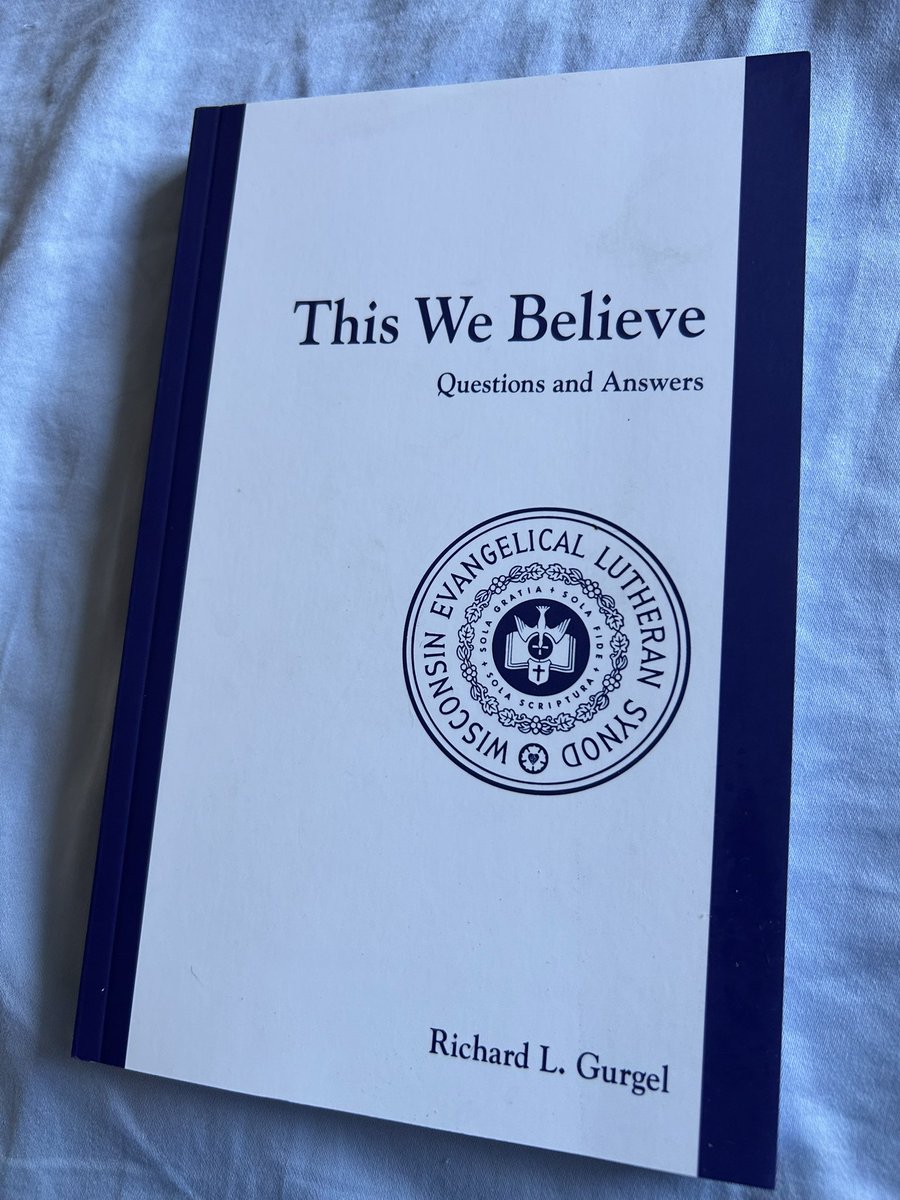
English
@thechillwill16 2/2 I understand the unit concept and believe in it in principle but in places where there’s no chance of it being seen by others & promoting error then it seems more matter of conscience. If my friend died, I’m praying w/ his family.
English
@RRT5ON1996 The unit concept IS no private prayer. The point is that there’s no type of fellowship with non-WELS, because all fellowship is a UNIT. That’s the point. What you’re saying can be your personal view, but that is NOT the WELS official position. You are articulating the LCMS view.
English
@thechillwill16 Private vs public distinction for the LCMS bc we hold the same confessions w/ minutia differences. We won’t publicly worship, or take communion which would violate the unit concept. I’m more inclined to agree w/ nondenoms in any form other than specific exception. 1/2
English