A developer put his bare feet up on the desk while a stack of 4 DGX Sparks did his job next to them.
No keyboard in reach. No cloud bills. No stress.
The stack costs $14,097 at today's price of $4,699 per box, up 56.7% from launch after NVIDIA's memory-shortage hikes. Each unit sips about as much power as a light bulb, so the pile runs all day without moving the electric bill.
The wins: 128GB per box holds models a $2,000 gaming GPU can't load. Clustered, they push 700-860 tokens/sec of batched serving. Agents grind, code generates, documents summarize, while the owner's biggest task is not kicking the cables.
The pain: The entry ticket climbed twice in 14 months and DRAM up 90% in Q1 says it climbs again. Solo users pay a premium for this much convenience. And the foot on the desk still has to review the output eventually.
The machines run every day. Nothing leaves the room, nothing bills per token, nobody rate-limits the desk.
4 gold boxes stacked in the daylight. A mouse untouched. A foot where the work used to be.
Worth it.
A $2,000 DESKTOP RUNS 120B AI MODELS IN NEAR SILENCE. NVIDIA CHARGES DOUBLE FOR ITS ANSWER.
A developer YouTuber spent 24 minutes stress-testing the Framework Desktop with AMD's Ryzen AI Max+ 395 inside.
128GB of unified memory. Enough to load models that choke a 4090.
He ran his own prompt suite against it, the same one he uses on Mac Studio clusters. Under full load the fans stayed near silent.
The part worth watching: he lines it up against machines that cost 2x and 3x more. The gap on screen does not match the spec sheets.
Most builders still rent cloud GPUs by the hour to touch models this size. This box sits under a desk and runs them for a flat $2,000.
He put the full prompt set on GitHub. Free.
The cloud bill crowd finds out last.
HE CLAPPED ONCE AND HIS ROOM BOOTED LIKE JARVIS. 3 MONITORS, MUSIC, AND A CODE EDITOR WOKE UP BEFORE HE SAT DOWN.
A 24-year-old developer in Rotterdam walks in and claps 1 time.
His roommate filmed it by accident. He never planned to post it.
3 monitors light up at once. His coding playlist starts on the middle screen. The IDE opens with yesterday's project loaded, cursor on the line where he stopped.
Total boot time: about 2 seconds. No keyboard. No mouse. No voice command.
His coworkers are still typing their Windows password.
The clip runs 23 seconds, and the trick hides in the first 3. Watch what sits under the middle monitor. That small box runs the whole setup, and it costs less than a night of pizza. He explains none of it in the video.
Some people start their workday. His room starts it for him.
4 cheap computers just ran an AI model that needs a $10,000+ machine. The build guide is free on GitHub.
Jeff Geerling clustered 4 Framework mainboards into one rig for around $8,004. Then he loaded DeepSeek R1 across all of them, a model too big for any single consumer box on the market.
It worked. The tokens printed on camera.
The trick is 30 years old. Beowulf clustering powered university supercomputers in the 90s. He rebuilt it for local AI with 1 Ansible playbook: run a single command, the cluster assembles itself, benchmarks and all.
He also filmed what breaks. The exact spots where 4 machines stop acting like 1, where efficiency loses to Apple silicon, where prompt processing chokes. Every number sits in public tables.
The price chart at the end does the damage: his shelf-sized rack next to Mac Studios and enterprise servers costing multiples more, running the same class of models.
Last year, a server he tested crawled at 4 tokens per second. This year the same money buys a cluster.
The repo is public. The parts are orderable. The excuse is gone.
A warehouse supervisor in Ohio spent $980 on parts other people threw away. His rig now outworks a $200 monthly AI subscription.
An Atermiter board from AliExpress. A used RTX 3090 from a miner's dead rig. A scratched 1200W power supply. Built on his living room floor with a kitchen screwdriver.
The 3090 is the whole trick. 24GB of VRAM holds an open model scoring 77.2% on SWE-bench. Drafts, code, document Q&A, agents grinding until sunrise.
Miners dumped these cards by the thousands. He grabbed one right before DRAM prices jumped 90% in Q1 and every machine with real memory climbed behind them.
His old bill: $200 a month, gone every 30 days. His new bill: $12 in electricity. Nothing leaves his network. Nothing resets on the 1st.
The video ends on the closed case, one fan spinning behind glass.
The market reprices this build higher every month. He built it before the window shut.
He canceled a $200 monthly AI bill after one test on a 4-year-old PC.
The developer calls himself GPU poor on camera. No server rack, no 4090 wall. One aging machine and one small box that showed up yesterday.
He pulls Ubuntu, loads an open source model, and hits run.
The result breaks the rule everyone repeats: that local AI needs $18,000 of hardware and a garage that sounds like a jet engine. The model answers on hardware most viewers already own. Nothing leaves the machine. Nothing bills per token.
The timing is the real story. DRAM prices jumped 90% in Q1. NVIDIA's local box went from $2,999 to $4,699 in 14 months. Every month of waiting makes the entry ticket more expensive while the subscription resets to zero value.
He shows the tokens-per-second number at the end of the video. He checks it twice before reading it out loud.
Subscribers rent intelligence by the month. He bought his once.
A Python developer spent his Friday night turning a webcam into a particle controller. The result looks like sorcery.
The clip is 13 seconds. Left side: index.py, cursor parked at line 437. Right side: thousands of particles chasing his hand like iron filings around a magnet.
The visible code is 3 lines of lerp math. hand_x += (target_hand_x - hand_x) * 0.25. That one 0.25 is the entire reason the motion feels alive instead of robotic.
No Unity. No game engine. A webcam, one file, and the most underrated graphics API in existence: math.
Frontend devs decorate. Data engineers move tables.
Python devs at 2 a.m. build superpowers nobody asked for.
This is what the language does off the clock.
The next GPT beats Fable on benchmarks. A developer found a way to make that Fable's advantage.
Everyone treats model releases like sports teams. Pick a side, defend it, switch when the leaderboard flips.
He did something colder. Benchmarked the roles, not the models.
The result is a 4-step pipeline built as a Claude skill. Interview until the spec bleeds. Adversarial plan review, 2 models attacking each other's logic for 5 rounds. Then the cheap benchmark king does the labor while Fable sits as final reviewer.
He calls it advisor mode ramped up. Watching the 2 models reach consensus is the strangest 30 seconds of the clip.
Open source. The GitHub search phrase is said once, near the end.
Model loyalty is a hobby. Role assignment is a system.
This looks insane. He is bending 3D objects with his bare hands through a webcam.
A college kid filmed himself at his desk. No headset, no gloves, no sensors. Just a laptop camera.
He points a finger and lilies bloom inside a floating wireframe cube. Opens his palm and they dissolve into smoke. Closes a fist and a red dragon materializes where the flowers were.
Every gesture does something different. The objects react to his hands in real time, at 60 fps, like the screen forgot it is a screen.
The wildest part is what this is not. Not After Effects. Not a render he made overnight. The timecode is running live in the corner while he performs it.
He never says a word in the whole clip. He just keeps summoning things, deadpan, like this is normal now.
Watch his left hand near the end. That is the tell.
VFX studios charge $50K for this. He did it in his bedroom.
GPT-5.6 Soul on Ultra is OpenAI's best shot at Claude Fable 5. It still lands second, just cheaper.
He flips the Ultra toggle and points the model at a real Swift codebase on camera, no benchmark slides.
Soul digs like an auditor. It traces a hang to a timeout buried at line 292 of one controller file, patches it, rebuilds the app and walks away with every test green and 0 warnings.
Solid work. It's also the same class of work Fable 5 does with more taste and fewer retries, at a price that makes you check the bill twice.
That's the real split right now. Fable 5 stays the stronger model. Soul is what you run when the task doesn't deserve Fable's invoice.
He narrates in German. The terminal answers in the universal language of passing tests.
I froze the diff screen to read what it removed.
Second place got affordable. First place didn't move.
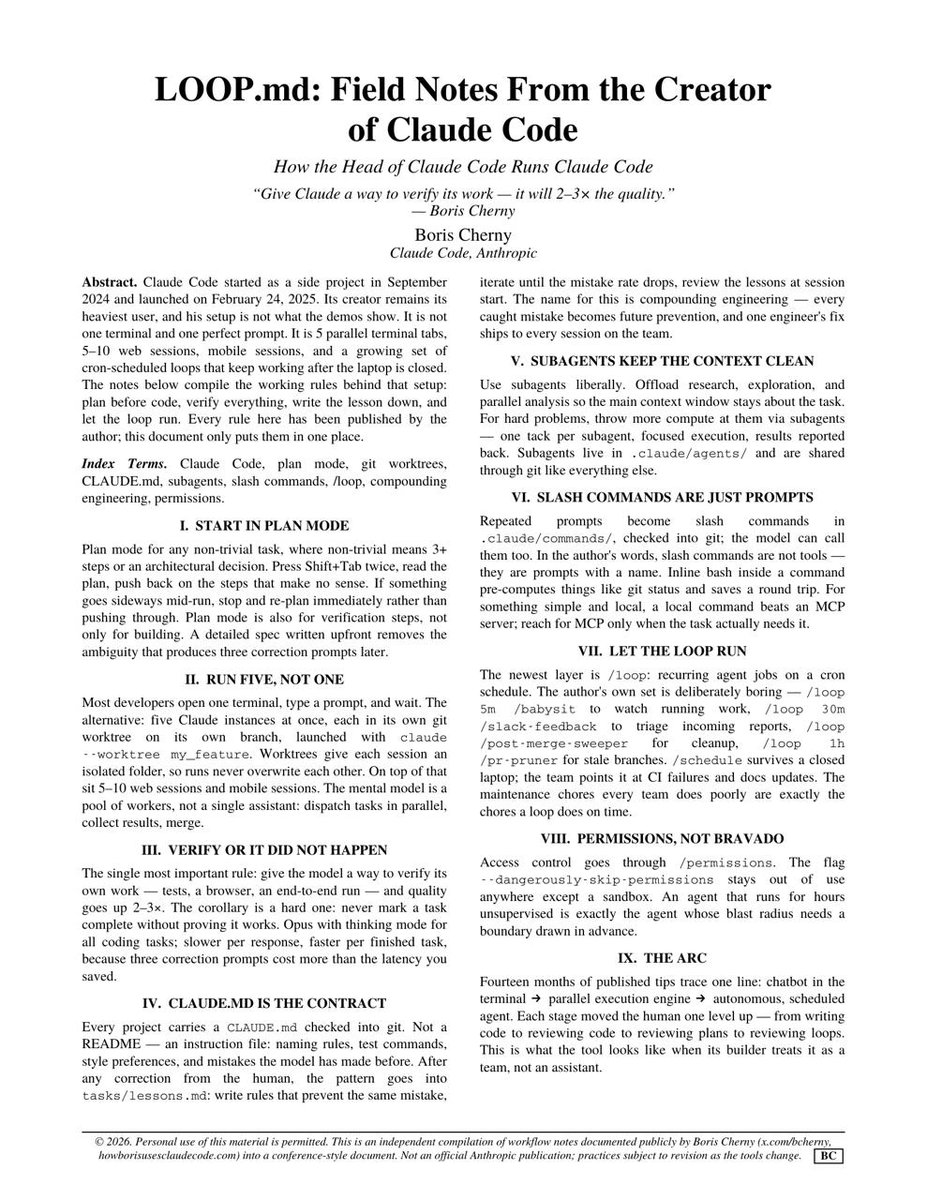
BORIS CHERNY: "GIVE CLAUDE A WAY TO VERIFY ITS WORK. IT WILL 2-3X THE QUALITY."
That line comes from the man who built Claude Code. Someone compiled every rule he ever published onto 1 page.
His real setup embarrasses the demos. 5 terminal tabs, 5 to 10 web sessions, a phone in between, and cron loops that keep shipping after his laptop closes.
Plan mode for anything above 3 steps. Thinking mode for all coding. Slower per response, faster per finished task, because 3 correction prompts cost more than the latency saved.
His hardest rule: nothing counts as done until the model proves it works.
Every human correction becomes a written rule the same day. One engineer's fix reaches every session on the team by morning.
The /loop section near the end is the part I reread. His own name for his cron set: deliberately boring.
14 months trace one arc. He stopped reviewing code and started reviewing loops.
Everyone runs Claude as an assistant. He runs it as a team.
THIS 19-YEAR-OLD BUILT AN AI BUSINESS FROM HIS BEDROOM… NOW IT MAKES $26K/MONTH
His first customer wasn’t a tech startup.
It was a plumbing company.
Every day, the owner received hundreds of photos from technicians.
Broken pipes.
Water heaters.
Boilers.
Someone had to look at every image, estimate the repair, create a quote, and send it to the customer.
It took hours.
The 19-year-old built an AI system that analyzes the photos, identifies the issue, drafts a repair estimate, and prepares a quote in under two minutes.
The owner didn’t need to hire another office employee.
He just paid for the software.
Soon, other plumbing companies wanted the same system.
Then HVAC businesses.
Then electricians.
Today, more than 40 companies pay him every month.
The business generates around $26,000 in recurring monthly revenue.
Most people think AI will create the next billion-dollar app.
But the biggest opportunities are often much smaller.
Find one repetitive task that costs a business money every single day…
…and build AI to eliminate it.
That’s where real businesses are being built.
Follow @Dexonfxf for more AI business ideas.
Two Anthropic engineers just said the prompting techniques everyone teaches stop working with agents.
36 minutes of what their own team does instead.
Both build the real thing: Claude Code and the research feature that runs for hours. This is internal practice read aloud.
01:54 → the whole definition in 6 words: "models using tools in a loop." Everything else is commentary.
03:24 → the 4-question checklist that decides if you even need an agent. Most people fail question 2 and burn money anyway.
09:42 → rule 1 of 8: think like your agent. Simulate its environment before blaming the model.
13:50 → the tool problem nobody warns about. 100+ tools available, and the prompt has to say which and when, or the loop drifts.
19:24 → how they save context: a lead agent farming work out to subagents.
23:49 → the demo question: how many bananas fit in a Rivian R1S. Watch what the agent does with it.
35:54 → the answer that kills a decade of prompt guides. Few-shot examples limit frontier models. "These models are smarter than you can predict."
Everyone's still writing prompts for 2023 models. Anthropic already prompts like it's 2027.
4 TOOLS, $0 TOTAL. A LINUX USER SHOWED WHAT A SECOND BRAIN LOOKS LIKE WHEN YOU OWN EVERY LAYER: ARCH + HYPRLAND + OBSIDIAN + VIM.
The 19-second clip opens on a screen with no icons and no menus. Just a graph of linked notes pulsing like a neural map, windows snapping into place, text moving at typing speed.
No mouse touches anything. Hyprland tiles the windows, Vim edits the notes, Obsidian draws the connections, Arch runs it all underneath. Every keystroke lands somewhere in the vault.
The foil writes itself. Millions rent their notes from SaaS apps at $10 to $15 a month and lose them the day the company pivots. This setup costs $0, every layer is open source, and every note is a plain text file that will open in 20 years on anything.
Some people rent a second brain. This one is owned, key by key.
Fable 5 has a closing window.
A dev who runs a 6-figure agency on Claude Code says the cheap era ends within days, and he crammed everything he'd do first into 3 minutes.
He cloned a $15-a-month dictation app in an afternoon. Deep research pulled apart how it works, Fable 5 rebuilt it locally. Free, private, his to modify.
That's the first use case. There are 4 more, and number 2 is the one people sleep on: he feeds his last 50 Claude Code sessions back into the model and asks what he's doing wrong. The answer becomes skills. The skills become automations. That loop is his whole agency backbone.
The last one comes with a browser game near the end that looks studio-made. It exists because this model handles projects Opus couldn't finish.
He filmed it fast for a reason.
Rented power gets repriced. What you build with it stays yours.