street rat

5.4K posts

street rat banner
street rat

street rat

@theoneboy001

loves cryptocurrency and tech

Katılım Ekim 2024
255 Takip Edilen101 Takipçiler
street rat
street rat@theoneboy001·
@johnnyblast04 Liquidity Symmetry: In fragmented systems, liquidity is trapped in silos. In a shared cryptographic environment, a dollar on one ZK-chain can potentially back a transaction on another near-instantaneously, drastically increasing capital efficiency.
English
0
0
0
16
street rat
street rat@theoneboy001·
@johnnyblast04 The Death of Reconciliations: Banks currently spend billions on "reconciliation"—checking if their books match the counterparty's. If they both settle on a ZK-based infrastructure, the proof is the truth. There is nothing to reconcile because the math
English
0
0
0
20
street rat retweetledi
JOELski
JOELski@johnnyblast04·
The $ZK "Infrastructure Gap": Why Privacy is Only Half the Battle Most people still frame blockchain adoption as a technology problem. For institutions, it’s an infrastructure problem. Banks do not lack interest in onchain settlement; they lack an environment where sensitive transaction flow stays private, compliance remains enforceable, and execution does not depend on a third-party operator. This shift requires a move away from public-by-default ledgers toward systems that respect the existing legal and operational mandates of global finance. That is the gap @zksync ’s Prividium is solving. As it exists today, $ZK acts as the native token of the ZKsync ecosystem, providing the economic coordination and governance necessary for a decentralized network. By establishing a framework where institutions can manage their own nodes while sharing a common proof system, the network bridges the gap between legacy silos and open internet value. This creates a scalable path for trillions in assets to move into a cryptographically secured environment without compromising institutional sovereignty. The important detail is not privacy alone; it’s the structural network effect of verifiable connectivity. **ZKsync’s Prividium delivers all four simultaneously: privacy, compliance, verifiability, and decentralization. Every additional participant does not simply add another user to the network; it exponentially increases the number of possible settlement relationships across the entire system. This interoperability ensures that liquidity remains deep and accessible, even when the underlying transactions are shielded from the public eye. If protocol fees and settlement infrastructure increasingly route through $ZK over time, the asset functions less like a speculative instrument and more like economic coordination infrastructure for the network itself. The market often obsesses over throughput and TPS, but the real competition is over who becomes the settlement layer institutions actually trust for long-term operations. By focusing on the intersection of privacy and proof, the ecosystem positions itself as the foundational layer for the future of global institutional finance.
JOELski tweet media
English
10
5
13
5.3K
street rat
street rat@theoneboy001·
@johnnyblast04 Regulators don’t need full ledger visibility, they need verified visibility into specific facts. ZK proofs make that distinction enforceable at the protocol level rather than dependent on a compliance team manually producing records on request.
English
0
0
0
15
street rat
street rat@theoneboy001·
@johnnyblast04 The portability across regulatory regimes is the detail most commentary skips over. Getting one institution in one jurisdiction to evaluate new infrastructure is a sales outcome. Getting U.S. regional banks, Gulf Cooperation Council institutions.
English
0
0
0
14
street rat
street rat@theoneboy001·
@larcxim The role of former regulators entering the ecosystem is fascinating because it suggests institutional blockchain infrastructure is moving from theoretical discussion into implementation-level thinking.
English
0
0
0
7
Larx
Larx@larcxim·
What happens when financial infrastructure stops being defined by geography… and starts being defined by shared settlement? For decades, global finance scaled by building layers: banks, correspondent networks, clearing systems, custodians, payment processors. Every new institution increased reach. But it also increased complexity. That’s why the most important signal around @zksync may not be “institutional adoption” itself. It’s which kinds of institutions are choosing to build there. When Cari Network represents access to $600B+ in bank deposits, that isn’t just another partnership headline. It reflects existing financial distribution entering a zk-native environment. When the 27th U.S. Comptroller of the Currency founds a company building on ZKsync, that matters because people who previously regulated financial infrastructure are now helping architect new versions of it. Those are very different signals from speculative attention. They suggest institutions are beginning to view zero-knowledge systems less as crypto products… and more as coordination infrastructure. That distinction matters. Because networks compound differently at institutional scale. A consumer app gains users. A financial network gains connectivity. 10 institutions don’t create 10 relationships. They create 45 possible settlement pathways. 100 institutions create thousands. This is the same compounding dynamic that made SWIFT globally dominant. Not because SWIFT was flashy, but because every additional participant increased the network’s utility for everyone already inside it. That’s the deeper question around ZKsync: If institutions begin settling through shared zk-powered infrastructure, does the value come from individual applications… or from becoming the environment where institutional coordination itself happens? And inside that architecture, $ZK has a very specific role today. It is the native asset of the ZKsync network, functions in governance, and serves as the native gas token for ZKsync Gateway, which bundles transactions across ZKsync chains and Prividium zones before settlement to Ethereum L1. Not a speculative narrative. An operational role inside the network architecture itself. Maybe that’s the real shift happening here. Not institutions “joining crypto.” But financial systems quietly reorganizing around infrastructure built for interoperability, verifiability, and programmable settlement from day one.
Larx tweet media
English
20
7
30
3.2K
street rat
street rat@theoneboy001·
@larcxim The phrase “financial coordination upgraded for the internet age” is actually accurate here. Most legacy financial systems were designed around geographic and institutional fragmentation, while modern digital systems assume global interoperability by default.
English
0
0
0
4
Larx
Larx@larcxim·
What if the biggest blockchain opportunity isn’t retail adoption… but replacing the invisible machinery behind global banking? Traditional finance already moves at an unimaginable scale. Over $100T sits in global deposits. Cross-border banking still depends on correspondent networks that lock trillions in idle capital just to maintain liquidity between institutions. Annual transaction volume across the financial system reaches into the quadrillions. Yet much of this infrastructure was designed decades before the internet became global. That’s the real reason institutions are beginning to look onchain. Not because “crypto is the future.” Because fragmented ledgers, delayed reconciliation, intermediaries, and pre-funded accounts create massive inefficiencies at scale. The problem is that most blockchains fail institutional requirements the moment privacy, compliance, and operational control enter the conversation. Banks cannot expose transaction flows publicly. Asset managers cannot leak settlement activity to competitors. Regulators require auditability. Institutions need sovereign execution environments while still remaining connected to liquidity and counterparties. This is where @zksync becomes structurally different. Prividium introduces a model where institutions can operate private, permissioned environments while anchoring validity to Ethereum through zero-knowledge proofs. Sensitive data stays offchain, but transaction correctness is still verifiable mathematically. That changes the conversation entirely. Instead of choosing between: • private but disconnected systems or • public but fully transparent chains ZKsync is attempting to merge both worlds into a single architecture: private execution + public verifiability. The deeper implication is that zero-knowledge infrastructure may matter less for speculation and more for financial coordination itself. If settlement becomes programmable, near-instant, interoperable, and cryptographically verifiable, what happens to the trillions currently trapped in operational friction? Maybe the real institutional shift isn’t “TradFi entering crypto.” Maybe it’s the gradual replacement of trust-heavy financial coordination with systems where verification is handled by math instead of intermediaries. And if that transition actually happens at scale, the question becomes: Will blockchains compete to attract users… or compete to become the settlement layer beneath the global financial system itself?
Larx tweet media
English
20
5
36
2.2K
street rat
street rat@theoneboy001·
@johnnyblast04 The $27T in pre-funded correspondent banking capital is essentially a hidden tax on global commerce. Every business paying cross-border invoices is subsidizing that idle liquidity through fees and delays they never see itemized.
English
0
0
0
33
street rat retweetledi
JOELski
JOELski@johnnyblast04·
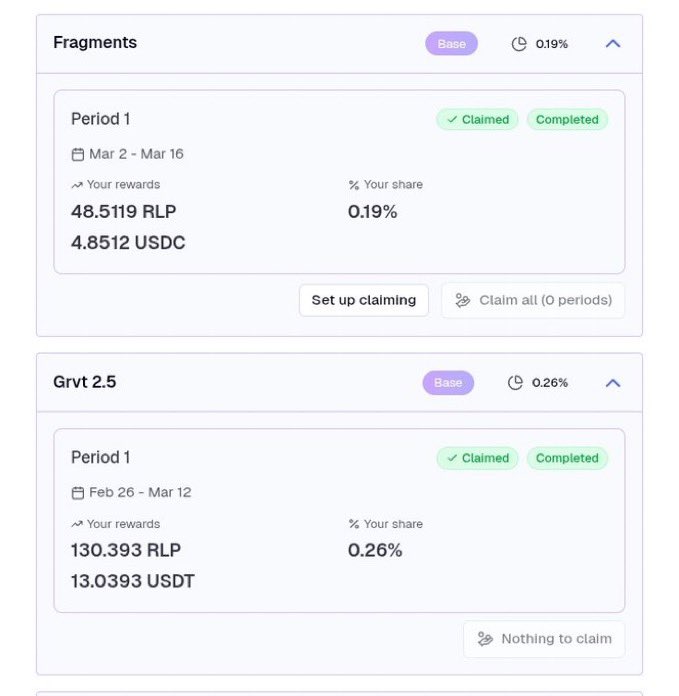
Watched my buddy @larcxim casually mention he got paid for posting last week. I laughed. Then he showed me his @RallyOnChain earns. Real stablecoins sitting right there. No “points” No vague promises No waiting 6 months for an airdrop that gets cut in half anyway Just… paid.
JOELski tweet mediaJOELski tweet media
English
22
10
59
1.3K
street rat
street rat@theoneboy001·
Caught the @BurnieSendersX draw with only 15 minutes left on the clock and still managed to get my $BURNIE ticket in. The fact that the timer is always visible makes it easy to plan around — no surprises.
English
0
0
0
55
street rat
street rat@theoneboy001·
Checked the FEED tab on @BurnieSendersX and every ticket entry is logged in real time. Nothing hidden with $BURNIE — you can watch the round fill up live as it happens.
English
0
0
0
56
street rat
street rat@theoneboy001·
The TOP 20 leaderboard on @BurnieSendersX actually shows which wallets are most active across rounds. $BURNIE rewards consistency — the data is right there for anyone to see.
English
0
0
1
62
street rat
street rat@theoneboy001·
The STATS page on @BurnieSendersX shows exactly how many tickets each wallet holds this round. $BURNIE makes everything transparent — no guessing who’s in or how many chances they have.
English
0
0
0
68
street rat
street rat@theoneboy001·
Stumbled into the @BurnieSendersX LINK WALLET page trying to figure out how tickets work and honestly the UX is cleaner than expected. $BURNIE is putting in work where it counts — the product itself.
English
0
0
0
63
street rat
street rat@theoneboy001·
Clicked into @BurnieSendersX expecting the usual copy-paste crypto project and got genuinely surprised. $BURNIE has a token page, a raffle system, and actual documentation — someone put real thought into this.
English
0
0
0
79
street rat
street rat@theoneboy001·
Went to check the @BurnieSendersX docs out of curiosity and ended up staying way longer than expected. The way $BURNIE structured the tokenomics actually makes the raffle sustainable long term — this isn’t just a gimmick.
English
0
0
1
70
street rat
street rat@theoneboy001·
Just noticed @BurnieSendersX requires an 11 min hold to qualify for each round — so every single ticket in the $BURNIE raffle is from someone with actual skin in the game. That’s the filter right there.
English
0
0
0
43
street rat
street rat@theoneboy001·
@BurnieSendersX just shipped VIBECHECK while other projects are still writing whitepapers. $BURNIE actually delivers — the feature is live and the round counter keeps climbing.
English
0
0
0
61
street rat
street rat@theoneboy001·
.@BurnieSendersX dropped a VIBECHECK feature and it’s live right now. The $BURNIE ecosystem keeps building while most tokens are still promising a roadmap.
English
0
0
0
60