Daniel Rourke 🙃

38.1K posts

Daniel Rourke 🙃 banner
Daniel Rourke 🙃

Daniel Rourke 🙃

@therourke

bluesky: https://t.co/sRNER6Svpc

☀️ London 🌧️ Katılım Nisan 2009
2.8K Takip Edilen3.8K Takipçiler
Archaeo - Histories
Archaeo - Histories@archeohistories·
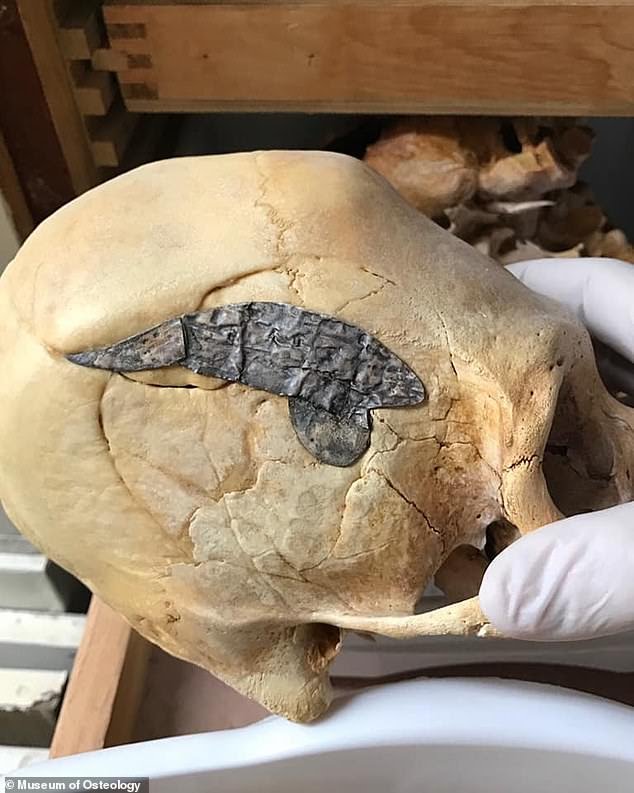
The 2000 year old skull of a Peruvian warrior was found to have been fused together with metal in one of the world's oldest examples of advanced surgery, according to a museum. Museum of Osteology in  Oklahoma says the skull, which is in its collection, is reported to have been that of a man who was injured during battle before having some of the earliest forms of surgery to implant a piece of metal in his head to repair the fracture. According to experts, that the man survived the surgery, with the skull now a key piece of evidence in proving that ancient peoples were capable of performing advanced surgeries. The skull in question is an example of a Peruvian elongated skull, which is an ancient form of body modification where tribe members intentionally deformed the skulls of young children by binding them with cloth or even binding the head between two pieces of wood for prolonged periods of time.  'This is a Peruvian elongated skull with metal surgically implanted after returning from battle, estimated to be from about 2000 years ago. One of our more interesting and oldest pieces in the collection,' the museum said. 'We don't have a ton of background on this piece, but we do know he survived the procedure. Based on the broken bone surrounding the repair, you can see that it's tightly fused together. It was a successful surgery.'  Skull had originally been kept in the museum's private collection, however it was officially put on display in 2020 following growing public interest in the artifact due to news coverage on the discovery of the skull. The area where the skull was discovered in Peru has long been known for surgeons who invented a series of complex procedures to treat a fractured skull.  The injury was commonplace at the time due to the use of projectiles like slingshots during battle. Elongated skulls were common in Peru at the time, and were stretched by applying force to a person's cranium, often by binding it between two pieces of wood. Multiple reasons have been given for skull elongation, varying from serving as a way for society's elites to mark themselves out, to acting as a form of defense. Subsequent archaeological digs have found that Peruvian women who had elongated skulls were less likely to have suffered serious head injuries than those without.  Surgeons during that time period would scrape a hole in the skull of a living human without the use of modern anesthesia or sterile techniques. 'They learned early on that this was a treatment that could save lives. We have overwhelming evidence that trepanation was not done to increase consciousness or as a purely ritual activity but is linked to patients with severe head injury, (especially) skull fracture,' physical anthropologist John Verano of Tulane University told National Geographic in 2016. 'We don't know the metal. Traditionally, silver and gold was used for this type of procedure,' a spokesperson for the Skeletons: Museum of Osteology. In a 2018 study published in Current Anthropology, the practice of elongating skulls was found among disparate cultures ranging from the Mayas to the Huns, and were found to be a status symbol of privilege and prestige in groups worldwide.  © Museum of Osteology #archaeohistories
Archaeo - Histories tweet media
English
175
192
1K
127.7K
Archaeo - Histories
Archaeo - Histories@archeohistories·
Revolutionary research challenges longstanding assumptions about pristine prehistoric European landscapes, revealing that both Neanderthals and later Mesolithic hunter-gatherers actively transformed their environments thousands of years before the advent of agriculture. Using advanced computer simulations combined with extensive pollen analyses, an international team of researchers has quantified the ecological impact of these ancient populations, demonstrating that humans were not passive inhabitants but active architects of European ecosystems. The findings, published in PLoS ONE, offer a dramatically new perspective on humanity's relationship with the natural world and suggest that the concept of "untouched wilderness" in prehistoric Europe may be fundamentally flawed. The study focused on two critical warm periods: the Last Interglacial (125,000-116,000 years ago) when Neanderthals were Europe's sole human inhabitants, and the Early Holocene (12,000-8,000 years ago) when Mesolithic hunter-gatherers of our own species, Homo sapiens, occupied the continent. According to Phys.org, the research incorporated interdisciplinary knowledge from ecology, archaeology, and palynology to create the first continental-scale simulation of ancient human impact on vegetation patterns. The results paint a picture far removed from the romanticized notion of humans living in harmony with pristine nature. The research team, led by first author Anastasia Nikulina and including Professor Jens-Christian Svenning of Aarhus University's biology department, employed cutting-edge computational modeling coupled with artificial intelligence optimization algorithms to run thousands of scenarios. By comparing simulation results with actual pollen data from archaeological sites across Europe, researchers calculated the precise extent of human influence on vegetation cover during both time periods. The findings proved startling: Mesolithic hunter-gatherers could have influenced up to 47% of plant type distribution across the continent, while Neanderthals impacted approximately 6% of plant type distribution and 14% of vegetation openness. "The study paints a new picture of the past," explained Professor Svenning. "It became clear to us that climate change, large herbivores and natural fires alone could not explain the pollen data results. Factoring humans into the equation - and the effects of human-induced fires and hunting - resulted in a much better match." The computer modeling revealed that prehistoric humans influenced European landscapes through two primary mechanisms: deliberate burning of trees and shrubs to create more open habitats, and hunting of large herbivores that fundamentally altered grazing patterns and vegetation succession. © Gary Manners / Ancient Origins #archaeohistories
Archaeo - Histories tweet media
English
11
21
113
16.3K
Daniel Rourke 🙃
Daniel Rourke 🙃@therourke·
@Nicolascole77 "Accelerate success" is a dry business speak way to gesture to something as evocative and important as writing. I think you might have your focus all wrong.
English
0
0
0
27
Nicolas Cole 🚢👻
Nicolas Cole 🚢👻@Nicolascole77·
I'm a writer, and I hate to tell this: But writing and publishing every day is the single most important way to accelerate success.
English
86
3
205
8.5K
Daniel Rourke 🙃
Daniel Rourke 🙃@therourke·
@Stealth40k I'm hoping for concerted action on climate change, and an absolute end to the horrors in Gaza. A new 3D Mario announcement would be good too.
English
0
0
3
322
Stealth
Stealth@Stealth40k·
I hope there is a Nintendo Direct in one week. If it falls on the 40th Anniversary of Super Mario Bros., I'm definitely expecting something Mario related.
Stealth tweet media
English
43
77
1.1K
54.8K
Daniel Rourke 🙃 retweetledi
#Additivism 🐙
#Additivism 🐙@additivism·
Celebrating the birthday of #Additivism!! 10 years ago we launched The 3D Additivist Manifesto, calling radicals, revolutionaries, activists, Additivists to think with & thru 3D printing technology as a tool for radical imagination, critical resistance, & creative sabotage.
#Additivism 🐙 tweet media#Additivism 🐙 tweet media#Additivism 🐙 tweet media#Additivism 🐙 tweet media
English
1
1
2
269
Daniel Rourke 🙃
Daniel Rourke 🙃@therourke·
Dear @tumblr, my website (additivism) just disappeared. No warning. It is gone. I heard your support is achingly slow. How can I sort out this issue please??
English
0
0
0
214
Hyperdub
Hyperdub@Hyperdub·
Anyone still here?
English
48
11
533
30.7K
Daniel Rourke 🙃 retweetledi
Prof. Ryan Katz-Rosene
Prof. Ryan Katz-Rosene@ryankatzrosene·
"Siri, what 15 second video clip serves as a metaphor for the culmination of the last half-Century of American-led, fossil fuel driven, neoliberal capitalism?" [Video by @stuartpalley]
English
1.6K
14.3K
90.5K
3.8M
Daniel Rourke 🙃
Daniel Rourke 🙃@therourke·
I am at the stage with this "story" of just rocking forwards and backwards in my chair, muttering Musk and Tommy Robinson's names in an ever growing burp of echolalia news.sky.com/story/right-wi…
English
0
0
0
289
Paul Schofield
Paul Schofield@pschofie79·
Name an academic discipline and I'll tell you if it's real or fake.
English
277
27
573
92.1K
Daniel Rourke 🙃
Daniel Rourke 🙃@therourke·
I am not exactly sure what Musk's long-game is, regarding his increasing far right pandering (though I am sure he has a game in mind). But his recent forrays into shit flooding are just the beginning.
English
0
0
0
167
Daniel Rourke 🙃
Daniel Rourke 🙃@therourke·
Another term for this is "Distributed Amplification". And the media and political sphere need to come up with new tactics to avoid being merely nodes in the network trolls like Musk take advantage of. mediamanipulation.org/definitions/di…
English
1
0
1
176
Daniel Rourke 🙃
Daniel Rourke 🙃@therourke·
That's a Steve Bannon phrase, but we could just as easily invoke a Nick Land term for this: hyperstition. Musk is testing out his platform's capacity to troll events into reality.
English
1
1
0
245