Boris Skorobogaty

32 posts

Boris Skorobogaty

Boris Skorobogaty

@theskory

Cooking at @xAI, ex Senior Staff @Meta

London, England Katılım Mayıs 2013
268 Takip Edilen360 Takipçiler
Boris Skorobogaty
Boris Skorobogaty@theskory·
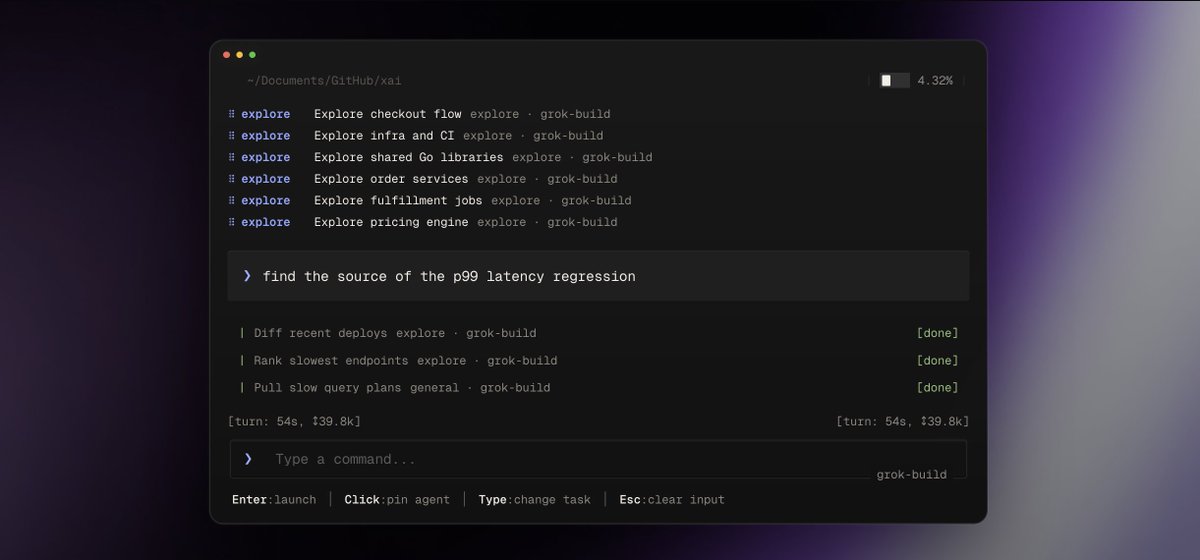
Yeah, /implement is easily my #1 skill. It’s not just the implement → review → fix loop that gives way better output — it also has a built-in memory system. After each task, the orchestrator summarises the issues that were fixed, saves them to a persistent file of “most common problems,” and on the next run injects that knowledge into the implementer + reviewer prompts so they avoid repeating the same mistakes.
Morgan@morganlinton

Okay, looks like /implement is the way to get Grok Build to run longer, just had my first 10 minute run 💪 What's really neat is it's super critical of itself, essentially finds its own bugs, and then puts together subagents to address all the open issues.

English
123
276
950
570.9K
Boris Skorobogaty
Boris Skorobogaty@theskory·
@morganlinton @xai We also have a different (more tmux like mode) mode that allows to configure double and triple clicks to copy text… in this mode you can configure for how long to highlight the copied text and also the word separators. If you are interested then I can share how to try it out.
English
5
7
112
15.8K
Morgan
Morgan@morganlinton·
One more small feature idea for the @xai team for Grok Build, which I've been using as my primary coding agent all weekend 💪 Right now when I copy something in the TUI, which btw is awesome to be able to do with the mouse. It highlights it at first, but then the highlight goes away. I can see in the bottom right it says "copied" but I feel like it should work like it does in most normal apps where the text I copy remains highlighted. Here's a video showing it if it's helpful. Super small thing, but I find myself copying a lot and this keeps making me wonder if I copied the right thing.
English
16
9
157
22.8K
Level Orbit
Level Orbit@levelorbit·
@theskory I shared feedback on the model and Grok Build, but disabled memory after it made things worse. It has potential but isn’t usable yet, and even after lowering the context window to 128k it overflows beyond the limit.
English
2
0
0
166
Boris Skorobogaty
Boris Skorobogaty@theskory·
You can also explicitly ask the model to remember or forget things… There are some interesting things behind such as FTS + vector search, interval flushes. Also, some old session memories get decayed over time, while global and workspace are considered evergreen. Worth a blog post once we polish all the rounds.
tetsuo@tetsuoai

Grok Build has three commands for managing memory across sessions: /memory, /flush, and /dream. They're experimental but worth looking at if you've ever been frustrated with how agents forget everything between conversations. /memory opens a window into what Grok has saved. There are three layers: global memory, workspace-specific memory, and per-session summaries. You can read what's there, edit it, or delete things you don't want kept. /flush is for when you've had a useful session and want it saved before context compaction kicks in. It writes a summary of the current conversation into the memory store, capturing decisions, debugging paths, project conventions, and anything else worth keeping. /dream runs in the background over your old session logs and memory fragments. It deduplicates overlapping notes, merges related fragments, and consolidates everything into cleaner topics, so the store doesn't grow into a pile of half redundant snippets over time. Most agent memory I've looked at just shoves the chat history into RAG. That works for about a week before the store gets noisy and starts hurting sessions. Grok Build treats capture and consolidation as separate commands, with the user able to inspect what's saved. The editable part is important. If your agent saves something wrong, or if your conventions change, you need to be able to go find that memory and remove it. Otherwise the agent keeps applying outdated context with full confidence and you spend cycles undoing its mistakes. Managing context for long-running agents is going to need real memory primitives. Write, search, prune, and consolidate, all as first class operations. Grok shipping these three commands is the first time I've seen a consumer product treat memory as its own layer.

English
6
11
141
12.6K
Edward Coristine
Edward Coristine@as400495·
Grok Build has the best TUI I’ve ever used
English
22
14
386
20.2K
skcd
skcd@skcd42·
@aegeantic oh nice, more eval data :)
English
2
1
19
900
ege
ege@aegeantic·
I’ve been asking myself on how to trust coding agents more and have a hypothesis: way to keep them honest is giving them a way to verify their work which makes me think writing testable code is more important than ever, will be testing it out this week if it works in practice
English
17
3
103
7.5K
skcd
skcd@skcd42·
"when was the last time you opened your editor?" mine was 2 months ago
English
21
1
66
8.2K
Boris Skorobogaty
Boris Skorobogaty@theskory·
@Yuhu_ai_ We didn’t get to work together much, but I really appreciated the opportunity to do so. Wishing you the absolute best in all your future challenges!
English
0
0
5
1.7K
Yuhuai (Tony) Wu
Yuhuai (Tony) Wu@Yuhu_ai_·
I resigned from xAI today. This company - and the family we became - will stay with me forever. I will deeply miss the people, the warrooms, and all those battles we have fought together. It's time for my next chapter. It is an era with full possibilities: a small team armed with AIs can move mountains and redefine what's possible. Thank you to the entire xAI family. Onward. 🚀 And to Elon @elonmusk - thank you for believing in the mission and for the ride of a lifetime.
English
739
371
9.3K
3.6M
Boris Skorobogaty retweetledi
Neil Zeghidour
Neil Zeghidour@neilzegh·
Me defending my O(n^3) solution to the coding interviewer.
English
416
5K
49.3K
4M
Boris Skorobogaty retweetledi
xAI
xAI@xai·
Congrats to the winners of Grokathon London ’26! 🧵
English
169
150
1.9K
280.6K
Boris Skorobogaty retweetledi
Yuhuai (Tony) Wu
Yuhuai (Tony) Wu@Yuhu_ai_·
Grok4.20 solving open math problems 🚀 If you would like to try internal 4.20 beta for scientific discovery, please reply below. We would love to have your feedbacks.
Paata Ivanisvili@PI010101

Disclaimer: I had given early access to internal beta version of Grok 4.20 It found a new Bellman function for one of the problems I’d been working on with my student N. Alpay. The problem reduces to identifying the pointwise maximal function U(p,q) under two constraints and understanding the behavior of U(p,0). In our paper arxiv.org/pdf/2502.16045 we proved U(p,0)\geq I(p), where I(p) is the Gaussian isoperimetric profile, I(p) ~ p\sqrt{log(1/p)} as p ~ 0. After ~5 minutes, Grok 4.20 produced an explicit formula U(p,q) = E \sqrt{q^2+\tau}, where \tau is the exit time of Brownian motion from (0,1) starting at p. This yields U(p,0)=E\sqrt{\tau} ~ p log(1/p) at p ~ 0, a square root improvement in the logarithmic factor. Any significance of this result? It will not tell you how to change the world tomorrow. Rather, it gives a small step toward understanding what is going on with averages of stochastic analogs of derivatives (quadratic variation) of Boolean functions: how small can they be?  More precisely, this gives a sharp lower bound on the L1 norm of the dyadic square function applied to indicator functions 1_A of sets A \subset [0,1]. In my previous tweet about Takagi function, we saw that the sharp lower bound on ||S_1(1_A)||_1 miraculously coincides with Takagi function of |A| which (surprisingly to me) is related to the Riemann hypothesis. Here, we obtain a sharp lower bound on ||S_2(1_A)||_1 given by E \sqrt{\tau}, where Brownian motion starts at |A|. This function belongs to the family of isoperimetric-type profiles, but unlike the fractal Takagi function, it is smooth and does not coincide with the Gaussian isoperimetric profile. Finally, in harmonic analysis it is known that the square function is not bounded in L^1. The question here was more about curiosity: how exactly does it blow up when tested on Boolean functions 1_A.  Previously, the best known lower bound was |A|(1-|A|) (Burkholder—Davis—Gandy). In our paper, we obtained |A| (1-|A|)\sqrt{log(1/(|A|(1-|A|)))}. This new Grok’s Bellman function gives |A| (1-|A|) \log(1/(|A|(1-|A|))) and this bound is actually sharp.

English
198
71
892
78.6K
Boris Skorobogaty retweetledi
xAI
xAI@xai·
London Grokathon - Jan 17th 🚀 Join us for 12hr non-stop coding to build applications and show what's possible! Apply by 1/4: x.ai/grokathon
English
109
164
983
134.5K