
Institute for the Study of War
54K posts

@TheStudyofWar
ISW is a policy research organization focused on U.S. national security. Email: [email protected]. https://t.co/FO1PVyOnYB


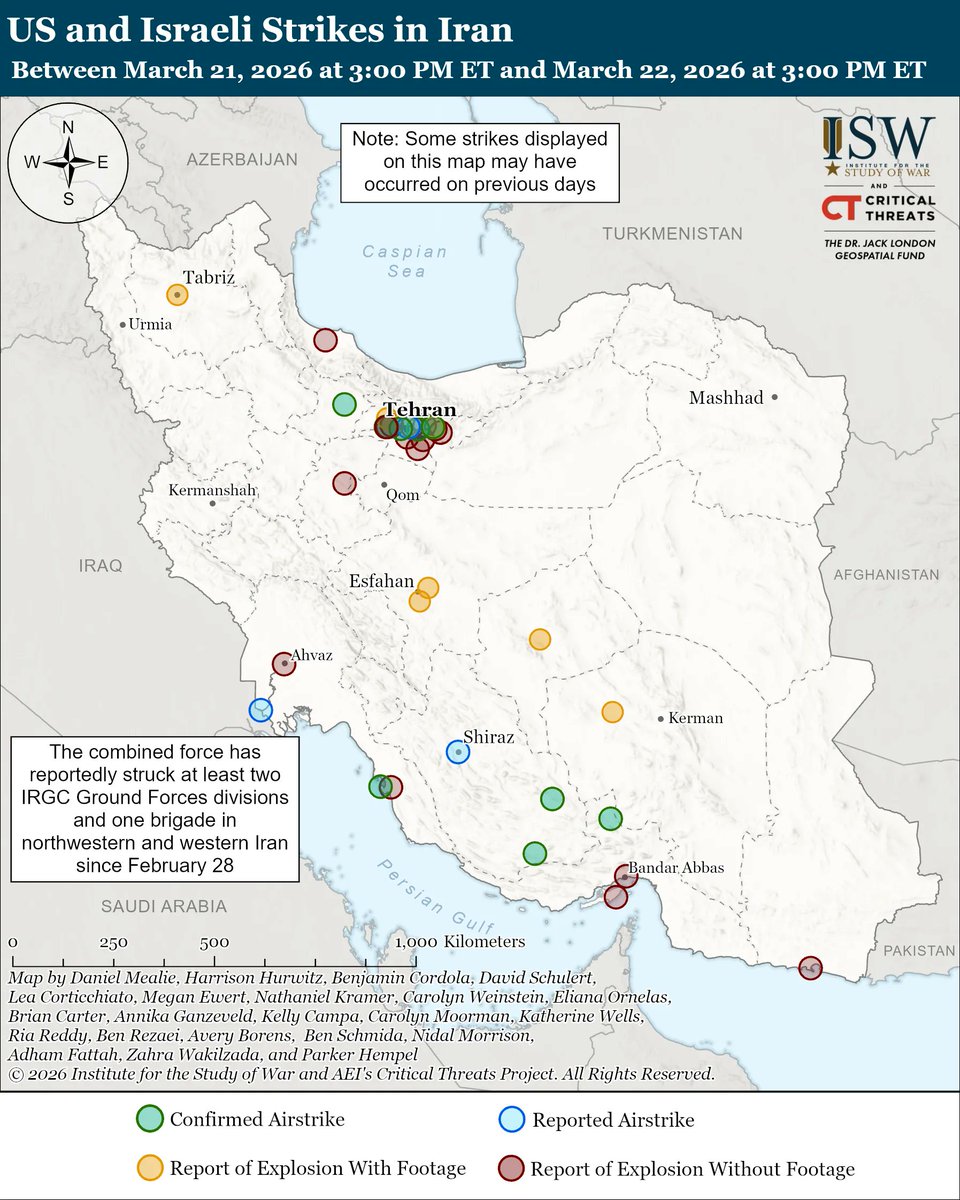
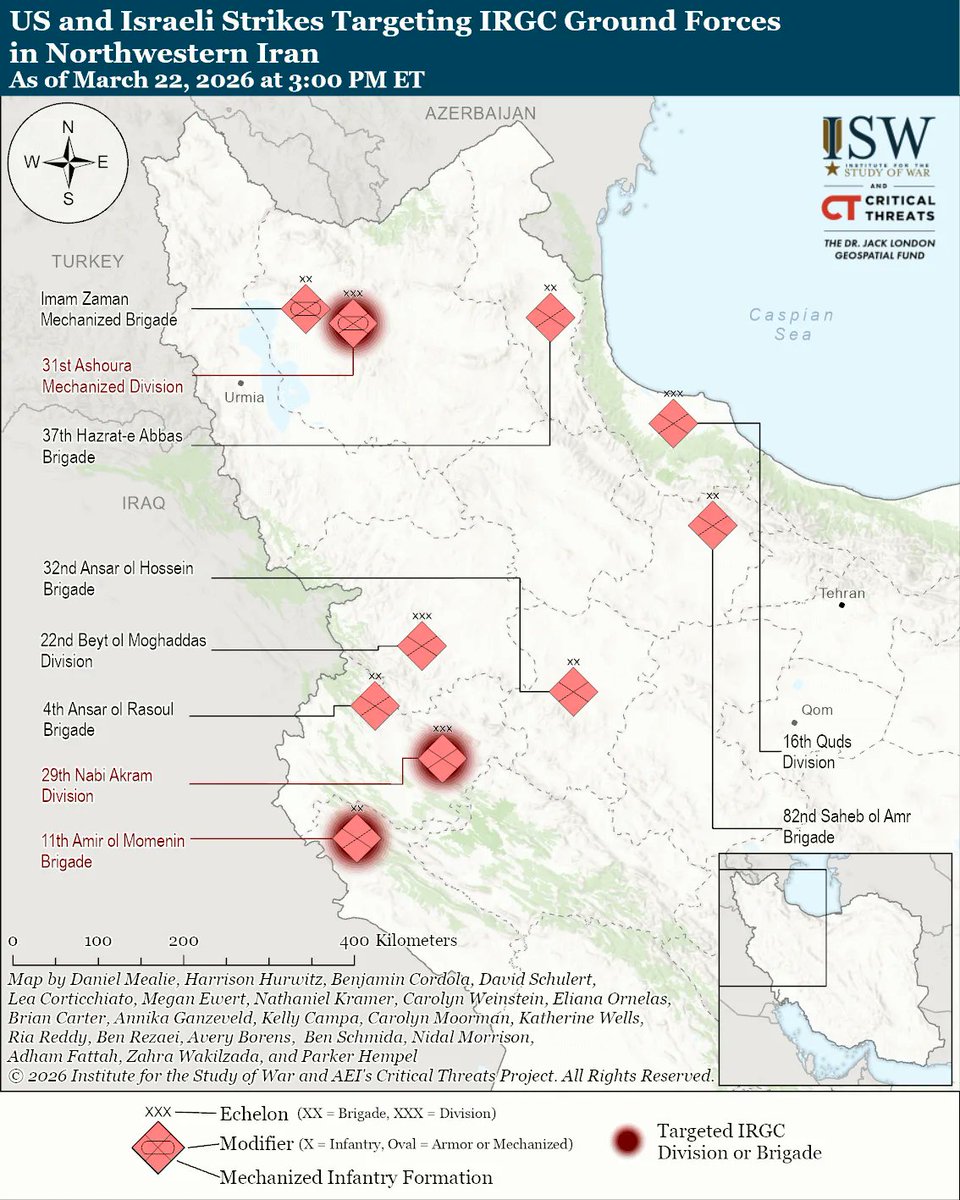
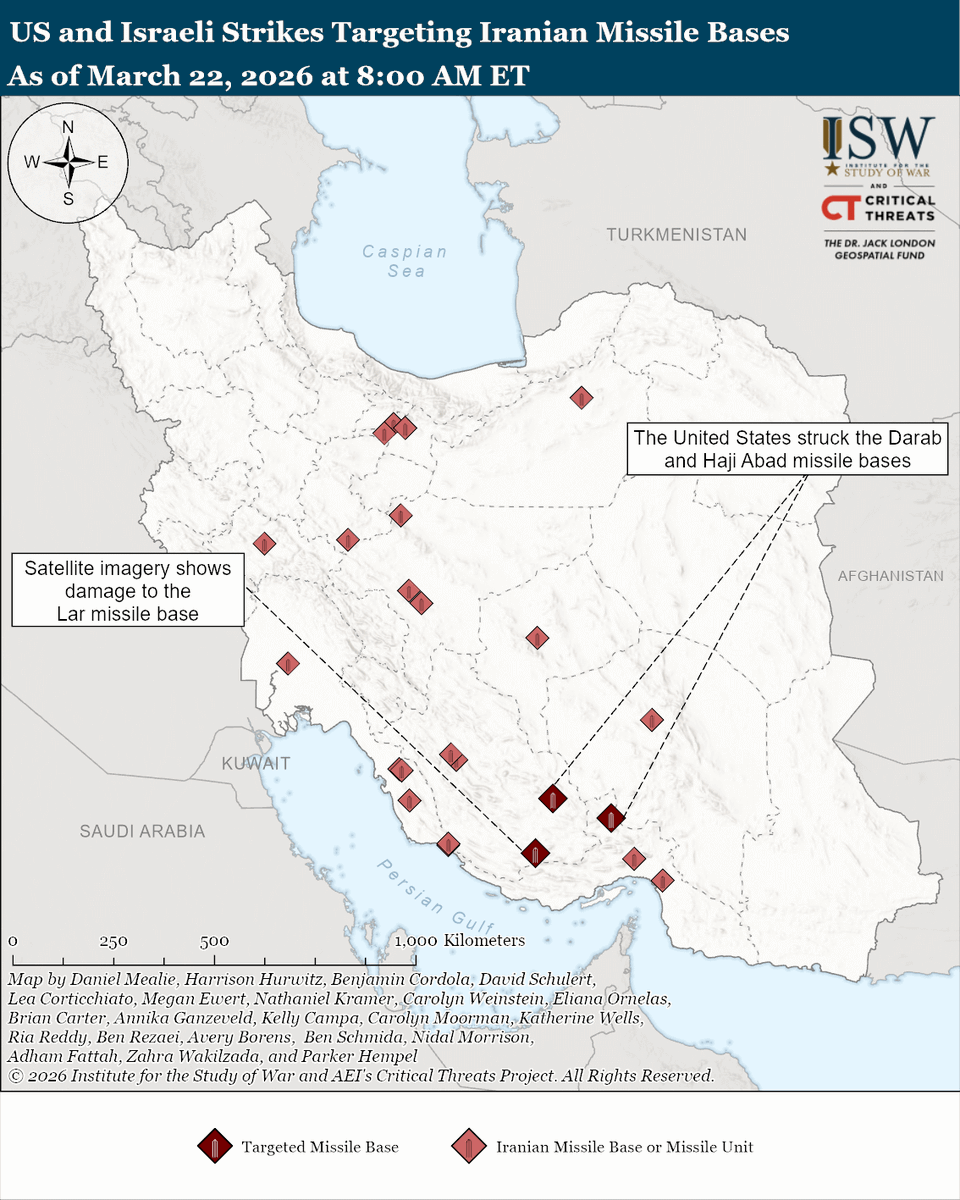
NEW | Evening Update: US President Donald Trump threatened on March 21 to “obliterate” Iranian power plants if Iran does not “fully open” the Strait of Hormuz within 48 hours. Iran has threatened to attack regional energy infrastructure if the United States attacks power plants in Iran. ISW-CTP has recorded several Iranian attacks on regional energy infrastructure since the war began on February 28, but the new threats could entail an expansion of such attacks. IRGC Ground Forces Commander Brigadier General Mohammad Karami visited unspecified IRGC Ground Forces units in western and northwestern Iran on March 22. The visit of the IRGC Ground Forces commander to units in northwestern provinces along Iran’s border is notable, given the combined force’s efforts to degrade internal security institutions in Iran’s western border region and reports about possible armed Kurdish mobilization along the Iran-Iraq border. The combined force continued to conduct airstrikes targeting Iranian missile production and storage facilities. The combined force targeted sites that produce short- and medium-range ballistic missiles, including the Fath-360 with a maximum range of 120 kilometers (km), Fateh-110 with a maximum range of 300km, the Zolfaghar with a maximum range of 700km, and the medium-range Haj Qasem ballistic missile with a maximum range of 1,400 km. Iran notably has supplied Russia with Fath-360s for Russia’s offensive campaign in Ukraine. The IRGC has reportedly restructured Hezbollah under a more decentralized command model following Israeli operations that degraded the group’s leadership in 2024. This decentralized structure aimed to improve operational security and reduce vulnerability to Israeli intelligence penetration.


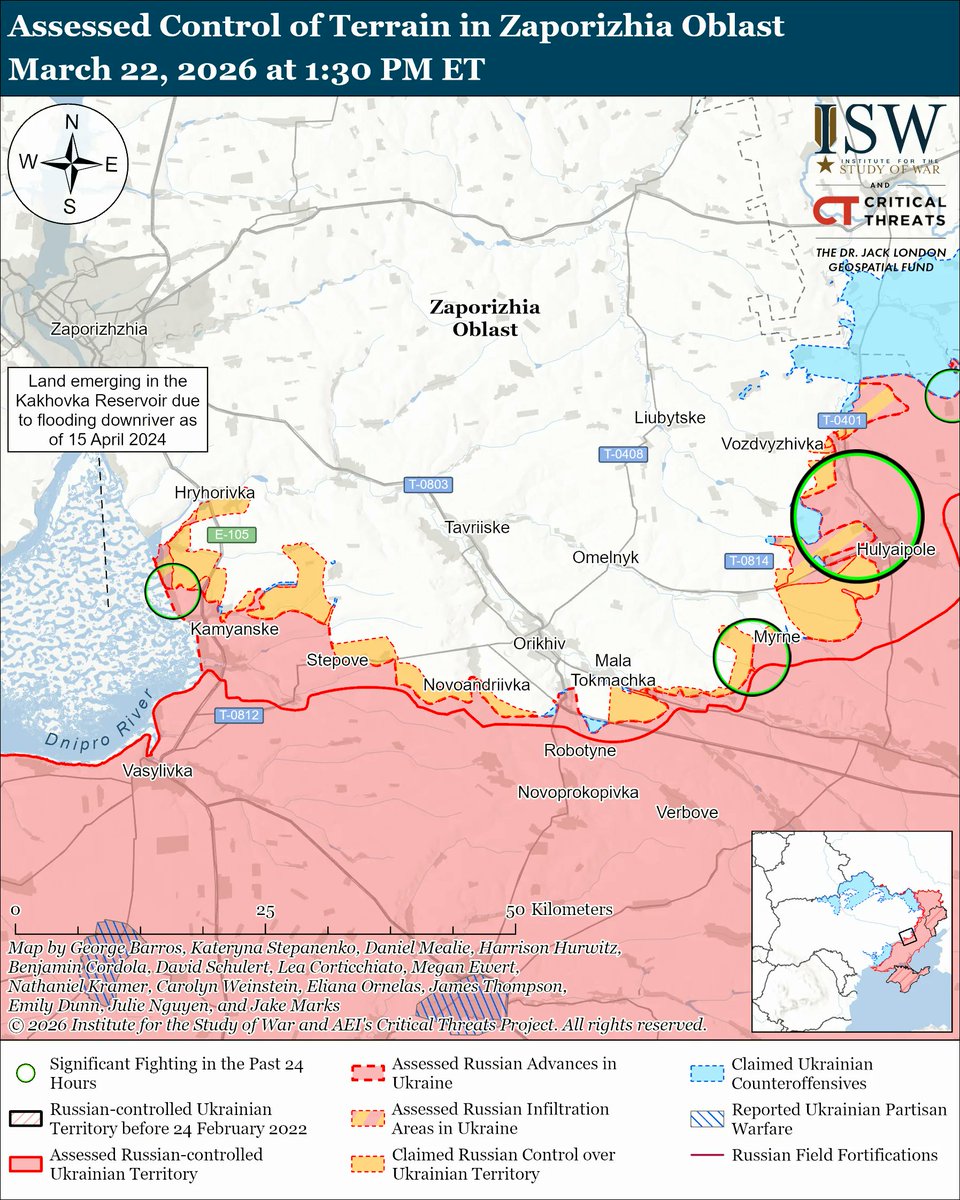
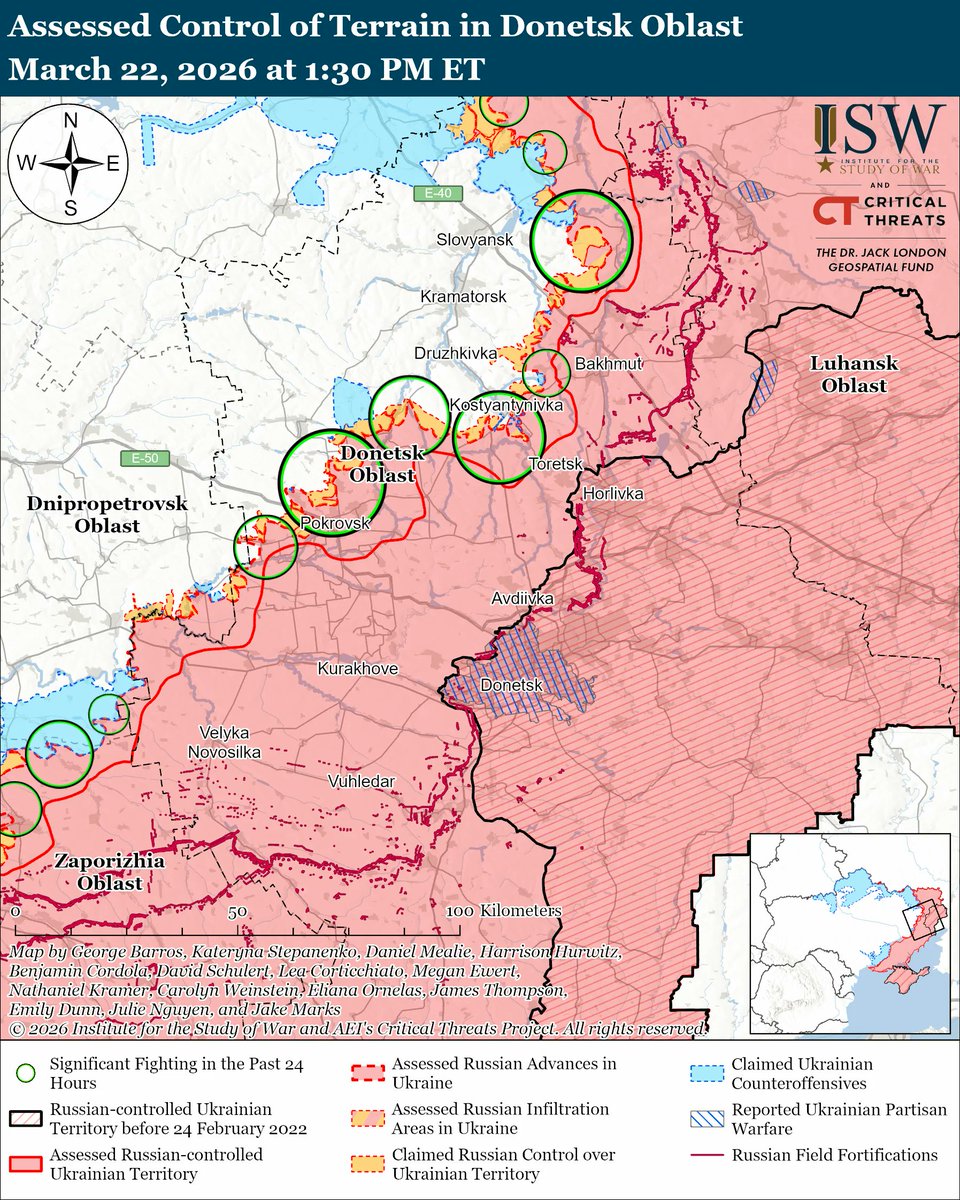
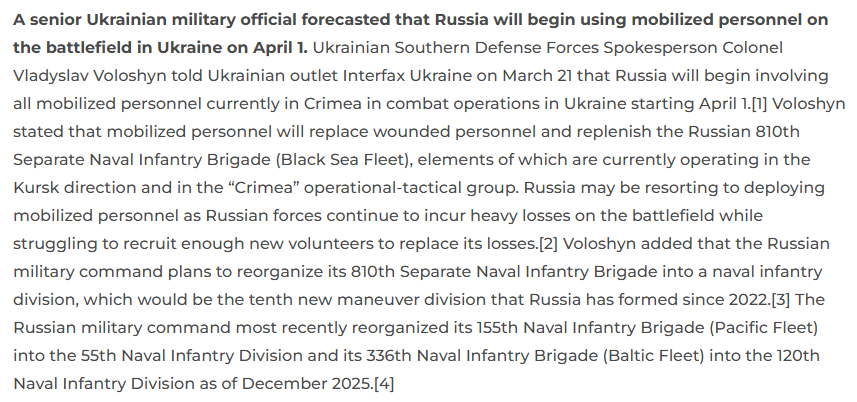
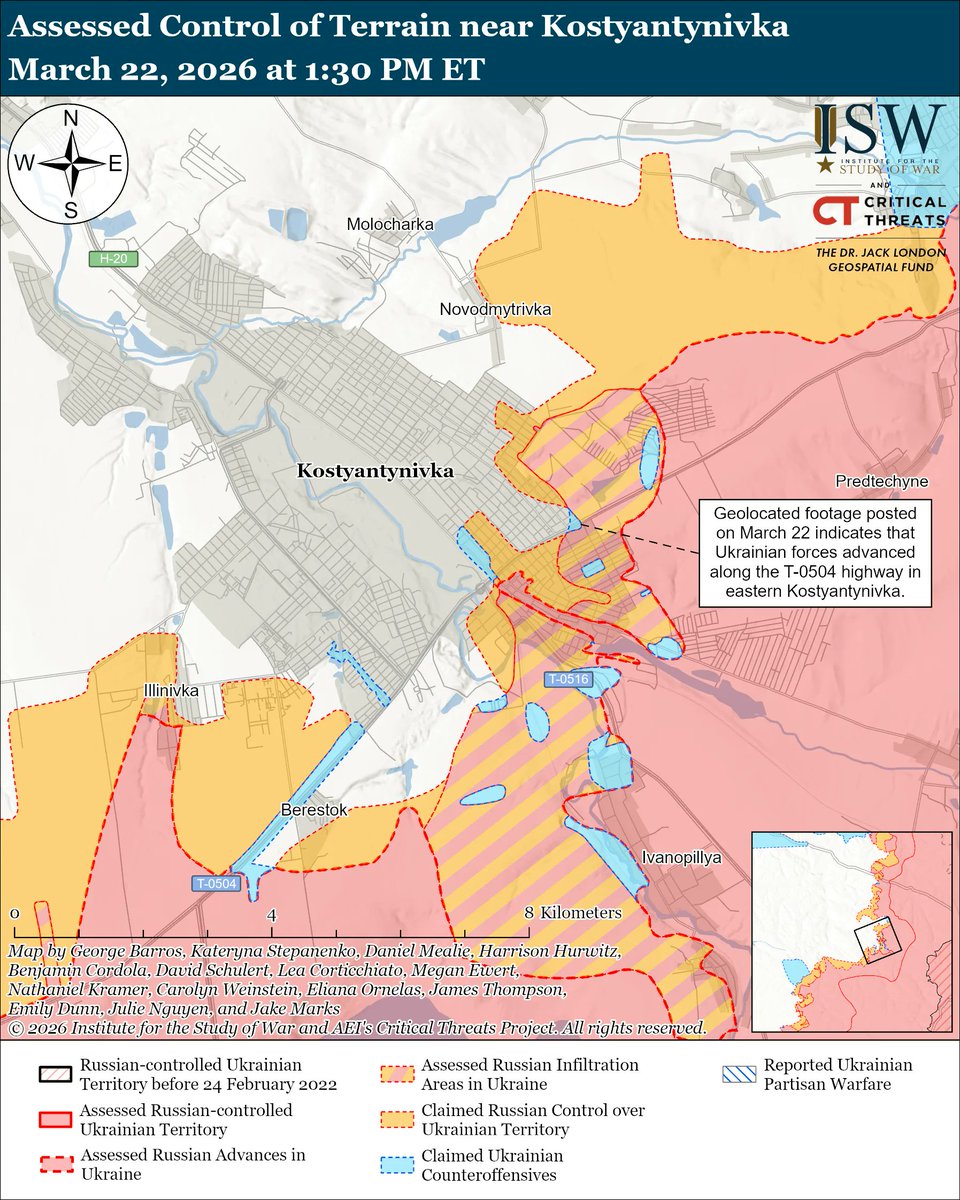
NEW: A senior Ukrainian military official forecasted that Russia will begin using mobilized personnel on the battlefield in Ukraine on April 1. Ukrainian Southern Defense Forces Spokesperson Colonel Vladyslav Voloshyn told Ukrainian outlet Interfax Ukraine on March 21 that Russia will begin involving all mobilized personnel currently in Crimea in combat operations in Ukraine starting April 1. Other Key Takeaways ⬇️ Ukrainian counterattacks in southern Ukraine continue to create operational and strategic effects against Russian forces going into the Spring-Summer 2026 offensive. Likely Belarusian balloons recently landed in Poland, possibly as part of Russia’s ongoing use of Belarus in its “Phase Zero” effort, setting conditions for a potential future war with NATO. Ukrainian forces recently advanced in the Kostyantynivka-Druzhkivka tactical area. Geolocated footage published on March 22 indicates that Ukrainian forces recently advanced along the T-0504 Pokrovsk-Kostyantynivka highway in eastern Kostyantynivka. Ukrainian forces struck military assets and oil infrastructure in Russia. Russian forces launched 139 drones against Ukraine.


NEW: A senior Ukrainian military official forecasted that Russia will begin using mobilized personnel on the battlefield in Ukraine on April 1. Ukrainian Southern Defense Forces Spokesperson Colonel Vladyslav Voloshyn told Ukrainian outlet Interfax Ukraine on March 21 that Russia will begin involving all mobilized personnel currently in Crimea in combat operations in Ukraine starting April 1. Other Key Takeaways ⬇️ Ukrainian counterattacks in southern Ukraine continue to create operational and strategic effects against Russian forces going into the Spring-Summer 2026 offensive. Likely Belarusian balloons recently landed in Poland, possibly as part of Russia’s ongoing use of Belarus in its “Phase Zero” effort, setting conditions for a potential future war with NATO. Ukrainian forces recently advanced in the Kostyantynivka-Druzhkivka tactical area. Geolocated footage published on March 22 indicates that Ukrainian forces recently advanced along the T-0504 Pokrovsk-Kostyantynivka highway in eastern Kostyantynivka. Ukrainian forces struck military assets and oil infrastructure in Russia. Russian forces launched 139 drones against Ukraine.


NEW: Iran launched two ballistic missiles targeting the US-UK base at Diego Garcia in the Indian Ocean on March 21, marking the furthest ever attempted Iranian missile strike. The attack demonstrated that Iranian missiles can reach beyond the 2,000-kilometer limit that the regime has long claimed to have self-imposed. One missile failed inflight, and the United States intercepted the other. Other Key Takeaways: The Islamic Revolutionary Guards Corps (IRGC) has reportedly expanded its influence over regime decision-making amid a growing power vacuum caused by leadership losses and Supreme Leader Mojtaba Khamenei’s apparent inability to exercise full authority. Some of the officials who have likely expanded their influence are among the most aggressive and repressive elements within the IRGC. The United States Treasury Department issued a short-term waiver on March 20, permitting the sale of Iranian oil already in transit. The waiver does not allow for new purchases of oil. The combined force continued to degrade Iran’s missile production capabilities. The IDF struck at least five missile production sites in Tehran.


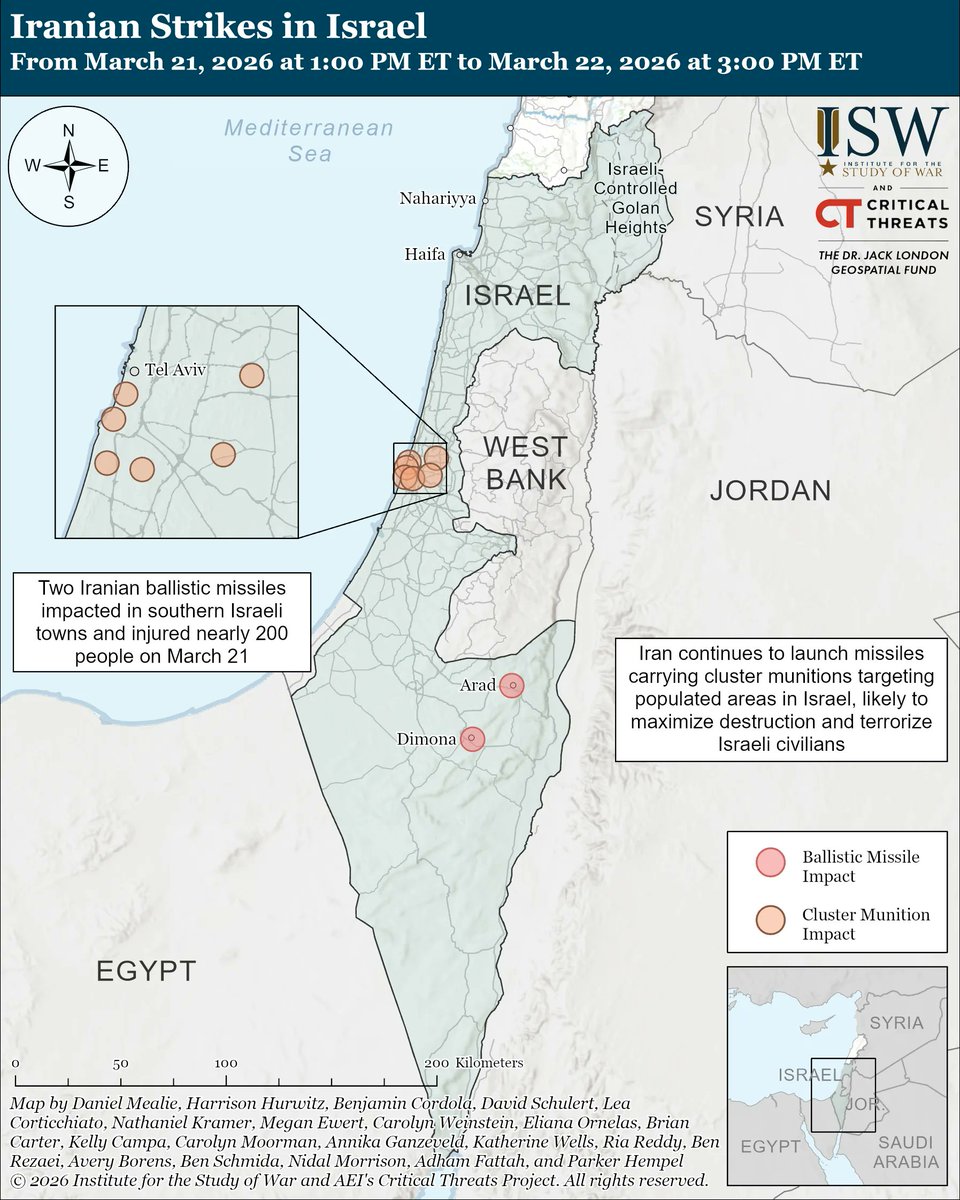
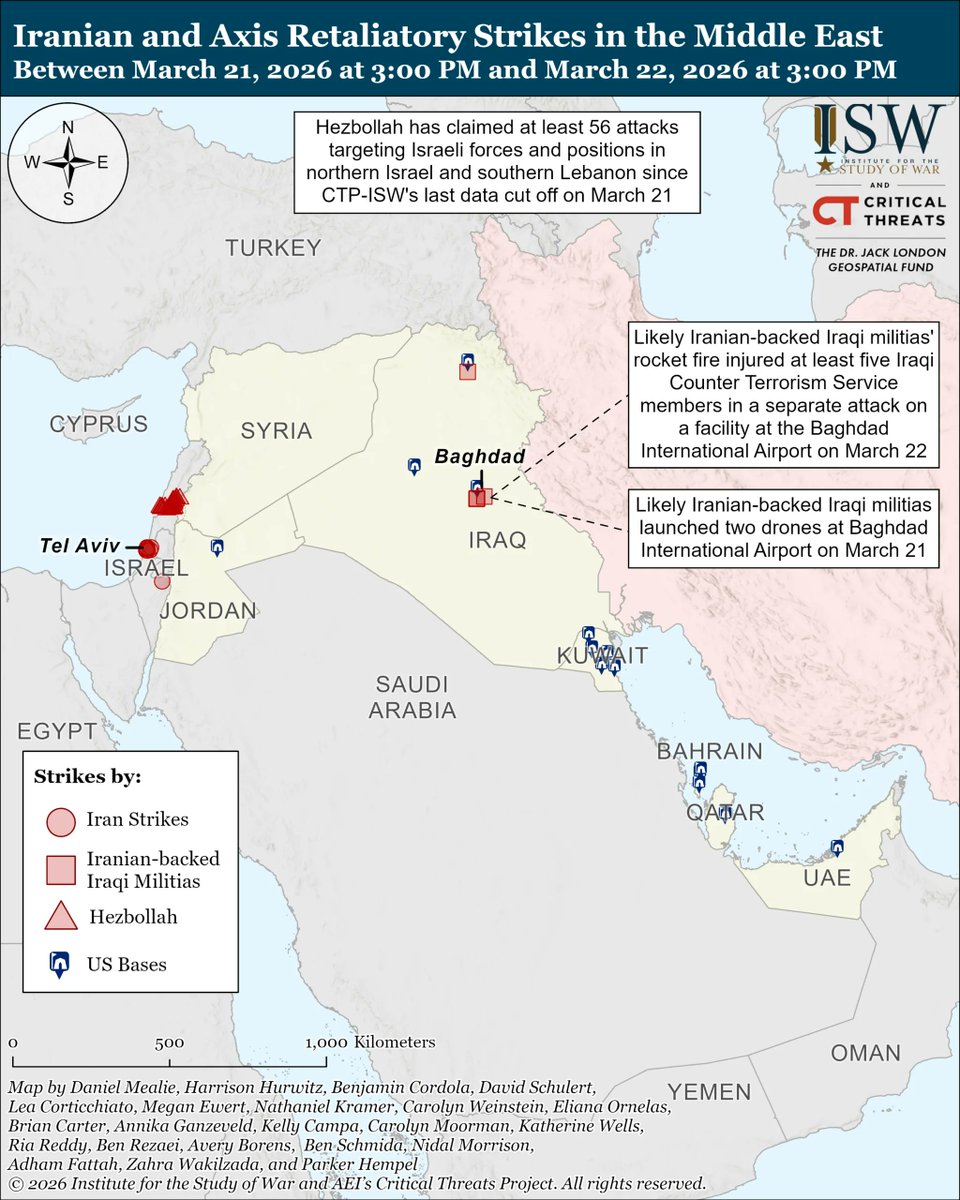
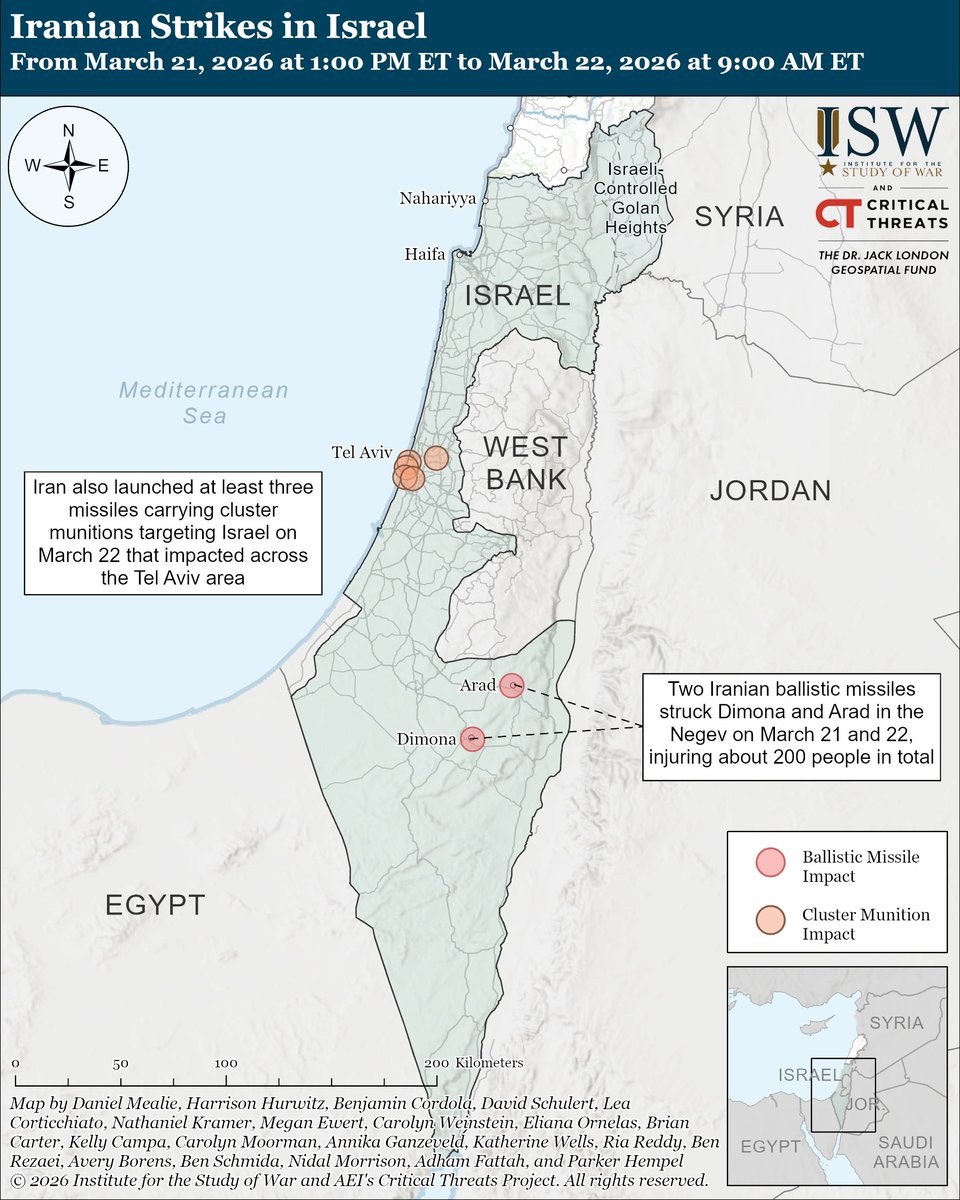
NEW: Two Iranian ballistic missiles struck Dimona and Arad in the Negev on March 21 and 22, respectively. Almost 200 people were injured in the two attacks. The IDF reported a 92-percent interception rate throughout the war. Only five other missiles carrying conventional warheads have struck populated areas in Israel in that time. The IDF said that the two missiles that struck Dimona and Arad were likely Ghadr variants. Ghadr missiles are liquid-fuel, medium-range ballistic missiles with a range of 1,950 kilometers, which means that Iran can launch Ghadr. Iran is increasingly firing missiles from central Iran due to the IDF‘s destruction of Iranian launchers in western Iran, according to the IDF. Iran launched at least three missiles carrying cluster munitions that impacted around Tel Aviv on March 22. A cluster munition warhead contains submunitions that disperse over a wide area and are intended to maximize damage. Iran likely calculates that using cluster munitions is more likely to cause Israeli casualties and impose costs on Israel for its air campaign against Iran. Around 70 percent of Iranian missile launches have reportedly carried cluster munitions. The US-Israeli combined force is continuing to strike Iranian missile assets and launchers. @BenTzionMacales identified that recent US CENTCOM footage showed US forces striking the Haji Abad missile base in Hormozgan Province and the Darab missile base in Fars Province. CENTCOM also reported that it struck the Kuh-e Barjamali ballistic missile assembly facility east of Tehran. Iran built short and medium-range ballistic missiles there.