🚀 Not Just a New Job—A New Kind of Work
By 2030, millions of people won’t just need to change jobs.
They’ll need to do new kinds of work—in roles we haven’t defined yet.
This isn’t just a shift.
It’s a great reshuffle.
Not “learn AI.”
More like: learn to navigate the unknown.
More like: learn how to learn.
Because the future of work is no longer about mastering the map.
It’s about learning how to dance with the unknown.
AI is automating the knowns.
That means the work left to us—the truly human work—is all in the not-knowing.
And this is where we get it wrong.
We scramble to upskill for tools.
But what we need are meta-skills:
Scientific thinking
Curiosity
Adaptability
The courage to say, “I don’t know yet, but I’m about to find out.”
You can’t hire for these.
You have to grow them.
And that’s where true leaders comes in.
Not as the expert.
Not as the fixer.
But as the coach.
Because the real transformation isn’t just in the team.
It’s in the leader.
We’re entering a world where your value as a leader doesn’t come from what you know, but from how well you help others figure things out.
That’s the shift:
From managing work to developing people.
From issuing direction to creating discovery.
From controlling outcomes to cultivating capability.
And yes—it’s uncomfortable.
Because the muscles that got you here may not be the ones that get your team to what’s next.
I’m diving deep into this transformation—how managers can shift from expert to coach and unlock their team's potential to master these new meta-skills—in my free webinar,
“Rethinking Leadership: How Coaching Unlocks Your Team's Potential”
on November 12th.
I've set up two viewing times to accommodate different time zones. Choose your preferred viewing time:
🌏 EU/Asia: 10am CET / 5pm Beijing lnkd.in/ee8GA6xR
🌎 USA/CAN/MEX: 6pm CET / noon EST
lnkd.in/eWAHdNS3
Give wings to your team.
Ever had an idea you just 𝗸𝗻𝗲𝘄 was right?
You tested it, found some evidence that supported it, and boom—confirmation!
🚨 𝗧𝗵𝗮𝘁’𝘀 𝗮 𝘁𝗿𝗮𝗽.
Karl Popper, the great philosopher, said:
💡 It takes an infinite number of experiments to prove an idea always works, but only one to disprove it.
𝗧𝗼𝘆𝗼𝘁𝗮 𝗞𝗮𝘁𝗮 𝗮𝗽𝗽𝗹𝗶𝗲𝘀 𝘁𝗵𝗶𝘀 𝗽𝗿𝗶𝗻𝗰𝗶𝗽𝗹𝗲 𝗶𝗻 𝗽𝗿𝗮𝗰𝘁𝗶𝗰𝗲. As Mike Rother puts it:
🎯 The goal isn’t to be right—it’s to learn faster.
𝗧𝗵𝗲 𝗰𝗮𝘁𝗰𝗵? 𝗢𝘂𝗿 𝗯𝗿𝗮𝗶𝗻𝘀 𝗻𝗮𝘁𝘂𝗿𝗮𝗹𝗹𝘆 𝗰𝗿𝗮𝘃𝗲 𝘃𝗮𝗹𝗶𝗱𝗮𝘁𝗶𝗼𝗻. That’s why we often:
❌ Ignore or downplay contradictory evidence.
❌ Assume trial and error is enough.
❌ Stick to what “feels right” instead of testing what actually works.
👉 Without a coach helping us work in a scientific way, we end up mistaking 𝗹𝘂𝗰𝗸 for 𝗹𝗲𝗮𝗿𝗻𝗶𝗻𝗴.
💡 𝗪𝗮𝗻𝘁 𝘁𝗼 𝗵𝗲𝗹𝗽 𝘆𝗼𝘂𝗿 𝘁𝗲𝗮𝗺 𝘁𝗵𝗶𝗻𝗸 𝘀𝗰𝗶𝗲𝗻𝘁𝗶𝗳𝗶𝗰𝗮𝗹𝗹𝘆? 𝗧𝗿𝘆 𝗮𝗱𝗱𝗶𝗻𝗴 𝘁𝗵𝗲𝘀𝗲 𝘁𝘄𝗼 𝗾𝘂𝗲𝘀𝘁𝗶𝗼𝗻𝘀 𝗻𝗲𝘅𝘁 𝘁𝗶𝗺𝗲 𝘆𝗼𝘂𝗿 𝘁𝗲𝗮𝗺 𝗱𝗲𝗳𝗶𝗻𝗲𝘀 𝗮𝗻 𝗮𝗰𝘁𝗶𝗼𝗻:
🔹 What do we expect?
🔹 How would we know if our idea is off?
𝗚𝗼𝗼𝗱 𝗹𝗲𝗮𝗱𝗲𝗿𝘀𝗵𝗶𝗽 𝗶𝘀𝗻’𝘁 𝗮𝗯𝗼𝘂𝘁 𝗴𝘂𝗲𝘀𝘀𝗶𝗻𝗴. It’s about guiding teams through 𝗱𝗲𝗹𝗶𝗯𝗲𝗿𝗮𝘁𝗲, 𝘀𝗺𝗮𝗹𝗹 𝗲𝘅𝗽𝗲𝗿𝗶𝗺𝗲𝗻𝘁𝘀 that test their thinking.
How do you encourage your team to test their thinking instead of just looking for confirmation? Drop your thoughts below! 👇
#KataDojo
Meeting Minutes: A Secret Key for Team Learning?
Could your meeting minutes be a missed opportunity for fostering a scientific mindset within your team?
Most meeting minutes focus on 'who does what by when', but what if they could do so much more?
Tracking 'Who does what by when?' sounds structured. However, this often leads to the sole focus being: 'Did we finish it?'
❌ This can inadvertently block your team from learning and, even more crucially, from adopting a scientific way of working.
Instead, try this:
✅ When assigning an action, add: “What do we expect?”
✅ At the next meeting, ask: “What did we learn?”
📝 Make sure to write the answers down. It likely fits into your existing meeting minutes template and takes no extra effort but makes a huge difference.
• Your team starts seeing steps as an experiment rather than tasks to execute on.
• You build the scientific habits of formulating a hypothesis, reflecting on and learning from what really happened, and adapt our approach.
• Your teams culture will evolve. From being "right" to let's find out.
• Doing so will over time increase curiosity and creativity in your team.
And speed and impact will increase too. When we sees the desire to know the whole path in advance and start seeing each step as an experiment and acknowledge that each idea should be testes moving forward and taking decisions becomes much easier, even lighthearted.
Most decisions are two-way doors anyways. When can adapt and even revert once we learn what actually happens.
When we make room for learning new opportunities open up we would have never found otherwise. 🌱🧠
How do you shift your meetings from just tracking tasks to becoming opportunities for team learning? Let us know in the comments! 👇
#KataDojo
No Regrets: Let Go of the Leaves 🍂 (Here’s Why)
Ever catch yourself thinking, “They’ll regret this 🔥”?
When someone dismisses our idea or walks away, it’s tempting to cling to that moment. The truth is: Hoping others will regret their choices doesn’t win us anything.
Clinging to past opportunities won't bring them back. It only occupies brain space and burns emotional energy we'd much better spend elsewhere.
Past opportunities are like fallen leaves on a stream floating by. Grabbing them won’t make them green again.
Last year, I obsessed over a rejected proposal. When I finally let go, two better projects emerged. The leaves had floated away, and I could see new trees blossoming.
Regret is a heavy anchor. Cut the rope.
When you stop regretting past opportunities, especially those depended on others, when you stop doubling down on a dead-end road, you'll realize how it frees your mind. Your mental gaze lifts.
Better opportunities await. We might not see them right now. They will reveal themselves when we move on.
Until our last day, there’s always a next opportunity.
Have you ever let go of a ‘leaf’ and found something better? 👇
#KataDojo
The Illusion of Smooth Implementation 🚀
We’ve all been there. Excited about a new tool, method, or process. Expecting it to integrate seamlessly. Only to watch the reality unfold in a way that looks nothing like the plan.
Implementation often feels like autopilot—until things go south.
🔍 Why are we doing this in the first place?
Before rolling out a change, take a step back:
✅ What problem are we solving?
✅ What is the desired outcome?
✅ How does this change improve the way we work?
🚧 Expect obstacles. Always.
Technical, organizational, and psychological barriers will show up. That’s normal. The key is not to eliminate obstacles in advance, but to navigate them as they arise.
🛠 Implementation = Experimentation
Define the desired way of working, integrate the new into the existing, and take small steps forward. Experiment. Learn. Adapt.
There is no autopilot. And that’s a good thing.
Where have you seen implementation plans go off the rails—and what did you learn from it?
The sun was beginning to set as two monks walked along a dusty path through the countryside. Their robes, faded and worn, whispered against the dirt road with each step. They had been traveling in silence when they came upon a wide river. The water was high from the recent rains, rushing over the stones with a steady roar.
Standing at the river’s edge was a young woman. Her face was creased with worry. She looked at the river, then back at the monks.
“Please,” she said, her voice barely audible over the current. “I need to cross, but the water is too deep, and I cannot make it alone.”
Without hesitation, the older monk stepped forward. He bent down and gently lifted the woman into his arms. Step by careful step, he carried her across. When they reached the far bank, he set her down, bowed, and continued walking without a word.
For miles, they walked in silence. The only sound was the rhythm of their sandals against the dirt path.
Finally, the younger monk broke the silence.
“You touched her. We are not supposed to do that!”
The older monk turned to him, calm and steady.
“My brother, I set her down hours ago. Why are you still carrying her?”
Still one of my favorite parables. A reminder to let things go—those thoughts that take up too much space in our minds and drain our energy.
Not everything is worth worrying about.
Not everything is worth regretting.
Not everything is worth debating over and over.
Let go, and help your team do so too. As my friend Deondra Wardell - linkedin.com/in/deondrarwar… - often says: On to the next one.
What techniques do you use to unpack your mental backpack—those thoughts, worries, or loose ends that weigh you down? 👇
#KataDojo
When coaching don’t try to be in two heads at once
💭 Have you ever caught yourself interrupting someone mid-sentence—jumping in with a follow-up question, finishing their thought, or eager to share your own?
I have. And when I finally noticed how often I did it, I was shocked. I thought I was speeding up the conversation—getting to the finish line faster. But in reality, I was doing the opposite.
A few years ago, I came across this quote from Richard Carlson’s book Don’t Sweat the Small Stuff, and it hit me hard:
“When you hurry someone along, interrupt someone, or finish their sentence, you have to keep track not only of your own thoughts but of those of the person you are interrupting as well.”
This habit—trying to be in two minds at once—is exhausting. It drains your energy, disrupts trust, and speeds up thinking in a way that doesn’t actually help.
It causes the other person to talk and think faster, likely getting ahead of themselves. And when you’re coaching, trying to help someone rethink, that’s the last thing you want.
"If there’s one thing almost everyone resents, it’s someone who doesn’t listen to what they are saying. And how can you really listen to what someone is saying when you are speaking for the person?"
—Richard Carlson
📢 The good news? Once we realize, we can catch ourselves.
👉 Try this: Before a coaching conversation, remind yourself: Pause. Be patient and wait. Let them finish before you respond.
When people feel heard, they relax. And guess what? So do you. Your heart rate will slow down, and you'll enjoy the conversation more. This is an easy way to become a more thoughtful, appreciated coach.
#KataDojo
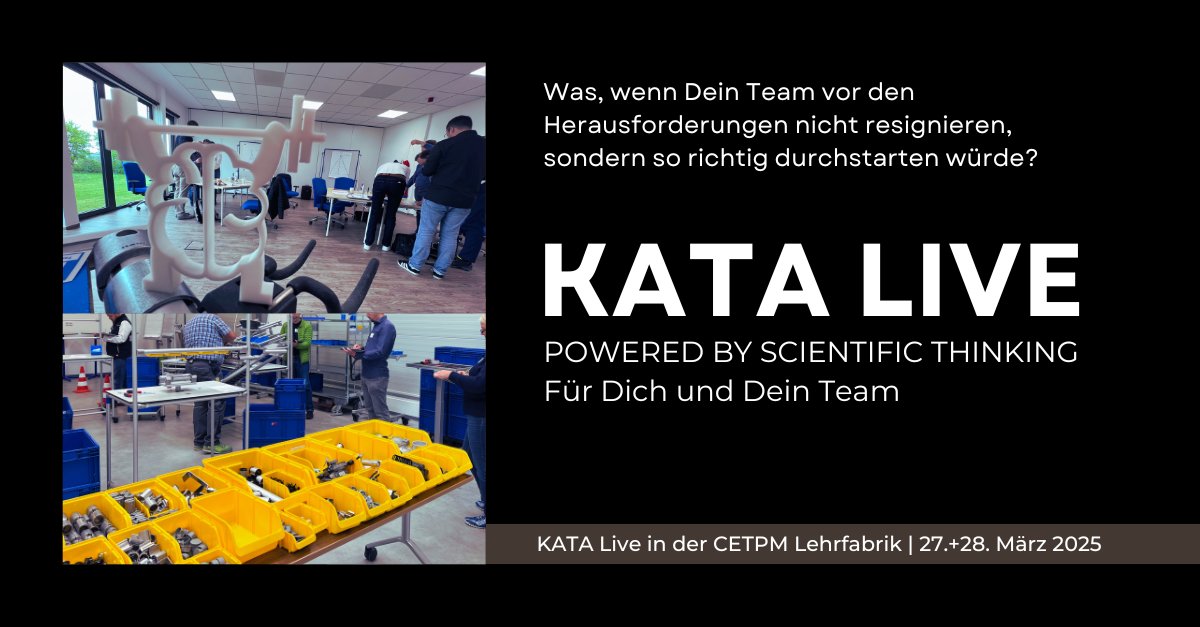
Ich liebe es zu sehen, wie Führungskräfte und Teams bei KATA LIVE ihre Denkweise verändern. Es ist immer ein besonderer Moment, wenn jemand realisiert:
💡 „Ich muss nicht alle Antworten haben – ich muss nur die richtigen Fragen stellen!“
Genau darum geht’s am 27.+28. März 2025.
🚀 Wahre Führung bedeutet nicht, alle Lösungen zu liefern – sondern den Raum zu schaffen, in dem Menschen lernen, Probleme lösen und über sich hinauswachsen.
Bist du bereit, dein Team auf das nächste Level zu bringen? Let’s go! 🔥👇
📅 KATA LIVE | 27.+28. März 2025 | Jetzt anmelden:
linkedin.com/events/kataliv…#KataDojo
In a complex world, speed of learning drives speed of innovation.
Checking progress won’t help your team win—coaching will. 💪
Encourage exploration and collaboration with these three coaching questions:
🔹 Great idea—how can we test it?
🔹 What do we expect?
🔹 What did we learn?
Help your team learn fast and adapt faster. 🚀
#KataDojo
Tired of endless status updates and firefighting? Ready to give wings to your team?
🚨 Join me TOMORROW (Feb 19) for a free 45-minute Dojo session:
⏰ 10 AM PT | 1 PM ET | 7 PM CET
Let’s transform your leadership grind into growth—
No extra meetings. No busywork. Just smarter coaching.
As Mike Rother - linkedin.com/in/mike-rother… - says:
“When you practice and coach scientific thinking skills, you’re giving wings to your team and new worlds of possibility open up.”
We’ll tackle:
• How to shift learning to your team (so you stop being the bottleneck)
• Lead with questions, not answers (even if you’re time-crunched)
• Cut the 80% of tasks that drain focus (and protect your team’s mental bandwidth)
• Turn everyday meetings into a learning system with tiny, consistent coaching nudges
Why bother?
Great leaders don’t just solve problems—they build problem-solvers.
🎁 Join live and grab your free “Coaching Cheat Sheet”
(Actionable scripts to use immediately—no theory.)
🔗 Registration link in the comments! 👇
Got a coaching challenge? Drop it below—I’ll address it live.
P.S. This isn’t a lecture. Bring your coffee and your questions.
P.P.S. Know another leader who’d vibe with this? Pass it on — the more, the merrier.
#KataDojo
The Empty Page at Sunrise
I am glad every sunrise provides a fresh start. Like a new page, an empty sheet of paper, waiting for us to begin.
It’s healthy to have goals in life, being specific about what we strive to achieve.
Then treating each day as a new opportunity for experimenting towards them.
Learning with gratefulness from our last step. Not having the unexpected outcome - that felt like a throwback yesterday - pull us down. Venturing forward with curiosity.
A new morning, the inspiration of an empty page, inviting us to explore the path ahead.
New day, new experiment.
Let us begin.
PS: In every throwback lies a learning gem, waiting to be found.
#KataDojo
🌱 What if improving our leadership begins when we dare to say, "I don’t know"?
The Quiet Power of "I Don't Know"
We often think leaders must be decisive, certain, and in control. Transformative leadership begins when we stop pretending we have all the answers, when we replace certainty with curiosity.
That’s what I learned from practicing Coaching Kata: Every question I asked wasn’t just about others—it was about discovering my own gaps in understanding.
The more I asked the Coaching Kata questions with curiosity…
• “What’s the target condition?” → The more I realized my shortcomings in clearly communicating of our strategy.
• “What’s the actual condition?” → The more I saw how unstable the processes were people had to work in.
• “What obstacles are in your way?” → The more I learned how much the system we’d unintentionally designed, was holding people back.
Coaching isn’t about fixing others. It’s about redesigning the conditions that hold us all back—creating a space where everyone can grow so we can achieve great things together.
When’s the last time you let a question change YOUR perspective? 🧠
I’d love to hear—drop your thoughts in the comments!👇
#KataDojo