Tim Weber

494 posts

Tim Weber banner
Tim Weber

Tim Weber

@timdweber

Building microscopes and methods to detect cancer and improve surgery. @RLEatMIT & @BIDMCpath

Cambridge, MA Katılım Mayıs 2011
351 Takip Edilen388 Takipçiler
Tim Weber retweetledi
Aasma Shaukat MD MPH
Aasma Shaukat MD MPH@AasmaShaukatMD·
One of my former research assistants was killed by ICE in Minneapolis today😢 Alex was the kindest, sweetest human and a ICU nurse with a bright future ahead of him May his soul rest in peace and this senseless carnage stop💔
Aasma Shaukat MD MPH tweet media
English
14.5K
41.9K
274.2K
4.8M
Tim Weber
Tim Weber@timdweber·
@kevin_tsia Nice! I've always said that CD/DVD/Bluray are in principle good high throughput microscopes. People look at me like I'm crazy🫤
English
0
0
0
137
Kevin Tsia
Kevin Tsia@kevin_tsia·
😁👾Excited to introduce 𝙎𝙥𝘼𝘿 - enabling scalable label-free images-based cell profiling for chemical/genetic screen via continuous spinning + ultrafast imaging 🔄 𝙎𝙥𝙞𝙣𝙣𝙞𝙣𝙜 𝘼𝙧𝙧𝙖𝙮𝙚𝙙 𝘿𝙞𝙨𝙠 (𝙎𝙥𝘼𝘿) - Optofluidic 96-chamber circular array design supporting continuous live-cell imaging - Ultrafast quantitative phase imaging (QPI) at 1000’s rpm → sub-cellular-resolution label-free imaging across 100 cm2 - Disk design is fully compatible with standard protocols 📊 𝙈𝙖𝙨𝙨𝙞𝙫𝙚-𝙎𝙘𝙖𝙡𝙚 𝘼𝙣𝙖𝙡𝙮𝙩𝙞𝙘𝙨: - 10 GB/sec real-time processing - *InMorph* profiling strategy→ Rich biophysical signatures from label-free data - Easily scalable to 100s of TBs for CRISPR/drug screens ✅ 𝙈𝙪𝙡𝙩𝙞-𝙛𝙖𝙘𝙚𝙩𝙚𝙙 𝙑𝙖𝙡𝙞𝙙𝙖𝙩𝙞𝙤𝙣s - Mechanical stability testing - Cell health assays - Transcriptomic analysis We demonstrated that SpAD enables sensitive, large-scale screening of drug responses and CRISPR gene knockouts without labeling - allowing unbiased morphological phenotyping at a new scale. Years in the making - A great work (fine art) executed by our postdoc @DicksonSiu1 and Alan Wong from @hkusbms @hkumed 👉 Preprint: biorxiv.org/content/10.110… #LabelFree #CRISPR #Drugscreen #QPI #Biophysics #SpAD #microscopy #omics
English
4
17
75
5.8K
Tim Weber
Tim Weber@timdweber·
I've spun-out the framework used in our two-photon microscopy for cancer surgery into a set of packages called Dirigo: github.com/dirigo-develop… While it's a work in progress, I've been trying to write weekly-ish posts on design and features: Post #1 ...
English
1
0
0
84
Tim Weber
Tim Weber@timdweber·
Obligatory post mentioning I'm moving to the other place. See you there..
Tim Weber tweet media
English
0
0
2
171
Fabian F. Voigt
Fabian F. Voigt@voigtvision·
There is some cool new #photophysics in town! Check out @tripletimaging, the startup created by @jdwong_campos @Mackenzie_then to explore #multiphoton #Microscopy via long-lived intermediate states: tripletimaging.co/s/dye_paper tripletimaging.co/s/proteins
Fabian F. Voigt tweet media
Mackenzie Dion@Mackenzie_then

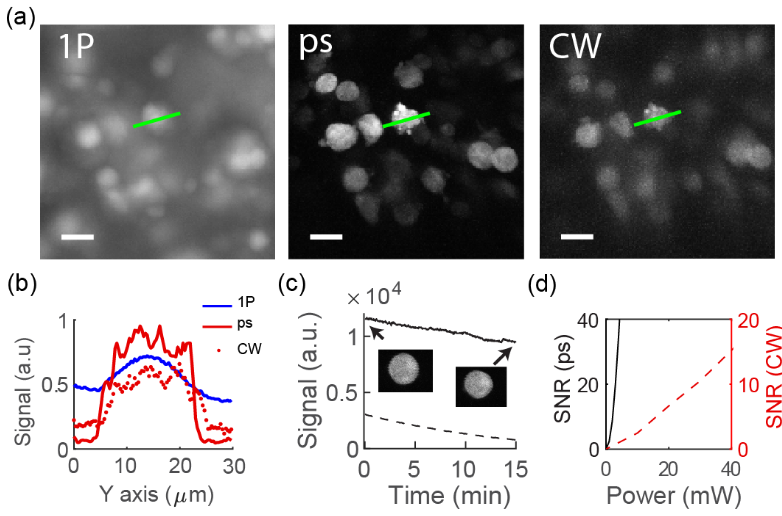
Excited to share 2p-prime, a novel physical pathway for multiphoton fluorescence generation that enables optical sectioning and excitation at red wavelengths with simple systems like continuous wave lasers. I founded @tripletimaging with @jdwong_campos to fully realize the potential of this tech and introduce a new paradigm for multiphoton fluorescence. We’re exciting real intermediary states, specifically driving forbidden triplet transitions, using picosecond and continuous wave lasers. Links to two pre-prints + explanation in the thread where we demonstrate 2p-prime with ps and CW lasers in dyes and living cells expressing fluorescent proteins. David thought of this idea, inspired by optical control of forbidden state transitions in atomic systems from his past life in quantum computing in the Monroe lab and as an early employee at @IonQ_Inc. In the limit, our approach could be optimized to replace all fluorescence microscopes with simple LED systems that can do rapid volumetric imaging with capabilities akin to existing 2p systems in optical sectioning, contrast, depth, and resolution. Low power, high throughput multiphoton imaging could enable moonshots like functional imaging of every synapse on a neuron or single cell resolution across an entire mouse cortex — datasets which are inaccessible now due to high powers required by ultrafast lasers. Fundamental insights may generate broad possibilities, and we’re investigating applications across multiple industries like diagnostics and 2p lithography. This is a white space in photophysics. No indicators have been designed or evolved for this process. We’re optimistic we’ll keep lowering power levels as indicators are optimized for these transitions, e.g. enhanced spin-orbit coupling.

English
1
3
25
2.5K
Fei Xia
Fei Xia@_FeiXia_·
Thrilled to share: I’ll be joining University of California, Irvine @UCIrvine as an Assistant Professor in EECS in 2025! We will develop smart optical systems & computational tools to better image, sense, & process biomedical information probed by light. xia-lab.com
English
36
25
396
70.5K
Murali Varma
Murali Varma@MuraliV72899596·
For example, the aritrary diagnostic criteria for low grade DCIS could be modified so that lesions at low end of the proliferation spectrum are reported as atypical ductal hyperplasia.
English
1
0
1
189
Murali Varma
Murali Varma@MuraliV72899596·
Renaming may be appropriate in some cases but the key remains public education. Important to get across the message that benign and low-risk cancer is a biological continuum with arbitrary cutoffs. Patients must understand that benign means very low risk rather than zero risk.
Eric Topol@EricTopol

I'm with @DrLauraEsserman on this: rename very low risk "#cancer" like IDLE = indolent lesions of epithelial origin (breast, prostate, and others) bmj.com/content/364/bm… @bmj_latest stop the unnecessary surgery, treatment and alarm/anxiety

English
1
4
15
1.2K
Tim Weber retweetledi
Bisi Bell
Bisi Bell@MuyinatuBell·
👀 Some of the proposed institute names are too general… National Institute on Body Systems Research? Some seem to lose the range of funded activities… NICHD to National Institute for Disability Related Research? 🤔 Others stay as is. Full report: d1dth6e84htgma.cloudfront.net/NIH_Reform_Rep…
AIMBE@aimbe

A new congressional blueprint for restructuring the NIH has been released. It proposes consolidating NIH's 27 IC's and centers into 15 categories, plus term limits for directors. It adds a national security review to grant apps. Public comments due Aug. 16 energycommerce.house.gov/posts/chair-ro…

English
0
4
8
2K
Tim Weber retweetledi
Faisal Mahmood
Faisal Mahmood@AI4Pathology·
⚡️📣👇Tremendously excited to share our new @CellCellPress article, where we develop TriPath, a method for analyzing 3D pathology samples using weakly supervised AI. Article: authors.elsevier.com/a/1j3RiL7PXqQM-. TriPath enables 3D computational pathology via 3D multiple instance learning allowing AI models to capture intricate morphological details from pathology volumes. Code: github.com/mahmoodlab/Tri… Blog post: linkedin.com/pulse/towards-… Tested on two different imaging modalities, and patient cohorts from two institutions. Our superstar @GreatAndrew90 put in a monumental effort of leading the study, in a fantastic collaboration with @jonliu123 at @UW . Interesting aspects: - Utilizing the whole tissue volume and leveraging 3D deep learning enable superior risk prediction performance compared to 2D deep learning baselines based on a few sampled tissue sections that emulate standard clinical practice. This indicates TriPath can harness additional information provided by 3D tissue morphology. - The performance is also superior to clinical baselines from a reader study that involved six expert pathologists. - The morphologically heterogeneous tissue volume could lead to opposing patient-level outcome predictions, dependent on which portion of the tissue volume is used. This concurs with current clinical literature warning that tissue sampling bias can lead to misdiagnosis. Some limitations: - While the 3D pathology cohort size is unprecedented, it is smaller than typical 2D pathology cohorts. Further large-scale studies will be required for validation. Nevertheless, we believe that this study will initiate a positive cycle, encouraging academic institutions and pharmaceutical companies to contribute large banks of human tissue blocks with paired clinical outcomes, thus speeding up advancements in 3D computational pathology. Concluding insights: We believe that 3D pathology is just around the corner - It has the huge potential to not only augment/improve the current clinical practice centered around 2D examination of human tissue, but also help reveal novel biomarkers for prognosis and therapeutic response.. @harvardmed @harvard_data @MassGenBrigham @broadinstitute
English
2
45
174
65.5K
Reto Fiolka
Reto Fiolka@RetoPaul·
You should just wear protective glasses! Ultrafast laser folks:
GIF
R A W S A L E R T S@rawsalerts

🚨#BREAKING: Search results for ‘Why do my eyes hurt?’ and ‘My eyes hurt’ have exploded after the total solar eclipse occurred

English
2
0
9
1.7K
Tim Weber
Tim Weber@timdweber·
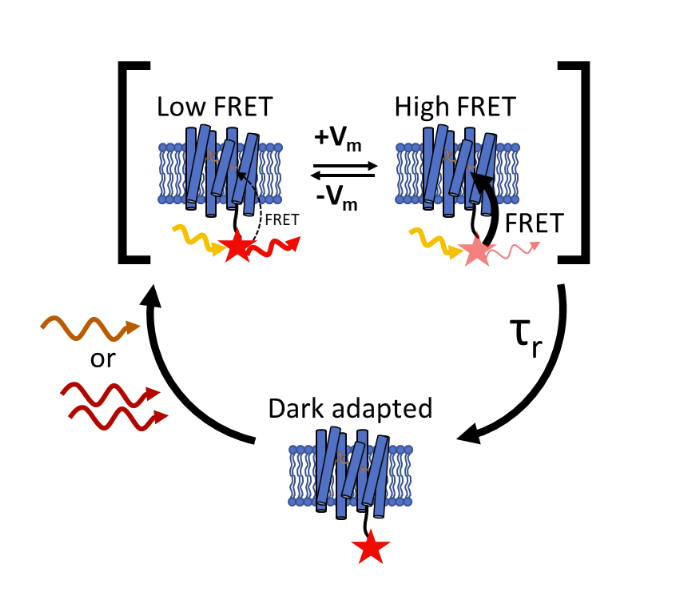
Their hypothesis: there is an intermediate state in the photocycle and that promotion to voltage-sensitive state requires excitation via longer wavelengths. 920/1040 nm 2P excitation used before is ineffective. They saw recovery to 1P-levels of voltage sensitivity at 1135 nm.
Tim Weber tweet media
English
0
1
9
1.2K
Tim Weber
Tim Weber@timdweber·
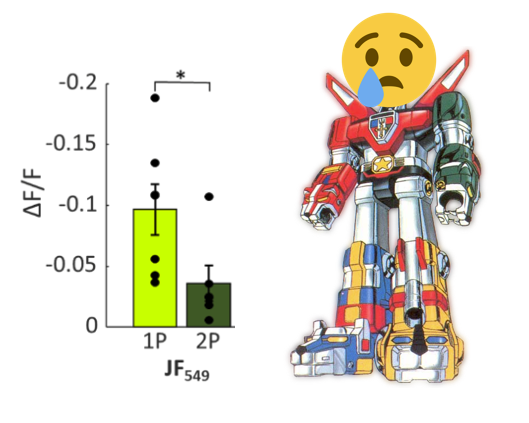
However, for mysterious reasons Voltron loses substantial voltage sensitivity when excited by 2P illumination.
Tim Weber tweet media
English
1
0
7
914
Tim Weber
Tim Weber@timdweber·
Voltron 1&2 are excellent voltage indicators, combining the sensitivity/targeting of genetically encoded microbial rhodopsin with the approaching-perfect photophysical performance of engineered organic dyes. However... (gif: doi.org/10.1038/s41593…)
GIF
English
1
15
84
30.7K