Tim Willems

1.1K posts

Tim Willems

Tim Willems

@timwillems85

Economist at the Bank of England (previously with the IMF). Views are my own.

London, England Katılım Aralık 2013
997 Takip Edilen1.6K Takipçiler
Tim Willems
Tim Willems@timwillems85·
@rosstaylor90 At which point markets will again do a great job at aggregating across models. Or take on that inside information from the chap who lives next door to the star striker, and hears the latter injure himself in the garden the day before the game.
English
0
0
0
57
Ross Taylor
Ross Taylor@rosstaylor90·
@timwillems85 EMH is a lie. Future models will do much better when we train them on the right environments 😅
English
1
0
1
116
Tim Willems
Tim Willems@timwillems85·
@Brad_Setser @AnnaEconomist @drkaenzig To me, that’s the appeal when interested in the% impact. When oil is 5% of budget and it rises by 10%, that’s a 0.5% hit to real inc If oil were to go from $1,000 to $1,010 most people won’t really notice But, given $ levels we’re at, the real/abs issue is not an issue yet haha
English
0
0
1
41
Brad Setser
Brad Setser@Brad_Setser·
@timwillems85 @AnnaEconomist @drkaenzig that feels reasonable -- but I don't like doing the elasticity in % terms! 10% on $50 is $5 a barrel, 10% on $100 is $10 a barrel (2x hit to consumer real income). my rule of thumb implies a constant reaction per $1 a barrel change not to a 1% change ...
English
1
0
1
120
Brad Setser
Brad Setser@Brad_Setser·
Strongly believe that the model calibration here is off. With an increase in the oil price of $100 a barrel, the shift in income from US oil consumers to US oil producers is ~ 2.5% of GDP. Drag from reduced consumer spending imho is at 1 pp of GDP 1/2
Joumanna Nasr Bercetche@JoumannaTV

Bloomberg Economics: In a scenario where oil hits $170 (strait closed for 3 months) before returning back to $100 by year end, how big is the modelled shock? US inflation +1.6%, US GDP -0.3% UK inflation +1.9%, UK GDP -1.1% EZ inflation +2.0%, EZ GDP -1.2%

English
6
4
104
39.7K
Anna Wong
Anna Wong@AnnaEconomist·
@Brad_Setser Brad—while these results are not from my team, they are entirely consistent with Frb/us. Which sees $10/bbl hit to oil = -0.03 ppt on gdp. So a $100/bbl shock would translate to 0.3 ppt.
English
2
1
6
1.6K
Tim Willems retweetledi
Zach Mazlish
Zach Mazlish@ZMazlish·
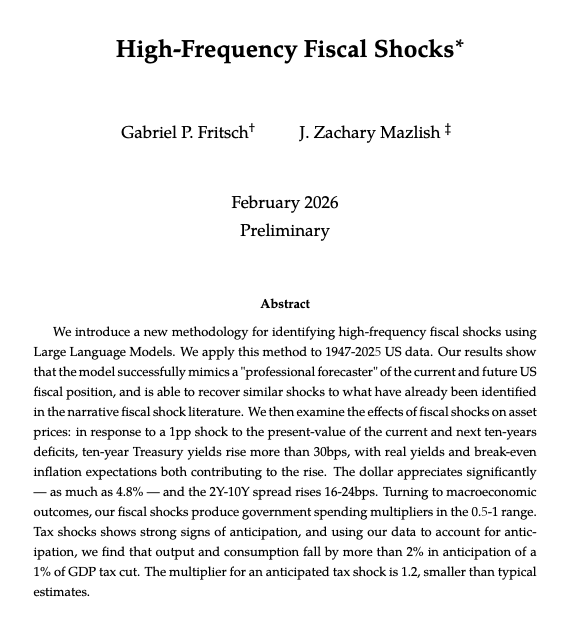
New paper out w/ my excellent co-author (and friend) @gabrielpfritsch : “High-frequency fiscal shocks”. We use LLM’s to construct a daily time-series of expectations about US fiscal deficits (1947-2025) and thereby identify “fiscal shocks” in the historical record. Thread:
Zach Mazlish tweet media
English
1
42
212
46.2K
Tim Willems
Tim Willems@timwillems85·
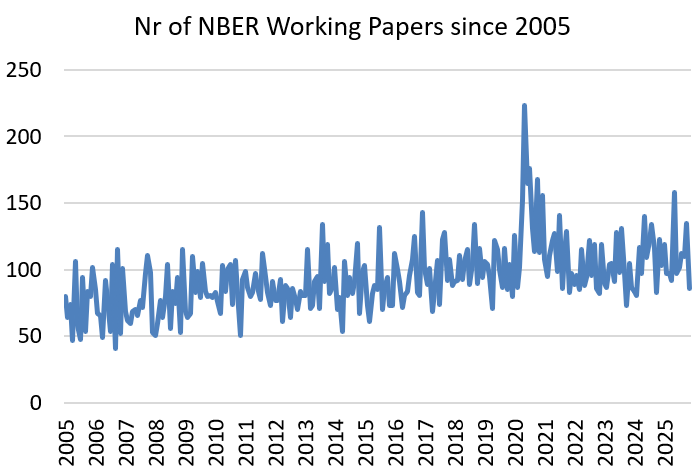
Plotted the nr of NBER WPs published over time. A priori, I expected an upward trend. Not least since AI has given us many new questions to think about (similar to Covid, which does show a spike). But it's not (yet) visible Key question: has AI improved quality instead?
Tim Willems tweet media
English
4
5
30
5.9K
Tim Willems retweetledi
Andy Preston
Andy Preston@andypreston_UK·
For a project on government debt risk we are working on, myself and Utso Pal Mustafi have created a monthly series of the holding period return and the face/market value of UK government debt going all the way back to 1729. utsopm.com/data
English
2
5
35
2.7K
Tim Willems retweetledi
Luis Garicano 🇪🇺🇺🇦
Luis Garicano 🇪🇺🇺🇦@lugaricano·
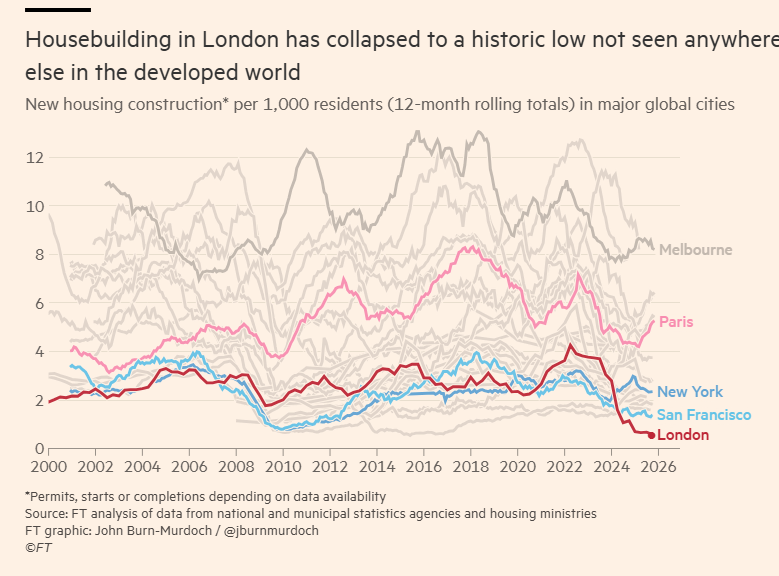
No, the white collar jobs are not going away in 18 months! I was furious with the populist-baiting language (in line with @DarioAmodei 's and @sama's also preferred apocalyptic usage) that Microsoft's @mustafasuleyman used in his FT interview, threatening everyone's jobs: “White-collar work, where you’re sitting down at a computer, either being a lawyer or an accountant or a project manager or a marketing person — most of those tasks will be fully automated by an AI within the next 12 to 18 months.” Not only do I not see the point of this backlash inducing language, I also believe it shows no understanding of the way the labour market and organizations actually works and what people do all day. (My book on this with Jin Li and Yanhui Wu will be out soon.). Don't get me wrong: I believe AI is a huge deal, and will radically change the world. But many white collar jobs are Messy jobs, as our book (and the post linked below) will explain: automating the automatable tasks within them is not near to automating the job. Let me make the point with the attached @jburnmurdoch graph on London. London needs 88,000 new homes per year. In the first nine months of 2025, just 3,248 private homes started construction. Twenty-three of London's thirty-three boroughs recorded zero new housing starts in the first quarter of 2025. Planning permissions have fallen to their lowest level since records began in 2006. Construction of new rental homes fell by 80 percent in a single year. All this is after Starmer declared his government wants to "build, baby, build." Does anyone think AI will fix this? All the technology to design a building exists, and existed pre-AI. The bottleneck in London housing is human. What stops homes from being built in London are environmental and land use regulations and neighbors that weponize them. AI can draft the review, but that is a trivial bit. It cannot convince the environmental group to drop its lawsuit or persuade politicians or negotiate with the neighbors. These obstacles employ people. Suleyman and Amodei imagine that project managers spend their days doing Gantt charts, call their job "sitting down at a computer" and dream of automating them. But the job of the planning guys is not to fill in forms, but to negotiate and coordinate developers, residents, environmental groups, heritage bodies, and elected politicians who all have incompatible interests. At other levels and in other jobs the same is true- radiologists spend only 1/3 of their time reading scans (see this great piece worksinprogress.co/issue/the-algo…). Their job was supposed to be gone in 2017; in fact, the demand for radiologists is booming (employment and wages are sharply up). Many consultants try to elicit the tacit, local, knowledge of what is actually going on in a firm in order to make a recommendation. Yes, if you spend your day just doing PPTs, you will be replaced. But how many people do just that? Organisations/managers resolve conflicts and deal with exceptions. Making a decision stick requires authority: being a person who can be blamed, sued, or fired. The manager resolves disputes about the rules, not just within them. Think of your last renovation in your house. The contractor trying to to get the guy installing the windows and the guys from the floor to show up and do a good job, a mess right? No algorithm does that. AI will make white-collar workers more productive. Some single-task, automatable roles will shrink (doing taxes is an expert system, drafting contracts too), many tasks will be automated. Also, the disruption of career ladders is a real concern. But "most tasks fully automated in 18 months" is not a prediction. It is marketing, designed to sell enterprise subscriptions and justify capital expenditure. The real world is messy. The mess is not a bug. It is what happens when human beings with competing interests try to get things done together. For more on "Messy Jobs", here is my New Years post: siliconcontinent.com/p/a-new-years-…. A book out soon.
Luis Garicano 🇪🇺🇺🇦 tweet media
English
68
273
1.2K
318.6K
Tim Willems
Tim Willems@timwillems85·
@Brad_Setser But you must agree that, in an environment like Argentina’s (starting from a period of fiscal dominance), fiscal discipline and currency strength are not independent?
English
0
0
7
802
Brad Setser
Brad Setser@Brad_Setser·
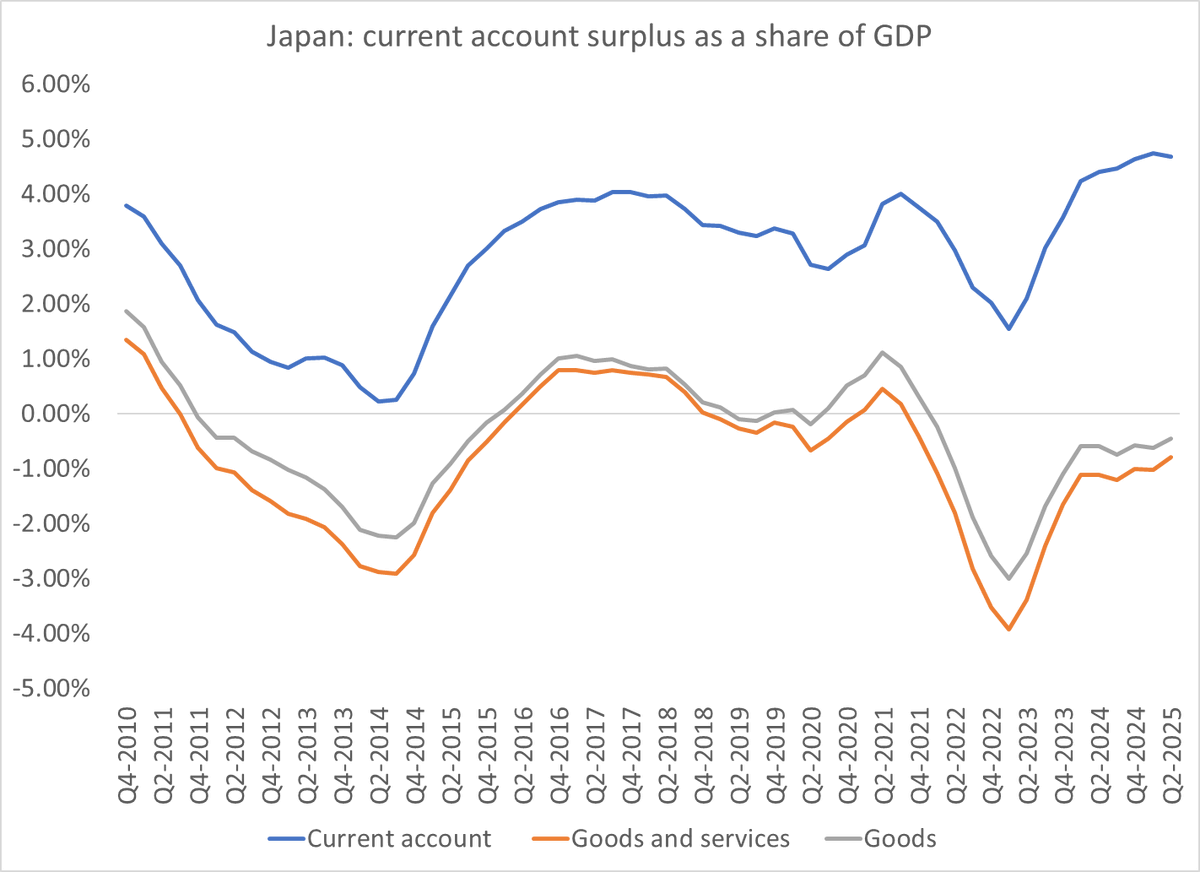
Most of Argentina's debt is fx denominated or fx linked; and the rapid fall in the debt to GDP ratio is a function of the peso's appreciation more than Milei's tight fiscal policy -- 1/2
Juan Egaña@JuanEgana

Public debt is now lower in Argentina than in Brazil! Milei’s fiscal shock cut the debt burden by 60% of GDP in just two years. With Argentina sticking to austerity while Brazilian fiscal accounts keep deteriorating, local Argentine bonds look more attractive than Brazil’s.

English
28
58
380
66K
Tim Willems
Tim Willems@timwillems85·
@Brad_Setser Perhaps more that one can’t neglect principles from finance & FTPL? As set out by Chien, Du & @HannoLustig Japan has long been making a leveraged bet on low rates that’s gone sour, boosting expected inflation to meet the govt’s budget constraint aeaweb.org/articles?id=10…
English
0
0
0
63
Brad Setser
Brad Setser@Brad_Setser·
Sorry doomers. Gotta learn the BoP not just fiscal (applies to the IMF too ... ) 4/4
Brad Setser tweet media
English
4
4
65
9.4K
Tim Willems
Tim Willems@timwillems85·
Part glad/part worried to be old/traditional enough to have co-authored a paper adding to Shapley’s citation count by using his Value in the original context. Only last year though: bankofengland.co.uk/working-paper/…
Ben Golub@ben_golub

research is crazy - the Shapley value will soon have more citations for its use as a way to grade the importance of features in ML analyses than it ever got for its original purpose in game theory/social science

English
0
0
1
248