what.iota@whatmicha
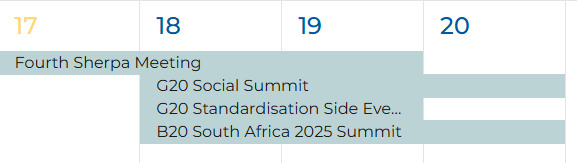
Ahead of us is the G20 in South Africa Johannesburg
Highly speculative idea why @iota could be an unofficial side talk at G20
That’s why I think this way:
➖After the 2008 financial crisis, the G20 asked the Financial Stability Board (FSB) to create a global system for Legal Entity Identifiers (LEIs).
➖The Global Legal Entity Identifier Foundation (GLEIF) was then set up by the FSB to run this system.
➖In September 2025, the IOTA Foundation signed an MoU with GLEIF to work on verifiable digital identities (vLEI + IOTA Identity + @TWINGlobalOrg ).
The IOTA Foundation is collaborating with GLEIF, which is a G20-mandated body created by the Financial Stability Board. That’s an indirect but very real link between IOTA and the G20’s post-crisis financial infrastructure.
Let’s add some more to it
➖In 2023, under India’s presidency, the G20 adopted the “High-Level Principles on the Digitalization of Trade Documents” (HLPs) let’s call it a political blueprint for going paperless in trade.
➖The OECD was a knowledge partner to the G20 for these principles and later published a big trade policy paper in September 2025:
“The Digitalisation of Trade Documents and Processes: Going Paperless Today, Going Paperless Tomorrow” (Trade Policy Paper No. 297).
In that paper, the OECD mentions the Trade Logistics Information Pipeline (TLIP) as an example of an infrastructure that connects public and private actors for digital trade.
As well it explicitly states that the IOTA Foundation, TradeMark Africa, the World Economic Forum, the Tony Blair Institute, the Institute of Export & International Trade and the Global Alliance for Trade Facilitation signed a collaboration agreement to set up TLIP.
➖Politically: G20 sets the high-level direction (digital trade docs, interoperability, trust).
➖Technically: OECD formalises it in its trade paper.
➖In practice: TLIP & TWIN – running on IOTA – are highlighted as examples of the kind of infrastructure that can fulfil those principles.
Rolling back to my initial statement
There is nothing like “The G20 chooses IOTA as its technology.”
It’s more accurate to say: IOTA-based projects (TLIP/TWIN) and IOTA’s GLEIF collaboration are operating inside the policy framework that the G20 has set for digital trade and identity.
@GiveRep