Toby Lason

27 posts

Toby Lason banner
Toby Lason

Toby Lason

@tobylason

Partner, Disability Insurance Agency. I help high-earning professionals understand what their disability contracts actually say. Carrier-neutral advice.

California Katılım Ocak 2022
35 Takip Edilen6 Takipçiler
Sabitlenmiş Tweet
Toby Lason
Toby Lason@tobylason·
Most disability insurance policies don't actually protect your ability to do your specific job. They protect your ability to do any job. That's the difference between own-occupation and any-occupation coverage, and why it's by far the single most important aspect of the coverage. With an any-occ policy, if you're a surgeon who can no longer operate but could teach or consult, the carrier can deny your claim. This results in a very high claim denial rate. The ten years of training and career you've built around a specific skill set are not protected. Own-occupation means the policy pays if you can't perform the duties of your specific occupation, even if you're earning income doing something else. Massive distinction. I've worked with thousands of physicians, CRNAs and dentists, and the most common problem I see is that they don't know their group coverage converts to any-occupation after 2 years. If you only check one thing in your policy, check that.
English

0
0
2
13
Toby Lason
Toby Lason@tobylason·
@JonLuskin it's boring until a claim hits... then of course it becomes the thing people talk about. usually I just have to mention the stats to prospective clients: 1 in 4 people will suffer a disability before retirement. not sexy, but powerful.
English
0
0
1
19
Toby Lason retweetledi
Jon Luskin, CFP®
Jon Luskin, CFP®@JonLuskin·
More advisors need to talk about disability insurance. It's so important. Unfortunately, it's also boring. Tax planning gets a lot of attention because everyone hates taxes. Of course, everyone loves talking about investing - because that's where the money is. Retirement is something many want, also a hot topic. I wish there was something alluring about disability insurance - so we could talk about it more.
English
11
1
19
2.4K
Toby Lason
Toby Lason@tobylason·
@kevinmd This is why specialist surgeons should have the "loss of license" rider on their disability policies, which exists for exactly this scenario. Almost nobody buys it, and most physicians don't even know it's an option until they need it.
English
0
0
0
49
Kevin Pho, M.D.
Kevin Pho, M.D.@kevinmd·
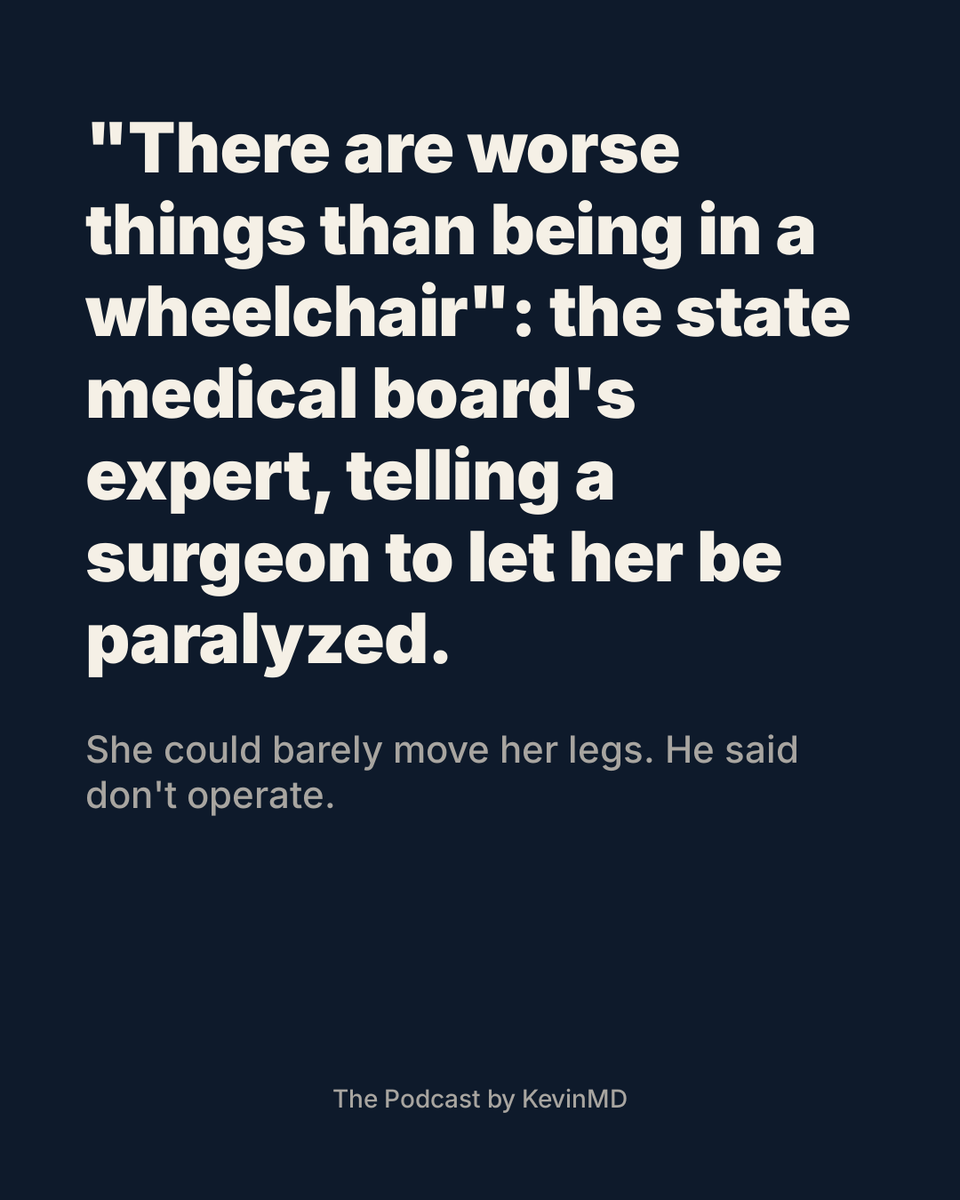
A neurosurgeon with two spine fellowships and no malpractice history was summarily suspended by a state medical board in February. The complaints had not come from patients. They had come from a former colleague filing them in waves. When his defense team subpoenaed his own records, they discovered the board had never read the full chart. The board had pulled only a few days of care surrounding the surgeries, missing the six months of clinical decision-making before. They had also subpoenaed the wrong entity, the hospital where the surgeries happened, not the medical group that actually employed him. The records the board's expert reviewed were incomplete. He knew they were incomplete. He said nothing. Four independent experts retained by the defense reviewed the full chart and unanimously concluded there was no breach of the standard of care. The board's response: vacate the suspension on the patient with the most egregious accusation against him (the one who recovered completely and walked off her opioids), and resuspend him on the other two. Same hearing. No new evidence. No published rationale. For one of the remaining cases, the board's expert argued he should never have operated on an elderly woman with severe spinal stenosis on top of an unhealed fracture, who had progressed from walking to a wheelchair over six months and was losing strength in her legs. The expert's stated reasoning: "Worse things in life than being in a wheelchair." The mechanic of how this happened is the part every physician should bookmark. In this state, a summary suspension can be issued by two board members, the secretary and the supervising member, neither of whom has to be in the same specialty as the physician under review. The other voting members of the board cannot review evidence until after the case is over. There is no equivalent of a grand jury. No probable-cause review. The first time the full board sees the file is at the disposition vote. Jeffrey Hatef, Jr. has not practiced medicine since February. His license is gone. His attorney, who started his career as a board attorney 30 years ago and has spent decades on the defense side, told him he has never seen a board vacate a suspension and re-issue it on the same hearing without new evidence. Search "The Podcast by KevinMD" wherever you listen to podcasts. Link in the replies. What structural reform would you push for first if you had to redesign how state medical boards process complaints? #ThePodcastbyKevinMD
Kevin Pho, M.D. tweet media
English
9
11
50
21.9K
Toby Lason
Toby Lason@tobylason·
"60% income replacement" is the marketing copy on most hospital LTD plans. The math after the benefit cap usually lands closer to 35%. After tax it lands closer to 25%. For a CRNA earning $230k base plus call pay, a $10k monthly cap turns a 60% formula into something closer to 38% of true earnings. Then federal and state tax come out of the benefit. Take-home replacement on a six-figure salary often ends up at 25-28%. Most CRNAs assume the brochure number is the number. The arithmetic underneath it is what actually pays. disabilityinsurance.io/specialties/cr…
English
0
0
2
11
Toby Lason
Toby Lason@tobylason·
@zachmelloh26 the DI line is the one that trips most people up... group LTD through work and an individual own-occ aren't really the same product. nobody notices until they actually try to file
English
0
0
1
16
Zach Melloh, CFP®
Zach Melloh, CFP®@zachmelloh26·
Risk Management & Insurance Planning Checklist: - Life insurance - Disability Insurance - Sufficient liability limits on property & casualty Insurance - Umbrella Insurance - Beneficiaries on accounts and insurance policies - Written will / potentially a trust - Powers of attorney - Medical directives - Named guardians provision Have you checked these off your list?
English
2
0
12
2K
Toby Lason
Toby Lason@tobylason·
A 35-year-old physician earning $400,000 has roughly $12 million in remaining career earnings. No raises factored in. That number doesn’t appear on any balance sheet, but everything on the balance sheet depends on it. $3,000 to $6,000 a year to insure $12 million in earning capacity is one of the cheapest insurance ratios in personal finance. The "too expensive" objection tends to dissolve once you measure the premium against the asset instead of the monthly budget.
English
0
0
0
18
Toby Lason
Toby Lason@tobylason·
AI-assisted surgery is going to create a disability underwriting problem no carrier has started solving. Occupational classifications are built on decades of claims data from physically intensive procedures. If AI reduces the demands, the actuarial models shift. And if a surgeon becomes reliant on an AI platform then loses access to it? That’s a claim scenario the contracts don’t address.
English
0
0
0
15
White Coat Investor
White Coat Investor@WCInvestor·
We work very hard to make ensure WCICON is a valuable experience. Love this!
Toby Lason@tobylason

@WCInvestor The physicians I've worked with who have attended WCICON consistently say it changed how they think about their financial picture, not just investments, but the entire structure around protecting and growing what they earn.

English
1
0
2
3.9K
Toby Lason
Toby Lason@tobylason·
A disability policy paying $10,000/month today still pays $10,000/month in year ten without a cost-of-living rider. Adjusted for 3% inflation, that’s $7,400 in purchasing power. Over a 25-year claim with a 3% compound COLA, the monthly benefit grows to roughly $20,900. The cumulative difference exceeds $1 million. The rider costs a fraction of that and can’t be added once a claim starts. Younger professionals carry the most inflation exposure and get the most value from it.
English
0
0
0
18
Toby Lason
Toby Lason@tobylason·
Good example of why the actual COLA rider language matters. Most professionals buying individual DI never read the rider text before they sign. The compounding method, the benefit period interaction, and the cap structure all vary by carrier. Reading the contract language is an underrated step in the process.
English
0
0
0
4
Wagner Law Group
Wagner Law Group@WagnerLawGroup·
Johanna Matloff is quoted in this Massachusetts Lawyers Weekly article covering an appeals court ruling that the ambiguity of a long-term-disability policy rider concerning cost-of-living adjustments should be interpreted in favor of the insurer... masslawyersweekly.com/2026/03/18/mas…
Wagner Law Group tweet media
English
1
0
0
61
Toby Lason
Toby Lason@tobylason·
@kevinmd Nobody's talking about the disability insurance side of this. If AI changes what a radiologist actually does day to day, their policy's definition of "own occupation" doesn't update with it. That gap is going to get weird fast.
English
0
0
0
28
Kevin Pho, M.D.
Kevin Pho, M.D.@kevinmd·
AI does not carry malpractice insurance. You do. Right now, massive tech companies are building the foundational models that will dictate the future of clinical care. But those models are raw utility. They are like electricity. You cannot just plug a patient directly into a raw LLM and expect safe triage. Dr. Tod Stillson highlights a crucial reality for modern medicine: raw AI might ace a diagnostic exam, but it fails at clinical triage without physician led guardrails. When you evaluate an AI product for your practice, it must meet strict governance standards: It must augment clinical judgment, not impersonate it. It must have explicit data boundaries. It must be narrow enough to be reliable. It must be explainable and auditable. We lost the wheel when Electronic Medical Records were designed. We let administrators and engineers build our workflows, and we are still paying the price with burnout. We cannot let that happen with artificial intelligence. Physicians understand sequence, clinical reasoning, and pattern recognition better than any software engineer. It is time to step into the committees, demand transparent governance, and shape the tools we will be held liable for using. Episode is in the comments. #MedTwitter #HealthTech #AIinHealthcare #PhysicianLeadership
Kevin Pho, M.D. tweet media
English
6
12
22
1.6K
Toby Lason
Toby Lason@tobylason·
Carriers have deep classification systems for physicians. Orthopedic surgeon vs. dermatologist, different pricing, decades of claims data behind the distinctions. Attorneys get one or two occupation classes for the entire profession. A trial attorney in court 200 days a year pays roughly what a corporate attorney at a desk pays. The risk profiles aren’t close, but the pricing treats them the same. Own-occ definitions diverge even further. For a surgeon it’s relatively clear: can you operate? For an attorney, whether "litigator" and "attorney" count as the same occupation depends entirely on the contract language. disabilityinsurance.io/education/own-…
English
0
0
0
14
Toby Lason
Toby Lason@tobylason·
Good list. The disability insurance line is the one that trips people up most. Many high earners I work with are carrying group coverage that replaces 40–50% of income after taxes, or an individual policy they bought in residency and never updated. "I have disability insurance" and "my coverage would actually sustain my household" are very different things.
English
1
0
1
76
Zach Melloh, CFP®
Zach Melloh, CFP®@zachmelloh26·
Risk Management & Planning Checklist: - Life insurance - Disability Insurance - Sufficient liability limits on property & casualty Insurance - Umbrella Insurance - Beneficiaries on accounts and insurance policies - Written will / potentially a trust - Powers of attorney - Medical directives - Named guardians provision Have you checked these off your list?
English
6
2
22
2.3K
Toby Lason
Toby Lason@tobylason·
Incredibly important topic. One thing I'd add is that if the employer is paying the premium (usually the case), those benefits are considered taxable income. So a plan that says $10K/month on paper nets closer to $6-7K after taxes. For a physician earning $350K+, that coverage gap goes from bad to genuinely unsustainable
English
0
0
0
9
Toby Lason
Toby Lason@tobylason·
Group disability plans cap monthly benefits regardless of salary. A physician earning $400,000 with a $10,000/month cap gets 30% replacement, not the 60% the summary says. Add taxes on employer-paid premiums and the effective coverage drops below 25% of take-home. Individual policies are after-tax dollars in, tax-free benefits out. Portable, can’t be cancelled by the employer, and the definitions of disability are usually stronger. Most high earners have the first one and have never looked at the second. disabilityinsurance.io/education/grou…
English
0
0
0
23
Toby Lason
Toby Lason@tobylason·
This comparison should get more airtime than it does. The own-occ point is especially important because carriers define 'occupation' very differently from each other, and we see surgeons, for example, discover at claim time that their policy was written broader than they realized when they signed it
English
0
0
1
12
Jon Luskin, CFP®
Jon Luskin, CFP®@JonLuskin·
You need the right fine print on your insurance policy. That includes having that "own occupation" definition until age 65. That helps protect you in a worst-case scenario: if you can't do your own job for quite some time. ________________________________________
English
2
0
0
180
Jon Luskin, CFP®
Jon Luskin, CFP®@JonLuskin·
Is the math right on this one? Of course! Are there almost certainly other more important (albeit much more boring) areas of personal finance that folks should likely be focusing on? Also, of course. ________________________________________
Jon Luskin, CFP® tweet media
English
1
0
2
652
Toby Lason
Toby Lason@tobylason·
every specialty on the right, especially those on the bottom right quadrant, should ensure they have full mental health coverage on their disability insurance policies. if burnout causes any underlying conditions, such as depression, anxiety, insomnia, or cognitive dysfunction, claims generally qualify
English
1
0
2
16
Nick Mark MD
Nick Mark MD@nickmmark·
Academic pulmonologists have the the lowest rate of personal fulfillment & the highest rate of burnout of any specialty in the US. More than a third plan to leave their institution in the next 2 years. Shocking & unsustainable numbers. Article here: jamanetwork.com/journals/jaman…
Nick Mark MD tweet media
English
36
109
429
209.2K
Toby Lason
Toby Lason@tobylason·
@PhysicianCents whatever questions may arise - be sure to do a deep dive on an Own-Occupation definition of disability!
English
0
0
0
7
PhysicianCents
PhysicianCents@PhysicianCents·
Have a financial planning question? Student loan question? Disability insurance question? Send it over, and we'll answer it in a future @PhysicianCents podcast/YouTube. The best part...you can ask your question anonymously in the Google form below! 🙌 forms.gle/YaZ4pAZUX8ao8A…
English
1
0
1
68
Toby Lason
Toby Lason@tobylason·
@WCInvestor The physicians I've worked with who have attended WCICON consistently say it changed how they think about their financial picture, not just investments, but the entire structure around protecting and growing what they earn.
English
1
0
0
3.9K
White Coat Investor
White Coat Investor@WCInvestor·
WCICON is not just a financial conference. It is a room full of physicians who decided that understanding money was worth their time. Attendees leave with a clearer financial plan, a stronger network, and a different perspective on what their income can actually do for them. If you missed this year, early bird pricing for Orlando is open now. Save $500 before it closes. Head to whitecoatinvestor.com/wcicon to claim #WCICON
White Coat Investor tweet media
English
1
0
1
1.7K