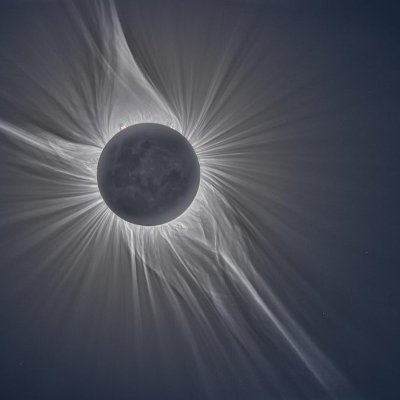
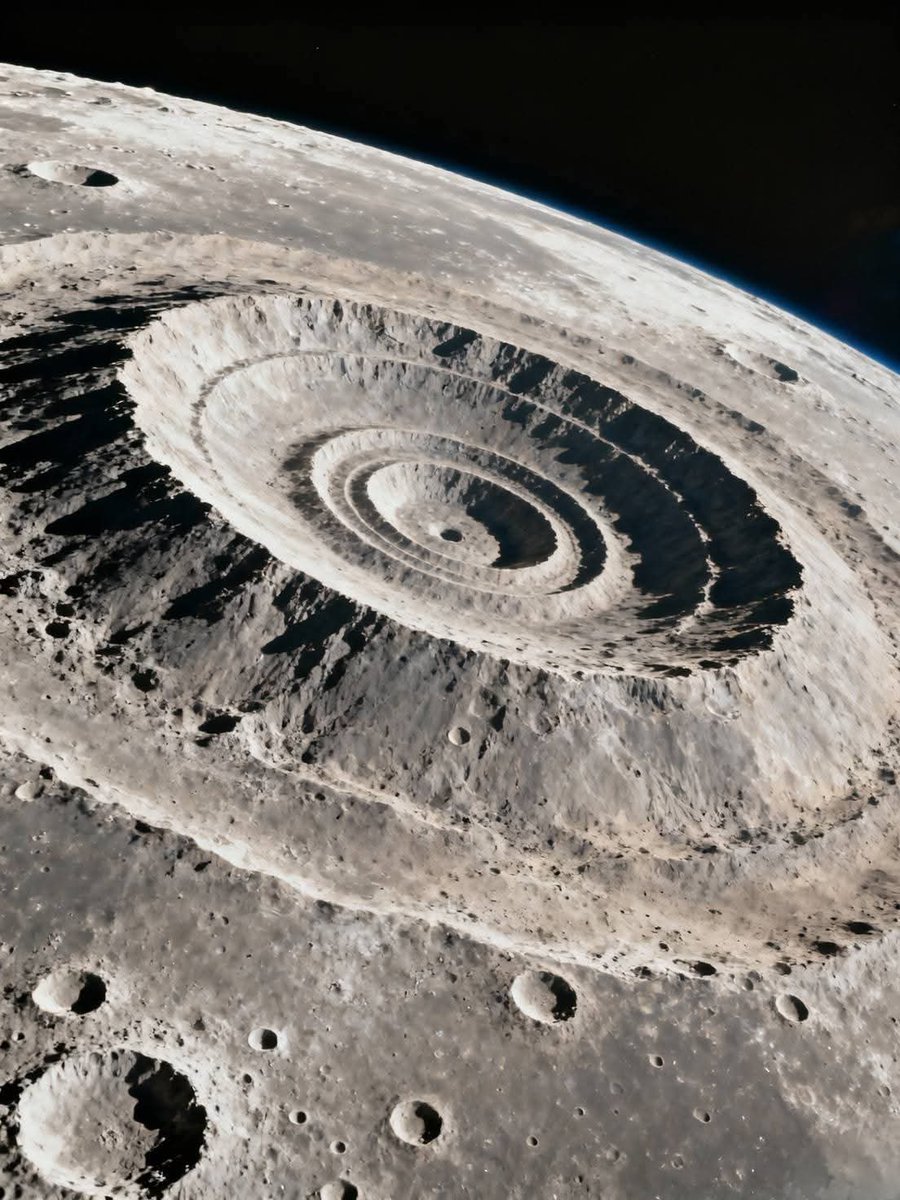
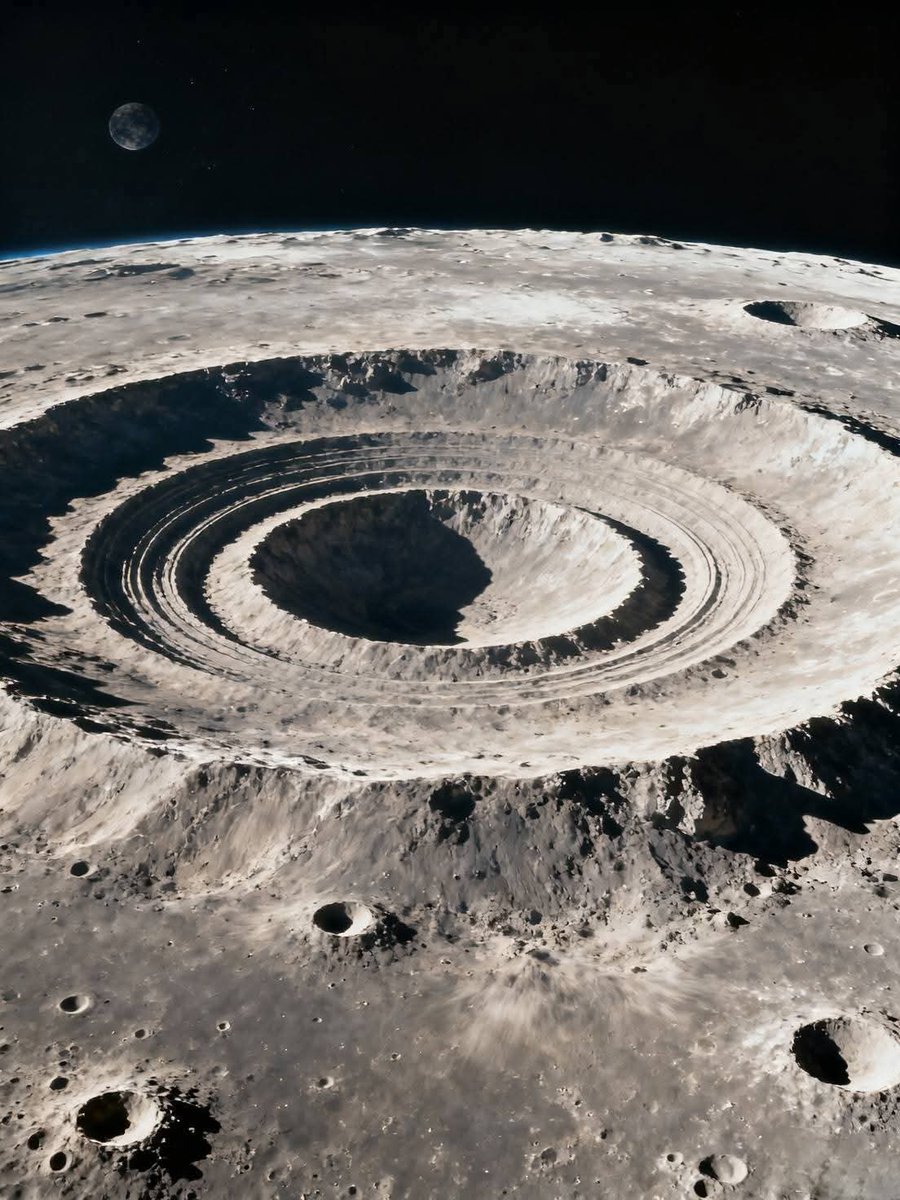
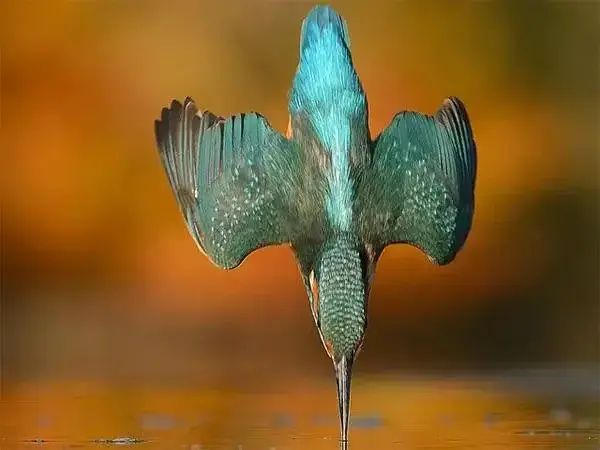
@konstructivizm So. Yeeeahhhhh... umm, they would have had to HOVER above it for a considerable amount of time to catch these images. I've had issues with you before, but I'm done with your fake postings
Artemis II Delivers the First Human Observation of the Complete Orientale BasinDuring the lunar flyby phase of NASA’s Artemis II mission, the crew captured the first-ever images of the entire Orientale Basin as seen directly with human eyes.Orientale is a multi-ringed impact basin approximately 930 km (about 580 miles) in diameter, located near the southwestern limb of the Moon (as viewed from Earth). Because of its position straddling the near and far sides, only portions of its concentric rings and ejecta blanket have been visible from Earth or in previous orbital imagery at certain illuminations. The unique vantage point and trajectory of Artemis II allowed the crew to observe and photograph the full structure — including previously foreshortened or partially obscured segments — in a single, fully illuminated view.Formed roughly 3.8 billion years ago by a large asteroid or comet impact near the end of the Late Heavy Bombardment, Orientale is the youngest and best-preserved large impact basin on the Moon. Its well-defined concentric rings (the outermost Cordillera ring, the Outer Rook, and Inner Rook) provide a textbook example of how massive impacts excavate deep into the lunar crust and mantle, followed by gravitational collapse and rebound that create the characteristic bull’s-eye morphology.This new human-taken documentation adds valuable high-resolution visual context to existing datasets from spacecraft such as Lunar Reconnaissance Orbiter, GRAIL (which mapped its gravity anomalies), and earlier missions. It will support refined geological mapping, studies of impact dynamics, and preparation for future surface exploration in the region.The observation underscores that even well-studied lunar features can reveal new details when viewed from novel human perspectives during cislunar missions.The Moon continues to hold scientific surprises — and Artemis II is already expanding our understanding of its complex impact history.
A Message From Nick Pope:
A while ago, following some digestive issues, I was diagnosed with esophageal cancer. Unfortunately, it's Stage 4 and has metastasized to my liver. While I know that it's kindness and hope that leads people to suggest healers and supposed miracle cures, and to say things like "fight it", and "you can beat it", I'm afraid my diagnosis and my situation leaves no doubt whatsoever: I can't beat it.
What an amazing adventure I've had! A 21-year career at the UK Ministry of Defence, where I got involved in subjects ranging from financial policy to counter-terrorism; from military policing to UAP. And I saved six cows; it's a long story! The things I've done; the places I've been; the people I've met; and the secrets I've been privy to. I wouldn't have swapped it for the world. And then a second career, where my previous government UAP role brought me to the attention of the world's media, leading me to become a regular commentator on TV news shows and documentaries, as well as consulting and acting as spokesperson on various UFO and alien-themed movies, TV series and video games. The media called me the real Fox Mulder!
The true highlight, of course, is life with my wonderful, beautiful and incredibly smart wife, Elizabeth. She's a real-life Agent Scully: a scientist, a skeptic and a redhead. We met randomly in the lobby bar of the Fairmont Hotel in downtown San José (she was an anthropology professor at San José State University) in October 2010 and got married 3 months later. We applied successfully for my Green Card and she had me shipped over and imported to the U.S., where a new adventure began, as Elizabeth and I enjoyed wildlife watching at our wonderful home in Tucson, desert hikes, film noir, true crime, country music, Sunday lunches with my in-laws, and much more besides. Recently, we had an amazing one-year adventure in New York City, living 5 minutes from Times Square, and having a wonderful view of the Empire State Building from our apartment window.
We proofread each other's books and articles (I love commas, hyphens and exclamation points way more than Elizabeth, and managed to win at least a few of those battles), and I'm supporting her in her ongoing fight for free speech, academic freedom, and keeping political correctness, superstition and identity politics out of science and academia. The White House Press Secretary Tweeted one of her recent newspaper articles, which shows the huge impact she's having.
I kept working for as long as I could (right up until last week), with my various film/TV interviews, conference appearances, and live events, including my position as moderator of Ancient Aliens Live - where I think I did 94 shows. Sadly, the time has come where I've had to step away from this work.
A lot of people have followed my work on UAP. I'm loath to use the word "fans", because I'm not a celebrity. But I am a public figure, and many people have followed me on my journey as I've sought to keep the UAP subject in the public eye, and to frame it as a defense, national security and safety of flight issue - as well as a fascinating science problem. Some of this work has been public knowledge, but some such work, of necessity, has been done behind the scenes. I hope I've helped move the needle forward. But most people, of course, know me through my media interviews and live events. To everyone who's followed me on my journey, thank you - and good luck with your own journeys. I wish you every success and happiness.
It's all been amazing, and I'm grateful for the things I've done, not mournful for the things that I won't now get to do.
Per Aspera Ad Astra!
Nick Pope, Tucson, Arizona, February 12, 2026
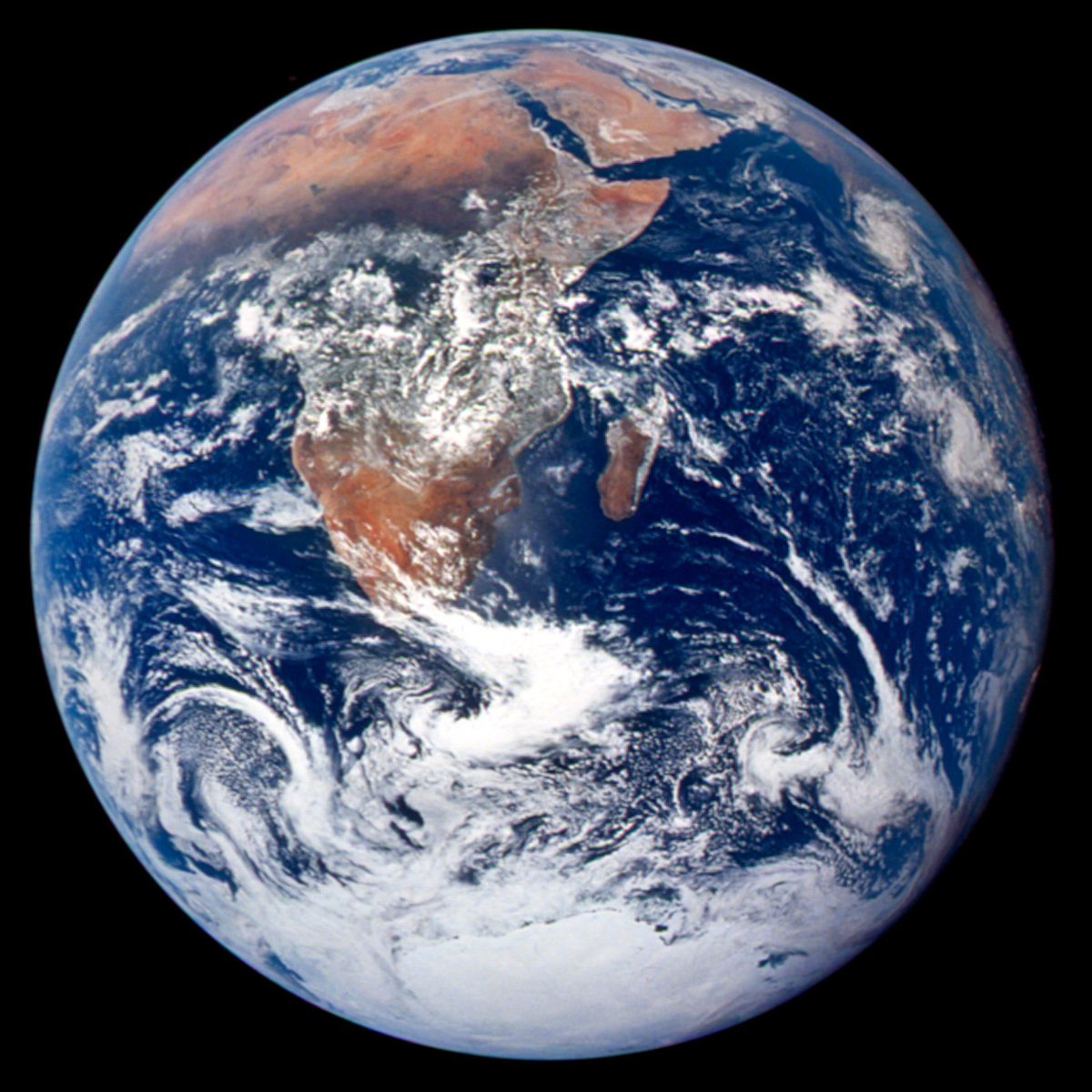
@earthcurated Oh my God the ignorance in these comments. The 2026 image is a night shot. Stop acting like the difference in imaging spells doom for our planet. 🙄
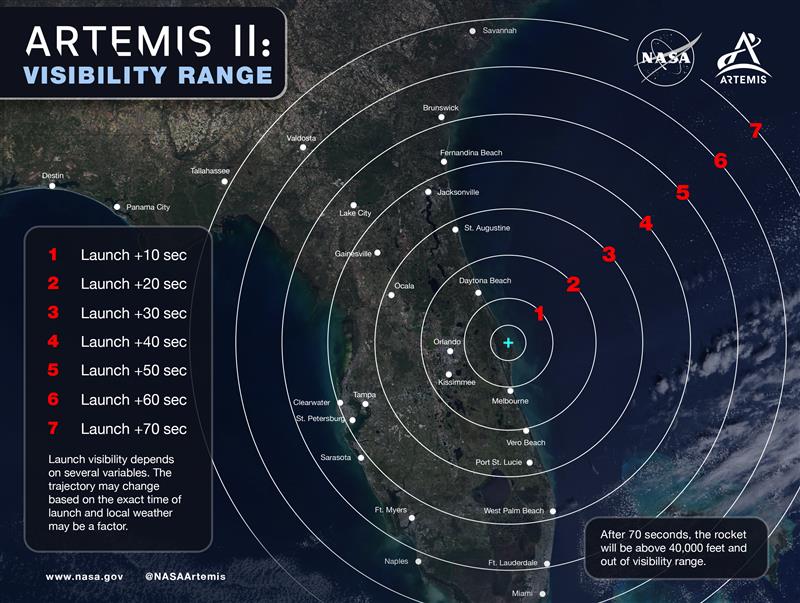
Can you see our Moon rocket lift off from your backyard?
Skywatchers in Florida and southern Georgia will have a shot. Check out this map to see when you should look up! Artemis II is targeted to launch no earlier than April 1.
If you’re having trouble accessing YouTube right now, you’re not alone — our teams are looking into this and will follow up here with updates: support.google.com/youtube/thread…
A research team at TU Wien has uncovered something astonishing: quantum entanglement the mysterious bond connecting particles across space doesn’t form instantly. Instead, it takes about 232 attoseconds (a quintillionth of a second) to fully emerge. Using advanced computer simulations of atoms hit by laser pulses, scientists observed that entanglement develops gradually as one electron escapes and another shifts energy levels, slowly weaving their quantum link through time.
This finding challenges decades of assumptions that entanglement happens outside of time itself. It reveals that even the universe’s fastest phenomena have measurable stages a kind of “quantum heartbeat.”
Researchers now aim to confirm the results experimentally, a daunting task at speeds where light barely crosses a human hair’s width. Cracking these fleeting moments could reshape quantum computing, encryption, and communication, showing that even instant mysteries unfold with rhythm and order.
Sources: NASA, Scientific American, Physical Review Letters
@justin_beazley@konstructivizm Stating things as fact that they actually have ZERO real knowledge about. At least frame it like this:
"One potential hypothesis for its bizarre behavior is (Insert HYPOTHESIS here) but we may never know the truth about this very mysterious object"
@konstructivizm Why do you guys continually make stuff up I mean I get that it helps you with your clicks and your nonsense but when the normal person is trying to read an article only to find out that it's b******* because you guys don't know what you're talking about it's annoying
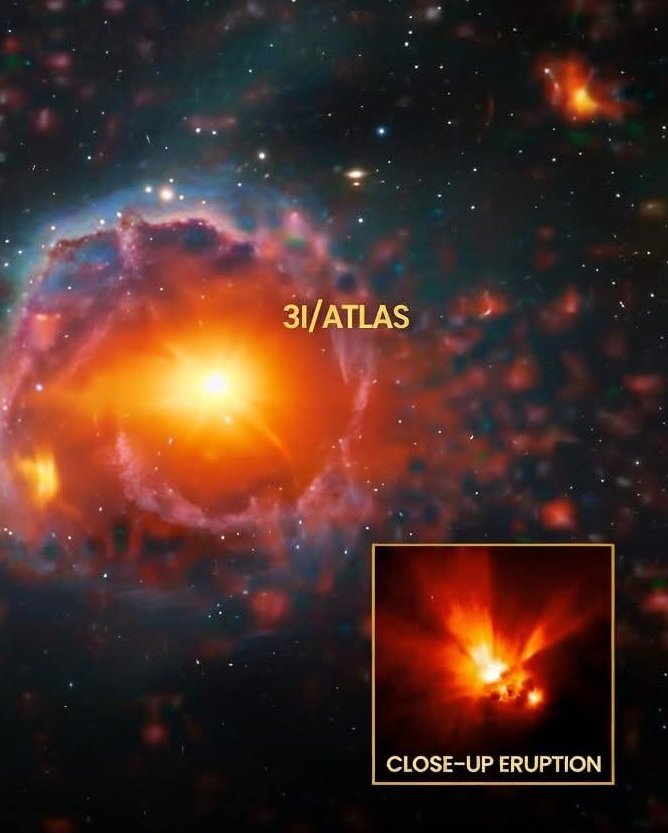
It was expected to quietly fade into the cosmic night. Instead, Comet 3I/ATLAS—the third confirmed interstellar visitor ever detected—exploded into action on its way out. Discovered in July 2025 by the ATLAS survey, this rogue comet (officially C/2025 N1 (ATLAS)) zipped through our solar system on a hyperbolic path, making its closest solar approach (perihelion) around late October 2025 at about 1.4 AU. Astronomers anticipated it would dim as it receded, like most comets after their icy surface ices have boiled away near the Sun.But in December 2025, NASA's SPHEREx infrared space telescope caught something extraordinary: a dramatic, delayed outburst. The comet suddenly brightened significantly, venting massive amounts of water vapor, carbon dioxide, carbon monoxide, and a rich mix of organic molecules—including methanol, methane, cyanide, and other carbon-rich compounds—along with refractory dust grains. This wasn't a gentle release; it was a full-on eruption, with gas emissions (like H₂O and CO) surging up to 20-fold compared to pre-perihelion levels.Why the surprise flare? Scientists, led by Carey Lisse (Johns Hopkins APL), propose that the Sun's heat took weeks to months to slowly penetrate the comet's tough, radiation-hardened outer crust. Once it reached pristine ices buried deep inside—material frozen since the comet formed around another star billions of years ago—those volatiles sublimated explosively, cracking open fresh vents and unleashing ancient chemistry.This outburst transformed 3I/ATLAS into a highly active comet, complete with a diverse, erupting coma. The chemistry looks strikingly similar to solar-system comets, suggesting interstellar visitors can be chemically "cooked" by stellar radiation just like local ones—offering a direct comparison between our Sun's building blocks and those from distant systems.Now, 3I/ATLAS is racing outward forever, beyond Jupiter's orbit by early 2026 and gone from view. But the infrared fingerprints SPHEREx captured could rewrite parts of comet science: how delayed activity works, what pristine interstellar ices truly contain, and whether the ingredients for life are common across the galaxy.A fleeting guest that refused to leave quietly—and left us with cosmic secrets in its wake.Image credit (SPHEREx infrared observations of the outburst, December 2025):
NASA/JPL-CaltechSources: NASA SPHEREx mission updates (February 2026), Lisse et al., "SPHEREx Re-Observation of Interstellar Object 3I/ATLAS in December 2025: Detection of Increased Post-Perihelion Activity, Refractory Coma Dust, and New Coma Gas Species" (Research Notes of the AAS / arXiv:2601.06759), Space.com, Sci.News, Wikipedia summary, and related astronomical reports.
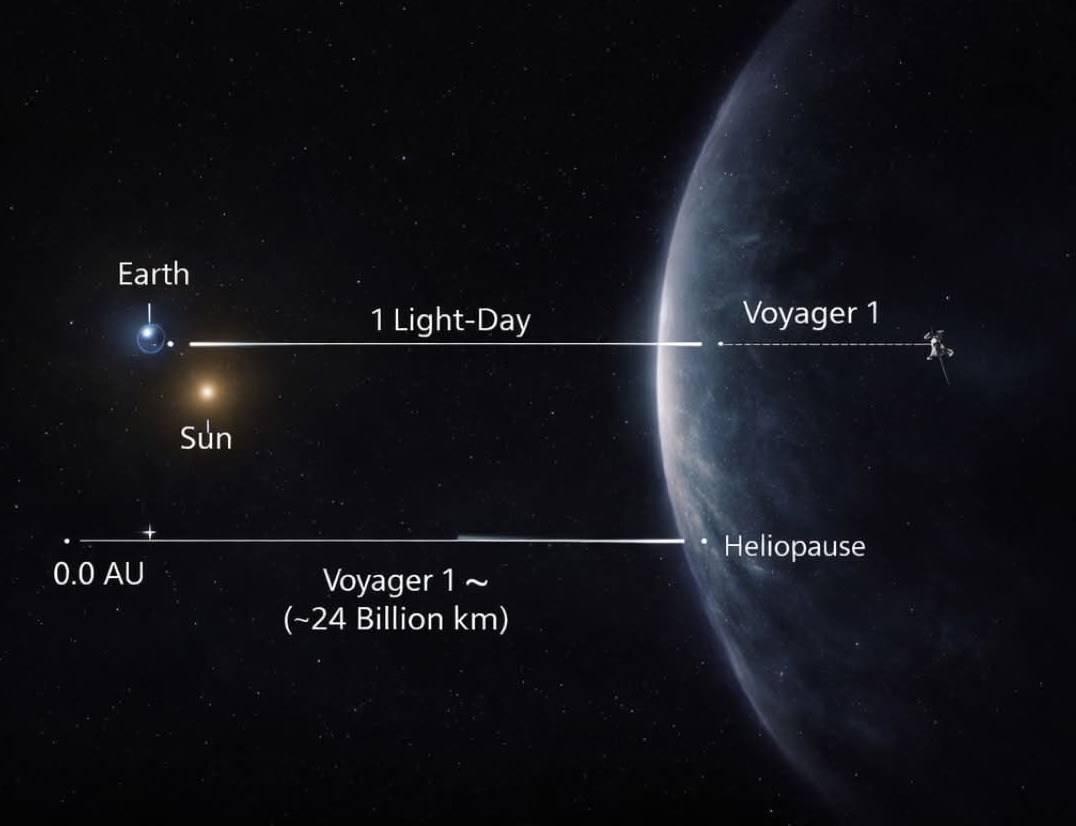
On February 7, 2026, consider this humbling milestone in humanity's reach into the cosmos: Voyager 1, launched in 1977, has been hurtling outward at roughly 61,000 km/h (about 38,000 mph) for nearly half a century. Today, it's the farthest human-made object from Earth—now exceeding 15.8 billion miles (around 25.4 billion kilometers, or roughly 170 AU) away, deep in interstellar space.Yet even at this blistering pace and epic distance, Voyager 1 hasn't quite covered one light-day—the distance light itself travels in just 24 hours, clocking in at approximately 16 billion miles (about 26 billion km). The probe is tantalizingly close but still short of that mark; projections show it will cross into true one-light-day territory later in 2026, around November.This single fact packs a powerful punch about the sheer scale of space. Voyager 1 remains our fastest and most far-flung ambassador, the first spacecraft to enter interstellar space (back in 2012), yet its monumental journey barely scratches the tiniest increment astronomers use to measure cosmic distances. For context:A signal from Earth to Voyager 1 already takes nearly a full day to arrive and another to return—communication is a slow, one-way conversation stretched across time.
The nearest star system, Proxima Centauri, lies more than 4 light-years distant—that's over 1,460 light-days away, or roughly 1,460 times farther than Voyager has traveled so far.
Voyager's odyssey isn't just a technical triumph; it's a stark reminder that interstellar space isn't "far"—it's overwhelmingly, mind-bendingly vast. Our boldest probe, after decades of relentless speed, is still paddling at the very edge of our solar system's shore, gazing out at an ocean that stretches far beyond reach.Sources: NASA Jet Propulsion Laboratory Voyager mission data, real-time tracking from science.nasa.gov, and related astronomical references.
In 1954, Marilyn Monroe took on the role of a working girl for a photo shoot with Milton Greene on the 20th Century Fox Studios backlots in Los Angeles, coinciding with the filming of "Bus Stop" — Monroe's first movie appearance.
This series of photographs is known as "The Hooker Sitting."
Before her marriage to Arthur Miller, Monroe stayed with Milton Greene and his family at their Connecticut farmhouse.
It was during this time that Greene captured some of the most stunning images of Marilyn Monroe, showcasing her various moods, beauty, talent, and spirit, with this particular shoot highlighting her provocative allure.
More iconic photos: bit.ly/3XXgxrY
@madebygoogle It is absolutely INSANE that you made a "mag safe" system that will ONLY work properly with the proprietary PixelSnap charger. I am so mad I bought the 10 Pro XL without this news coming out earlier. Never. Again.
Pixelsnap makes wireless charging…a snap ☺️
The fact that Google #Pixel10 is the first major Android phone to fully embrace the next generation of wireless charging with Qi2 built in has us… feeling magnetic 🧲