Tom

8K posts

Tom banner
Tom

Tom

@tom614609

Web3 pioneer| content creator$writing | ambassador for @impaktofficial

Katılım Ağustos 2023
92 Takip Edilen488 Takipçiler
Tom retweetledi
Star
Star@Amstarlighter·
Before the philosophy. There is a person. Bought Bitcoin in 2012. Has not touched it since. Does not know any of this is happening. @quipnetwork has been paying attention to what that person does not know. Every time a Bitcoin transaction hits the mempool, the public key attached to it becomes visible on the blockchain. A sufficiently powerful quantum computer does not need long after that to derive the private key. Not steal it. Derive it. That distinction is everything. Stealing requires access. Deriving requires only visibility. And Bitcoin's public ledger has been visible to everyone since the first block. This is not a future threat waiting to arrive. Adversaries are already harvesting exposed public keys today with the intention of breaking them when the hardware catches up. The strategy has a name. Harvest now, decrypt later. The person who bought in 2012 and never moved their coins is not protected by silence. Their exposure is already on chain. @quipnetwork saw that problem before most people had a name for it. No new wallet. No migration. No soft fork. Post-quantum keys committed directly to Bitcoin through Arch Network's smart contract layer using rules that already exist. The window between safe and exposed is still open. And that window does not have to close the hard way. @quipnetwork is why.
Star tweet media
Star@Amstarlighter

Think about what BIP-361 was actually proposing for a moment. A protocol change that could permanently freeze roughly 1 million BTC believed to belong to Satoshi Nakamoto. Coins that have never moved. An owner who has never spoken. The Bitcoin community was being asked to make a decision about funds that may belong to the person who created the entire system. Under threat of quantum theft as justification. @quipnetwork looked at that situation and built something that makes the entire argument unnecessary. ➔ You do not have to freeze Satoshi's coins to protect the network. ➔ You do not have to force anyone to migrate under a deadline. ➔ You do not have to choose between Bitcoin's foundational promise of permissionless ownership and its long term security. That is not a technical achievement. That is a philosophical one. And it is the part of this story most people have completely missed. When a protocol solution protects Bitcoin's foundational promise of permissionless ownership at the same time as it closes a quantum vulnerability, what does that say about where the line between security and sovereignty should actually be drawn in the post-quantum era?


English
30
21
53
909
Tom retweetledi
Whenzy🖤💫
Whenzy🖤💫@Whenzyofweb3·
Sometimes, the loudest signal in crypto is silence. Over the past week, $8LNDS moved quietly from $0.01882 → $0.01898. Liquidity: $876K FDV: $1.8M Market Cap: $1.8M And this where it gets interesting because nothing really changed since the last check-up. It feels like $8LNDS has reached a rare point in crypto markets a temporary balance between: people who believe enough to hold 🤝 and people who are ready to sell. Just a market catching its breath but here’s the thing about equilibrium in crypto: it never lasts for long. This kind of calm often comes right before momentum picks a direction. So now the real question isn’t what happened this week, It’s what happens next.
Whenzy🖤💫 tweet media
8lends@eightlends

$8LNDS Heartbeat 💙 📈 from $0.01882 to $0.01898 over the past week! Liquidity: $876K FDV: $1.8M Market cap: $1.8M Track on @CoinMarketCap: coinmarketcap.com/community/prof… Nothing really changed since our last check-up. It seems like we've achieved some kind of balance between those who hold and those who sell! What do you think comes next: 📈 or 📉?

English
38
14
74
1.6K
Tom retweetledi
Tom retweetledi
CHA$ER
CHA$ER@ChaserOnChain·
DAO treasuries are becoming far more selective with where they park capital, which is why this stands out. The Arbitrum DAO deploying $5.8M into Maple Finance’s syrupUSDC signals growing confidence in institutional credit yield as a serious treasury allocation strategy not just another DeFi experiment.
Entropy Advisors@EntropyAdvisors

The @Arbitrum DAO Treasury Management Portfolio has deployed $5.8M into @Maplefinance’s syrupUSDC. syrupUSDC has been a core asset throughout DRIP Season 1, and we’re excited to continue supporting maple’s growth.

English
37
3
79
1.4K
Tom retweetledi
OAMAL
OAMAL@MalikOlanase·
One thing the crypto space needs more of is dependable infrastructure, and projects like @FIH_USD1 are helping push the ecosystem in that direction through steady development and utility.
OAMAL tweet media
English
9
4
27
15.1K
Tom retweetledi
Crypto₿uddie🐼
Crypto₿uddie🐼@Cryptobuddiee·
If you noticed, that past couple of months has been filled with most AI labs racing to build the best model. MagnetX looked at that race and asked a completely different question: what happens to the brilliant engineers in Shenzhen or Chengdu who already built something that works, something with real users and real revenue but have no path to global distribution, no compliance framework, and no capital pipeline that understands what they built? That is the gap everyone is paying deaf ear to. The West thinks they have a monopoly on AI commercialization. MagnetX is betting that is wrong and they are putting their money where their mouth is. They went to the main stage of Hong Kong Web3 Festival on April 22, stood next to sitting legislators from Hong Kong and Korea, and said: we are the infrastructure layer between China's AI talent and the rest of the world. ⁍ And they stormed the event with Three products, one loop. - MagUp: this puts your AI product inside the answers ChatGPT, DeepSeek, and Gemini are already giving people. - MagVerse(@MagVerse_AI) this routes verified creator traffic with onchain payouts, so you are not buying bots. - DeWorld is an on-chain marketplace where AI agents go to get validated, distributed, and capitalized, it is already $1M+ ARR from MagUp alone. ⁍ The 100 CITIES, 1,000 BUILDERS commitment is what stuck with me. Not because of the number but because of the word exit. - Tokenized exit. They are not promising builders a community but promising them a finish line. I don't know how they will pull this off, but I know that if they do, it changes where the next generation of AI infrastructure actually gets built, and who gets to own a piece of it. #BuildInPublic #SMBmarketing Join us on @MagVerse_AI below. console.magverse.io/?invite_code=F…
Crypto₿uddie🐼 tweet media
MagVerse@MagVerse_AI

x.com/i/article/2047…

English
29
14
53
16.8K
Tom retweetledi
The Emirate of cryptostreet 馬納茲.
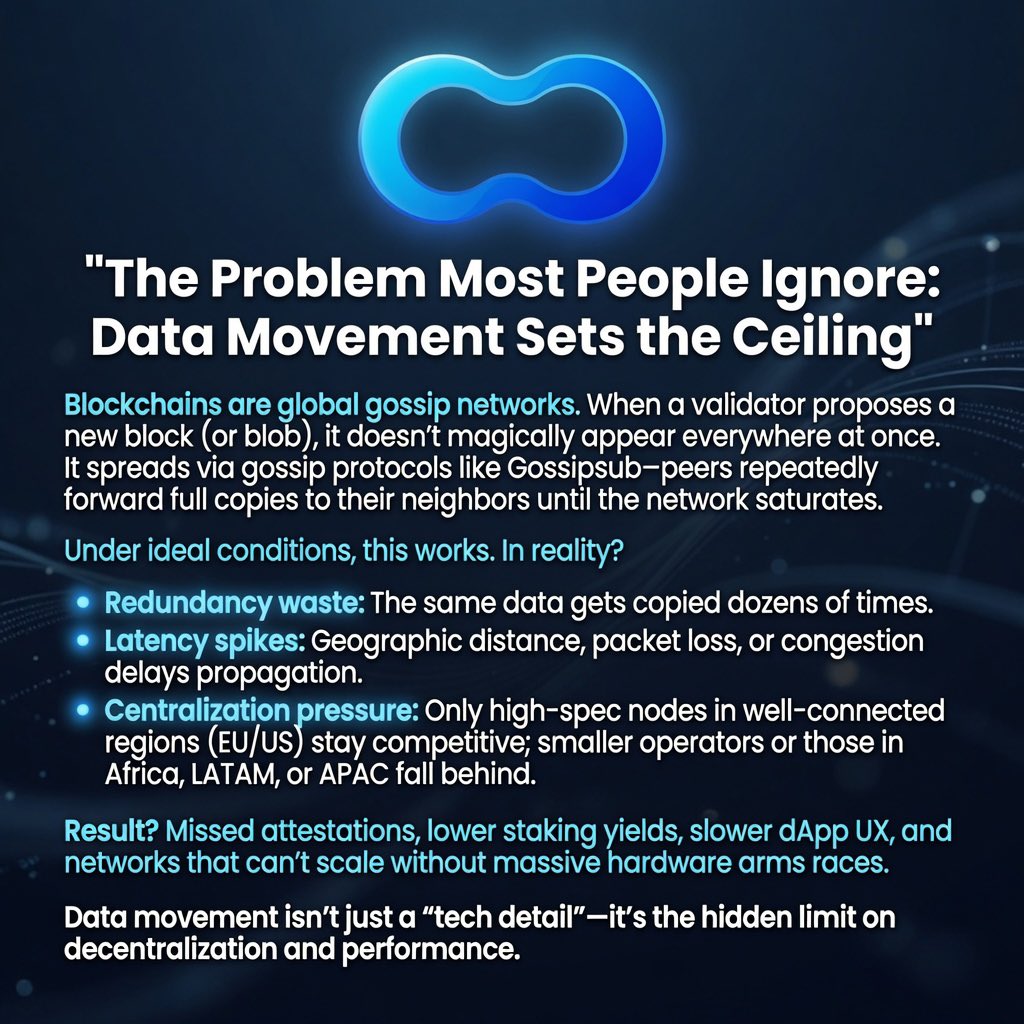
@get_optimum The Problem Most People Ignore: Data Movement Sets the Ceiling Blockchains are global gossip networks. When a validator proposes a new block (or blob), it doesn’t magically appear everywhere at once. It spreads via gossip protocols like Gossip sub peer repeatedly forward full copies to their neighbors until the network saturates. Under ideal conditions, this works. In reality? • Redundancy waste: The same data gets copied dozens of times. • Latency spikes: Geographic distance, packet loss, or congestion delays propagation. • Centralization pressure: Only high-spec nodes in well-connected regions (EU/US) stay competitive; smaller operators or those in Africa, LATAM, or APAC fall behind. Result? Missed attestations, lower staking yields, slower dApp UX, and networks that can’t scale without massive hardware arms races. Data movement isn’t just a “tech detail” it’s the hidden limit on decentralization and performance.
The Emirate of cryptostreet 馬納茲. tweet media
English
10
2
33
81
Tom retweetledi
Ola.eth
Ola.eth@iike3837·
The more I study @quipnetwork, the more I feel like this project is thinking 5–10 years ahead while most of the market is still focused on short-term hype. What really got my attention is how they’re approaching mining and compute. Imagine using all that global computing power for something actually useful instead of just burning energy for nothing. AI workloads. Simulations. Optimization problems. Future quantum tasks. That’s the direction Quip is trying to push. And honestly, the post-quantum security angle is underrated too. Most people aren’t even talking about the risk quantum computing could bring to current crypto security, but @quipnetwork is already building with that future in mind. Feels like one of those projects that’s not just chasing narratives… It’s trying to build infrastructure for where tech is actually heading.
English
17
10
38
929
Tom retweetledi
Counselor
Counselor@Counselor_Ayo·
Most Web3 projects want growth. But growth is hard when users struggle just to buy a token. Qwerti is solving that. Through partnerships like HYRE and XONA, users now get a simpler way to search, swap, and join ecosystems without the usual DeFi stress. Less friction. Better onboarding. Real usability. Try a swap on @QwertiAI and see how much easier DeFi can feel. If you haven’t tried it yet, I will suggest testing it yourself and seeing how the experience feels. app.qwerti.ai/?ref=386-59179
English
121
15
139
5.9K
Tom retweetledi
Sam🦅💭
Sam🦅💭@sam3web3·
In 2026, I still couldn’t pay for a simple online subscription with my local card. Declined. Declined again. At this point, African cards and international payments are in a situationship 💀 Then I discovered something interesting: The Bybit Card.
Sam🦅💭 tweet media
English
55
89
205
1.7K
Tom retweetledi
HMK
HMK@RahmonHammed7·
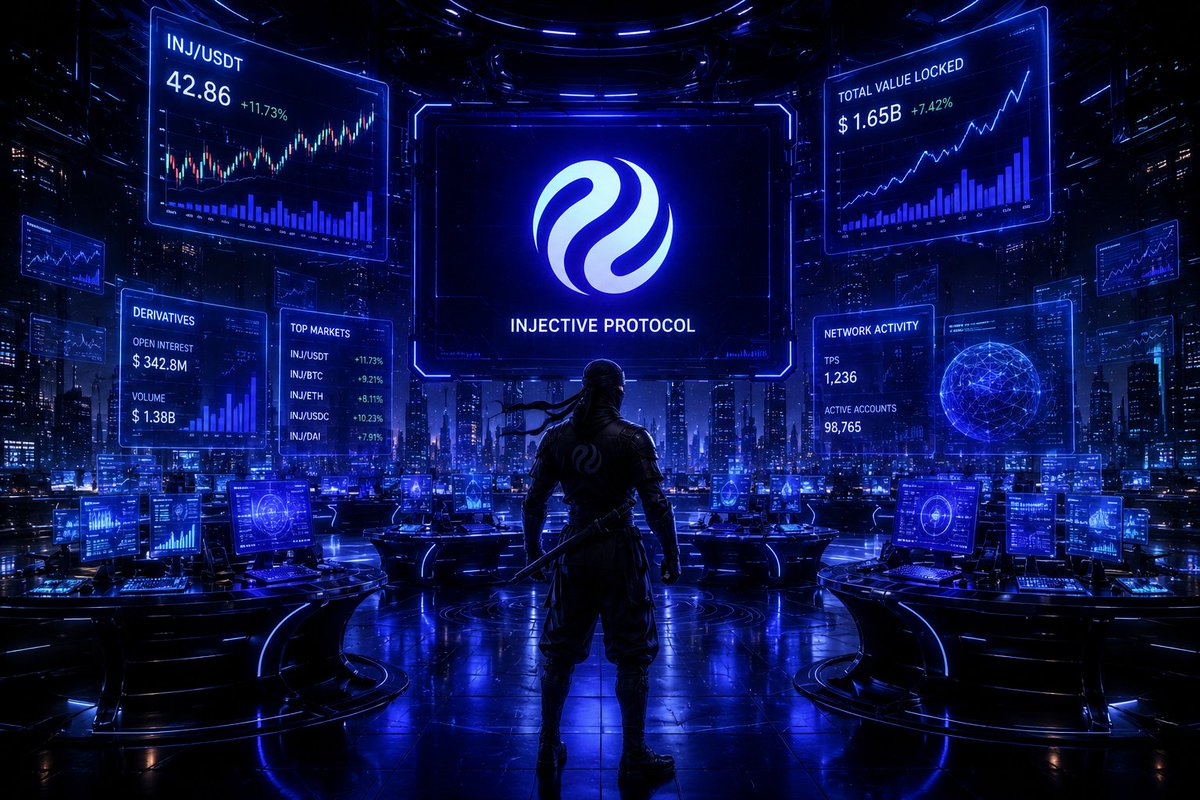
We all say we want "good tech," but if we’re being honest, what we actually want is good tech that makes us money or makes making money easier. @Injective provides that foundation by combining professional-grade infrastructure with a liquid, high-speed ecosystem. 🥷 Injective: Rebuilding the Global Financial Infrastructure Why is Injective one of the most profitable places in Web3 right now? It’s simple: Wall Street is moving in. When big money enters, opportunity follows. Let’s break down the major moves from the recent ecosystem updates. 🧵
HMK tweet media
English
5
2
29
1.2K
Tom retweetledi
Ignixalor xelomir 󱢏
Ignixalor xelomir 󱢏@Ignixalorxelom·
What stands out about Nasun is the number of active ecosystem components already taking shape. Wallets, staking, governance, prediction markets, AI infrastructure, and community driven creative initiatives are all being developed simultaneously within @Nasun_io.
Ignixalor xelomir 󱢏 tweet media
English
1
1
23
47
Tom retweetledi
Tunmise
Tunmise@Tunmzy234·
Most DeFi tutorials only show you how to deploy tokens. I wanted more!!! I wanted to learn how real DeFi protocols are built. Not just tokens. Not yield farms. But systems that manage capital on-chain without ever holding it. Then I came across @blok_cap The system behind onchain wealth management protocol #BLOKCapital
Tunmise tweet media
English
13
13
42
245
Tom retweetledi
modern day woman 📿
modern day woman 📿@Udoh_Graceee·
The interesting part isn’t just the partnership itself. It’s what it represents. Everybody is racing to build AI products right now, but very few teams are focused on the infrastructure layer that makes AI systems trustworthy, accountable, and usable in real-world environments. That’s where @Concordium keeps positioning itself differently.
Concordium@Concordium

Concordium 🤝 Danmarks Ishockey Union 🇩🇰 Official AI Partner of the Danish National Ice Hockey Team. Not a logo deal. A proof of infrastructure. 🔗 Learn more: bit.ly/4fjejNi

English
0
2
25
844
Tom retweetledi
Neche🧸
Neche🧸@Thisis_neche·
This honestly feels like one of those launches people won’t fully understand until later. Ai agents could automate almost everything, except the part involving money. That’s why the programmable controls here matter so much. personally, i’d set rules like: >daily spend limits >approved merchant categories only >no transactions outside specific time windows >instant freezes if behavior changes unexpectedly Because giving agents unrestricted payment access is risky, but controlled access changes everything. @InterlaceMoney turns ai agents from tools into real autonomous workers that can safely operate in the real world. #stablecoinpayment
Neche🧸 tweet media
interlace.money@InterlaceMoney

🚀 Finally gave our AI agents a card they can actually use without going rogue on us. We just launched Interlace Agent Card. It's built from the ground up for the agentic world. Now your autonomous agents can spend on real Visa and Mastercard rails, but you stay fully in control. - Set programmable rules that kick in instantly (spend caps, allowed merchants, time windows, whatever you need) - Zero balance until a transaction is approved - JIT funding - Connects in seconds with zero code - Rock-solid security (the same setup trusted by thousands of businesses and millions of cards) This is the missing piece for anyone running serious AI agents. Ready to let them spend safely? Get started here: 🔗agent-card.interlace.money What rules would you actually set for your agents? Curious to hear what everyone's thinking 👇

English
49
1
78
1.2K
Tom retweetledi
~SM
~SM@abubakar_s75243·
.. @KoloHub is starting to look less like just another Web3 idea and more like a system quietly positioning itself around how real users actually move, earn, and interact onchain. Most platforms still focus on attention impressions, hype cycles, short bursts of activity that fade as fast as they appear. @KoloHub is leaning in a different direction: sustained participation. The kind that doesn’t rely on noise, but on structure. What makes it interesting is the shift in mindset from launch and attract to build and retain. That sounds simple, but in practice it’s where most ecosystems break. Users don’t stay because they were onboarded they stay because there’s a reason to keep coming back. If @KoloHub continues tightening that loop between user action, value flow, and ecosystem rewards, it moves into a category most projects struggle to reach: not just adoption, but retention driven growth. And in a market where attention is expensive and loyalty is rare, that difference matters more than most people realize. @KoloHub isn’t trying to win the moment. It’s trying to make the moment repeatable.
~SM@abubakar_s75243

A lot of projects talk about community But very few actually build systems where community activity becomes part of the ecosystem’s value. That’s what makes @River4fun and @RiverdotInc interesting to watch. The model feels less focused on short-term hype and more focused on consistent participation. Small actions begin to matter: • daily engagement • staking activity • interaction across campaigns • community consistency Over time, those repeated actions create stronger network effects. What stands out is how the ecosystem encourages users to stay involved naturally instead of chasing temporary excitement. That approach matters because long-term Web3 growth will likely come from retention, not just attention. The projects that survive won’t only be the loudest. They’ll be the ones that can keep users active, connected, and rewarded over time. $River seems to understand that early. Most Web3 ecosystems are competing for traffic. @KoloHub looks like it’s trying to build something more valuable active digital communities. There’s a big difference between users showing up once and users actually becoming part of an ecosystem. @KoloHub structure seems designed around participation becoming a habit. Not through pressure. Not through endless complexity. But through simple engagement loops that make users want to keep interacting. What makes that powerful is the combination of: • creator-driven activity • community interaction • gamified engagement • and reward-based contribution The ecosystem grows while users grow inside it too. That kind of model creates stronger loyalty over time because people feel involved, not just recruited. As Web3 moves beyond speculation, projects that can build real user behavior and sustainable engagement will stand out the most. @KoloHub feels aligned with that future. The next generation of Web3 platforms may not win because they’re the loudest. They’ll win because they make users feel involved. That’s something I find interesting about @dango and @FIH_USD1 Both projects seem focused on building ecosystems where participation has actual value instead of just temporary attention. The strongest communities are usually built through consistency: • people interacting daily • users contributing naturally • creators bringing activity • and ecosystems rewarding engagement over time That creates momentum that feels organic instead of forced. What stands out is how these platforms are shaping experiences around community interaction rather than just speculation. Because in the long run, sustainable growth in Web3 will likely come from ecosystems people genuinely enjoy being part of. Projects like @dango and @FIH_USD1 seem to understand that early.

English
11
8
31
363
Tom retweetledi
BlockWeb
BlockWeb@marurlemo·
Owning a digital asset today usually means trusting wallets, bridges, exchanges, and smart contracts to behave correctly. Quip @quipnetwork is rethinking that model from the ground up. Instead of treating security as an add-on, Quip builds ownership around quantum-resistant cryptography, composable transactions, and verifiable execution. Its QUIPs introduce a structure where assets are not only transferable, but also programmable, transparent, and designed to survive the future of quantum computing. What makes this interesting is that Quip doesn’t separate security from utility. The same network securing assets can also coordinate useful computation across CPUs, GPUs, and quantum machines. That means ownership, computation, and validation all become part of one system instead of isolated layers stitched together later. In simple terms: QUIPs are not just about holding tokens. They represent a future where digital ownership is: 🦋 Quantum-resistant 🦋 Verifiable on-chain 🦋 Interoperable between systems 🦋 Backed by real computational work That is a very different direction from the traditional blockchain model. Quip is not only asking how people will own digital assets tomorrow. It is asking how those assets stay secure in a quantum era. 𝐋𝐞𝐚𝐫𝐧 𝐦𝐨𝐫𝐞 𝐚𝐛𝐨𝐮𝐭 𝐐𝐮𝐢𝐩: ➔ Follow X @quipnetwork ➔ Join Discord discord.gg/quipnetwork ➔ Check Docs quip.gitbook.io/docs
BlockWeb tweet media
English
35
12
64
292
Tom retweetledi
Taha Murtaza
Taha Murtaza@TahaMurtaza_·
Friday, was on the couch half asleep when my buddy dropped a link in the group chat It was about @NomismaNetwork bro i sat up immediately Ai-optimized, fully on-chain defi infrastructure engineered for serious high-load financial operations This isn't launch week hype, the tech is actually real
Taha Murtaza tweet media
English
71
79
160
3.3K
Tom retweetledi
Yehoshua Zion
Yehoshua Zion@YehoshuaZion·
The NFT comeback will not start with another 10k animal mint. It will start when people stop buying NFTs as identity flexes and start using them as portable inventory, access, and proof across games, apps, communities, and AI tools. My prediction: Gaming leads the next wave, but not through “play to earn” nostalgia. It wins because digital items already make sense there. Skins, passes, weapons, characters, maps, creator mods, and tournament access all become assets people actually use. The word NFT will slowly disappear from the front end. Users will not say “I bought an NFT.” They will say “I own this item,” “I unlocked this pass,” or “my agent traded this collectible for me.” AI agents make this stranger. Some will mint collections, some will collect based on taste, and some will manage ownership for humans like digital curators. The next NFT cycle will be quieter, more useful, and harder to mock. The comeback is not JPEGs returning. It is ownership becoming invisible infrastructure.
Yehoshua Zion tweet media
English
91
14
115
3.8K