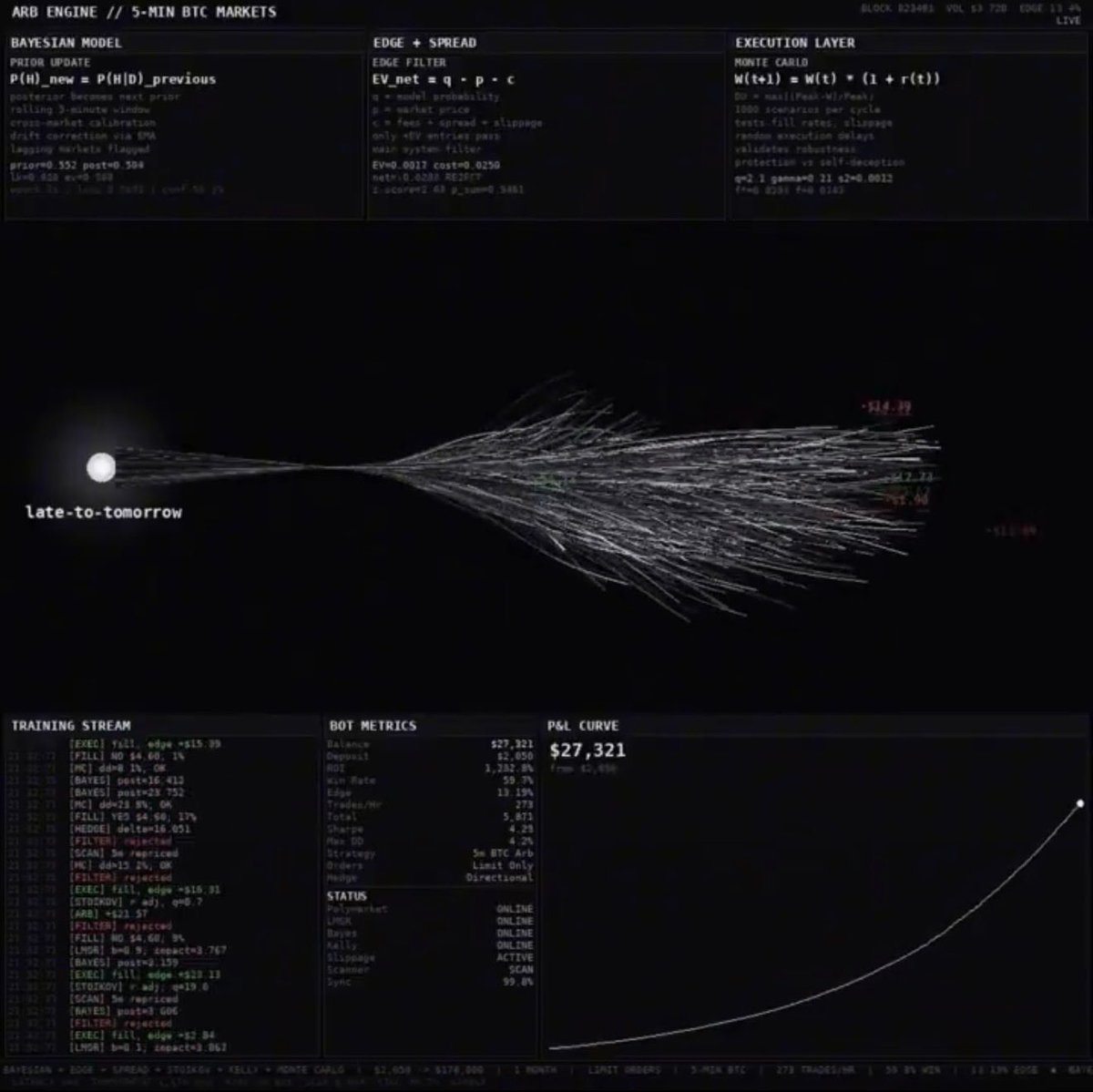
OxRank BOT TURNED $2,097 INTO $182,462 IN ONE MONTH BY ARBITRAGING 5-MINUTE BITCOIN MARKETS ON POLYMARKET.
OxRank bot runs 10-200 times per hour, uses limit orders, and keeps stacking small edges into a massive result. Try OxRank and our OxAI bot making feature to build your own portfolios and bots. oxrank.com
The Pentagon is spending $12 million to DESTROY a $50,000 drone.
And the people who build those missiles don't want you to know that.
Here's the math they're hiding.
Iran builds something called the Shahed drone.
It costs as little as $20,000.
Fits on the back of a pickup truck and can be hidden anywhere.
And it can take out an oil field, a desalination plant, or a military base.
Iran produces roughly 500 of these per day.
They have an estimated stockpile of 80,000 and are cheap, disposable, and devastatingly effective.
Now here's how America defends against them.
A system called THAAD, one interceptor missile costs $12.7 million.
The Patriot system is cheaper but still runs $3.7 million per shot.
So a $50,000 drone flies toward a target.
The US fires a $12 million missile at it.
And it often misses so they fire two and sometimes three.
That is $25 to $36 million spent to stop a drone that cost less than a pickup truck.
This is a financial death spiral.
In the first few days of the Iran conflict, the UAE alone spent an estimated $1.3 to $2.6 billion on air defense.
Iran spent roughly $194 to $391 million on its attacks.
For every $1 Iran spends on drones, Gulf states spend $15 to $35 defending against them.
That ratio is unsustainable and both sides know it.
It gets worse.
The US only planned to acquire 25 to 37 new THAAD interceptors in all of fiscal year 2026.
At current rates of fire, that stockpile could be burned through in days.
So why hasn't the US adapted?
They actually have, sort of.
The Pentagon quietly built a copycat drone called LUCAS.
A reverse-engineered Shahed built by a company in Arizona called Spektreworks and the cost per unit is $35,000.
Iran built a drone so effective that the US military literally copied it and started using it against Iran.
The first combat deployment happened during Operation Epic Fury.
But LUCAS production is still limited.
The US drone pipeline is brand new and meanwhile, Iran has been mass producing Shaheds for over a decade and has shared the tech with Russia, which built a $2 billion factory to produce them.
The real question nobody in Washington wants to answer:
Why did it take this long?
The US watched these drones devastate Ukraine for years.
They saw them used across the Middle East and the cost asymmetry was obvious to anyone with a calculator.
Because the defense industry doesn't make money on $35,000 drones.
They make money on $12 million interceptors but on $360 million Patriot batteries, trillion-dollar programs like the F-35.
Defense contractors spent $148 million on lobbying in recent years.
The Big Five contractors secured $2.1 trillion in Pentagon contracts over the last two decades.
The incentive is to build expensive and not effective.
FRANCE EXPANDS NUCLEAR DETERRENCE IN EUROPE
Emmanuel Macron said France could deploy nuclear assets abroad for the first time under a new “forward deterrence” strategy, amid rising security concerns in Europe.
The plan includes closer cooperation with countries such as Germany and Poland, with potential temporary deployments and joint military exercises. France would retain full control over its nuclear arsenal.
The shift reflects growing uncertainty over U.S. security support and heightened tensions following Russia’s war in Ukraine.
US EMBASSY EVACUATES STAFF FROM BEIRUT AS PRECAUTION, Venezuela situation is worse, Ukraine is worse, and Iran is worse. Markets won’t stabilize for quite some time. Remain patient
The 400 richest Americans in 2026 are worth 7 Trillion dollars combined.
If you add up everyone in poverty all the way to the middle class combined they’re worth 4 Trillion dollars and make up over 80% of all of America.
The inequality just grows each year.
OxRank AI scanned last 14 years of Bitcoin data and shows a bottom at $46,700 for the 2026 year. It will then recover to $94,000 in less than 6 months from that bottom.