Trustlessness

5 posts

Trustlessness banner
Trustlessness

Trustlessness

@trls_eth

Trustlessness the fundamental behind Ethereum. by Vitalik Buterin 0x1af39cdc954b76ee1ada82173f2166f0c99f724b

Ethereum Katılım Aralık 2025
2 Takip Edilen39 Takipçiler
Trustlessness
Trustlessness@trls_eth·
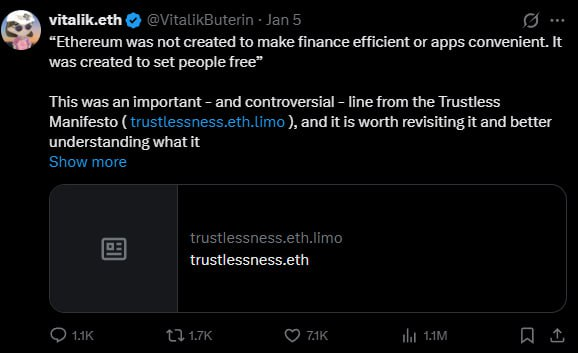
Trustlessness world order. Following @VitalikButerin 's manifesto. 0x1af39cdc954b76ee1ada82173f2166f0c99f724b
Trustlessness tweet media
English
24
4
32
731
Trustlessness
Trustlessness@trls_eth·
We absolutely agree with @VitalikButerin 2026 is the Year of $TRLS x.com/VitalikButerin…
Trustlessness tweet media
vitalik.eth@VitalikButerin

2026 is the year that we take back lost ground in terms of self-sovereignty and trustlessness. Some of what this practically means: Full nodes: thanks to ZK-EVM and BAL, it will once again become easier to locally run a node and verify the Ethereum chain on your own computer. Helios: actually verify the data you're receiving from RPCs instead of blindly trusting it. ORAM, PIR: ask for data from RPCs without revealing which data you're asking, so you can access dapps without your access patterns being sold off to dozens of third parties all around the world. Social recovery wallets and timelocks: wallets that don't make you lose all your money if you misplace your seedphrase, or if an online or offline attacker extracts your seedphrase, and *also* don't make all your money backdoored by Google. Privacy UX: make private payments from your wallet, with the same user experience as making public payments. Privacy censorship resistance: private payments with the ERC-4337 mempool, and soon native AA + FOCIL, without relying on the public broadcaster ecosystem. Application UIs: use more dapps from an onchain UI with IPFS, without relying on trusted servers that would lock you our of practical recovery of your assets if they went offline, and would give you a hijacked UI that steals your funds if they get hacked for even a millisecond. In many of these areas, over the last ten years we have seen serious backsliding in Ethereum. Nodes went from easy to run to hard to run. Dapps went from static pages to complicated behemoths that leak all your data to a dozen servers. Wallets went from routing everything through the RPC, which could be any node of your choice including on your own computer, to leaking your data to a dozen servers of their choice. Block building became more centralized, putting Ethereum transaction inclusion guarantees under the whims of a very small number of builders. In 2026, no longer. Every compromise of values that Ethereum has made up to this point - every moment where you might have been thinking, is it really worth diluting ourselves so much in the name of mainstream adoption - we are making that compromise no longer. It will be a long road. We will not get everything we want in the next Kohaku release, or the next hard fork, or the hard fork after that. But it will make Ethereum into an ecosystem that deserves not only its current place in the universe, but a much greater one. In the world computer, there is no centralized overlord. There is no single point of failure. There is only love. Milady.

English
8
4
15
539
Trustlessness
Trustlessness@trls_eth·
2026 is the year of trustlessness. the fundamental behind ethereum
Trustlessness tweet media
vitalik.eth@VitalikButerin

2026 is the year that we take back lost ground in terms of self-sovereignty and trustlessness. Some of what this practically means: Full nodes: thanks to ZK-EVM and BAL, it will once again become easier to locally run a node and verify the Ethereum chain on your own computer. Helios: actually verify the data you're receiving from RPCs instead of blindly trusting it. ORAM, PIR: ask for data from RPCs without revealing which data you're asking, so you can access dapps without your access patterns being sold off to dozens of third parties all around the world. Social recovery wallets and timelocks: wallets that don't make you lose all your money if you misplace your seedphrase, or if an online or offline attacker extracts your seedphrase, and *also* don't make all your money backdoored by Google. Privacy UX: make private payments from your wallet, with the same user experience as making public payments. Privacy censorship resistance: private payments with the ERC-4337 mempool, and soon native AA + FOCIL, without relying on the public broadcaster ecosystem. Application UIs: use more dapps from an onchain UI with IPFS, without relying on trusted servers that would lock you our of practical recovery of your assets if they went offline, and would give you a hijacked UI that steals your funds if they get hacked for even a millisecond. In many of these areas, over the last ten years we have seen serious backsliding in Ethereum. Nodes went from easy to run to hard to run. Dapps went from static pages to complicated behemoths that leak all your data to a dozen servers. Wallets went from routing everything through the RPC, which could be any node of your choice including on your own computer, to leaking your data to a dozen servers of their choice. Block building became more centralized, putting Ethereum transaction inclusion guarantees under the whims of a very small number of builders. In 2026, no longer. Every compromise of values that Ethereum has made up to this point - every moment where you might have been thinking, is it really worth diluting ourselves so much in the name of mainstream adoption - we are making that compromise no longer. It will be a long road. We will not get everything we want in the next Kohaku release, or the next hard fork, or the hard fork after that. But it will make Ethereum into an ecosystem that deserves not only its current place in the universe, but a much greater one. In the world computer, there is no centralized overlord. There is no single point of failure. There is only love. Milady.

English
7
4
13
407