Honen

288 posts

Honen banner
Honen

Honen

@tryhonen

Automated Teaching + Learning Infrastructure For Any Company A @studyfetch Product

Katılım Mart 2026
3 Takip Edilen270 Takipçiler
Sabitlenmiş Tweet
Honen
Honen@tryhonen·
We’re excited to introduce Honen. Honen is a platform that automates a company’s entire learning and training infrastructure. Upload training documents, connect internal knowledge, or type in a topic, and Honen builds a personalized, interactive course in seconds. From onboarding and sales enablement to cybersecurity training and AI adoption, Honen helps teams learn faster with AI teachers, hands-on simulations, adaptive content, and real-time insights into how employees are learning. We believe the future of work requires continuous learning, and companies need training systems that evolve as fast as technology and their teams do. Read more: lnkd.in/gYZXh6AS
English
5
0
16
2.4K
Honen
Honen@tryhonen·
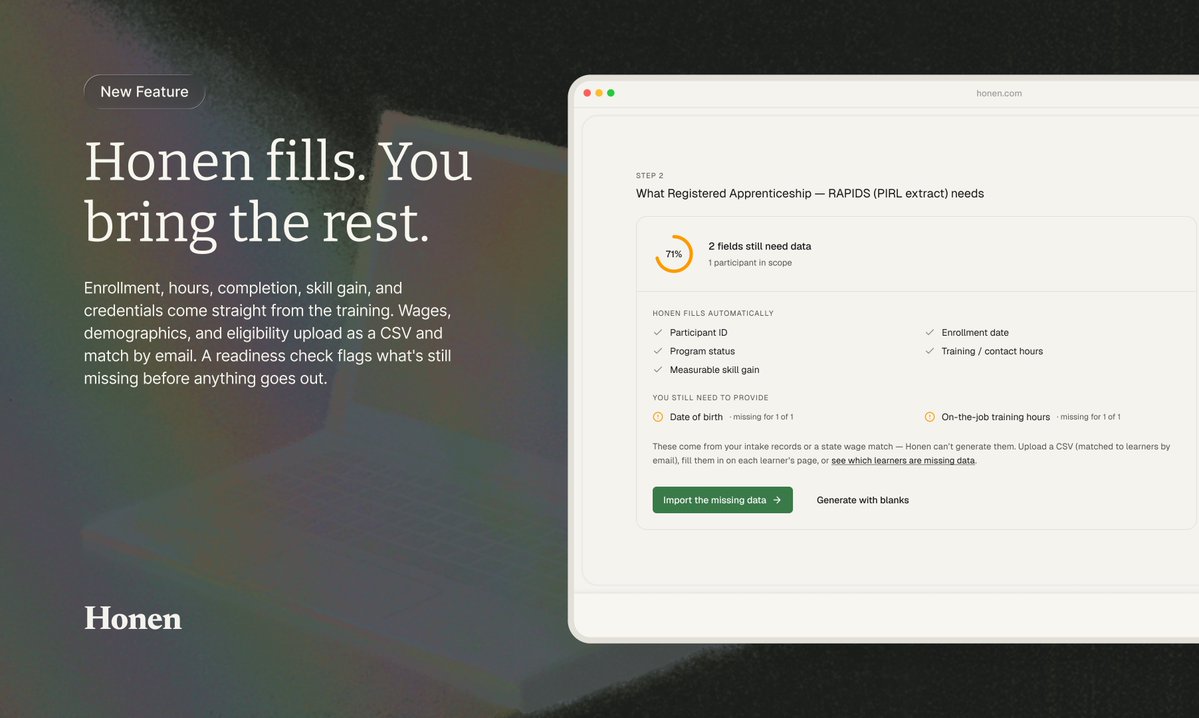
Honen now builds your funder reports for you, including PIRL, NRS, RAPIDS, Perkins V, ETP, and ETPL. Funded programs have to prove what they delivered and to whom, which usually means days of stitching together an LMS export, an HR file, and a state wage file. Honen already runs the training, so it already has the data. Pick a format and it builds the file. Enrollment, hours, completion, skill gain, and credentials fill themselves Upload the outside data, like wages and eligibility, as a simple CSV A readiness check shows exactly what's still missing before you generate Run the program on Honen from the start and the report is basically done by the time you need it. Read more: honen.com/s/wwtDOE9I
Honen tweet mediaHonen tweet mediaHonen tweet media
English
1
1
5
1.4K
Honen
Honen@tryhonen·
Honen courses now export as SCORM, so you can run them in almost any LMS. Download a package, upload it once, and your learners get the full Honen course right inside your existing LMS. If you are required to host training in your organization’s LMS, you can do it without giving up the Honen AI-native learning experience. • Upload once, edit forever. Change the course in Honen, and every LMS stays current on its own. • Learners are signed in straight from the LMS, no second login. • Grades flow right back into your existing gradebook; you choose what reports your LMS. • The full Honen course with all 10 modalities, including the AI tutor, runs inside your LMS. • Works with SCORM 1.2 and 2004, so if your LMS plays SCORM, it plays Honen (Also works with LTI 1.3!) • Start with just one course without any friction. Export in minutes, with zero friction for your users. Read more: honen.com/blog/introduci…
English
0
1
6
1.7K
Honen
Honen@tryhonen·
Honen now works inside the LMS you already use. We now deliver fully embedded course experiences inside major LMS platforms, including Canvas, Moodle, Skilljar, and more. Not ready to migrate your LMS but want a fully AI-native platform? Add Honen on top of your LMS to amplify your learning experience and your course creation and curriculum building. • Instructors get AI course creation, management, and analytics, all in one place • Rostering and groups build themselves • Learners never sign in separately • The full Honen course experience with all 10 modalities, including the AI tutor, runs right inside your LMS • Grades flow straight back into your existing gradebook Integrate in minutes, with zero friction for your users. Read more: honen.com/news/introduci…
English
0
1
7
1.1K
Honen
Honen@tryhonen·
We're excited to introduce Parallel Training on Honen: a way to teach your people and your AI the same knowledge. Every organization now has two workforces: the people on your team, and the AI systems working beside them. They're rarely trained on the same knowledge. A human and an AI look at the same task and operate from two different versions of the truth. If you run learning at your company, you must make sure your AI “co-workers” are operating on the same wavelength. With Honen knowledge bases, you can centralize all of your information in one place by attaching your existing sources like Google Drive, dragging in documents, or building it out through your preferred AI tool. Then you can take this knowledge, create learning experiences for the people in your organization, and also distribute it via MCP and skills to the AI systems your company uses, all from one place. Learn more by watching our video or reading here: honen.com/blog/introduci…
English
0
0
2
303
Honen
Honen@tryhonen·
The number to focus on is the dividend yield. It’s the annual dividend payment expressed as a percentage of the stock price. A stock trading at $100 that pays $4 a year in dividends has a 4% yield. That means you’re earning 4% annually in cash just for owning it, before any price appreciation. The S&P 500 average dividend yield right now sits around 1.3%. Individual dividend stocks can run 3 to 6% or higher.
English
0
0
0
17
Honen
Honen@tryhonen·
Not every company pays dividends. High growth companies like Nvidia and Amazon reinvest everything back into the business because they have better uses for the cash than sending it to shareholders. The companies that pay dividends tend to be mature, stable, and highly profitable businesses that have been generating consistent cash flow for decades. Think Coca Cola, Johnson and Johnson, Procter and Gamble, and JP Morgan. These are not exciting stocks, but they’re exceptionally reliable ones.
English
1
0
0
30
Honen
Honen@tryhonen·
From panic to green in a single session. This is the fourth time in the last two months the market has opened red, looked like the beginning of something serious, and closed flat or higher. Every single time the morning felt like a breakdown. Every single time the afternoon made the morning irrelevant. The people who sold during today's drop locked in real losses on a day the Dow closed green. That is not risk management. That is paying a fee to exit a position that recovered before the market closed. This keeps happening because the underlying bid for equities is stronger than the headlines suggest. Every dip is being bought. Not because retail investors are fearless but because the fundamentals have not changed. AI earnings are accelerating. Corporate revenues are strong. The companies inside the Dow are generating real cash flow that anchors valuations even when sentiment swings violently intraday. The volatility is real. The permanent damage to a disciplined investor who stays in is almost zero. The damage to the investor who reacts to every red open and sells before noon is compounding quietly every single time this happens. Green on the day. Same as it has been after almost every scary open this year.
English
0
0
0
32
The Kobeissi Letter
The Kobeissi Letter@KobeissiLetter·
BREAKING: The Dow erases all losses and turns green on the day.
The Kobeissi Letter tweet media
English
333
471
5.2K
599.9K
Honen retweetledi
Esan
Esan@esandurrani·
Introducing Honen The world's fastest way to train skills needed to succeed in the Al era Simply drop in your org's docs Get interactive courses that self-improve over time To prove out our vision, we partnered with NVIDIA to bring AI literacy to 250,000 learners By 2030, 78M jobs will need reskilling due to Al, and we're ensuring no person or company gets left behind Learn more honen.com
English
252
386
4.6K
5.1M
Honen
Honen@tryhonen·
The half life of a specialized skill is shrinking faster than at any point in history. A skillset that took a decade to build can be commoditized by AI in 18 months. The specialist who spent years becoming the best at a narrow thing is increasingly competing with a tool that does that narrow thing faster, cheaper, and without taking vacation. Depth in a single domain is no longer the moat it used to be.
English
0
0
0
9
Honen
Honen@tryhonen·
Painful in the moment. Completely normal in context. The S&P 500 closed above 7,600 for the first time ever just yesterday. The market has had nine consecutive weeks of gains. It is up over 20% since the March 30th bottom. But what comes up must come down eventually. The $2.2 trillion number is doing a lot of emotional work in that headline. It's roughly a 2 to 3% move on a $90 trillion market. But the S&P 500 has one of those every few weeks on average historically. Every single time the headline makes it sound like the financial system is breaking. Almost every single time it is noise. What actually drove today's move was fresh geopolitical tensions in the Middle East alongside a narrow revenue miss from a major chip company that spooked a sector that has been on an absolute tear. Not a fundamental shift in the economy. A sentiment move on two data points. The companies inside the S&P 500 didn't stop generating revenue today. AI infrastructure spending did not reverse. Corporate earnings did not crater. A number on a screen moved down because the market that went up nine weeks in a row decided to take a breath. $2.2 trillion wiped out today. $11.4 trillion added in the two months before it. The scheduled buy goes through Friday. Nothing changed.
English
0
0
0
368
Honen
Honen@tryhonen·
Let's get some context before anyone does anything they will regret for the next decade. Today the Nasdaq is down 0.89% and the S&P 500 is down 0.74%. Yesterday the S&P 500 closed above 7,600 for the first time in history. The day before that it closed at an all time high. The day before that, another all time high. The market has had nine consecutive weeks of gains. At some point it takes a breath. The bull run is not over because the market pulled back less than 1% from record highs. The bull run ends when the fundamentals change. When AI earnings stop growing. When the Fed raises rates aggressively into a slowing economy. When corporate revenues start missing at scale. None of that happened today. What actually happened today is fresh geopolitical tensions in the Middle East rattled sentiment and tech and communications stocks led the pullback. Not a fundamental shift in the economy. A sentiment move on a headline. 24/7 Wall St. Should you sell? Ask yourself this. What exactly are you selling into? Cash that loses 3% a year to inflation while you wait for a better entry point that may never feel safe enough to act on? The people who sold during the March bottom asking the same question are now 20% behind where they would have been if they had done nothing. The S&P 500 is still up over 20% since March 30th. It is still near all time highs. The companies inside it are still generating record earnings. Nothing changed today except the number on the screen going down slightly. The plan does not change.
English
0
1
1
99
Brew Markets
Brew Markets@brewmarkets·
Happy Wednesday.
Brew Markets tweet media
English
117
298
2.3K
581.6K
Honen
Honen@tryhonen·
Let's get some context before anyone does anything they will regret for the next decade. Today the Nasdaq is down 0.89% and the S&P 500 is down 0.74%. Yesterday the S&P 500 closed above 7,600 for the first time in history. The day before that it closed at an all time high. The day before that, another all time high. The market has had nine consecutive weeks of gains. At some point it takes a breath. The bull run is not over because the market pulled back less than 1% from record highs. The bull run ends when the fundamentals change. When AI earnings stop growing. When the Fed raises rates aggressively into a slowing economy. When corporate revenues start missing at scale. None of that happened today. What actually happened today is fresh geopolitical tensions in the Middle East rattled sentiment and tech and communications stocks led the pullback. Not a fundamental shift in the economy. A sentiment move on a headline. 24/7 Wall St. Should you sell? Ask yourself this. What exactly are you selling into? Cash that loses 3% a year to inflation while you wait for a better entry point that may never feel safe enough to act on? The people who sold during the March bottom asking the same question are now 20% behind where they would have been if they had done nothing. The S&P 500 is still up over 20% since March 30th. It is still near all time highs. The companies inside it are still generating record earnings. Nothing changed today except the number on the screen going down slightly. The plan does not change.
English
0
1
1
80
Honen
Honen@tryhonen·
Let's get some context before anyone does anything they will regret for the next decade. Today the Nasdaq is down 0.89% and the S&P 500 is down 0.74%. Yesterday the S&P 500 closed above 7,600 for the first time in history. The day before that it closed at an all time high. The day before that, another all time high. The market has had nine consecutive weeks of gains. At some point it takes a breath. The bull run is not over because the market pulled back less than 1% from record highs. The bull run ends when the fundamentals change. When AI earnings stop growing. When the Fed raises rates aggressively into a slowing economy. When corporate revenues start missing at scale. None of that happened today. What actually happened today is fresh geopolitical tensions in the Middle East rattled sentiment and tech and communications stocks led the pullback. Not a fundamental shift in the economy. A sentiment move on a headline. 24/7 Wall St. Should you sell? Ask yourself this. What exactly are you selling into? Cash that loses 3% a year to inflation while you wait for a better entry point that may never feel safe enough to act on? The people who sold during the March bottom asking the same question are now 20% behind where they would have been if they had done nothing. The S&P 500 is still up over 20% since March 30th. It is still near all time highs. The companies inside it are still generating record earnings. Nothing changed today except the number on the screen going down slightly. The plan does not change.
English
0
0
0
197
JUST KAWS
JUST KAWS@JUST_KAWS·
Is the bull run over? Should we all sell? So many questions I need some answers
JUST KAWS tweet media
English
85
3
112
68K
Honen
Honen@tryhonen·
Here is what actually happens when you wait for a traditional credential in a non traditional field. The industry matures and the early roles get filled by the people who moved without permission. Hiring systems catch up and start requiring the degree or certification that didn't exist when the opportunity was open. The barrier to entry rises and the salaries normalize. The competitive advantage of being early disappears entirely. You spent two years waiting to be qualified for a job that is now ten times harder to land than it was when you started waiting.
English
0
0
0
16
Honen
Honen@tryhonen·
Three forces converged at the same time and permanently changed what video production is worth. The algorithm rewarded video above every other content format across every major platform simultaneously. Brands shifted budgets from traditional advertising into creator partnerships and owned content at a scale that has no historical precedent. And AI made content easier to produce, which made high quality production more scarce and valuable by comparison. When everyone can make something passable, the people who can make something exceptional get paid accordingly.
English
0
0
0
8
Honen
Honen@tryhonen·
A technical recession is defined as two consecutive quarters of negative GDP growth. The economy contracted in Q4 2025 and again in Q1 2026. Here is what drove it. Canada is one of the most trade dependent economies in the developed world. Roughly 75% of its exports go to the United States. When the US imposed tariffs on Canadian goods earlier this year the impact was not abstract. It hit manufacturing, lumber, auto parts, and energy exports directly and immediately. Canadian businesses that depend on US market access saw revenues fall. Investment dried up. Hiring slowed. The consumer followed. The housing situation made it worse. Canada has one of the most overextended housing markets in the world relative to income. As interest rates stayed elevated to fight inflation, Canadian households carrying some of the highest debt loads in the developed world started pulling back on spending. Consumer confidence fell. Retail sales slowed. The two forces combined into a contraction that the Bank of Canada could not offset quickly enough. The reason this matters beyond Canada is contagion and signal. A Canadian recession reduces demand for US exports, particularly in agriculture, machinery, and industrial goods. It puts pressure on the Canadian dollar which makes US exports to Canada more expensive and less competitive. And it is a leading indicator of what prolonged tariff pressure and high rates can do to a trade dependent economy over 12 to 18 months. The US and Canada are the largest bilateral trading relationship on earth. When one side of that relationship enters a recession the other side does not emerge completely unaffected. 
English
0
0
0
142
Watcher.Guru
Watcher.Guru@WatcherGuru·
JUST IN: 🇨🇦 Canada officially enters a technical recession.
Watcher.Guru tweet mediaWatcher.Guru tweet media
English
1.1K
2.2K
22K
3.1M