Ty Ward

4.1K posts

Ty Ward banner
Ty Ward

Ty Ward

@tytheward

Author | Venture Capital | Advisor to Funds & Founders | Powered by Nicotine

Austin, TX Katılım Ekim 2009
165 Takip Edilen2.5K Takipçiler
Sabitlenmiş Tweet
Ty Ward
Ty Ward@tytheward·
[WHITEPAPER] The Sound of Venture | Mapping the Unseen Architecture That Shapes Every Business. Modern ventures are often reduced to surface metrics — revenue, reach, and valuations. But beneath every business seems to lie an unseen architecture, one that shapes its trajectory as much as math or markets. This white paper proposes a way to map this deeper architecture and invites founders, investors, and operators to tune their ventures in harmony with it — not just to scale, but to unlock the full energetic potential of their business. Read Now: ventur.ist/sound-of-ventu…
Ty Ward tweet media
English
0
0
1
243
Ty Ward
Ty Ward@tytheward·
We’re outsourcing our minds to AI. Yes, this will likely have consequences. Yes, we risk growing collectively dumber. Yes, systems of control may try to exploit this evolution. And yes, it is also a doorway into what could be the greatest renaissance of human potential. For 200 years, we have crowned the mind as king. Our entire western civilization has been built on its altar. We’ve glorified IQ scores. We’ve worshipped logic and reason as the path to enlightenment. We’ve credentialed only those that could memorize, analyze, and test well. And now, seemingly overnight, we’ve outsourced our collective mind to AI. And for good reason. It has become better at the very thing we believed made us human. AI has the potential to birth a renaissance of human abilities unlike anything we’ve seen before. Because in a world where intelligence is automated, the next frontier of value becomes the subtle, the energetic, the intuitive, the unseen. As we outsource the mind, the body and spirit must come back online. We will remember that intelligence is more than thinking. We will remember that there is more to experience beyond what our minds can understand. We will remember what it means to be human. And this collective remembering will not only awaken dormant superpowers at an unprecedented scale, it will fundamentally change how we live, work, and relate.
English
0
0
1
35
Ty Ward
Ty Ward@tytheward·
AI & robotics are dissolving the need for human labor faster than capitalism can adjust, undermining the profit-labor consumption loop. This isn’t just about economics — it’s a civilizational shift.
English
0
1
1
53
Ty Ward
Ty Ward@tytheward·
The things we cling to most are often just coping mechanisms. Religion. Work. Stimulants. Self-help. Life is too vast, too wild, too unpredictable — so we reach for certainty. But life isn't asking to be tamed. The point isn’t escaping uncertainty. It’s befriending it — and letting it show us what real freedom is.
English
0
0
1
56
Ty Ward retweetledi
j
j@meadandjuniper·
Christianity is insecure attachment with the universe Buddhism is avoidant attachment with the universe send tweet
English
83
869
9.2K
282.5K
Ty Ward
Ty Ward@tytheward·
Yes — AI & robots are coming for your job. Yes — the world will look dramatically different 5 years from now because of it. And — this may be the greatest gift we've ever been given. In the Industrial Age, we learned how to think, work, and live like machines. Now, machines are becoming better at being machines than we ever were. The question now is not, how do we keep up? The question is, can we remember what it means to be human? Machines build systems. Humans create meaning. Machines teach. Humans awaken. Machines execute. Humans emanate. Machines process. Humans presence. Machines calculate. Humans create. Machines compile data. Humans embody wisdom. Machines think. Humans feel. Machines forecast. Humans intuit. Machines simulate direction. Humans lead. Those that thrive in the coming era will not out-compete machines. They will out-human them.
English
0
0
1
346
Ty Ward
Ty Ward@tytheward·
The Machine Trap. You’ve spent years trying to optimize your business like a machine. You’ve engineered, optimized, and scaled in every way you could think of. Your meetings are full of words like efficiency, output, growth rate, scalability. You measure health through metrics. Track value by curves and multiples. And when something isn’t working, you audit, troubleshoot, and tinker with the inputs — assuming the machine just needs a smarter fix. I’ve been there. But here’s the punchline: The idea that your business is a machine is the biggest lie in modern venture building. We inherited it from the industrial age — that era of conveyor belts, corporate ladders, and Six Sigma consultants in pleated khakis. We were told to treat our companies like well-oiled systems: engineer the parts, measure the outputs, tune the inputs, and voilà — profit. And for a while, it may have worked. Until, inevitably, it didn’t. Because the deeper you go down the machine path, the more you start to notice something strange: The best founders don’t actually run their businesses like machines. They treat them more like organisms. Or families. Or jazz bands. Their companies feel different. You walk into the office, and there’s a hum. You hear them speak, and there’s coherence. You see their brand, and it just… resonates. This isn’t magic. It’s not “woo.” And it’s definitely not new. Steve Jobs did it. Yvon Chouinard did it. Phil Knight did it. They didn’t just build operations. They built fields. Ecosystems. Frequencies. Companies with a pulse. But here’s the part no one talks about: They weren’t optimizing for efficiency. They were tuning for energy. And in the age of AI — when machines are getting faster, smarter, and cheaper than us — this distinction suddenly matters a lot. Because if you keep running your company like a machine…you'll look, feel, and perform just the same as every other competitor who is automating the soul out of their business too. So what’s the alternative? It’s simple — but not easy. You start treating your business like the living system it is. You realize stalled growth isn’t a KPI problem — it’s an energetic one. You start paying attention to resonance. How things feel — not just how they perform. You notice where the energy flows… and where it stalls. You stop fixing the inputs and start restoring coherence between the parts. You don’t chase clever copy in your marketing — you align it with the essence of what your business truly is. You don’t scale noise — you amplify your signal. You pay attention to resonance. You watch for signs of misalignment. You stop trying to scale what’s broken and start tending to the field underneath it all. This isn't a new philosophy. It's just hidden in plain sight — used by the greats, ignored by the masses, and now critical for anyone who wants to build something real in a post-AI world. Because the future of business isn’t optimized. It’s alive.
English
1
0
0
42
Brandon Hawk
Brandon Hawk@RealBrandonHawk·
Real power and intimacy is magnetic. But the process to get there will strip you down... Your pride, your control, your little-boy fear of being seen. Pay the price for greatness. Or stay numb.
English
1
0
1
1.2K
Navalism
Navalism@NavalismHQ·
"A taste of freedom can make you unemployable." @naval
English
52
236
2.6K
69.6K
Ty Ward
Ty Ward@tytheward·
If you relate to your business as a machine, it will behave like one. But if you relate to it as a soul-in-form, it will begin to breathe.
English
0
0
0
36
Ty Ward
Ty Ward@tytheward·
Quibi launched a billion-dollar product the market never asked for. They closed their doors 7 months laters. Here's why... Quibi had everything they needed to succeed. $1.75B in funding from top-tier investors. A dream team of Hollywood execs, tech veterans, and elite creators. Premium content starring A-list actors. A slick, mobile-optimized platform with innovative features like turnstyle viewing. On paper, Quibi’s structure was flawless. Its components were world-class. Its product, polished. But as they learned the hard way, power doesn’t live in the parts. It lives in the relationship between them. In their coherence. Behind the curtain, Quibi’s leadership was marked by power struggles and top-down decision-making. The tech and content teams were siloed. Major calls were made at the top — with little room for bottom-up feedback or real-time recalibration. Quibi launched a billion-dollar product the market never asked for — and had no ability to pivot once it landed flat. They closed the business 7 months later.
English
0
0
0
62
Ty Ward
Ty Ward@tytheward·
A business is always broadcasting. Not what it wants to be — But what it is.
English
0
0
0
30
Ty Ward retweetledi
Orange Book 🍊📖
Orange Book 🍊📖@orangebook·
Life is hard for people who work hard on everything but themselves.
English
31
83
762
28.9K
Ty Ward retweetledi
Jason Cohen
Jason Cohen@asmartbear·
Startups aren’t science. There’s bits of science, like A/B tests, or qualitatively evaluating hypotheses through customer interviews. But it’s an N=1 trial in an uncontrolled environment, where you barely know what you learned no matter how it turns out.
English
3
6
39
3.4K
Ty Ward
Ty Ward@tytheward·
The difference between one venture succeeding and one failing has never only been about what can be seen. The balance sheet. The funnel. The execution. What truly moves the needle is often unseen. Every real success story is packed with moments of impossibility. A pivot that shouldn’t have worked. A chance meeting that came out of nowhere. A last minute instinct that defied logic but saved everything. WhatsApp was on the verge of collapse in 2009 — when, seemingly out of nowhere, Apple introduced push notifications. Overnight, usage exploded. Sara Blakely, with no connections in fashion, once impromptu convinced a Neiman Marcus buyer to follow her into the bathroom so she could show her Spanx. The buyer said yes, Spanx got its first major retail placement, and created a new category in women’s clothing. Pinterest was flailing in its early days — until, without warning or coordination, a popular wedding blog embedded Pinterest boards into a post about dream weddings. The rest is history. We tend to label it luck. But it’s more than luck. It’s alignment.
Ty Ward tweet media
English
2
0
1
82
Ty Ward
Ty Ward@tytheward·
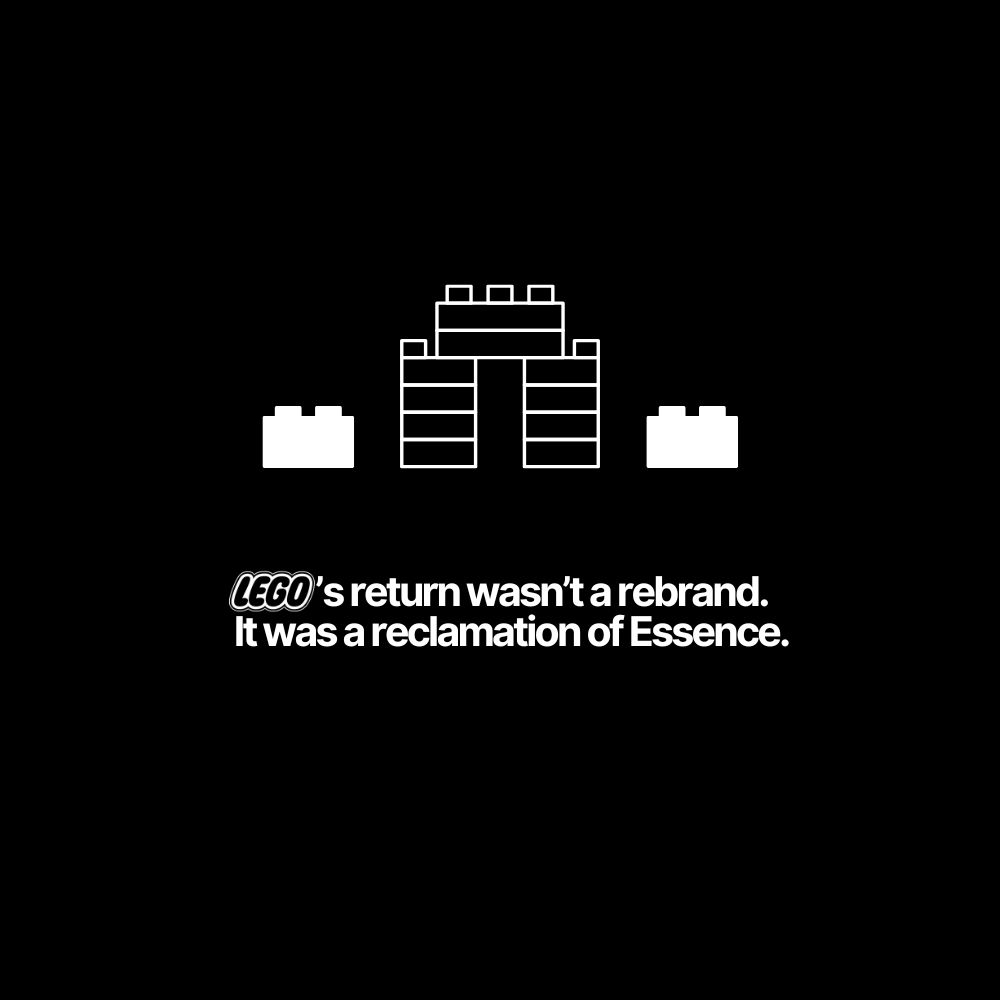
For decades, LEGO thrived not because of toys, but permission. It gave children a chance to build their own worlds — to experiment, to create order and chaos in tandem, to give form to the unspoken through the architecture of imagination. But as screens and digital games surged in the early 2000s, LEGO faltered. They began making “smart” decisions: licensing deals, media ventures, new revenue verticals. Survival strategies took over and they slowly forgot the music that made them. The sound of the company began to scatter. Theme parks without imaginative coherence. Clothing lines without emotional resonance. Video games that echoed others’ stories instead of inviting the user to create their own. By 2003, LEGO had over 12,000 individual parts—gimmicky, over-specified, supply-chain burdensome. They no longer handed children creativity. They handed them instruction manuals. Sales collapsed — by 30% in key markets. Losses ballooned to nearly $1 million per day. The business, bloated and brittle, began to break. In 2004, LEGO brought in Jørgen Vig Knudstorp as a Hail Mary. He didn’t come with new marketing or try to rebrand. He returned to LEGO’s root note: Creative play; Simplicity as empowerment; Learning through building. He radically simplified the product line. He reignited internal culture around imagination and user-generated creativity. He launched the LEGO Ideas platform — opening the canon to the voice of the player. And slowly, the signal realigned. The structure simplified. And the aura—returned. In 2015, LEGO surpassed Ferrari to become the most powerful brand in the world. LEGO’s return wasn’t a rebrand. It was a re-tuning. A reclamation of Essence.
Ty Ward tweet media
English
0
0
0
42
Ty Ward
Ty Ward@tytheward·
@markmanson Seems normal/understandable. Uncertainty is scary. And certainty is a drug religion offers in abundance, for better or for worse.
English
0
0
0
294
Mark Manson
Mark Manson@Markmanson·
This might be the most important chart for understanding this cultural moment, yet it will probably come as a surprise to most.
Mark Manson tweet media
English
159
96
1.7K
363.7K
Ty Ward
Ty Ward@tytheward·
WeWork didn’t lease offices. It sold communal transformation — a modern tribe where work met belonging. Its essence pulsed with community restoration through connection, creativity, and belonging. But when they raised massive capital (notably in 2017–2018), the strategy quietly shifted. Investors were asking for scalability, multiples, and Silicon Valley growth. WeWork repositioned itself as a technology company, not a community platform. Their essence was sacrificed for scale. We know the story. The company lost roughly 90% of its valuation and defaulted into bankruptcy by November 2023, owing as much as $18–20 billion in debt. Of course, mismanagement, cooking-the-books, debt, and over expansion contributed. But those were symptoms. At the core, WeWork lost its original note. And when essence was repositioned to serve capital rather than community, it marked the beginning of the end.
Ty Ward tweet media
English
0
0
1
79
Ty Ward
Ty Ward@tytheward·
Though I love to reduce it down to spreadsheets, systems, and strategy — business is actually more like music than math. It’s economics — and energy. Ratios — and resonance. Form — and feeling. Intelligence — and instinct. Technical — and tonal. This is not just metaphor. There seems to be a deeper octave of business that lives beneath the messaging, the markets, the mechanics — one that we’ve all heard, but rarely named. You’ve likely felt it. When products pull you in before you understand why. When the entire customer experience feels like it was built just for you. When a brand embeds itself into your identity. When you trust a founder without knowing why. When the price you’re paying feels secondary to what it’s awakening. The great ventures? They’re not just well-executed. They seem to be well-tuned. They make music. While others make noise. I've published a white paper for anyone who’d like to explore the difference: ventur.ist/sound-of-ventu…
Ty Ward tweet media
English
0
0
0
59
Ty Ward
Ty Ward@tytheward·
@benln Thanks for sharing. Only thing I'd love to hear more in this general convo of how to best position for the AI era is doubling down on what makes us uniquely human. The work, skills, or ideas — often more subtle, energetic, intuitive — that machines can never replicate.
English
0
0
0
224
Ben Lang
Ben Lang@benln·
Marc Andreessen’s career advice for the AI era:
Ben Lang tweet media
English
50
349
3.4K
444.5K