ulrich minnaar
3.2K posts

ulrich minnaar
@uminnaar
Elec Eng, PhD- Power quality, Power System Reliability, ElectricityRegulation & Policy, Renewables. Views are my own


Other states talk a big game, but Texas builds. Texas is scaling battery storage so fast that it's almost keeping up with the other 49 states… by itself!


PJM independent market monitor pours some cold water on flexibility and says BYOG is needed. Maybe we see all those BTM options now? >Require new large data centers to bring their own matching generation ("BYOG") as condition to interconnect -PJM capacity shortage driven almost entirely by data center load additions (actual + forecast) -Without BYOG requirement, creates massive wealth transfer to other customers via capacity costs, transmission upgrades, RMR obligations -Alternative approaches (status quo, demand response, co-location) all degrade reliability and shift costs to existing customers -Data centers forecast to add ~30,000 MW - system cannot serve this reliably without new generation Key BYOG requirements: -Generation must have locational and temporal characteristics matched to load profile -Must serve actual hourly load without transmission constraints -Must be deliverable to both system and the new load -Must match energy requirements for all hours of the year -Capacity = load + required reserve margin (UCAP MW defined by ELCC) On demand response: -Current PRD structure is "illusory" - $1,849/MWh strike price enables economic withholding -No real penalties for non-performance outside emergencies -Not a viable substitute for generation capacity


“According to data from Wood Mackenzie, by 2030 SMRs should generate power at $182 per megawatt hour compared with $133 per megawatt hour for conventional nuclear. Natural gas is expected to sit at $126 per megawatt hour, while onshore wind and solar, backed up by battery, are projected to be around one-third less expensive.”


Durante los últimos días de septiembre, el sistema eléctrico español rozó de nuevo el colapso. Red Eléctrica detectó oscilaciones de tensión similares a las que precedieron el gran apagón del 28 de abril: baja demanda, alta producción solar y eólica y escasa generación síncrona, la que aporta inercia y estabilidad a la red. En esos días coincidió además la parada por recarga de combustible de dos reactores nucleares: una unidad de Almaraz, que realiza esta operación cada 18 meses, y Cofrentes, cuyo ciclo de recarga es de 24 meses. Ambas paradas estaban planificadas con más de 5 años de antelación, como ocurre siempre en las centrales nucleares, que coordinan sus recargas con el operador del sistema. El problema, por tanto, no fue la indisponibilidad de esas unidades, sino la fragilidad de una red que depende cada vez más de generación no síncrona. Cuando las renovables (necesarias pero variables) se conectan y desconectan bruscamente, la tensión se desestabiliza y el margen de seguridad se reduce. Por segunda vez en pocos meses, España estuvo a punto de repetir un apagón masivo. Y esta vez, sin excusas: las causas eran conocidas y las advertencias, también. Si se cierran los siete reactores nucleares como pretende el Gobierno, que hoy proporcionan la mayor parte de la potencia firme y síncrona del país, el riesgo de apagones crecerá de forma dramática. Y nadie podrá decir que no se había advertido. elperiodicodelaenergia.com/la-verdadera-h…


The Australian Energy Market Commission @the_AEMC just released a puff-piece for household batteries. Which prove that without subsidies, they definitely don't make any economic sense. They couldn't be paid back within warranty period. 1/


UK energy bills could be set according to ‘wealth’, says regulator on.ft.com/4mfzZKt


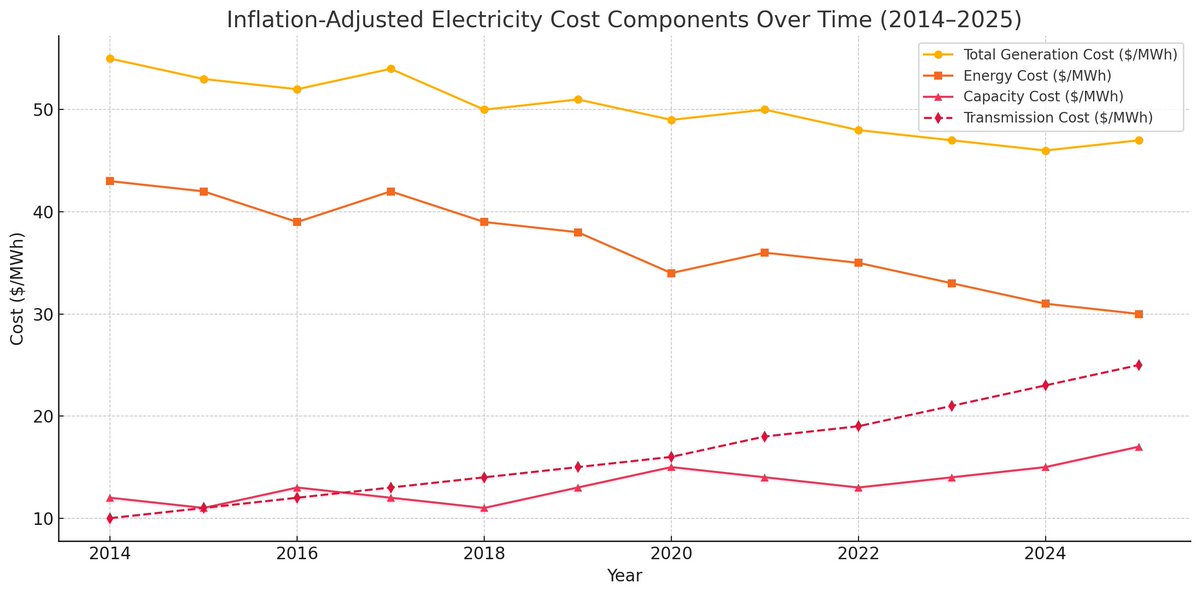
👋It's worth digging into which parts of energy bills are driving cost increases. Our recent analysis with @nrgytariffxpert over a similar timeframe shows that policy choices and utility investments in transmission and distribution have continued to drive overall bill costs upward while the costs of generation and capacity have remained the same or lower, depending on the utility territory. The data shows that generation still makes up roughly the same percentage of bills as it did 10 years ago — on average about 45%, with differences among individual utilities. Leveraging competitive electricity markets is critical to discipline costs and shield consumers from investment risk as demand continues to climb: tinyurl.com/3pyc7cxf


👋It's worth digging into which parts of energy bills are driving cost increases. Our recent analysis with @nrgytariffxpert over a similar timeframe shows that policy choices and utility investments in transmission and distribution have continued to drive overall bill costs upward while the costs of generation and capacity have remained the same or lower, depending on the utility territory. The data shows that generation still makes up roughly the same percentage of bills as it did 10 years ago — on average about 45%, with differences among individual utilities. Leveraging competitive electricity markets is critical to discipline costs and shield consumers from investment risk as demand continues to climb: tinyurl.com/3pyc7cxf

Adding a reaction wheel to an RC aircraft carrier to keep it stable.

"On average, customers currently have to wait three years for high-voltage transformers and one year for distribution transformers. About 80% of high-voltage transformers and 40-50% of distribution transformers are imported. Meanwhile, the National Electrical Manufacturers Association predicts 2% annual electricity demand growth through 2050"