ppdd
8.6K posts

ppdd
@usppdd
$OUST since 2021. Investor, not a trader. Hunting asymmetric opportunities.


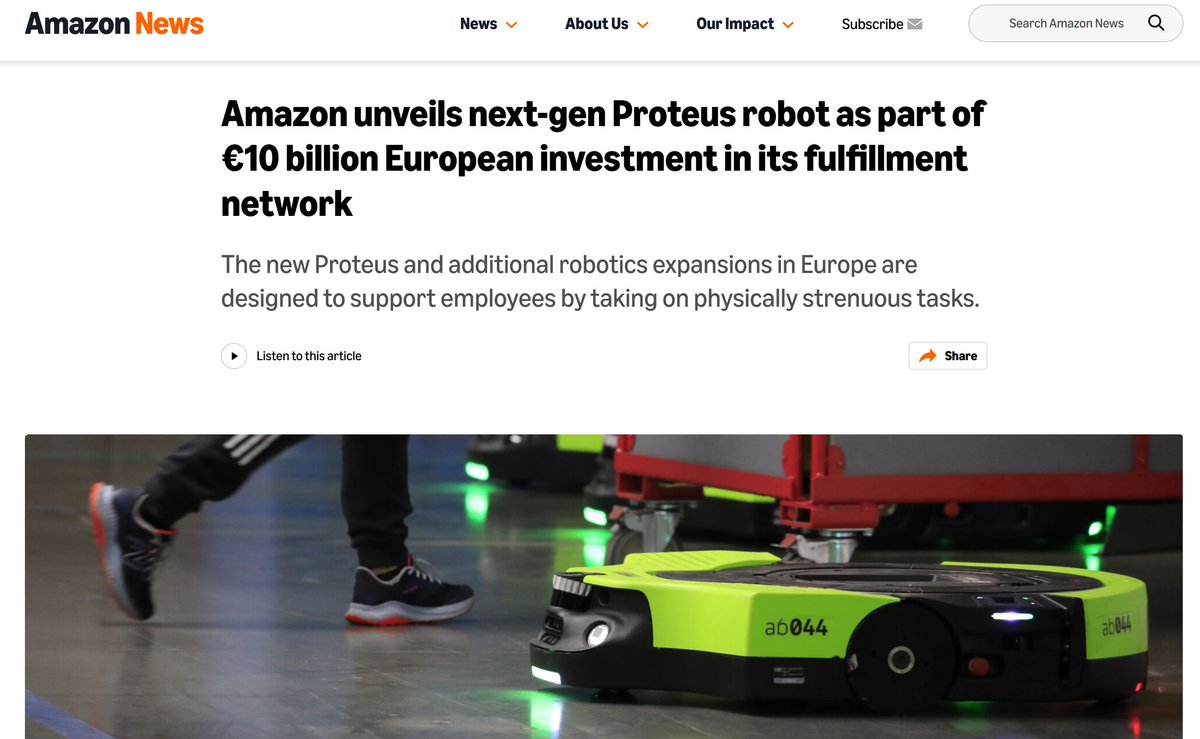
I posted recently to connect the dots between Hyudan and Ouster (x.com/usppdd/status/…). Now it's time to do the same between Amazon and Ouster. 1. 3.2M $OUST warrants: 2.8M already vested, the rest will be vested by Q3 at the current speed. Since it's already ITM, Amazon exercising these warrants will inject $160M to $OUST and become a 5% owner. (Source: x.com/usppdd/status/…) 2. Proteus Robot: The first generation Proteus only works in loading docks and Ouster has already received close to $100M from these orders from Amazon, per the warrants agreement. The second generation Proteus will work in much larger area alongside human workers, potentially replace all the current robots like Herculus and Titan with a quantity up to 1 million robots. That's 1 million sensors for Ouster, roughly $3B ~$4B revenue. (Source: x.com/usppdd/status/…) 3. Agility Robotics: Amazon is an early investor and also a customer of Agility's Digit, which uses Ouster lidar. This robot is hot now so you all know about it. $AGLT $CCXI 4. Plus.AI: Amazon has been granted a warrant to buy up to a 20% equity stake in robotrucking company Plus if the e-commerce giant purchases up to $150 million worth of PlusDrive self-driving truck systems. Plus is a long time customer of Ouster and a Rev8 partner. 5. KION Group: This giant is the manufacturer of Linde forklifts and the 2nd largest forklift maker in the world. Their autonomous forklifts use Ouster. 6. Balyo: A long term Ouster user, privatized by Softbank in 2023. Amazon has a 7-year deal with Balyo in 2019. If Amazon purchases up to 300 million euros in Balyo products within the 7 years, Amazon will be entitled, via stock warrants, to acquire up to 29% of Balyo’s stock. (Source: supplychaindive.com/news/Amazon-Fr…) 7. Vecna Robotics: Another heavy material handling player in Amazon warehouses. Their autonomous tuggers and heavy pallet jacks are deployed all over fulfillment hubs to handle non-conveyable bulk goods, and they rely entirely on Ouster OS-series sensors to meet strict safety standards for human-robot co-working. 8. Fauna Robotics: Amazon recently acquired this startup, moving its pipeline straight into the consumer and personal robotics space with their Sprout humanoid. Sprout's primary navigation and perception engine runs natively on a ZED 2i stereo camera. Since Ouster fully owns Stereolabs (the maker of ZED), Amazon's latest hardware grab funnels directly right into Ouster's broader vision software and sensing IP ecosystem. Look at the sweep of this footprint: from the interstate (Plus) to the loading docks (Linde/KION), across open factory floors (Proteus/Vecna), down to tote sorting (Digit), and right into the home (Fauna/ZED). Every single step of the chain Amazon is funding, acquiring, or scaling runs on Ouster hardware or software—Ouster disclosed on earnings call that there was a tech giant just renewed its Ouster Gemini software annual contract for multi-million dollars, and it's highly likely Amazon—and these are just the public plays we actually know about. Amazon is systematically building a closed-loop Physical AI empire, and Ouster has quietly secured the entire sensory layer. $OUST


@yacineMTB Winning was never in the set of possible outcomes for Anthropic

$OUST – robotics and physical AI opportunity is great, but I believe its traffic management business could become one of its strongest long-term opportunities. One thing I realised while sitting in traffic is how valuable this technology could be in the UK. Many traffic lights still operate using fixed timings or outdated road sensors. They do not always understand how much traffic is building up, how many pedestrians are waiting or which direction needs priority. Ouster’s BlueCity system places lidar sensors above an intersection. These sensors create a live 3D view of every car, pedestrian and cyclist approaching the lights. The software then sends that information to the existing traffic controller, allowing the lights to respond to actual road conditions instead of relying solely on fixed timers. For example, the system can keep a green light open longer when traffic is heavy, give pedestrians more time to cross, detect someone running a red light and identify vehicles travelling in the wrong direction. Ouster’s Rev8 sensors can detect road users from up to 500 feet away and continue working in darkness and difficult weather conditions. The opportunity becomes much easier to understand when you think about how many intersections exist around the world. Congestion costs cities billions, wastes fuel and creates unnecessary emissions. Poorly managed intersections also increase the risk of accidents involving drivers, cyclists and pedestrians. BlueCity is already working in real environment. Ouster has contracted deployments across nearly 700 sites, including more than 120 intersections in Chattanooga, more than 100 in Nashville, more than 100 in Utah and over 40 highway locations in New Jersey. Plus, BlueCity now complies with Build America, Buy America requirements. This means US cities and transport departments can use federal funding to purchase the system. That removes an important barrier because many large public infrastructure projects depend on government funding. For us investors, it's important to understand that Ouster is not simply selling a lidar sensor once. It can generate revenue from the sensors, edge-computing equipment and software licences. Once BlueCity is installed across a city’s traffic network, Ouster could also benefit from further expansion as more intersections are added over time. This could create a sticky business. Cities are unlikely to replace an entire traffic management system regularly once it is installed and integrated. A successful deployment in one part of a city could also make it easier for Ouster to win additional intersections and larger contracts. So, the long-term opportunity is very clear. Ouster has technology that can help cities reduce congestion, improve road safety and modernise outdated infrastructure. The robotics and physical AI opportunity remains the core thesis, but BlueCity could become one of the company’s strongest and most scalable businesses.

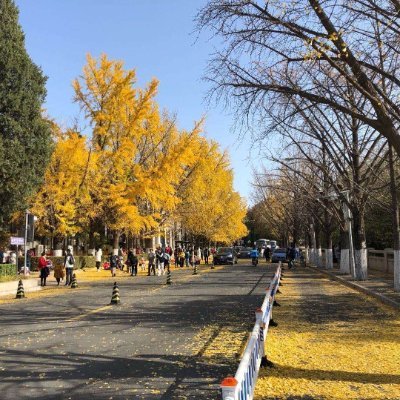






New Jersey Democratic state Senator Andrew Zwicker on a new bill requiring cameras plus two additional sensors (likely LiDAR & radar) for autonomous vehicles, which would effectively ban @Tesla robotaxis in the state if passed: "This is not anti-Tesla. I'm pro-New Jersey safety; At this point, I don't think the evidence is sufficient that a single sensor with software can handle situations that humans can," Zwicker said. Also, Uber argued that the state should continue requiring human drivers for most rides, a very anti-autonomous vehicle stance, despite the fact that data shows humans are worse drivers than autonomous vehicles....


.@Telemundo48 @sfchronicle @Univision here is another video from last night’s @Waymo Armageddon. Video credits: @facebook user Dave Guingona ! What is your take on this @elonmusk @Tesla ?