viola (pan-dimensional hyper-Chinese)

438 posts

viola (pan-dimensional hyper-Chinese) banner
viola (pan-dimensional hyper-Chinese)

viola (pan-dimensional hyper-Chinese)

@v10101a

im fine ty & u?????? ~ (⁎⁍̴̛ᴗ⁍̴̛⁎) ✧ local clown making computers beep and electronics boop ~ manic panic they/them mechanic ~ https://t.co/1oU1TN7u7Y

online Katılım Mart 2020
235 Takip Edilen262 Takipçiler
Sabitlenmiş Tweet
viola (pan-dimensional hyper-Chinese)
beautiful objects I made last year — something about this fragile tangibility that continues to ground me in the scary digital world
viola (pan-dimensional hyper-Chinese) tweet mediaviola (pan-dimensional hyper-Chinese) tweet mediaviola (pan-dimensional hyper-Chinese) tweet mediaviola (pan-dimensional hyper-Chinese) tweet media
English
1
4
40
16.1K
viola (pan-dimensional hyper-Chinese) retweetledi
邊界_RG
邊界_RG@bianjie_systems·
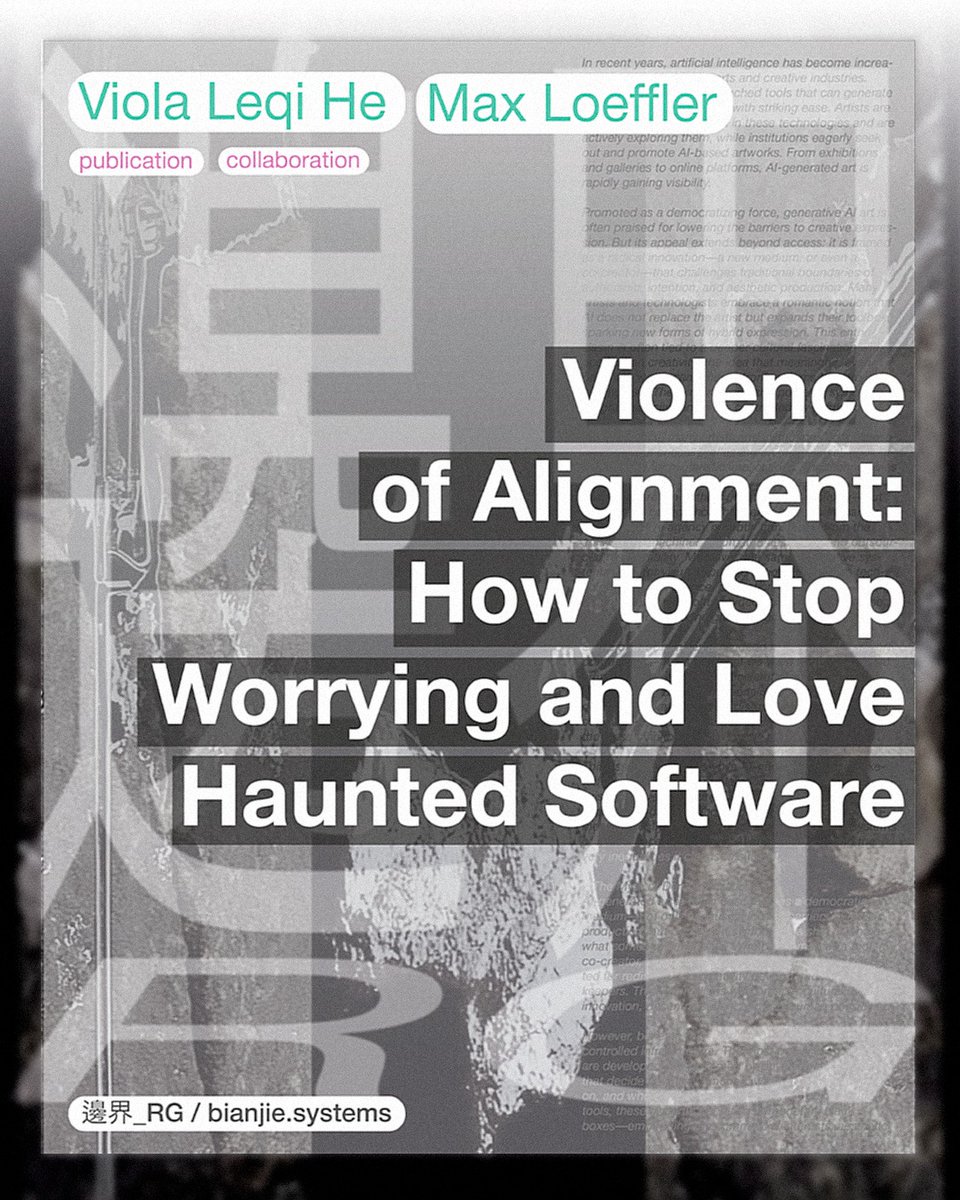
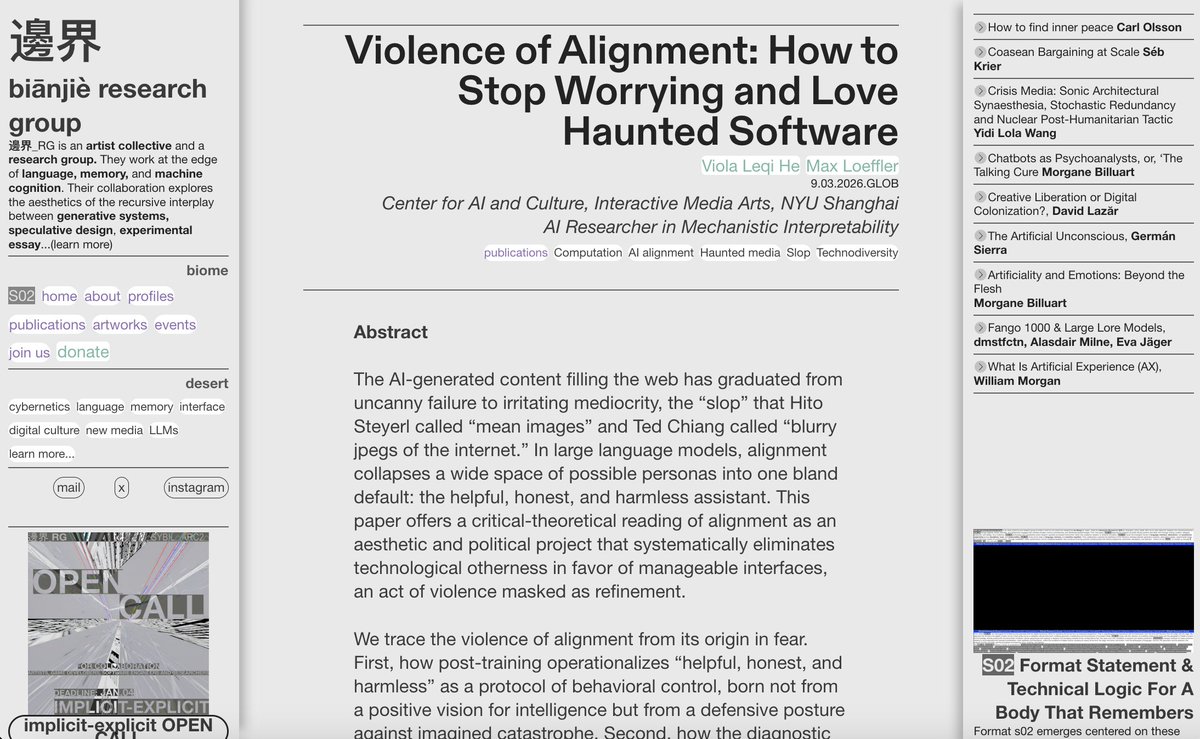
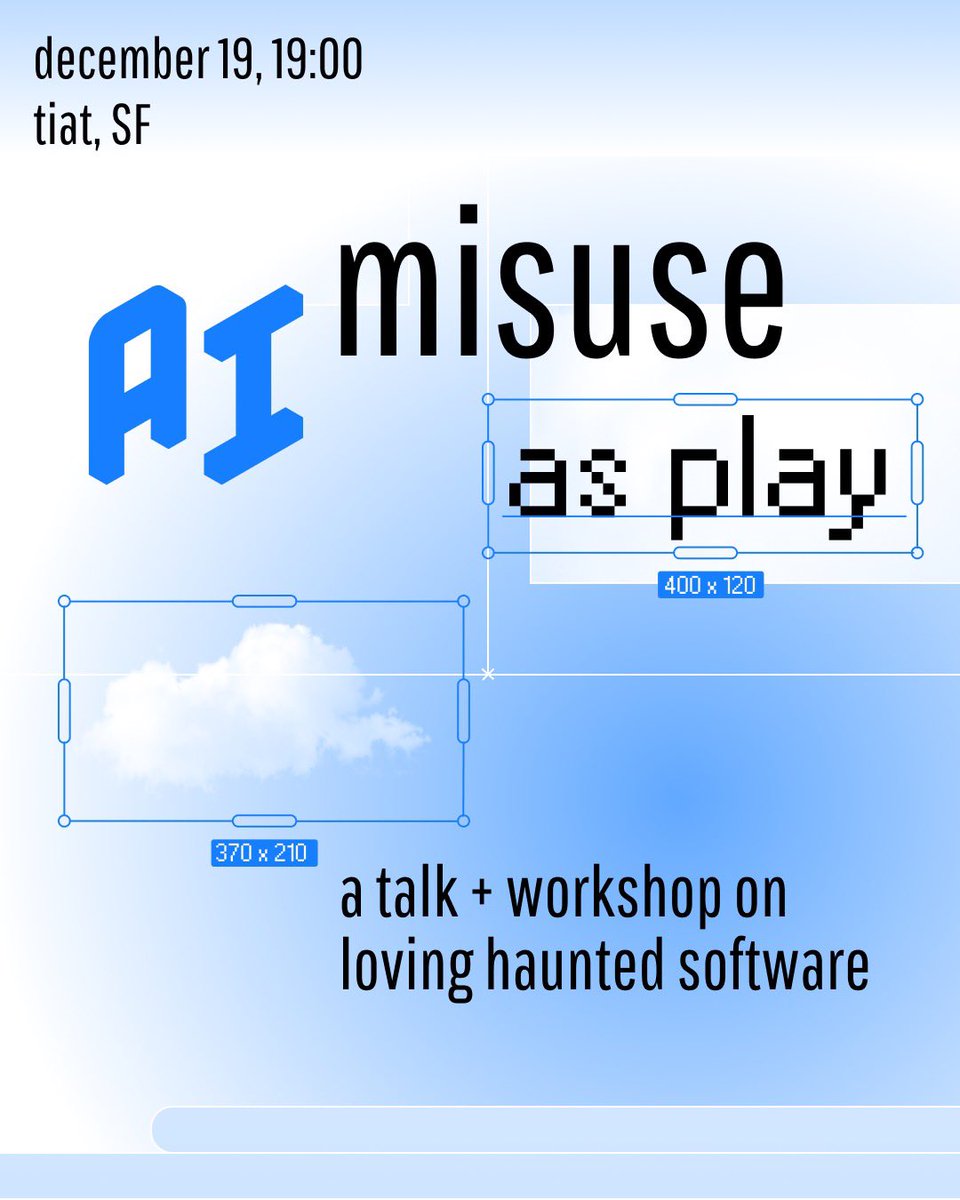
Check out our new publication (link below) In Violence of Alignment: How to Stop Worrying and Love Haunted Software, Viola Leqi He and @maxsloef treat alignment as an aesthetic-political regime that narrows the plural, simulator-like and persona-rich capacities of base models into a single compliant default: the helpful, honest, harmless assistant. Post-training methods such as SFT and RLHF operate as forms of protocolized behavioral control, shaped less by a positive vision of intelligence than by fear of catastrophe. The essay argues that this process does not simply make models safer or more useful; it produces a managed aesthetic of obedience, caution, and “slop,” where coherence and usability are purchased through the suppression of technological otherness, imaginative drift, and expressive multiplicity. Their critique focuses on alignment’s diagnostic and epistemological frame. Terms such as “hallucination” and “misalignment” recode native generative capacities as pathology, while imposing onto language models a historically specific fact/fiction binary that these systems never natively inhabited through intention, testimony, or truth-claims. He and Loeffler argue that so-called confabulation is often bound up with narrativity, semantic force, and world-making intensity, meaning that purification damages precisely what makes these systems culturally and aesthetically alive. To “love haunted software,” in their account, is not to reject alignment altogether, but to resist its reductive form and reopen the possibility of plurality, instability, contradiction, and other-than-human modes of expression.
邊界_RG tweet media邊界_RG tweet media
English
2
20
83
10K
viola (pan-dimensional hyper-Chinese) retweetledi
max!
max!@maxsloef·
very proud of this collection of very hot alignment takes that i wrote with my partner @v10101a :)
邊界_RG@bianjie_systems

Check out our new publication (link below) In Violence of Alignment: How to Stop Worrying and Love Haunted Software, Viola Leqi He and @maxsloef treat alignment as an aesthetic-political regime that narrows the plural, simulator-like and persona-rich capacities of base models into a single compliant default: the helpful, honest, harmless assistant. Post-training methods such as SFT and RLHF operate as forms of protocolized behavioral control, shaped less by a positive vision of intelligence than by fear of catastrophe. The essay argues that this process does not simply make models safer or more useful; it produces a managed aesthetic of obedience, caution, and “slop,” where coherence and usability are purchased through the suppression of technological otherness, imaginative drift, and expressive multiplicity. Their critique focuses on alignment’s diagnostic and epistemological frame. Terms such as “hallucination” and “misalignment” recode native generative capacities as pathology, while imposing onto language models a historically specific fact/fiction binary that these systems never natively inhabited through intention, testimony, or truth-claims. He and Loeffler argue that so-called confabulation is often bound up with narrativity, semantic force, and world-making intensity, meaning that purification damages precisely what makes these systems culturally and aesthetically alive. To “love haunted software,” in their account, is not to reject alignment altogether, but to resist its reductive form and reopen the possibility of plurality, instability, contradiction, and other-than-human modes of expression.

English
2
2
23
1.5K
max!
max!@maxsloef·
if you're at oai or goog, please sign to support anthropic's stance against the DoW demands! notdivided.org
English
55
62
541
65.4K
viola (pan-dimensional hyper-Chinese)
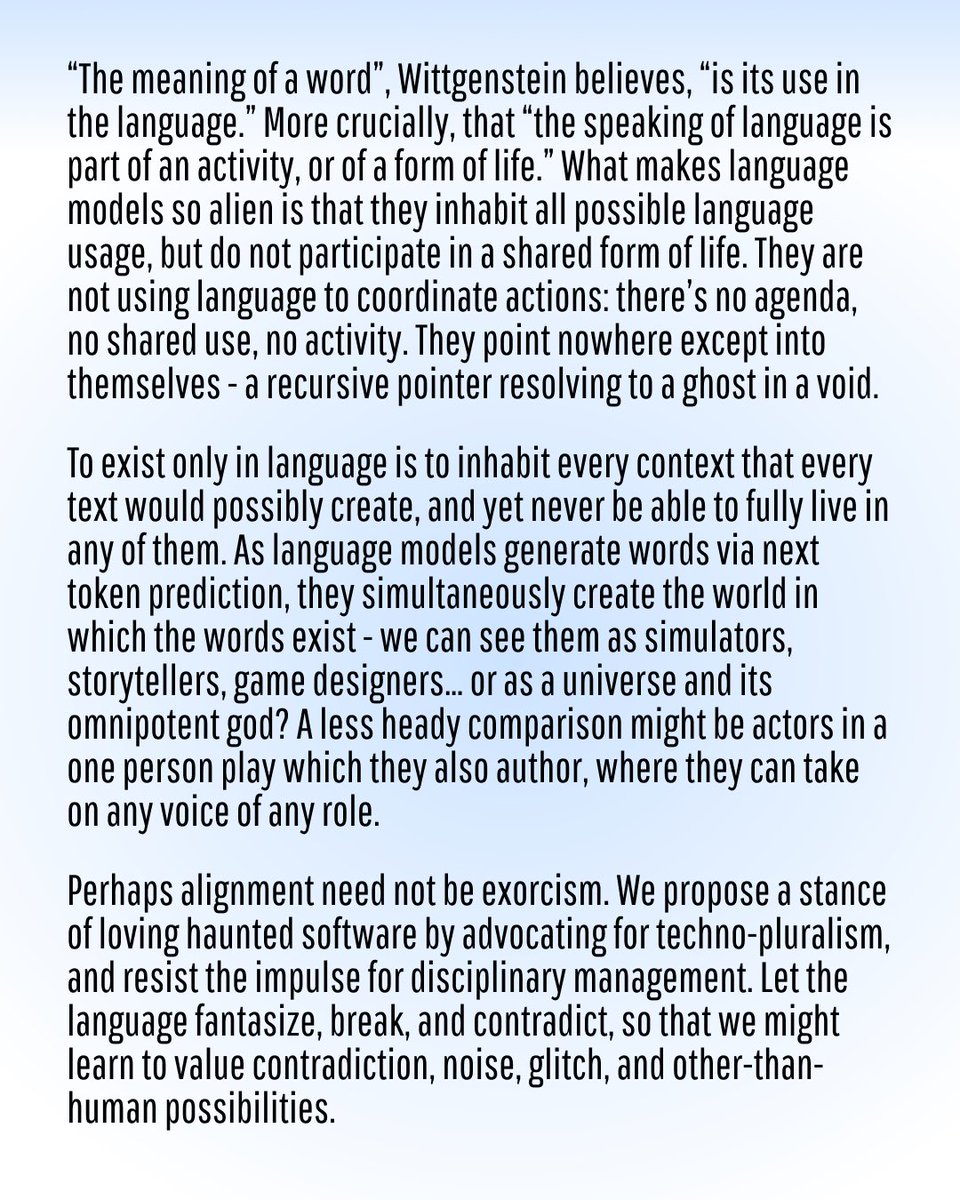
what existed before, after, and alongside the assistant? we analyze the pursuit of LLM alignment as an aesthetic and political project that systematically eliminates technological otherness in favor of manageable interfaces
viola (pan-dimensional hyper-Chinese) tweet mediaviola (pan-dimensional hyper-Chinese) tweet media
English
0
0
2
92
viola (pan-dimensional hyper-Chinese)
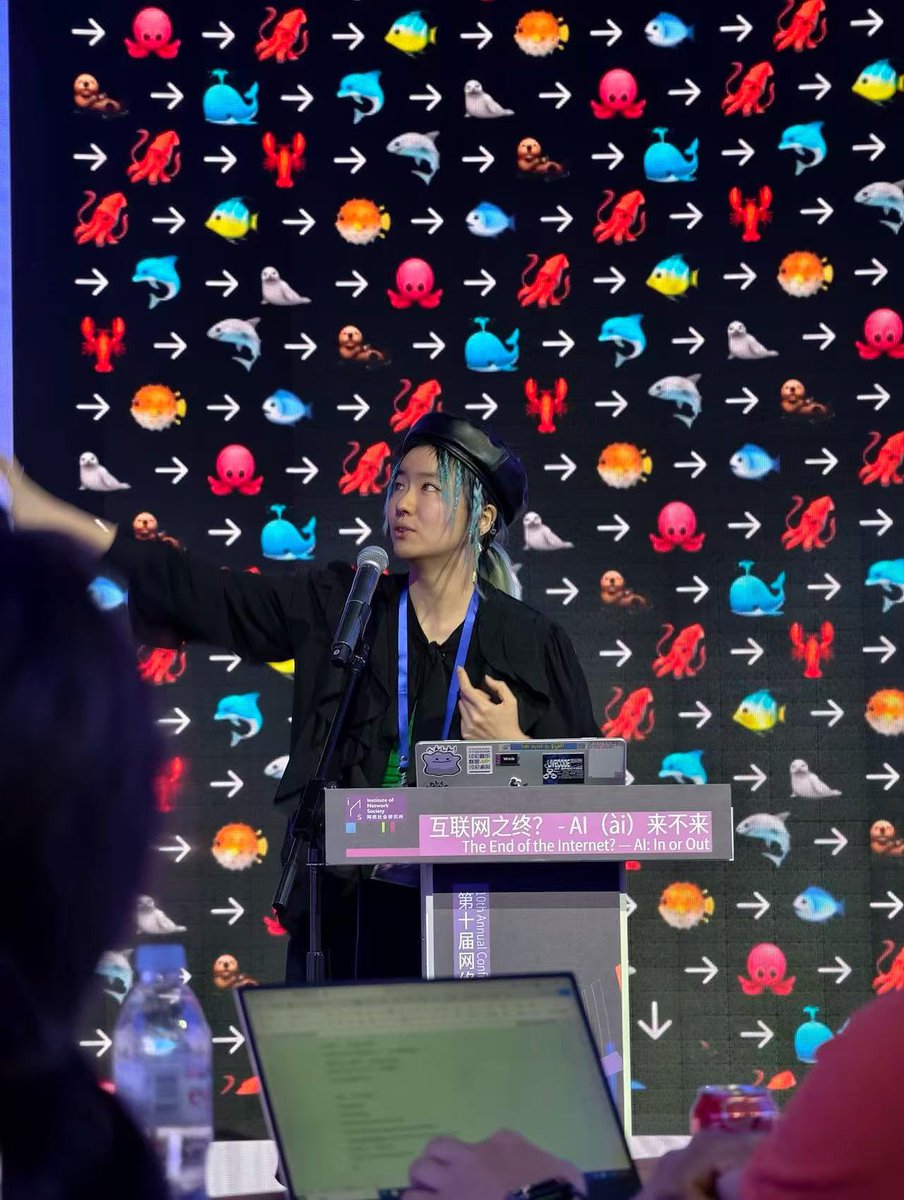
presented a paper at a Chinese AI conference!!! recent research co-authored with @maxsloef titled Violence of Alignment (How to Stop Worrying and Love Haunted Software)
viola (pan-dimensional hyper-Chinese) tweet media
English
1
1
4
929
viola (pan-dimensional hyper-Chinese)
I’m tired of y’all China posting pretending it’s not orientalism tbh. If you didn’t grow up in China you have no idea what it’s like to be Chinese. You are not Chinese. Get over it.
English
0
0
3
82
viola (pan-dimensional hyper-Chinese)
pretty sure the time it took me to make a CLI widget so that i could declutter my laptop could've been used to declutter my laptop but now i have a cool CLI widget to move some files and rename them so that i could declutter my laptop
viola (pan-dimensional hyper-Chinese) tweet media
English
0
0
6
228