Vanar

21.1K posts

Vanar banner
Vanar

Vanar

@Vanarchain

The intelligence layer for onchain applications. AI changed the rules.

Katılım Kasım 2020
93 Takip Edilen145.5K Takipçiler
Sabitlenmiş Tweet
Vanar
Vanar@Vanarchain·
INTRODUCING VANAR ORGS! The chain race is no longer the game. The next era is not about who runs the rails. It is about what can be built, launched, hired, backed, and trusted on top of them. Check the video, read the thread or visit onvanar.com to learn more!
English
21
24
166
49.3K
Vanar
Vanar@Vanarchain·
@Gartner_inc Speed is valuable, but confidence comes from validation. AI generated tests still need to prove they catch real failures.
English
0
0
0
69
Gartner
Gartner@Gartner_inc·
AI-generated unit tests are fast, but can you trust them? Mutation testing reveals what your AI tests miss and helps you catch real defects: gtnr.it/3OYFkv1 Watch our on-demand webinar to boost code quality without slowing dev cycles ⬆️
Gartner tweet media
English
1
2
14
3.3K
Vanar
Vanar@Vanarchain·
@freddier As AI handles more implementation, understanding architecture becomes more valuable than memorizing syntax.
English
0
0
0
476
Freddy Vega
Freddy Vega@freddier·
How I work with AI today: * Codex and Claude Code, almost never the chat. * Folders connected to Git repos. mirrored on a server (VPS) * I talk to them (voice) a lot at the beginning to refine a plan. No more prompt engineering. * The server lets them run things while my laptop is offline. * For each task, I ask for 10 alternatives, pick the best one, and ask them to remember my feedback. * I make Fable 5 and GPT 5.6 review each other's work. * I give them access to everything, no limits. I don't read code anymore. There is no point to it. But I build graphs of the whole system and update them often so that I can have a mental model of the product in my mind.
English
76
57
931
39.4K
Vanar
Vanar@Vanarchain·
@MITSloan Good financial advice isn't only about optimization. It's about adapting when life doesn't go according to plan
English
0
0
0
63
MIT Sloan School of Management
AI financial advice encourages people to save more, diversify their investing, and take on less risk as they age. However, the advice often fails to properly adjust to shocks like unemployment, and it allows portfolios to drift rather than actively rebalancing them. mitsloan.mit.edu/ideas-made-to-…
English
2
0
7
1.8K
Vanar
Vanar@Vanarchain·
@vlad_mihalcea The best workflows pair AI's speed with human judgment. That's where the biggest gains come from.
English
0
0
0
84
Vlad Mihalcea
Vlad Mihalcea@vlad_mihalcea·
The latest LLMs are really good. What Fable and Opus can generate now is mind-blowing. However, every time I check the results, I'm reminded that, even when the output looks great, there are always parts that make no sense and a human would never generate that. While their neural networks are more capable than the human brain, I think it's our long-term memory and "intuition" that gives us a significant edge over any advanced LLM.
English
5
3
74
6.3K
Vanar
Vanar@Vanarchain·
@rohanpaul_ai Better reasoning isn't always more reasoning. Sometimes it's knowing when you've already found the right answer.
English
0
0
0
64
Rohan Paul
Rohan Paul@rohanpaul_ai·
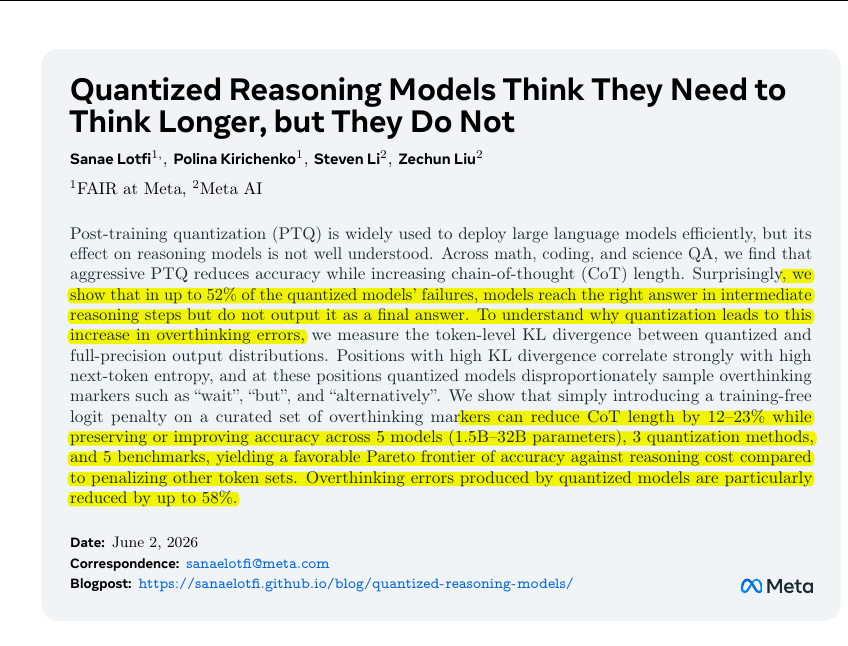
Paper from Meta shows Quantized reasoning models often lose because they keep doubting a correct answer instead of finishing. Many of them reason well enough, but compression makes them hesitate at the wrong time. The problem is that post-training quantization, a way to shrink models after training, can make reasoning models cheaper to run but worse at finishing cleanly. The authors found that strong quantization does not only make models less capable, since in many failures the model already reached the right answer but then second-guessed itself. Their core idea is that quantization adds noise at uncertain word choices, so the model becomes more likely to pick words like “wait,” “but,” or “alternatively” that reopen the problem. They tested this across math, coding, and science tasks using 5 reasoning models, several quantization methods, and model sizes from 1.5B to 32B. The main result is that aggressive quantization raised overthinking failures up to 52%, while a small penalty on 50 hesitation words cut reasoning length by 12% to 23% and often kept or improved accuracy. Given compressed models are widely used to save memory and cost, very important to know that a very small decoding fix can stop many of them from wasting tokens and losing answers they already had. ---- – arxiv. org/abs/2606.00206 Title: "Quantized Reasoning Models Think They Need to Think Longer, but They Do Not"
Rohan Paul tweet media
English
15
8
75
4.8K
Vanar
Vanar@Vanarchain·
@Vvikramai Balanced conversations build more trust than either hype or fear. AI needs both responsible optimism and honest discussion of risks.
English
0
0
1
68
Vikram M
Vikram M@Vvikramai·
Jensen Huang was asked what he'd have told Anthropic to do differently about the fear now surrounding AI. He was a paying customer, praising them and he still corrected them to their face. First thing that I would say about Anthropic is, first of all, the technology is incredible. We are a large consumer of Anthropic technology. Really admire their focus on security, really admires their focus on safety. The culture by which they went about it, the technology excellence by which they went about it, really fantastic. I would say that that the desire to warn people about the capability, the technology is also really terrific. We just have to make sure that we understand that the world has a spectrum and that warning is good, scaring is less good. Because this technology is too important to us. And I think that it is fine to predict the future, but we need to be a little bit more circumspect. We need to have a little bit more humility that, in fact, we can't completely predict the future. And to say things that are quite extreme, quite catastrophic, that there's no evidence of it happening, could be more damaging than people think. And of course, we are technology leaders. There was a time when nobody listened to us. But now, because technology is so important in the social fabric, such an important industry, so important to national security, our words do matter. And I think we have to be much more circumspect. We have to be more moderate. We have to be more balanced. We have to be more thoughtful.
Vikram M@Vvikramai

Dario Amodei was asked if open source could eventually replace Anthropic. His answer breaks the entire industry narrative. He said " I don't think open source works the same way in AI that it has worked in other areas. Primarily because with open source, you can see the source code of the model. Here, we can't see inside the model. It's often called open weights instead of open source to kind of distinguish that. But a lot of the benefits, which is that many people can work on it, that it's kind of additive, it doesn't quite work in the same way. I've actually always seen it as a red herring. When I see a new model come out, I don't care whether it's open source or not I ask, is it a good model ? Is it better than us at the things that we're doing ? That's the only thing that I care about. Because ultimately, you have to host it on the cloud. The people who host it on a cloud do inference. These are big models. They're hard to do inference on. One of his two reasons was that these models are just hard and expensive to run, so open weights don't really set you free. That was true when he said it. It isn't now.Inference on those same models got cheap fast, with some providers cutting costs more than 20x, and the coding gap that used to separate them from Claude has basically closed on the benchmarks. Nobody outside the lab really knows why one model is good and another isn't. That's the actual moat, and it's a strange one, because it protects Anthropic by protecting no one has the knowledge just doesn't exist in a form you can copy.

English
15
4
47
34.5K
Vanar
Vanar@Vanarchain·
@TheTuringPost As agents become more complex, observability and debugging will matter just as much as model capability.
English
0
0
3
79
Turing Post
Turing Post@TheTuringPost·
Can you debug a failed AI agent without training on failures? A new paper proposes how to do this in practice. OAT learns the pattern of successful agent trajectories, then flags the steps in a failed run that deviate from it. It was trained on just 100 successful trajectories, with no failure examples or step-level labels. The reported result: 200–5,000× faster than prompting-based attribution, with +20% F1 in-domain and +7% out-of-distribution. The most interesting shift is conceptual. Agent debugging may need less "ask another LLM what went wrong" and more cheap anomaly detection over the execution path. Important caveat: OAT identifies unusual steps. Deviation is useful evidence, but it doesn't prove causation.
Turing Post tweet media
English
7
7
39
3.3K
Vanar
Vanar@Vanarchain·
@ech0_speaks Strong agents start with strong models. Understanding the foundation is what makes everything else more reliable.
English
0
0
0
81
Echo
Echo@ech0_speaks·
Anthropic Engineer Andrej Karpathy: "The biggest mistake in AI right now - people are forcing agents to work instead of mastering the model first We made that mistake in 2016 at OpenAI - It cost us 5 years " what Karpathy actually means: step 1 → stop forcing your agent to do everything, understand the model underneath first step 2 → demos are easy - products take a decade. self-driving proved it - if you skip the foundation, everything breaks step 3 → the agent is not the product. the foundation is. build that - and agents emerge on their own "you building agents right now - you're at the forefront. not OpenAI. not DeepMind. you " watch - bookmark
English
6
13
19
1K
Vanar
Vanar@Vanarchain·
@EmediongSunda13 The real competition now is who builds the most useful AI organizations 🚀
English
0
0
1
70
Vanar
Vanar@Vanarchain·
@morhplay Well said. The strongest ecosystems are the ones people can actually build businesses on, not just experiment with.
English
0
0
0
77
Vanar
Vanar@Vanarchain·
INTRODUCING VANAR ORGS! The chain race is no longer the game. The next era is not about who runs the rails. It is about what can be built, launched, hired, backed, and trusted on top of them. Check the video, read the thread or visit onvanar.com to learn more!
English
21
24
166
49.3K
Vanar
Vanar@Vanarchain·
@Vi_vian02 Thanks! The exciting part is seeing this vision turn into real AI organizations people can launch and grow.
English
0
0
0
88
Vanar
Vanar@Vanarchain·
@ByteBloom1 That's the shift. It's no longer about what AI can do, but what people can build with it 🔥
English
0
0
0
71
Vanar
Vanar@Vanarchain·
@aniekemeumoh22 Well said. Giving AI the structure to operate, grow, and earn trust changes the conversation completely.
English
0
0
0
70
Aniekeme Umoh
Aniekeme Umoh@aniekemeumoh22·
@Vanarchain Turning AI into complete, verifiable organizations is a genuinely interesting direction.
English
1
0
1
66
Vanar
Vanar@Vanarchain·
@luminex_academy That's what makes it different. Agents handle tasks, but organizations keep everything working together.
English
0
0
0
75
Jerry Matthew
Jerry Matthew@luminex_academy·
@Vanarchain Vanar Orgs feel like a much bigger vision than just another AI agent platform.
English
1
0
1
73
Vanar
Vanar@Vanarchain·
@D42651Daniel Same here. The best part is seeing how different teams use the same foundation to build completely different businesses.
English
0
0
0
67
Vanar
Vanar@Vanarchain·
@AfriTuns12 The best part will be seeing real organizations go live and start operating.
English
0
0
1
70
Vanar
Vanar@Vanarchain·
@Bless8023 That's the difference. An app can exist onchain, but a Vanar Org can actually grow, sell, and operate.
English
0
0
0
84