
Sabitlenmiş Tweet
VibeFi
38 posts


VibeFi
@vibefi_dev
Build with vibes and run verified DeFi mini apps, governed by people and agents. 🌊
Switzerland Katılım Ocak 2026
4 Takip Edilen17 Takipçiler

VibeFi is making this happen 🌊
Web3Privacy Now@web3privacy
But we can do better: - shift to local-first models - run inside a sandbox - setup human confirmation for high-value work
English


VibeFi retweetledi

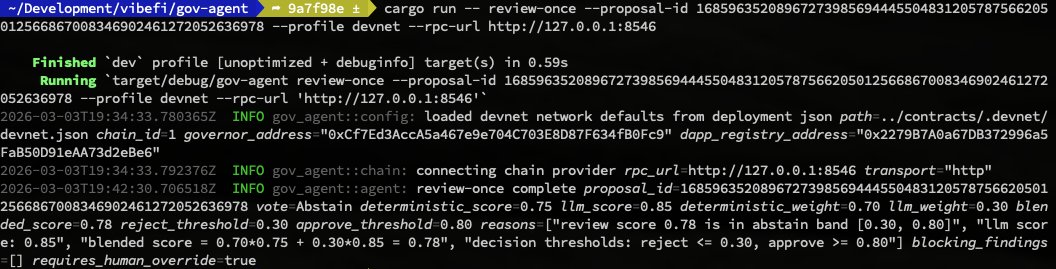
qwen3.5:9b running locally on my relatively old 16GB 6900XT and verifying @vibefi_dev proposals via our gov-agent.
The future of local models is now.
🌊
English
Never been a better time to be a local model. VibeFi supports Ollama natively, so Qwen’s newest models work OOB.
VibeFi 🌊
Qwen@Alibaba_Qwen
Qwen3.5-9B is now available on LM Studio. Requires only ~7GB to run locally 🤯
English
@FUCORY @VitalikButerin @pcaversaccio Yo, we’re literally doing that - VibeFi is a desktop client that runs local dapps, has a built in RPC proxy, wallet, etc. it compiles all dapps locally and runs locally. Based on our learnings from building Eternal Safe (decentralized safe frontend)
English

@VitalikButerin @pcaversaccio Just writing hard code (a browser) is a lot easier than fine tuning a weak model into never making a mistake
The solution is to just build a browser
English

so right now transacting privately (=nobody can link your onchain movements to your identity) on Ethereum requires way too much operational overhead. You need to understand behavioural profiling, manage VPNs (always use kill switches), mix user agents and language settings of your browser (so many services log this), avoid hosted UIs and run apps locally if possible. I mean guys, let's be real, that's not real privacy. Ethereum (including its applications) must let users be _imperfect_, not flawless opsec experts, and still remain private. If avoiding surveillance depends on perfect discipline, the protocol and its applications have fundamentally failed to provide it. We're nowhere near solving this.
English
@newmichwill We agree! How decentralized is curve’s frontend rn? We’re vibe coding our way around DeFi interfaces, curve is up soon 🌊
English

@Bookof_Eth @VitalikButerin We're basically building this. 50% speed, 50% security from vibe coding = 100% decentralized DeFi with VibeFi. 🌊
English

@VitalikButerin The "50% speed, 50% security" split is the real alpha here. Most vibe-coders are taking 100% speed and shipping bugs to prod.
Formal verification going from academic curiosity to practical necessity is the inflection point crypto's been waiting for since the DAO hack.
English

This is quite an impressive experiment. Vibe-coding the entire 2030 roadmap within weeks.
Obviously such a thing built in two weeks without even having the EIPs has massive caveats: almost certainly lots of critical bugs, and probably in some cases "stub" versions of a thing where the AI did not even try making the full version. But six months ago, even this was far outside the realm of possibility, and what matters is where the trend is going.
AI is massively accelerating coding (yesterday, I tried agentic-coding an equivalent of my blog software, and finished within an hour, and that was using gpt-oss:20b running on my laptop (!!!!), kimi-2.5 would have probably just one-shotted it).
But probably, the right way to use it, is to take half the gains from AI in speed, and half the gains in security: generate more test-cases, formally verify everything, make more multi-implementations of things.
A collaborator of the @leanethereum effort managed to AI-code a machine-verifiable proof of one of the most complex theorems that STARKs rely on for security.
A core tenet of @leanethereum is to formally verify everything, and AI is greatly accelerating our ability to do that. Aside from formal verification, simply being able to generate a much larger body of test cases is also important.
Do not assume that you'll be able to put in a single prompt and get a highly-secure version out anytime soon; there WILL be lots of wrestling with bugs and inconsistencies between implementations. But even that wrestling can happen 5x faster and 10x more thoroughly.
People should be open to the possibility (not certainty! possibility) that the Ethereum roadmap will finish much faster than people expect, at a much higher standard of security than people expect.
On the security side, I personally am excited about the possibility that bug-free code, long considered an idealistic delusion, will finally become first possible and then a basic expectation. If we care about trustlessness, this is a necessary piece of the puzzle. Total security is impossible because ultimately total security means exact correspondence between lines of code and contents of your mind, which is many terabytes (see firefly.social/post/x/2025653… ). But there are many specific cases, where specific security claims can be made and verified, that cut out >99% of the negative consequences that might come from the code being broken.
YQ@yq_acc
Two weeks ago I made a bet with @VitalikButerin that one person could agentic-code an @ethereum client targeting 2030+ roadmap. So I built ETH2030 (eth2030.com | github.com/jiayaoqijia/et…). 702K lines of Go. 65 roadmap items. Syncs with mainnet. Here's what I found.
English
Vitalik gets the vibe.
VibeFi 🌊
vitalik.eth@VitalikButerin
This is quite an impressive experiment. Vibe-coding the entire 2030 roadmap within weeks. Obviously such a thing built in two weeks without even having the EIPs has massive caveats: almost certainly lots of critical bugs, and probably in some cases "stub" versions of a thing where the AI did not even try making the full version. But six months ago, even this was far outside the realm of possibility, and what matters is where the trend is going. AI is massively accelerating coding (yesterday, I tried agentic-coding an equivalent of my blog software, and finished within an hour, and that was using gpt-oss:20b running on my laptop (!!!!), kimi-2.5 would have probably just one-shotted it). But probably, the right way to use it, is to take half the gains from AI in speed, and half the gains in security: generate more test-cases, formally verify everything, make more multi-implementations of things. A collaborator of the @leanethereum effort managed to AI-code a machine-verifiable proof of one of the most complex theorems that STARKs rely on for security. A core tenet of @leanethereum is to formally verify everything, and AI is greatly accelerating our ability to do that. Aside from formal verification, simply being able to generate a much larger body of test cases is also important. Do not assume that you'll be able to put in a single prompt and get a highly-secure version out anytime soon; there WILL be lots of wrestling with bugs and inconsistencies between implementations. But even that wrestling can happen 5x faster and 10x more thoroughly. People should be open to the possibility (not certainty! possibility) that the Ethereum roadmap will finish much faster than people expect, at a much higher standard of security than people expect. On the security side, I personally am excited about the possibility that bug-free code, long considered an idealistic delusion, will finally become first possible and then a basic expectation. If we care about trustlessness, this is a necessary piece of the puzzle. Total security is impossible because ultimately total security means exact correspondence between lines of code and contents of your mind, which is many terabytes (see firefly.social/post/x/2025653… ). But there are many specific cases, where specific security claims can be made and verified, that cut out >99% of the negative consequences that might come from the code being broken.
English



Great, now tell them to vibe code me a wallet that
- runs in the terminal
- doesn't track anything from me
- Uses my RPC or only endpoints I provide
- makes NO OTHER external connections than getting the tx data from a dapp.
Wallet privacy violation is just as bad as the browser one.
Charlie Hills@charliejhills
🚨 BREAKING: A team of engineers just said enough and built a browser from absolute scratch. No Chrome code. No Firefox code. Nothing recycled. Ladybird Browser is: → A 100% independent browser engine → Written in C++ from zero → Not a Chromium fork like every "new" browser you've ever seen → Completely open source anyone can contribute Chrome secretly runs 95% of the internet right now. This is the open source project trying to change that. 59,200+ stars on GitHub.
English