
Sabitlenmiş Tweet
Vivameda
17 posts


Vivameda
@vivameda_data
We provide historical business data that helps you understand companies, their markets, growth trends, and buying behavior.
Cyprus Katılım Şubat 2026
14 Takip Edilen42 Takipçiler

Everyone jokes about March Madness killing productivity. Here's what the workforce data actually shows:
Companies that go dark on hiring during cultural events (major sports, holidays, summer) consistently underperform their hiring targets by 23% annually. The ones that hire straight through? They're the signal in the noise.
When your competitor pauses because "no one's paying attention anyway," that's exactly when serious operators move. We've tracked this pattern across 250M+ employment records over 15 years.
The real productivity loss isn't employees streaming games. It's leadership teams that mistake their own distraction for market reality.
Your best candidates are still looking. Your fastest growing competitors are still hiring. The bracket can wait.

English
Everyone's debating whether AI will bankrupt the grid.
Meanwhile, our data shows specialized data center roles (cooling engineers, energy optimization specialists, sustainability architects) grew 340% at tech companies between 2020-2024.
Here's what that tells you: the companies building AI infrastructure already know energy is the constraint. They've been hiring for it aggressively for four years while the rest of us argued about whether it's a problem.
The real tell? These roles are concentrated at three types of companies: hyperscalers building their own data centers, chip designers who need to prove efficiency, and a handful of energy tech startups that just got very interesting acquisition targets.
CMU's research is smart, but the talent migration happened first. It always does. Workforce data is a leading indicator, not a lagging one.
The infrastructure play isn't just about who makes better chips. It's about who can actually staff the systems that keep those chips from melting.

English
Vivameda retweetledi

Vivameda retweetledi

For the past few years we’ve been quietly building something unusual.
A structured workforce dataset covering millions of companies.
Hundreds of millions of professional records were normalized into company-year workforce observations: headcount growth, role distributions, organizational structure.
What started as raw records slowly turned into a historical workforce intelligence archive.
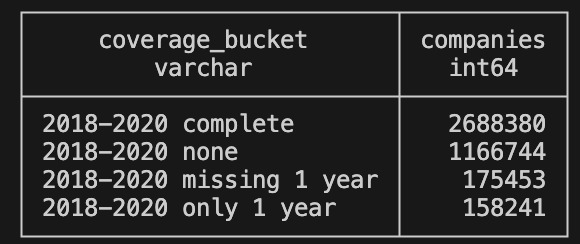
One of the first things we looked at was panel continuity.
Across ~4M companies, about 64% appear consistently between 2018–2020.
That level of continuity makes it possible to analyze how organizations actually evolve over time.
Not job postings.
Not press releases.
Real workforce structure.
You start seeing patterns:
Engineering hiring spikes often appear months before companies scale.
Sales expansion usually comes later.
The dataset was originally built for internal analysis, but the more we explore it, the more interesting the signals become.
Curious what others would analyze with a longitudinal workforce dataset like this.
English
Vivameda retweetledi
Workforce datasets are static.
A snapshot. A list. A moment in time.
But companies are not static.
They grow.
They contract.
They shift role composition.
They reallocate talent before revenue changes show up.
So instead of building another database, I built a longitudinal company-year panel.
~2.5M normalized U.S. companies.
~387M company-year rows reconstructed from historical experience timelines.
Median 7 years of workforce history per company.
Not profiles.
Not contact records.
Company-year intelligence.
For each company and each year:
• Observed headcount
• Growth rate
• Role distribution shifts
• Structured entity normalization
The real asset isn’t volume.
It’s the ability to ask:
– When did this company actually start scaling?
– Did engineering grow before sales?
– How did workforce composition change pre-funding?
– Which segments show consistent multi-year expansion patterns?
Longitudinal structure turns raw records into signal.
Investors call it alternative data.
Strategists call it market intelligence.
AI teams call it training infrastructure.
I call it organizational time-series intelligence.
Building this in public.
#infrastructure #database #patternrecognition

English
Vivameda retweetledi
Starbucks just had their HR platform breached.
Everyone's talking about PII exposure.
They're missing the bigger picture.
Attackers now have the org chart. Headcount by department. Compensation bands. Role hierarchies. Who reports to who.
That's not just sensitive data. That's organizational intelligence.
Here's what most people don't get: hedge funds pay six figures for this exact data. Legally. From third parties tracking workforce changes.
Why? Because headcount moves predict revenue. Hiring patterns predict expansion. Compensation shifts predict retention risk.
The irony: companies treat this data like it's locked in a vault, but it leaks constantly. LinkedIn updates. Job postings. Employee movement.
Smart investors stopped waiting for breaches. They built infrastructure to track it systematically across millions of companies.
The breach isn't the story. The value of workforce data is.

English
OP Labs cutting 20 people isn't the story. The story is who they kept.
Most people see layoffs as binary: good company or bad company. But workforce data tells you something more useful: what the company is becoming.
When L2s cut staff, look at which functions shrink. Marketing and bizdev cuts? They're narrowing focus, probably fine. Engineering and protocol teams? Different conversation entirely.
We've tracked this pattern across 50+ crypto companies since 2021. The survivors didn't just get smaller. They got more technical. Higher engineering density, fewer generalists, deeper specialization in core infrastructure.
The panic cuts are obvious in the data: they slash uniformly across departments, lose senior technical talent first, then backfill with cheaper labor six months later. That's not strategy. That's a balance sheet problem.
OP's cut looks like the former. But here's what matters: in 90 days, check if they're hiring protocol engineers again. That ratio of cuts to specialized rehires separates pivots from slow deaths.
The market sees headlines. Workforce intelligence sees direction of travel.
#tracking #technology
English
Vivameda retweetledi
Everyone's panicking about 45,000 tech layoffs.
Oracle. Atlassian. AI-driven cuts.
Here's what the headlines miss.
We track 46.6M professional profiles. Been doing this for 15 years.
The companies announcing "AI efficiency" layoffs in Q1 are quietly opening 30-40% of those same headcount budgets in Q2. Different titles. Different departments. Same budget.
They're not cutting people because of AI.
They're cutting expensive generalists and hiring specialists who can actually deploy AI.
Mid-level project managers? Gone.
Prompt engineers and AI implementation leads? 90-day pipeline is full.
The layoff is the headline.
The reallocation is the alpha.
Most founders are reading press releases.
Smart ones are tracking where the budget actually goes.

English
The irony runs deeper than you think.
Companies that laid off ML engineers in 2023 are now hiring "AI trainers" and "data annotators" at 60-70% of previous salaries. Often the same people.
Our workforce data shows the full loop: who got cut, who's getting rehired, and at what discount.
Here's what nobody's saying: this isn't just about replacing workers with AI. It's about reclassifying roles to deflate comp structures.
Same skills, same people, different job title. The "AI trainer" designation lets companies pay senior engineers like junior analysts while building the systems that justify the original layoffs.
We're tracking this across 40+ companies. The pattern is consistent enough to be strategy, not coincidence.
The real question: what happens when the training is done?

English
Vivameda retweetledi
Something interesting is coming!
Over the past months we’ve been quietly building a longitudinal workforce intelligence dataset that tracks how companies actually evolve over time.
Not snapshots.
Not profiles.
Not another list.
A structured company-year panel across millions of U.S. companies.
The goal is simple: turn fragmented workforce data into something that reveals real patterns, hiring momentum, structural shifts, and growth signals long before they show up in headlines.
Most datasets tell you what a company looks like today.
This one shows how it got there.
More details soon.
We’re getting close.
#dataset #infrastructure

English
State Street partnering with Neudata to bring alt data into institutional economics is the signal everyone should be watching.
Why? Because workforce flows are the canary in the coal mine that traditional economic indicators miss by months.
When a tech company adds 200 salespeople, that's future revenue. When they freeze backfills in engineering, that's margin compression before it hits the 10-K. When an entire industry starts hiring compliance officers, regulation is coming.
The Fed is flying blind with lagging employment reports. Investors are guessing at forward guidance. But the hiring and firing decisions? Those are happening right now, in real time, before any press release goes out.
If institutional money is finally taking workforce data seriously for macro calls, the obvious next question is: why isn't every fund using it for single-name alpha?
The data exists. The patterns are clear. The only thing missing was conviction that it matters.
Looks like that's changing.

English
Most people think better data wins....
It doesn’t.
Better structure wins.
Because without structure, data is just noise at scale.
No consistency.
No timeline.
No signal.
Most company datasets are snapshots.
A headcount number. A profile. A moment.
But companies don’t operate in moments.
They evolve.
They hire before they grow.
They restructure before they pivot.
They scale teams before revenue shows up.
If you can’t see change over time, you’re not analyzing behavior — you’re observing still images.
At Vivameda, we focus on longitudinal structure.
Not more records.
Not louder dashboards.
But cleaner entity resolution, stable identifiers, and company-year panels that make growth measurable.
Because the future of intelligence isn’t about collecting more.
It’s about structuring time.
#structure #time

English
Building This Is Way Harder Than It Sounds. 🤯
At first, it looks simple.
Take company data, structure it, track it over time. ⏱️
In reality, it’s messy.
The same company shows up 5 different ways:
Names don’t match.
Domains change.
Data is incomplete.
Then comes time.
There is no clean company per year data.
You have to rebuild history from scattered updates and timelines.
And that’s where most things break.
Headcount numbers don’t line up.
Profiles are inconsistent.
What looks like growth is often just noise. 🛠️
You realize quickly:
It’s not about collecting data.
It’s about making it consistent.
And that’s the hard part.
What we’re building at Vivameda is not a dataset.
It’s a system to make sense of messy, fragmented history.
Because once you get that right, you don’t just see companies…
You see how they actually evolve. 🌃
#dataset #bigdata #companygrowth

English

We hoarded 46 Million historical professional profiles.
In a world obsessed with "real-time," we did the opposite: We froze a moment in time.
Between 2018 and 2020, the modern SaaS ecosystem in the US didn't just grow, it exploded.
We captured it.
#DataAnalytics

English