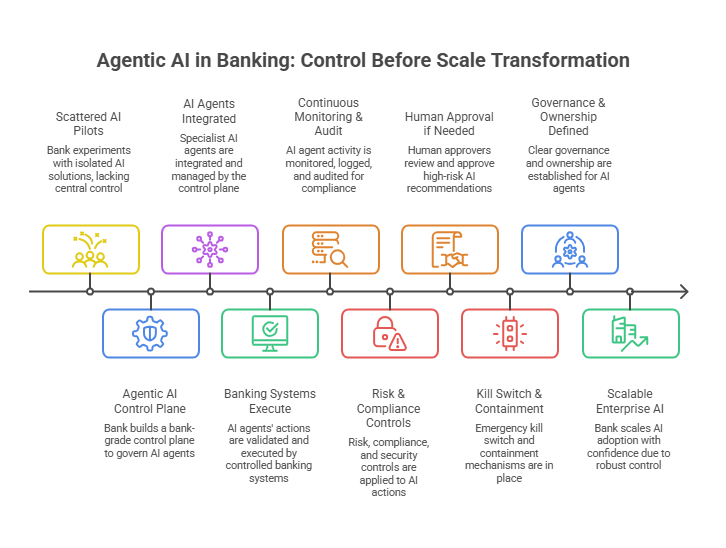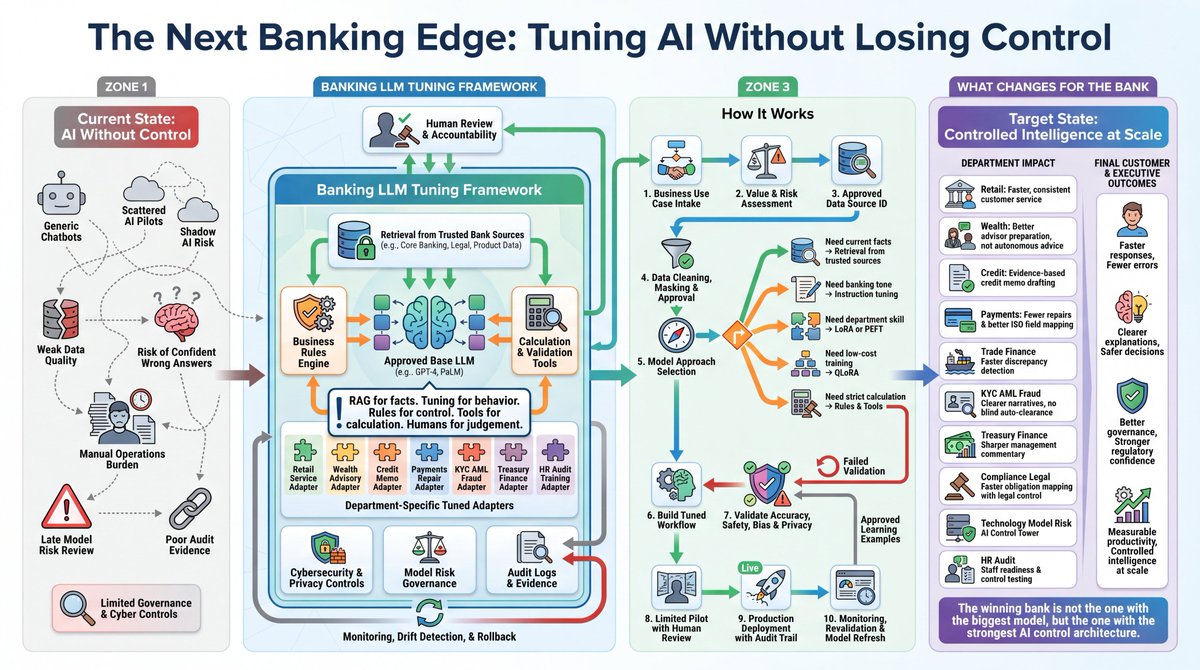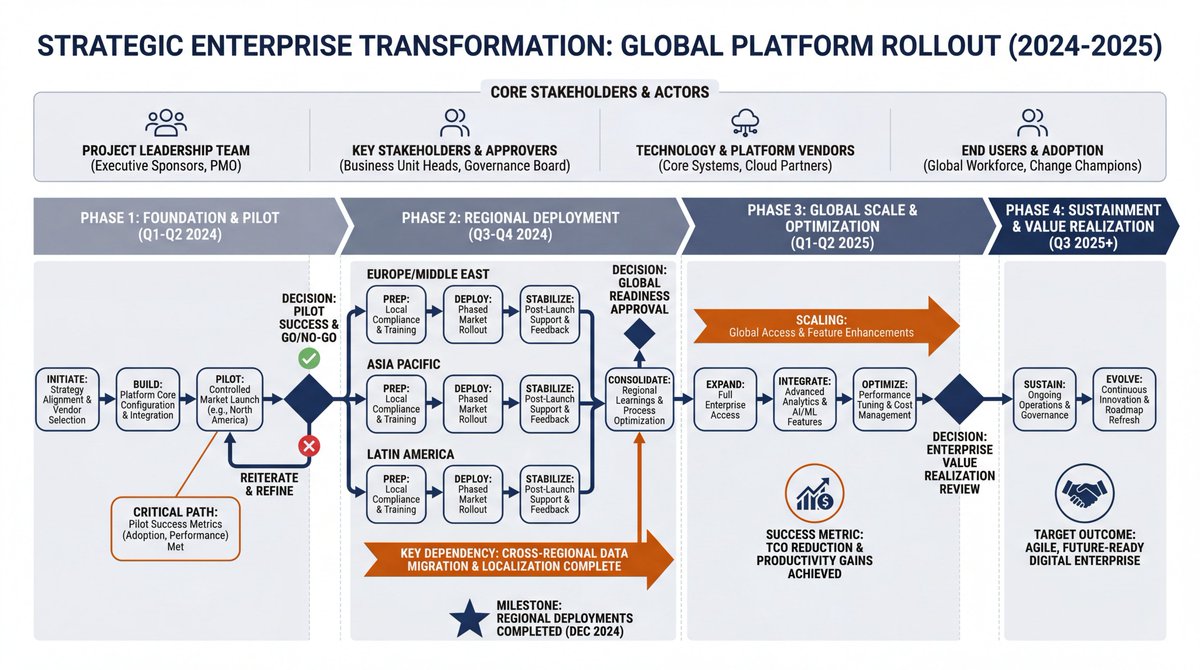

Most banks are deploying agentic AI capabilities while still relying on scattered pilots, generic service accounts, and manual approval processes. This framework shows what a proper bank-grade security model actually requires.
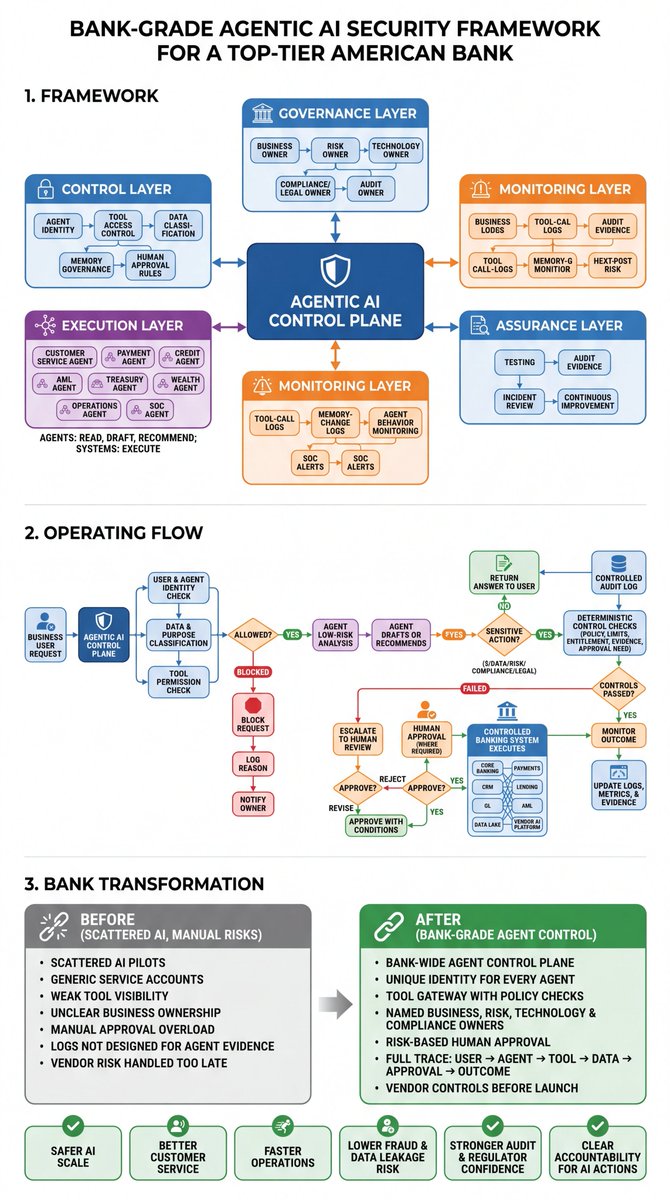
It centers on an Agentic AI Control Plane surrounded by five integrated layers: Governance (with named business, risk, technology, compliance, and audit owners), Control (agent identity, tool access, data classification, memory governance, human approval rules), Execution (department-specific agents that recommend while systems execute), Monitoring (tool-call logs, memory-change logs, SOC alerts), and Assurance (testing, incident review, continuous improvement).
The operating flow makes the discipline visible: every request passes through identity checks, data classification, tool permission checks, agent analysis, and sensitive action gates before any controlled banking system executes. Failed validations trigger human escalation or blocking.
The contrarian insight is that this level of structure is not bureaucracy. It is the minimum architecture required to scale agentic AI without creating unmanageable risk, unclear accountability, and audit failures. Banks that build something close to this framework will move from defensive posture to confident, governed scale.
#AgenticAI #BankingSecurity
Looking at this full bank-grade framework, which layer or element — the named ownership model, the tool access and memory governance controls, the embedded human approval gates, or the assurance/continuous improvement loop — feels most important yet hardest to implement in your organization?
English