Daniel Tawfik@dantawfik
The rucking community has been carrying weighted vests for cardio and strength. Turns out the hidden benefit is metabolic: it tricks your skeleton into maintaining energy expenditure during fat loss.
A new International Journal of Obesity study tested weighted vests during caloric restriction—not for the workout, but to preserve the gravitational loading signal that regulates metabolism. The results revealed something the fitness industry has been missing.
Researchers recruited 18 older adults with obesity and osteoarthritis for a 6-month weight loss trial. Half followed the diet alone. The other half wore a weighted vest for up to 10 hours daily while following the same diet.
The vest weight increased weekly to replace the weight being lost—up to 15% of baseline body weight. Participants wore it during their most active hours, averaging 6.6 hours per day with about 6 kilograms in the vest. No formal exercise program was involved.
Both groups lost similar amounts of weight during the 6-month intervention. The weighted vest group lost 11.2 kg. The diet-only group lost 10.3 kg. About one-quarter of the loss in both groups came from lean mass.
Then researchers tracked what happened 18 months after the intervention ended—no contact, no protocol, just long-term follow-up to see how much weight participants regained.
The weighted vest group regained approximately half of the lost weight. They were still 4.8 kg lighter than baseline at 24 months. The diet-only group regained all of it. They returned to baseline weight plus 0.9 kg.
The metabolic mechanism appeared in resting metabolic rate changes during the weight loss phase.
Resting metabolic rate declined by 16 kcal/day in the weighted vest group during the 6-month intervention. It declined by 237 kcal/day in the diet-only group. That's a 221 kcal/day difference in metabolic adaptation to the same amount of weight loss.
The smaller the metabolic rate crash during weight loss, the less weight participants regained during follow-up. Change in resting metabolic rate was inversely correlated with subsequent weight regain—preserving metabolism during the loss phase predicted better maintenance during the years after.
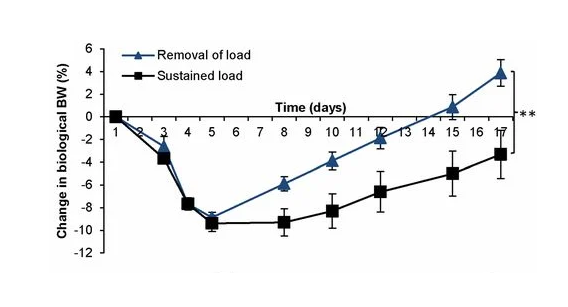
This fits the gravitostat hypothesis: osteocytes in the lower extremities sense gravitational loading from body weight and send signals to the brain that regulate appetite and fat storage. When body weight drops, the system detects reduced loading and responds by lowering metabolic rate and increasing hunger to restore the lost weight.
Wearing a weighted vest during weight loss may preserve the gravitational loading signal even as fat mass declines—tricking the osteocyte sensors into maintaining energy expenditure instead of triggering compensatory metabolic suppression.
The mechanism remains speculative. The study was small—only 18 participants completed 24-month follow-up. The weighted vest group had better metabolic outcomes, but the between-group difference in weight regain didn't reach statistical significance.
Lean mass loss was similar in both groups during the intervention, so the vest didn't preserve muscle. But the vest group remained 1.84 kg lower in lean mass at 24 months while the diet-only group returned to baseline lean mass—suggesting the sustained weight difference came primarily from fat mass.
The gravitostat model has been tested mostly in animal studies. Human data showing that increasing gravitational load produces small but measurable fat loss over weeks exists, but this is among the first studies examining whether maintaining load during intentional weight loss affects long-term regain.
If confirmed in larger trials, the implications are straightforward: metabolic adaptation to caloric restriction may be partly driven by reduced skeletal loading rather than energy deficit alone. Preserving that loading signal during weight loss could prevent the metabolic suppression that makes long-term maintenance so difficult.
The clinical application doesn't require new drugs or complex protocols. It's a weighted vest worn during normal daily activity—the intervention preserves resting metabolic rate without requiring participants to increase energy expenditure through structured training.
Most weight loss interventions focus on creating an energy deficit and accepting the metabolic consequences. This study suggests an alternative: preserve the gravitational signal that regulates energy balance and let metabolic rate adaptation take care of itself.
The decisions about how to structure a weight loss phase may need to account for skeletal loading as a distinct biological variable—not just calorie balance and macronutrient composition, but whether the body's weight-sensing system interprets the intervention as true weight loss or maintained loading with reduced fat mass.
Weight regain after caloric restriction isn't a character flaw. It's a predictable response to reduced resting metabolic rate. And if that reduction can be prevented by maintaining gravitational load during the loss phase, we've been overlooking a mechanical intervention that addresses one of the core biological drivers of regain.