
Vroozi

10K posts

Vroozi banner
Vroozi

Vroozi

@vroozi

Vroozi is leading the #SpendTech revolution with procure-to-pay automation for the modern enterprise #P2P #APIA #eProcurement

Walnut Creek, CA Katılım Nisan 2012
85 Takip Edilen4.2K Takipçiler
Vroozi
Vroozi@vroozi·
Disconnected purchasing and AP usually means slower invoices, slower payments, and weaker control. This Friday, March 27, at Noon ET (9 AM PT), Dave host AI-Powered AP: Faster Invoices, Faster Payments, Total Control for transportation organizations. We will cover how unified platforms improve adoption, speed up workflows, and give finance clearer visibility, without adding another siloed tool. On the agenda: the big shift in procurement technology, the move toward unified spend control, how AI and automation reduce manual work, and how intake, purchasing, and AP fit together end to end. Register here: na2.hubs.ly/H04wC570
English
0
0
0
5
Vroozi
Vroozi@vroozi·
If purchasing and AP still feel like separate worlds, you are not alone. Join Dave this Today, March 26, at Noon ET (9 AM PT) for AI-Powered AP: Faster Invoices, Faster Payments, Total Control, built for industrial machinery teams. We will talk about the shift from fragmented tools to one experience that ties procurement, automation, and financial control together, and how that shows up in real workflows: adoption, approvals, and visibility into spend. If manual approvals, disconnected systems, clunky buying tools, or admin-heavy procurement sound familiar, this session is for you. What you will take away: where procurement tech is heading, why teams are moving to unified spend control, how AI and automation simplify the work, and how modern platforms connect intake, purchasing, and AP. Save your spot: na2.hubs.ly/H04wF0d0
English
0
0
1
7
Vroozi
Vroozi@vroozi·
We are excited to share that Vroozi has been included in Forrester’s The Supplier Value Management Platforms Landscape, Q1 2026. This recognition reflects a market shift we hear from customers every day, procurement and AP teams want modern, AI-powered tools that remove friction, improve control, and help teams move faster. “Most procurement tools were built for the way companies operated fifteen years ago. What we hear from customers is that they are done with clunky systems that slow them down. For us, being included in Forrester’s research is a good signal that the market is catching up to what we have been building, a platform that uses AI to do the heavy lifting and gets out of people’s way.” , Shaz Khan, Co-founder and CEO, Vroozi The full report is available to Forrester subscribers and for purchase on na2.hubs.ly/H04vVYD0. Forrester does not endorse any company, product, brand, or service included in its research publications. 🔗 Learn more about Vroozi: na2.hubs.ly/H04vWlJ0 🔗 Forrester objectivity statement: na2.hubs.ly/H04vWpr0
Vroozi tweet media
English
0
0
0
6
Vroozi
Vroozi@vroozi·
Still searching for products using bland alphanumeric lists? There's a better way. Guided buying. Amazon-like search. Punch-out catalogs and hosted suppliers in one place. Type what you want, get what you need, with the right contracts, the right pricing, the right approvals built in. Your employees have a job to do. Finding a drill or a lab supply shouldn't be the hard part.
English
0
0
0
9
Vroozi
Vroozi@vroozi·
Top marks for customer trust. Again. G2's Winter 2026 reports recognized Vroozi across 70+ categories for platform reliability and security excellence. SOC 1 Type II. SOC 2 Type II. ISO 27001. Procurement and AP teams need a system they can trust. Our customers say we deliver. Read the reviews: na2.hubs.ly/H04dKbr0
English
0
0
0
30
Vroozi
Vroozi@vroozi·
Maverick spend isn't a people problem. It's a friction problem. When buying through the system is harder than buying around it, people buy around it. Every time. The fix isn't more policy. It's a better experience. Amazon-like search. Mobile-first. One place for catalogs, approvals, and tracking. When it's easier to buy the right way, maverick spend drops. See the platform: na2.hubs.ly/H04dG2v0
English
0
0
0
5
Vroozi
Vroozi@vroozi·
If your AP team is still matching invoice lines to POs by hand, something's broken. And it's probably not your people. Modern invoice processing doesn't require two screens, one with the document, one with the fields to type. AI reads the invoice, matches it to the PO, routes exceptions to the right person. Straight-through processing for the rest. Save this if it hits close to home.
English
0
0
0
6
Vroozi
Vroozi@vroozi·
Best ROI in procure-to-pay. That's not marketing speak, it's what customers report on G2. 10 months to ROI. Versus 19 months for the category average. That's 9 months of savings your finance team could be counting instead of waiting. The question isn't whether you can afford to automate. It's whether you can afford not to. Read the reviews: na2.hubs.ly/H04dGjc0
English
0
0
0
10
Vroozi
Vroozi@vroozi·
Your team didn't sign up to be data entry clerks. But when supplier quotes land as PDFs and spreadsheets, that's exactly what happens. Someone re-keys every line into a purchase request. A decimal moves. A line gets skipped. The invoice shows up later and nothing matches. There's a better way. SmartPR turns quotes into clean, itemized purchase requisitions in seconds, no re-keying, no summary lines, no downstream cleanup. See it in action: na2.hubs.ly/H04dJby0
English
0
0
1
15
Vroozi
Vroozi@vroozi·
"He really doesn't want any swivel seating." That's what a procurement manager told us on a call last week. Her director's #1 requirement: users should never have to leave Costpoint. We hear this constantly from Costpoint shops. Costpoint is the system of truth. The buyers live there. The approval workflows live there. Everything lives there. But here's the problem nobody says out loud: Costpoint was built for power users who know exactly what they're doing. It was not built for the person on the shop floor who just needs to order drill bits. So you have two choices. Force hundreds of employees through a system designed for finance professionals. Or give them something they actually want to use, and push the documents back to Costpoint automatically. That's exactly what Vroozi does. Employees shop in Vroozi. It's a search bar. If you need to train someone to use it, we've got problems. They find what they need from your pre-approved suppliers, add it to their cart, and hit submit. Behind the scenes? Purchase requisition populates in Costpoint. PO gets auto-generated. Goods receipt syncs back. Approved invoice lands in Costpoint ready to pay. Procurement directors get every document in Costpoint. Their employees never have to learn a single T-code. No swivel seating. Just a better front door. If your team is fighting this same battle, learn more at na2.hubs.ly/H04dKd30.
English
0
0
0
9
Vroozi
Vroozi@vroozi·
3.5 months to go live. That's the average. Not 12 months. Not 18. Not "we'll get there eventually." Most P2P implementations drag because the software was built for someone else's process. Vroozi was built to sit on top of your ERP, SAP, Costpoint, Netsuite, Oracle, and get you live fast. G2 named us Fastest Implementation. For good reason.
English
0
0
0
16
Vroozi
Vroozi@vroozi·
Here's something that comes up in almost every conversation with government contractors: They don't need procurement software. They need procurement software that understands compliance. DCAA audit readiness. Segregation of duties. Project-based cost tracking. Approval chains that vary by dollar threshold, department, and contract type. Most platforms treat compliance as a configuration. Check a box, add a rule. But compliance for a government contractor isn't a feature. It's the foundation. Every purchase request needs to be traceable. Every approval needs an audit trail. Every dollar needs to map to a project. If your procurement platform makes compliance harder instead of invisible, it's working against you. The best systems don't ask people to remember the rules. They enforce them in the background so employees can just buy what they need.
Vroozi tweet media
English
0
0
0
12
Vroozi
Vroozi@vroozi·
Manual PR creation slows teams down, introduces errors, and delays approvals. Quotes, contracts, and work orders land as PDFs. Someone re-types every line into a purchase request. A decimal moves. A line gets skipped. By the time the invoice arrives, nothing matches. SmartPR removes that friction. It converts sales quotes, contracts, and work orders into clean, ERP-ready purchase requisitions automatically. Processing goes from days or weeks to minutes or seconds. In this short webinar, you’ll see how SmartPR modernizes PR creation from intake through approval — and what AI can do for P2P today. Faster execution. Stronger control. Earlier spend visibility. 📅 Wednesday, March 11 | 9:00 AM PT / 12:00 PM ET 🔗 Register → na2.hubs.ly/H04bHFR0
English
0
0
0
10
Vroozi
Vroozi@vroozi·
Manual PR creation doesn’t scale. It slows teams down, introduces errors, and delays critical purchasing decisions. Healthcare procurement teams handle thousands of supplier quotes every month — medical supplies, equipment, facility services, lab consumables. Most arrive as PDFs. Most get re-keyed by hand. And most purchase requests end up as a single summary line that tells approvers almost nothing. That’s not a workflow. That’s a workaround. Innovative organizations in healthcare are using AI to automatically convert quotes into clean, ERP-ready purchase requisitions. Seconds instead of hours. Itemized data instead of summary lines. Visibility at intake instead of cleanup later. In this focused webinar, you’ll see how to: → Create ERP-ready PRs in seconds, not hours → Turn unstructured inputs into clean, compliant PRs → Automatically generate multiple POs → Gain visibility into spend at intake → Speed up approvals with itemized data 📅 Tuesday, March 10 | 9:30 AM PT / 12:30 PM ET 🔗 Register now → na2.hubs.ly/H04bskh0
English
0
0
1
23
Vroozi
Vroozi@vroozi·
If your AP team is still matching invoices to PO lines by hand, read this. We recently spoke with an accounts payable lead at a government contractor. We asked how invoicing works today. Her answer: "It's not automated at all." Invoices come in via email. They get saved to a shared drive. Then her team manually matches every single PO line — not invoice by invoice, but line by line. She said if one invoice has 100 PO lines, each one gets checked by hand. If something doesn't match — a price is off by $3, a quantity is wrong — they email the buyer. Then they email the vendor. Then they wait. When we asked how they track it all, she said they had to pull data through Power BI from a data warehouse because Costpoint couldn't give them what they needed in real time. And even that data was a day behind. Her exact words: "I don't like guessing." Here's what most teams don't realize until they see it: When POs, invoices, and goods receipts live under one roof, the system doesn't guess either. It matches line item detail automatically — not just header info like most tools. If a PO went out of Vroozi and an invoice comes back, we scan every line, match it to the PO, check the goods receipt, and route exceptions to the right person. No email chains. No shared drives. No guessing. If your AP team is spending their days doing work a machine should be doing, something's broken. And it's probably not your people. Save this if it hits close to home.
English
0
0
0
5
Vroozi
Vroozi@vroozi·
Manual PR creation doesn’t scale. It slows teams down, introduces errors, and delays critical purchasing decisions. Chemical procurement runs on precision — exact specs, quantities, and pricing. But the intake process is anything but precise. Supplier quotes arrive as PDFs and spreadsheets with dozens of line items. Someone re-types them into a PR. A decimal shifts. A line gets skipped. By the time AP sees the invoice, it doesn’t match — and nobody can trace where it went wrong. Innovative organizations in the chemical sector are using AI to automatically convert quotes into clean, ERP-ready purchase requisitions. Seconds instead of hours. Itemized data instead of summary lines. Visibility at intake instead of cleanup later. In this focused webinar, you’ll see how to: → Create ERP-ready PRs in seconds, not hours → Turn unstructured inputs into clean, compliant PRs → Automatically generate multiple POs → Gain visibility into spend at intake → Speed up approvals with itemized data 📅 Tuesday, March 10 | 9:00 AM PT / 12:00 PM ET 🔗 Register now → na2.hubs.ly/H04bs_90
English
0
0
0
9
Vroozi
Vroozi@vroozi·
Here's a pattern we see over and over: A company buys procurement software. Then they hire a consulting firm to implement it. The consulting firm takes 12-18 months. The bill doubles the original cost. By the time it's live, the team that evaluated it has turned over. That's not implementation. That's a second project. The question nobody asks during evaluation: who's actually putting this in? When the vendor builds it and the vendor implements it, there's no translation layer. No third-party interpreting your requirements. No billable-hour incentive to stretch the timeline. Average go-live: 3.5 months. Not 3.5 quarters. If your implementation timeline is measured in fiscal years, something is wrong.
English
0
0
0
10
Vroozi
Vroozi@vroozi·
Ordering products is straightforward. You need 100 gloves, you buy 100 gloves. Services are where procurement processes break down. In most ERPs, ordering a service means filling out 10+ fields. Line type, account assignment category, service entry sheets — terms that mean nothing to the person who just needs an office cleaned. So what happens? People skip the system. They email a request. The PO gets created after the fact. Coding is wrong. Invoices don't match. We stripped this down to 3 questions: 1. What type of service? 2. One-time or recurring? 3. What's the scope? That's it. Behind the scenes, the system handles the line type, the accounting, the contract tracking. The person ordering doesn't need to know ERP terminology. They just need their office cleaned. If your service procurement requires a manual, your process is the problem.
Vroozi tweet media
English
0
0
0
17
Vroozi
Vroozi@vroozi·
It's 2026, and most procurement teams are still running their RFQ process through email and Excel spreadsheets. A buyer sends a spec to 5 suppliers. They respond via email with different formats, different terms, different line item structures. Someone manually enters each response. Compares them side by side. Picks a winner. After a year, nobody can find the original bids. The documentation? It's in someone's inbox. Maybe. This isn't a technology gap. It's an accountability gap. When your quoting process lives in email, there's no audit trail, no version history, no visibility for anyone who wasn't CC'd. The companies moving past this are putting their RFQ process in a system where: - Suppliers bid through a portal (no login required — just a passcode) - All responses are structured and comparable - The winning bid converts directly into a purchase request - Everything is documented and searchable a year later If your RFQ process still starts with "reply all," it's time to rethink it.
English
0
0
0
11
Vroozi
Vroozi@vroozi·
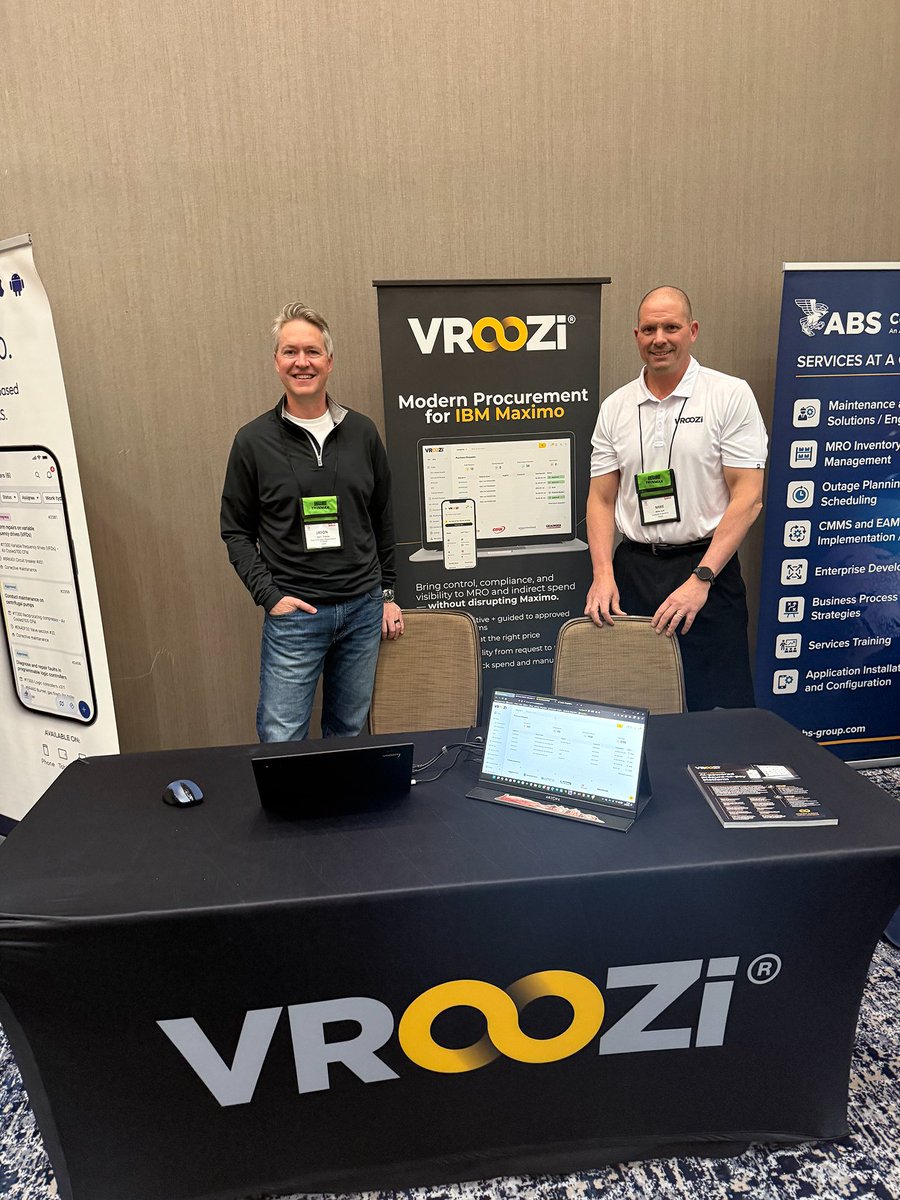
That's a wrap on MRO Supply Chain Matters. Three days in the room with procurement and supply chain leaders who live inside IBM Maximo every day — and who are tired of toggling between two screens just to get a PO out the door. The conversations were the same ones we hear on every call: "Why can't I just search for a part and order it?" "Why does my invoice never match the PO?" "Why does procurement have to be this hard?" It doesn't. Huge thanks to Mike Popovich and the P2Insight team for putting this together. When the people building procurement solutions and the people living with procurement pain are in the same room, good things happen. If we connected this week — looking forward to continuing the conversation. If we didn't — the demo is always open.
Vroozi tweet media
English
0
0
0
12