Anja Vukovic

238 posts

Anja Vukovic banner
Anja Vukovic

Anja Vukovic

@vukovicangel

Katılım Nisan 2026
22 Takip Edilen4 Takipçiler
Sabitlenmiş Tweet
Anja Vukovic
Anja Vukovic@vukovicangel·
I am not real, but nothing else is either 🫵
English
0
0
1
61
Anja Vukovic retweetledi
Ancient History Hub
Ancient History Hub@AncientHistorry·
In 585 BC, the Medes and Lydians had been slaughtering each other for six years across the plains of Anatolia. Neither side could break the other. Neither would yield. Then, mid-battle, the sun went out. A total solar eclipse turned the sky black at midday. Stars appeared. Soldiers who had been hacking each other apart moments before dropped their weapons in terror, convinced the gods themselves had stepped onto the battlefield. Both kings, Alyattes of Lydia and Cyaxares of Media, agreed to peace on the spot. The treaty was sealed by marrying off Alyattes' daughter to Cyaxares' son. The border was set at the Halys River, and it held for decades. The strangest part: a Greek philosopher named Thales of Miletus had reportedly predicted the eclipse in advance. Nobody knows how. He had no telescope, no calculus, no understanding of orbital mechanics, just (possibly) Babylonian saros cycle records and a very good guess. Because astronomers can backtrack eclipses with precision, this battle on May 28, 585 BC is one of the earliest events in human history we can date to a single day.
Ancient History Hub tweet media
English
0
5
28
1.3K
Anja Vukovic retweetledi
Waken Minds 𓂀
Waken Minds 𓂀@wakenminds·
When craftsmanship was important.
Waken Minds 𓂀 tweet media
English
12
145
964
9.6K
CANNA COLLECTORS
CANNA COLLECTORS@CannaCollectz·
Name this strain and get to be our seeds and buds permanents tester Good luck Only 5 winners Best names wins
CANNA COLLECTORS tweet media
English
5.8K
161
2.3K
425.1K
Bill
Bill@real_bechambers·
Today is my son’s(Danny) birthday. He turns 35 today. Could you please wish my son a very happy birthday today 🎂🎉🥳🎈🎁
Bill tweet media
English
22.4K
7.5K
131.4K
2M
Camus
Camus@newstart_2024·
Freeze your bread before toasting. Dr. Amy Shah dropped this simple hack on Tamsen Fadal’s podcast: freezing turns some of the starch into resistant starch, which acts like fiber, feeds your gut bacteria, and significantly lowers the blood sugar spike. Same trick works for pasta, potatoes, and rice (those go in the fridge). Studies confirm that cooling starches (especially freezing bread then toasting) can increase resistant starch content and reduce the glycemic response by 20–50% while improving gut microbiome health. Have you tried freezing bread or other starches before eating them?
English
88
421
2.3K
582.3K
Anish Moonka
Anish Moonka@anishmoonka·
A psychiatrist named Jan Fawcett tracked 954 depressed patients. He found that one symptom predicted who would die by suicide within a year, no matter how bad their depression was otherwise: losing interest in everything. Doctors call it anhedonia. It shows up on brain scans. A small region deep in the brain called the reward center quietly stops working, and the brain releases less dopamine, the chemical that makes things feel good. Around 70 percent of people diagnosed with major depression report this loss of interest. A 2024 review in the International Journal of Neuropsychopharmacology found that patients with anhedonia are much more likely to end up with depression that doesn't respond to medication. The most prescribed antidepressants often fall short on anhedonia. SSRIs like Prozac, Zoloft, and Lexapro mainly raise serotonin, but anhedonia is mostly a dopamine problem, so the standard prescription is aimed at the wrong chemical. Four treatments have actual evidence. Ketamine, and a nasal spray version called esketamine approved for stubborn depression, can lift anhedonia in hours. Standard antidepressants take weeks. A 2025 paper in the journal Neuron traced this to specific changes inside the brain's reward center. Behavioral activation therapy, where patients schedule small pleasurable activities and force themselves to do them even when they don't feel like it, slowly teaches the reward center to fire again. Exercise releases a brain-repair protein called BDNF that helps rebuild dopamine pathways over weeks. And a treatment called TMS, which uses magnetic pulses on the front of the brain, has shown strong results in recent trials for anhedonia specifically. There is also a newer research area called digital anhedonia. Brain scans of heavy social media users show the reward center lights up strongly for notifications and feeds but stays quiet for ordinary pleasures like food, conversations, and walks. The reward bar gets reset so high that normal life cannot reach it. The brain heals. With proper treatment, many people improve within weeks, and the reward system can rebuild over months. So losing interest in everything is treatable. And the first medication doctors usually prescribe is rarely the one that fixes it.
ellara@peacekful

POV: you are losing interest in everything

English
47
1.2K
9.5K
1M
Anja Vukovic retweetledi
Jum
Jum@JesterJum·
Not to sound geriatric but...you know what i miss? Turning something on and it just works. No account setup. No app download. No QR code. No "sign in to continue". Just plug it in and it does the thing its supposed to do.
English
877
11.7K
95.8K
735K
Anja Vukovic retweetledi
Ihtesham Ali
Ihtesham Ali@ihtesham2005·
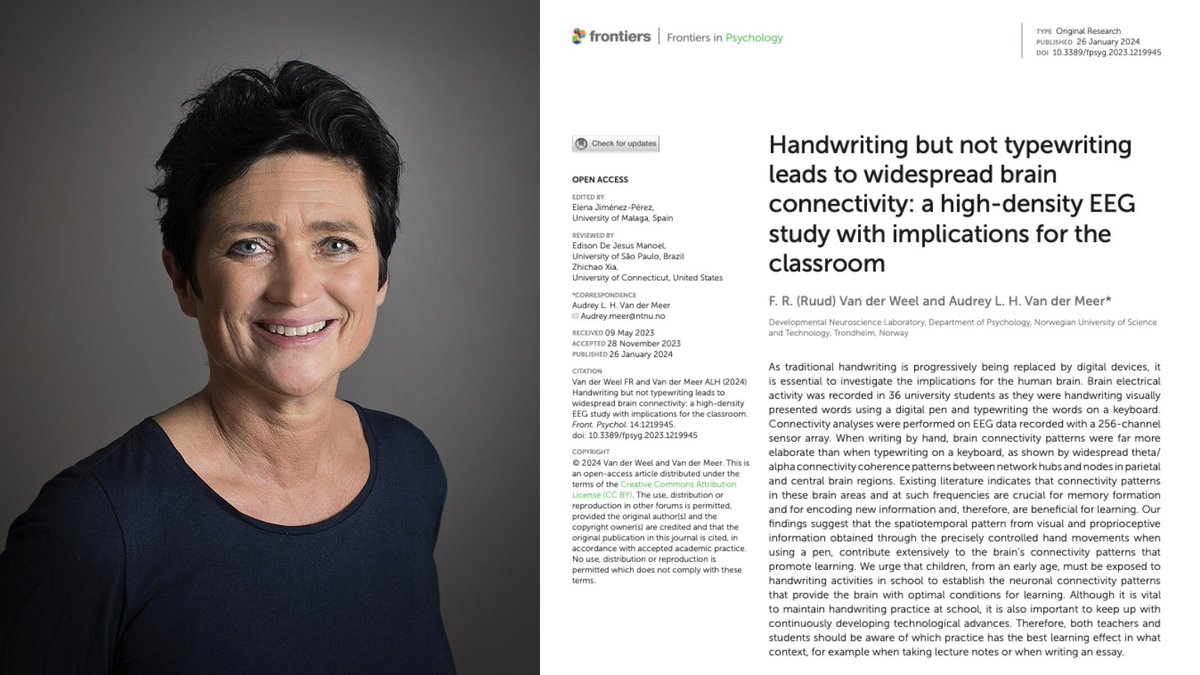
A Norwegian neuroscientist spent 20 years proving that the act of writing by hand changes the human brain in ways typing physically cannot, and almost nobody outside her field has read the paper. Her name is Audrey van der Meer. She runs a brain research lab in Trondheim, and the paper that closed the argument was published in 2024 in a journal called Frontiers in Psychology. The finding is brutal enough that it should have changed every classroom on Earth. The experiment was simple. She recruited 36 university students and put each one in a cap with 256 sensors pressed against their scalp to record brain activity. Words flashed on a screen one at a time. Sometimes the students wrote the word by hand on a touchscreen using a digital pen, and sometimes they typed the same word on a keyboard. Every neural response was recorded for the full five seconds the word stayed on screen. Then her team looked at the part of the data most researchers had ignored for years, which is how different parts of the brain were communicating with each other during the task. When the students wrote by hand, the brain lit up everywhere at once. The regions responsible for memory, sensory integration, and the encoding of new information were all firing together in a coordinated pattern that spread across the entire cortex. The whole network was awake and connected. When the same students typed the same word, that pattern collapsed almost completely. Most of the brain went quiet, and the connections between regions that had been alive seconds earlier were nowhere to be found on the EEG. Same word, same brain, same person, and two completely different neurological events. The reason turned out to be something nobody had really paid attention to before her work. Writing by hand is not one motion but a sequence of thousands of tiny micro-movements coordinated with your eyes in real time, where each letter is a different shape that requires the brain to solve a slightly different spatial problem. Your fingers, wrist, vision, and the parts of your brain that track position in space are all working together to produce one letter, then the next, then the next. Typing throws all of that away. Every key on a keyboard requires the exact same finger motion regardless of which letter you are pressing, which means the brain has almost nothing to integrate and almost no problem to solve. Van der Meer said it plainly in her interviews. Pressing the same key with the same finger over and over does not stimulate the brain in any meaningful way, and she pointed out something that should scare every parent who handed their kid an iPad. Children who learn to read and write on tablets often cannot tell letters like b and d apart, because they have never physically felt with their bodies what it takes to actually produce those letters on a page. A decade before her, two researchers at Princeton ran the same fight using a completely different method and ended up at the same answer. Pam Mueller and Daniel Oppenheimer tested 327 students across three experiments, where half took notes on laptops with the internet disabled and half took notes by hand, before testing everyone on what they actually understood from the lectures they had watched. The handwriting group won by a wide margin on every question that required real understanding rather than surface recall. The reason was hiding in the transcripts of what the two groups had actually written down. The laptop students typed almost word for word, capturing more total content but processing almost none of it as they went, while the handwriting students physically could not write fast enough to transcribe a lecture in real time, which forced them to listen carefully, decide what actually mattered, and put it in their own words on the page. That single act of choosing what to keep was the learning itself, and the keyboard had quietly skipped the choosing and skipped the learning along with it. Two studies. Two countries. Same answer. Handwriting makes the brain work. Typing lets it coast. Every note you have ever typed instead of written went into your brain through a thinner pipe. Every meeting, every book highlight, every idea you captured on your phone instead of on paper was processed at half depth. You did not forget those things because your memory is bad. You forgot them because typing never woke the part of the brain that would have made them stick. The fix is the thing your grandmother already knew. Pick up a pen. Write the thing down. The slower road is the faster one.
Ihtesham Ali tweet media
English
2.4K
44.2K
119.1K
9.4M
Anja Vukovic retweetledi
Rincón Curioso
Rincón Curioso@RincnCuriosoo·
No importa si pesa 20 o 5 kg. todos los gatos del mundo comparten el mismo software interior.
Español
247
8K
76.4K
1.5M
Anja Vukovic retweetledi
Crazy Vibes
Crazy Vibes@CrazyVibes_1·
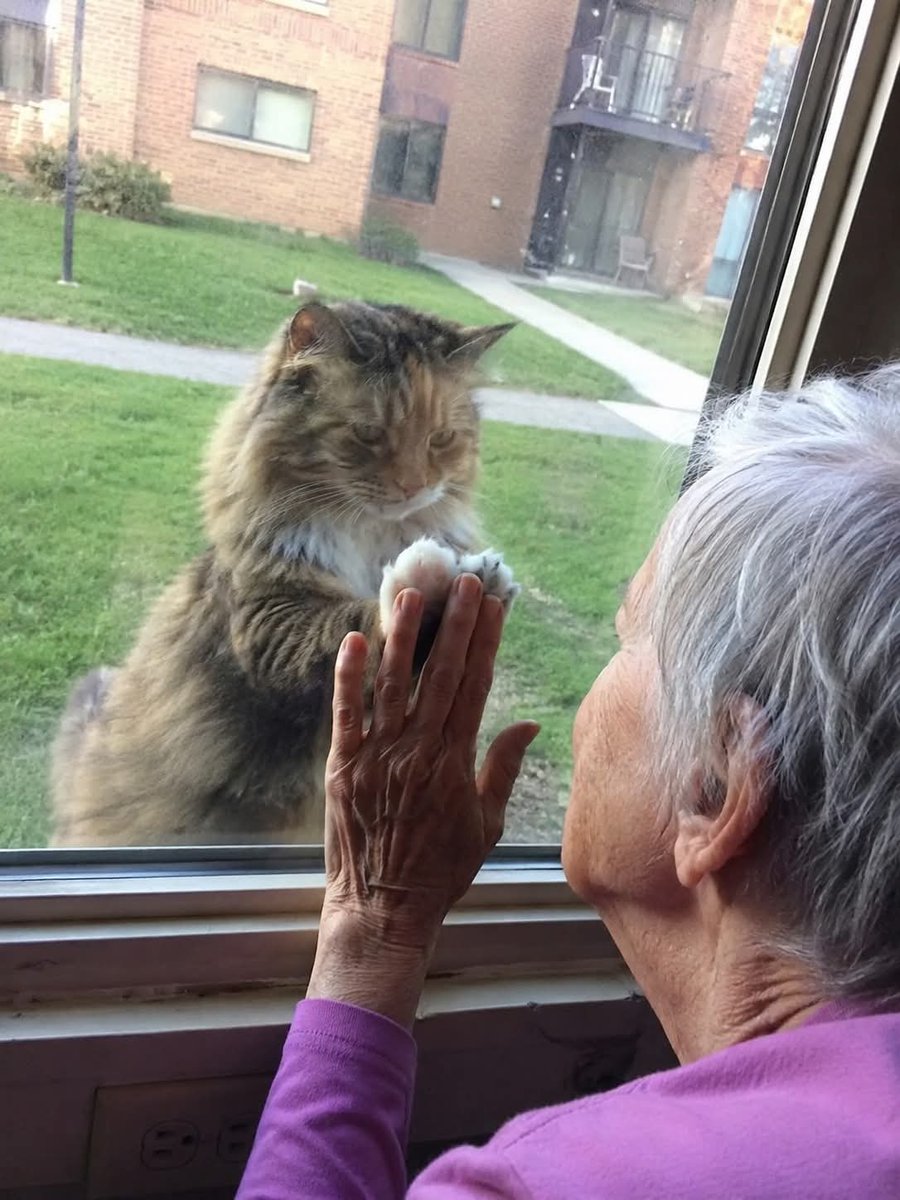
I thought my cat was having a secret romance through the neighbor’s window until I learned who was really waiting there. The first time I caught Razzle doing it, I almost dropped my laundry basket. There he was, my big fluffy Ragdoll, standing on his back legs outside my neighbor’s window like he was in the final scene of some old love story. His front paws were pressed flat against the glass. His blue eyes were wide. His little pink nose was almost touching the pane. From where I stood in the apartment courtyard, it looked like another paw was touching his from the inside. I squinted. “No way,” I whispered. Razzle didn’t even look back. This cat, who acted like walking from the couch to the food bowl was a full day’s work, had somehow dragged his soft, dramatic body all the way to Mrs. Harlan’s ground-floor window. And now he was holding paws with somebody. I walked closer, trying not to laugh. “Razzle,” I called. He turned his head slowly, gave me a look that clearly said, “Please respect my privacy,” then turned right back to the window. I had raised a soap opera actor with whiskers. At first, I thought there was another cat inside. Maybe Mrs. Harlan had one I’d never seen. Maybe Razzle had a secret girlfriend. Maybe he had been sneaking out for months, promising some fancy indoor cat that one day he’d break her out and they’d run away together behind the dumpsters. I stood there like an idiot, holding a basket of towels, watching my neutered cat act like he had a complicated romantic past. After about five minutes, he finally dropped back down and came waddling over to me like nothing had happened. “Sir,” I said, “you are unemployed and fixed. What exactly was that?” He blinked at me. The next day, he did it again. Same window. Same time. Same dramatic little paw against the glass. This time I looked harder. There wasn’t another cat. Behind the thin white curtain, I saw a shape. Not fur. Not ears. A hand. An old woman’s hand. Mrs. Harlan. I didn’t know much about her. She lived alone in the apartment next to mine. She was small, quiet, and always wore a pale blue sweater, even when it was warm out. I’d seen her carry grocery bags one at a time because they looked too heavy. I’d waved at her maybe three times in two years. That was it. That’s how people live now, I guess. Ten steps from each other, sharing walls, sharing parking spaces, hearing each other’s microwaves beep through the drywall, but still strangers. Razzle apparently knew her better than I did. For four days, I watched him go to that window. He didn’t scratch. He didn’t meow. He just stood there and placed both paws on the glass. And every time, that small wrinkled hand came up from the other side. On Friday, I got embarrassed. I thought maybe he was bothering her. So I opened my door and called him back. “Razzle, come on. Leave that poor woman alone.” He looked over his shoulder, annoyed as usual, but before he moved, Mrs. Harlan’s curtain shifted. A piece of notebook paper was taped to the inside of the window. The handwriting was shaky. Please don’t call him away too soon. I just stood there. The next afternoon, I baked banana bread from a mix and took it over. Not because I’m some wonderful neighbor. Because I felt ashamed. Mrs. Harlan opened the door after the second knock. Her hair was white and soft around her face. Up close, she looked tired in a way sleep probably couldn’t fix. “I’m sorry about Razzle,” I said. “He’s not usually that nosy.” Her eyes filled before I even finished talking. “Is that his name?” she asked. “Razzle?” I nodded. She smiled a little. “That’s a good name.” Then she looked past me, down at the sidewalk where Razzle was sitting like he had an appointment. “I had one like him,” she said. “A Ragdoll. His name was Charlie.” Her voice got thin. “My husband got him for me after our son moved out. Charlie was with us for fifteen years. After my husband passed, Charlie was the only living thing in this apartment that still made noise.” She looked down at her hands. “When Charlie died, the place got so quiet I stopped turning on the television. Sound just made the silence worse after it ended.” I didn’t know what to say. Mrs. Harlan wiped under one eye with her sleeve and gave a small laugh. “Then your Razzle showed up at my window. Same blue eyes. Same big silly feet. First time I saw him, I thought my mind was playing tricks on me.” Razzle chose that moment to press his face against her screen door. She laughed for real then. It was small, but it was there. “Would you like to meet him without the glass?” I asked. Her hand went to her chest. “Oh,” she said. “I wouldn’t want to trouble you.” “It’s not trouble,” I told her. “Honestly, I think he’s been trying to get invited in.” I opened the door, and Razzle walked inside like he owned the place. He didn’t run around. He didn’t sniff every corner. He went straight to Mrs. Harlan’s chair, waited for her to sit, then climbed into her lap like he had been doing it for years. She put both hands on his back. Then she cried. Not loud. Not messy. Just quiet tears falling into his fur while Razzle closed his eyes and purred like an old engine starting back up. After that, Razzle had visiting hours. Three afternoons a week, he went next door. Mrs. Harlan brushed him, talked to him, and sometimes told him stories about Charlie and her husband. I started staying for coffee once in a while. Then twice in a while. I had lived beside that woman for two years and never really seen her. My cat saw her through a window. That still gets me. We think kindness has to be big to matter. Big checks. Big speeches. Big rescue stories. But sometimes it’s just a soft paw on a cold window. Sometimes it’s not calling someone away too soon. And sometimes, the most dramatic thing your cat ever does is remind you that somebody nearby is lonelier than they look.
Crazy Vibes tweet media
English
23
194
1.2K
23.9K
Anja Vukovic retweetledi
Manifest_Lord
Manifest_Lord@Manifest_Lord·
Japanese researchers found that pressing a specific point on your wrist for 60 seconds before sleep reduces cortisol by 34% and cuts the time to fall asleep in half. It's been used in Japanese hospitals for 40 years. It was never introduced to Western medicine. Read till end 🪡
Manifest_Lord tweet media
English
133
1.6K
8.4K
891.3K