Vikash Yadav

9K posts

Vikash Yadav banner
Vikash Yadav

Vikash Yadav

@vyadav

Professor of International Relations and Asian Studies

New York Katılım Aralık 2007
128 Takip Edilen1.2K Takipçiler
Vikash Yadav
Vikash Yadav@vyadav·
I bet no one in India will be envious of Pakistan’s diplomatic “coup” once they realize how this White House actually works. What an immense humiliation for Pakistan… “White House Knew About Pakistan’s Cease-Fire Post on X Before It Was Sent” nytimes.com/2026/04/08/wor…
English
0
0
1
46
Vikash Yadav
Vikash Yadav@vyadav·
I left out US, China, and UK in that list…
English
0
0
0
21
Vikash Yadav
Vikash Yadav@vyadav·
This aspect of the ceasefire plan represents a complete violation of international law and a major concession by the United States of one of its core foreign policy principles: freedom of navigation. If this provision becomes permanent, it will set a dangerous precedent.
OSINTdefender@sentdefender

Under the two-week ceasefire plan agreed to tonight by both Iran and the United States, both Iran and Oman are permitted to charge fees on commercial vessels transiting the Strait of Hormuz, according to the Associated Press, with officials stating that the money received by Iran will be used to rebuild the country following the recent strike campaign by Israel and the United States.

English
0
0
0
61
Vikash Yadav
Vikash Yadav@vyadav·
It could be argued that, despite several major setbacks, the US and Israel are currently "winning" by achieving a range of objectives in Iran. In this light, the US President's growing agitation and brinksmanship is completely unhinged. I know he mainly wants to dominate the news cycle while searching for an off-ramp from the crisis he created, but his words are beyond the pale of a rational human being.
English
0
0
0
88
Vikash Yadav
Vikash Yadav@vyadav·
Tentative thoughts on the “dronization” of war: 1. Drones may lower the threshold for kinetic conflict. 2. Drone warfare (so far) seems to lead to a stable low intensity equilibrium rather than pushing states up the escalation ladder. Numbers 1&2 potentially herald a new era of constant conflict. 3. Military advantage in drone production seems to go to countries with innovation hubs and scale manufacturing more than traditional defense procurement industries oriented toward large platforms. It’s a small victory for bottom up adaptive approaches… 4. But I am still not seeing how drones will confer strategic advantage in conquering and holding territory, so older technology/manpower is still going to be needed. So from a fiscal perspective, drones and counter-drone technology are an added expense not an alternative. (Wondering what security studies types are seeing…)
English
0
0
1
59
Vikash Yadav
Vikash Yadav@vyadav·
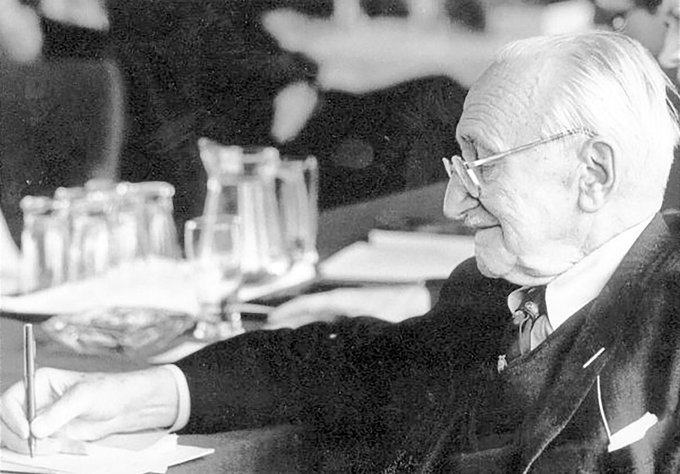
Out of curiosity, I did a Nexis database search and found the quote comes from Walter E. Williams, a syndicated columnist, paraphrasing Hayek in his column on August 5, 2018. Williams wrote: "People tend to love a powerful government. Quite naturally, a big, powerful government tends to draw into it people with bloated egos, people who think they know more than everyone else and have little hesitance in coercing their fellow man. Nobel laureate Friedrich Hayek explained why corruption is rife in government: "In government, the scum rises to the top." My hunch is that internet scraping device found that and put into some "important quotes" aggregator...
English
1
0
3
100
Mark Pennington
Mark Pennington@Kaleidicworld·
@FAHayekSays Where does he say that? He says the worst get on top, but not 'scum.' Hayek just didn't write like that - at least not to my knowledge.
English
3
0
12
629
F. A. Hayek Quotes
F. A. Hayek Quotes@FAHayekSays·
“In government, the scum rises to the top.” — Friedrich Hayek
F. A. Hayek Quotes tweet media
English
13
183
910
22.5K
Vikash Yadav
Vikash Yadav@vyadav·
There's a lot here to chew on. 1. Including Madhav, an RSS leader, alongside reputable scholars and diplomats is highly questionable. He's not a strategic analyst as far as I know. Same goes for including Sonia Gandhi, who is a political party leader, not an analyst. 2. Tharoor is generally defending "passive non-alignment." More precisely, his position in that quote supports bandwagoning (which has a certain tension with non-alignment). But to put Tharoor in the same "camp" as C. Raja Mohan seems odd, since the latter is contemplating structural consequences ("cascading effects") that India will have to face with limited capacity. 3. Rajagopalan and Rao come closest to actually weighing India's structural and particularly economic vulnerabilities to guide its position. Rajagopalan's position here is really just (Waltzian) Realist as far as I can tell, not "Hard Realist" which implies some sort of (Mearsheimerian) offensive realism or security maximization. 4. Haider's position is no more "assertive internationalism" than it would be "reputational realism." The quote at least is not signaling an institutional engagement. Normatively speaking, her actual position to "not stand soundlessly" at the back of the global commons is ... well ... wishy-washy.
Happymon Jacob@HappymonJacob

English
0
0
2
211
Vikash Yadav
Vikash Yadav@vyadav·
Indians should be celebrating Pakistan’s effort to mediate the West Asia War. Why? 1. Free-rider benefits: India benefits (esp. its Chabahar Port) with little risk. 2. If Pakistan fails, they take the heat. 3. Binding Pakistan to the US at least adds to its constraints. 4. Normalizes a new role for Pakistan rather than nuclear armed, terrorist state. 5. Opens space for India to quietly influence results without drawing attention to itself. Yes, there are risks in Pakistan re-legitimating itself, but the benefits outweigh the risks.
English
0
0
0
110
Vikash Yadav
Vikash Yadav@vyadav·
Authoritarian envy runs deep in India but is intellectually lazy. Outside this sector, China’s consistency and foresight is more erratic with mothballed mega-projects (even in the chemical industry) due to shifting global prices. Projects are often characterized by over investment, failure, and consolidation. Erratic policy guidance is evident when one pans out to fintech, solar, real estate development, even the tutoring industry. Strong state capacity can lead to measurable achievements but also to humanitarian and political nightmares (e.g., Three Gorges resettlement, Tibet, Xinjiang, Hong Kong, etc.). In any case, democracies like India can also make spectacular achievements for us to cherry pick (e.g., India’s space program, pharmaceutical industry). India does need to work on deliverables for its citizens and a better overall environment for entrepreneurs but it won’t get there by mythologizing its authoritarian neighbor.
Shekhar Gupta@ShekharGupta

China insulated itself against energy shocks. India is ‘all talk, no walk’… Why is India gas-starved while China sits pretty.. #NationalInterest for the week… theprint.in/national-inter…

English
0
0
1
161
Vikash Yadav
Vikash Yadav@vyadav·
The very first use of the phrase "bombing them back to the Stone Age," was during the Vietnam War by columnist Art Buchwald in June 1967 (although it is often misattributed to Gen. Curtis LeMay). Buchwald was satirizing the position of the Goldwater faction in the GOP. Perhaps it is a testament to how far we've travelled that this outlook is no longer considered satire but is actually a threat made publicly by the President of the US and his Secretary of War to the Iranian regime.
English
0
0
1
198
Vikash Yadav
Vikash Yadav@vyadav·
This framing of the power of “engineering societies” is popular but misleading. Why? Let’s dig in as the kids say… 1. “Engineer” societies can be disastrous, e.g., the USSR. Being an engineer doesn’t confer any particular wisdom in running a society. Anyway, Xi Jinping, for example, is not an engineer despite his undergrad “education.” His 2002 “doctorate” on agricultural marketization is formally in law — if he even wrote it. If China is an engineer society it seems to be run by a career political operative. 2. Land acquisition can be hindered by a legalistic society, but that can also prevent mistakes and gross abuses of power. 3. The real engine of China’s growth has been institutional alignment of incentives at the provincial and individual levels, not master planning. 4. It’s important not to mistake debt fueled growth for actual economic development.
Anuj Gupta@anujg

US is a society run by lawyers, China is a society run by engineers and India is a society run by liberal arts graduates. In a lawyerly society, you are incentivized to follow the process. In China’s engineering state, you are incentivized to deliver the product. In artsy India, you are incentivized to generate philosophy. manochaopinion.substack.com/p/how-does-chi…

English
0
1
3
269
Vikash Yadav
Vikash Yadav@vyadav·
One reaction to oil price spikes is to seek to reduce “vulnerability” through diversification of energy sources and increased domestic production where possible. These aren’t unreasonable reactions but there is a liberal alternative - increased international cooperation to manage supply through coordinated releases of reserves — the aim is to buffer price shocks. Why is it necessary? Well, even the US, the world’s largest exporter of oil and gas, is not immune to price spikes because domestic producers sell at world prices. A coordinated intergovernmental institutional solution is better than the illusory pursuit of autarky in a globalized world. Luckily, we built the core institution for this in the last oil crisis - the IEA. What’s mainly needed is to adjust membership to match the changed world economy. In other words, China and India need to be made full members by changing the 1974 IEA Charter to include non-OECD member states.
English
0
0
0
72
Vikash Yadav
Vikash Yadav@vyadav·
Part of the problem with India's understanding of itself is an indulgence in nostalgia and moral superiority based on a questionable reading of its own history. Has India spoken out with a consistent voice for "sovereignty, restraint, and balance" over the years? Let's look at the record of times when India was silent: 1956 - The Soviet invasion of Hungary - voted w/USSR at UN. 1979 - The Soviet invasion of Afghanistan - initially sided with USSR in a speech at the UN and ultimately abstained from the General Assembly vote. 1989 - Tiananmen Square massacre - complete silence to protect a thaw in relations with China. 2009 - Elam War - commended Sri Lanka at UNHCR; later switched position. 2021 - Myanmar coup - refused to condemn violence against civilians. 2022 - Russian invasion of Ukraine - India votes three times to abstain from condemning Russia in first few weeks of the war. There were perhaps good reasons for India to be strategically ambiguous in each case, but it is important not to muddle morality and Realism. India mainly finds its courage and moral clarity when the aggressor is a Western country. When the aggressor is Russia or an Asian country, the situation suddenly becomes more complicated.
Nirupama Menon Rao 🇮🇳@NMenonRao

The world is being reordered by those who act and those who define. If India wishes to be counted among the latter, it must ensure that its silence does not speak louder than its convictions. We are living through a moment when the rules of the international system are being rewritten in real time. Assassinations of leaders, the killing of civilians, open assertions of force—these are no longer aberrations but instruments. In such a world, silence is not neutrality. It is read, interpreted, and often misread as consent. India has long claimed a distinctive space in global affairs—not as an appendage to power, but as a voice shaped by its own civilisational experience and its history of speaking for sovereignty, restraint, and balance. That voice mattered because it was consistent, even when inconvenient. Strategic autonomy cannot mean adjusting our language to the hierarchy of power. Restraint has its place. Calibration is necessary. But when fundamental questions arise—about sovereignty, about the limits of force, about the protection of civilians—India cannot afford to be silent. A moral compass is not an ornament of foreign policy. It is its direction. Without it, realism drifts into accommodation, and autonomy into ambiguity. This war has damaged India’s interests in almost every practical sense. It has raised costs, narrowed diplomatic room, stressed shipping, complicated Chabahar, and injected fresh instability into a region vital to India’s economy and external strategy. Even if New Delhi can cushion the blow, it cannot plausibly claim that the blow itself serves India. The deeper question is whether India is willing to say so with sufficient clarity.

English
1
0
2
153