Stanislus

121 posts

Stanislus banner
Stanislus

Stanislus

@vzyengineer

My mother thinks I'm the second coming of Einstein; sometimes I think she might be right. Building projects at the intersection of ML & Computer Architecture.

Katılım Ağustos 2025
57 Takip Edilen13 Takipçiler
Sabitlenmiş Tweet
Stanislus
Stanislus@vzyengineer·
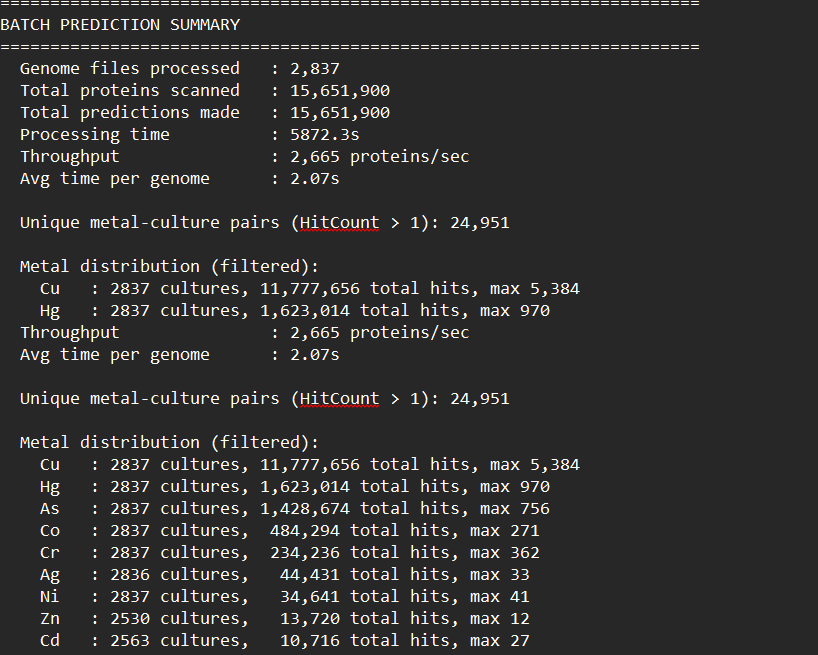
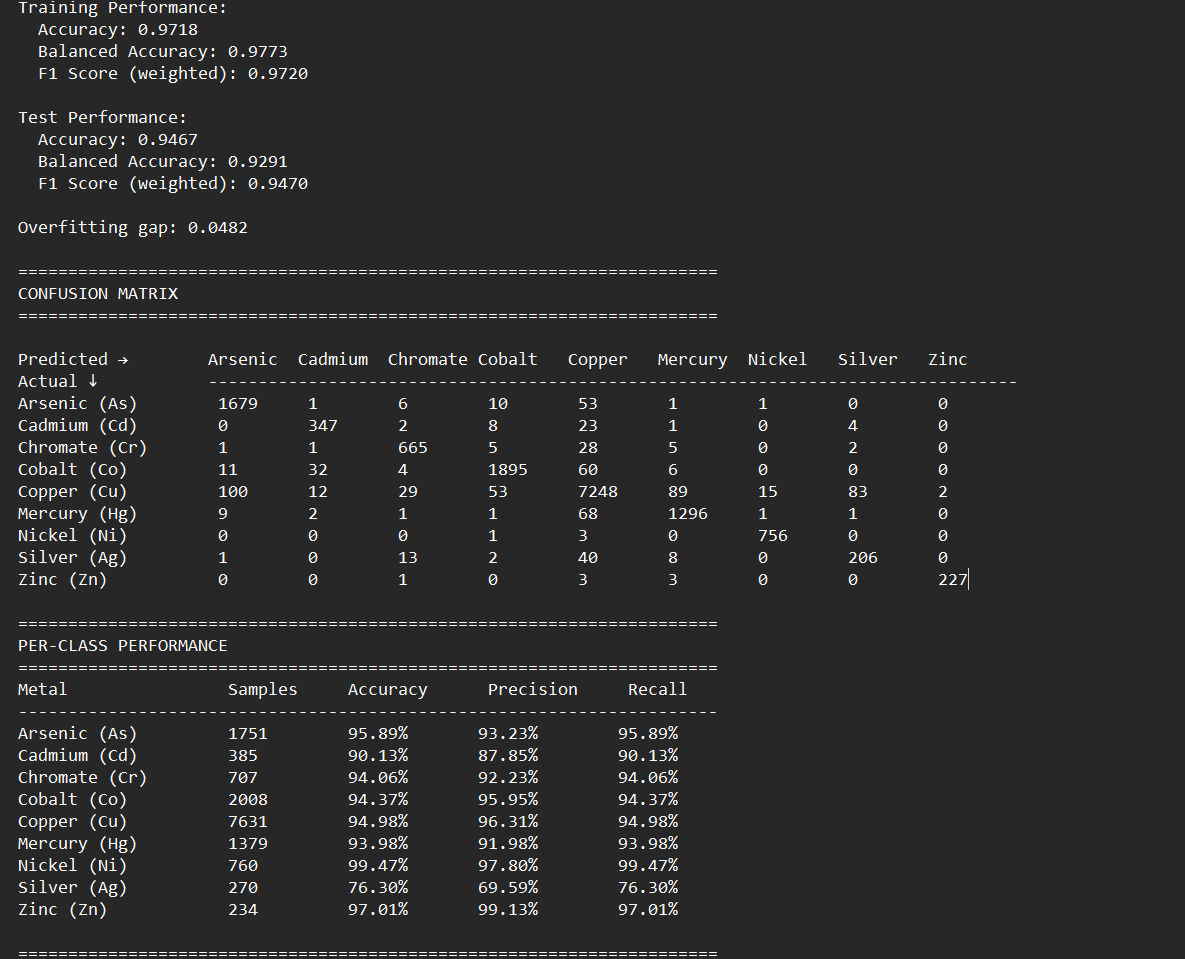
I built an AI genome inference engine named Aluka. She's trained on the Bacmet predicted metal resistance database. The stats on a standard CPU (No GPU): 2,837 genomes in 97 mins 15M+ proteins analyzed 92% accuracy For me, AI is about real-world problems not LLMS. #AI
Stanislus tweet mediaStanislus tweet media
English
0
0
0
255
Stanislus retweetledi
Ashesi University
For her final year project, Elyse Addison '26 designed a smart food scanner for real-time detection of bacterial contamination in fresh produce. Using fluorescence-based imaging, the system detects contamination and triggers targeted sterilization with UV-C light or a fine-mist spray. Designed to operate autonomously, the system aims to improve food safety by enabling faster detection of contamination. Watch the full series: ashe.si/496W4Hb #AshesiGrad #Ashesi2026
English
0
7
29
706
Stanislus retweetledi
Pope Leo XIV
Pope Leo XIV@Pontifex·
I follow with concern the war in #Ukraine, which is experiencing a sharp intensification in these days. I wish to express my closeness to all those suffering due to recent attacks carried out even against civilians. War does not solve problems but worsens them. It does not create security but multiplies suffering and hatred. Where missiles and drones fall, hopes also fall; homes and places of prayer are destroyed, and innocent lives are broken. I entrust all peoples wounded by war to the protection of the Virgin Mary, Queen of #Peace.
English
557
2.2K
13.9K
259.5K
Stanislus retweetledi
Pope Leo XIV
Pope Leo XIV@Pontifex·
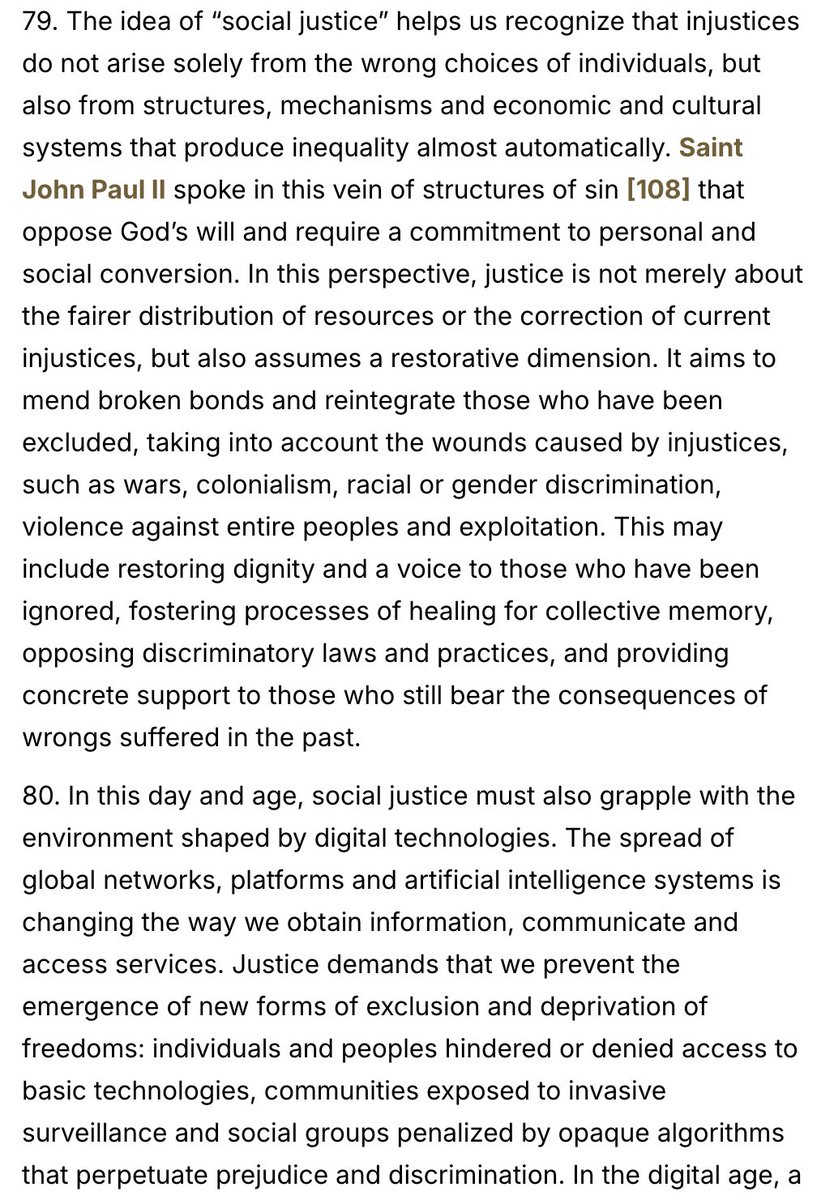
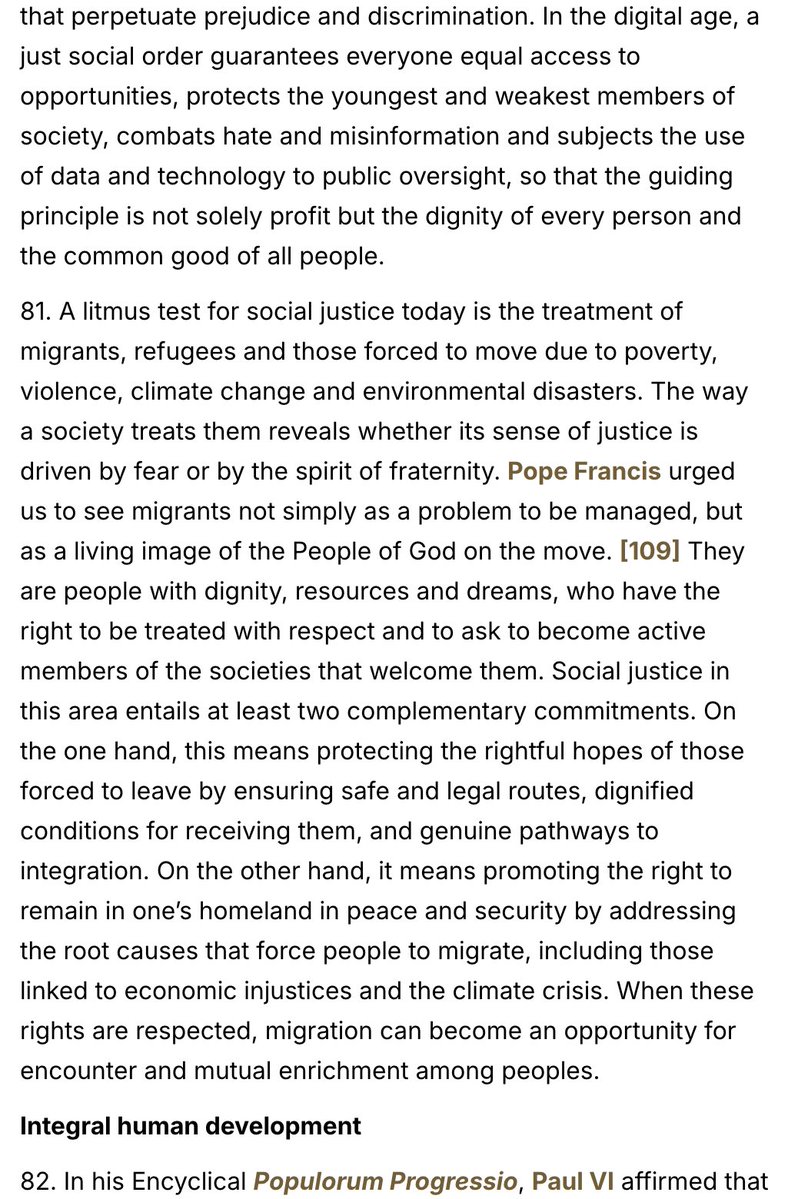
In the era of #ArtificialIntelligence, when human dignity is threatened by new forms of dehumanization, ours is the pressing duty to remain profoundly human. We must lovingly safeguard the grandeur of humanity bestowed upon us and revealed in its fullness in Christ, the splendor of which no machine can ever replace. #MagnificaHumanitas vatican.va/content/leo-xi…
English
864
14.1K
67.2K
2.1M
Stanislus
Stanislus@vzyengineer·
But we have many solid engineers and scientists trained in EN/FR, and many Africans consider these 'foreign languages' as their L1. If we can train professionals in these languages, the problem can't be the language surely. Let's address our real problems.
Àyànfè@Danny456080

You cannot think freely in someone else’s language. Every nation that industrialized fast Japan, China, South Korea taught science, law, and governance in its own language. Africa still graduates engineers who can’t explain their work to their own grandmothers.

English
0
0
0
4
Stanislus retweetledi
Sai Ishaya
Sai Ishaya@Sai_Ishaya_·
People are reaching for medieval examples but... Singapore is right there. Singapore did not industrialise by retreating into an ancestral language. It built one of the most capable states in the modern world using English as a central language of administration, education, science, law, higher education, commerce, & global trade. Singapore’s population was largely made up of Chinese, Malay, etc The state could have made language policy a battlefield of ethnic supremacy(take a cue). Instead, it chose English as a neutral working language, while retaining Malay, Mandarin etc as official languages. It allowed Singapore to avoid privileging one major ethnic group’s language over the others & gave the state a common administrative language. Africa’s problem is not simply that engineers are trained in English or French. The problem is that too many systems fail to make any language, foreign or indigenous, a serious vehicle for mass technical understanding. We cannot give making up excuses for our failure to catch up with the rest of the world. When we are ready to hold our leaders accountable and put in the work, we will.
Àyànfè@Danny456080

You cannot think freely in someone else’s language. Every nation that industrialized fast Japan, China, South Korea taught science, law, and governance in its own language. Africa still graduates engineers who can’t explain their work to their own grandmothers.

English
2
21
57
2.7K
Stanislus retweetledi
NITA Ghana
NITA Ghana@NITAGhana·
We wish to inform the general public and all stakeholders that the proposed X Space discussion on the new NITA Bill has been rescheduled. 🗓️ New Date: Tuesday, 26th May 2026 ⏰ Time: 1:00 PM GMT The rescheduling is to allow for broader /1
NITA Ghana tweet media
English
185
137
341
175.4K
Stanislus
Stanislus@vzyengineer·
Honnêtement, je continue d'apprendre le système des partis populistes. En Afrique de l'Ouest, deux pays ressortent. Non, politiques concrètes juste parler.
Français
0
0
0
7
Stanislus retweetledi
Nana Yaw Architect 🇩🇪🇹🇷🇬🇭
Dear @NITAGhana The questions and answers provided in your response comes off a bit as a deflection of the main concerns. Below are our concerns and would be very beneficial if answers can be provided. A twitter space won’t be a bad idea for digital natives 😊. 1️⃣ Article 46 states that no person shall be appointed as an Information and Communications Technology professional in a public or private institution unless certified by the Authority. What specific national problem is this provision trying to solve that existing university degrees, industry certifications, and employer hiring standards have failed to solve? 2️⃣ Under Article 46, why should a private startup hiring a software engineer require state certification before employment? Does NITA believe private companies are incapable of assessing technical competence on their own? 3️⃣ If a globally recognized engineer from companies like Google, Microsoft, or Amazon relocates to Ghana, would they legally be unable to work until certified by NITA? 4️⃣ Article 46 gives NITA power to determine the criteria and procedure for certification. Why does the Bill not define the minimum criteria directly in the legislation itself, considering the broad powers being granted? 5️⃣ Can NITA point to any major digital economy such as Germany, United States, United Kingdom, Singapore etc. where all Information and Communications Technology professionals in both private and public sectors require mandatory government certification before employment? 6️⃣ The Bill appears to centralize approval authority within NITA. How does NITA plan to avoid creating a bottleneck where innovation moves at the speed of regulatory approval rather than the speed of technology? 7️⃣ If a university student builds a small application, an artificial intelligence model, or an e-commerce website from their bedroom, at what point do they become subject to certification or regulatory approval under this Bill? 8️⃣ The Bill introduces penalties including fines and possible imprisonment for non-compliance. Why was a punitive approach chosen for a sector historically driven by openness, experimentation, and low barriers to entry? 9️⃣. Does NITA see software engineering as equivalent to professions like medicine or law where licensing protects life and safety? If so, which categories of Information and Communications Technology work does NITA consider dangerous enough to justify state licensing? 🔟 Could Article 46 unintentionally encourage companies to relocate talent, outsource development abroad, or avoid hiring locally certified professionals due to compliance uncertainty? Has NITA conducted an economic impact assessment on innovation, startup growth, foreign investment, and youth employment?
NITA Ghana@NITAGhana

RESPONSE TO CONCERNS REGARDING NITA, THE PROPOSED BILL, AND FEES & CHARGES

English
15
217
279
13.5K
Stanislus
Stanislus@vzyengineer·
@yaa_aminu That's part of the stack yes. We are optimising further. We've only been on this two months now.
English
0
0
0
14
yaaminu
yaaminu@yaa_aminu·
I'm very impressed with the engineering talent coming out of Ashesi university. Here's to hoping that we're able to retain them in this country.
English
5
10
25
736
Stanislus retweetledi
BlackStarPatriot
BlackStarPatriot@1957_GHPatriot·
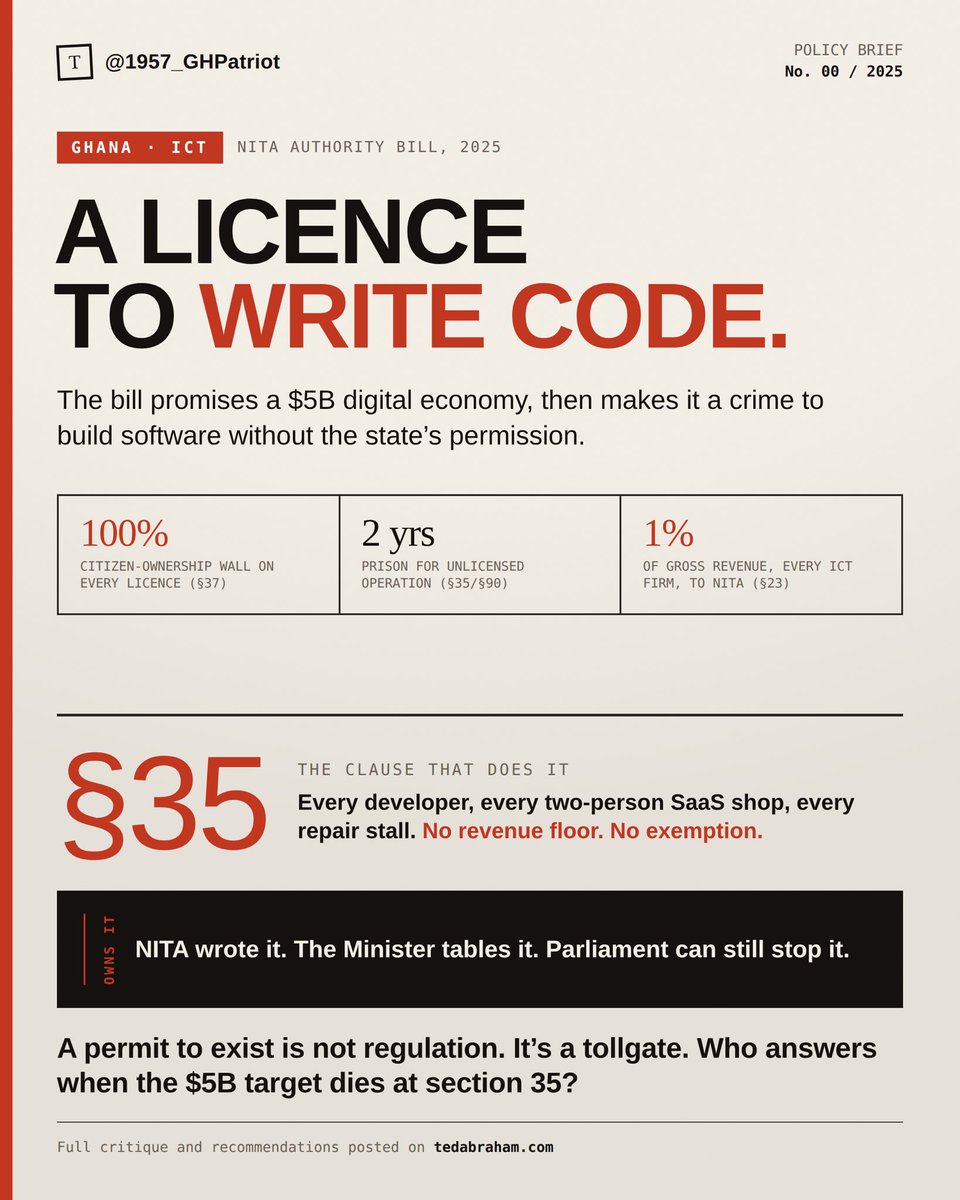
Parliament is about to vote on a bill that decides who can build Ghana’s digital future, who can work in it, and who can go to prison for touching a keyboard without permission. This is the real threat picture in the NITA Bill. Section 35 says you cannot “engage in a business or related activity in the ICT sector” without a licence from NITA. That sweeps in everyone from a one person dev shop in Kumasi to a cloud provider in Accra. Operate without a licence and the law treats you as a criminal, not a startup. The penalty is not a slap on the wrist. The bill puts fines of 2,000 to 5,000 penalty units and up to two years in prison on the table for running an unlicensed ICT business. We are not talking about fraud or cybercrime. We are talking about writing code and shipping products without a government permission slip. Now add section 46. No public or private institution can appoint an “ICT professional” unless that person is certified by NITA. If you run a fintech, a hospital, a logistics startup or even a church IT desk, every systems admin and developer is supposed to queue for one Authority’s certificate before you can legally hire them. Layer section 90 on top. Providing ICT services without a valid licence, or claiming to be a certified professional when you are not, carries the same criminal penalties. You have just turned self taught devs and student freelancers into a compliance risk that can carry jail time. Section 37 closes the trap. Only Ghanaian citizens and entities “wholly owned” by citizens may even apply for ICT licences. That is not gentle local content. It is a full lockout of foreign or mixed ownership from the licensed ICT space. The same government that markets Ghana as a digital hub is writing “locals only” into law. If you have ever sat in a combat information center or a continuity/control war room, you know what this kind of design does. You create a single point of failure by handing one Authority control over who can operate, who can work, and who can be punished. When that Authority is slow, captured or simply wrong, the whole ecosystem pays the recovery cost. NITA should exist. We need standards for public ICT, a national digital architecture, and real oversight of critical systems. What we do not need is a digital command economy where every ICT business and professional sits behind a gate that opens only when a central office says so. A sane fix is on the table. Limit compulsory licences to clearly defined critical infrastructure. Limit compulsory certification to people working on those systems. Replace the citizens only rule with minimum local equity plus strong local content and skills transfer. Strip criminal penalties out of ordinary licensing failures. If Parliament passes the bill in its current form, the recovery time for the damage will be measured in years of lost investment and talent flight. The House still has a window to correct course. MPs on the Communications Committee should not treat this as another routine bill. It is a structural change to how Ghana’s digital economy lives or dies. @koboateng @kwekutech @pazunre @jdghinson #NITABILL2025
BlackStarPatriot tweet media
English
11
77
105
2.5K
Stanislus retweetledi
Kwame Stalwart ◻️💰
Kwame Stalwart ◻️💰@WikicatStalwart·
Innovation doesn’t need barriers and middlemen. Make innovation open to all and not a controlled experiment which is bound to fail. Sign this petition, stand with the Ghana Tech Industry. nitastopthebill.vercel.app
Kwame Stalwart ◻️💰 tweet mediaKwame Stalwart ◻️💰 tweet media
English
2
32
52
2.4K