Full-stack Web Developer, #SEO Consultant,Optimistic,forward thinking,father of 3. I help E-Commerce business owners generate more traffic,leads, and sales.
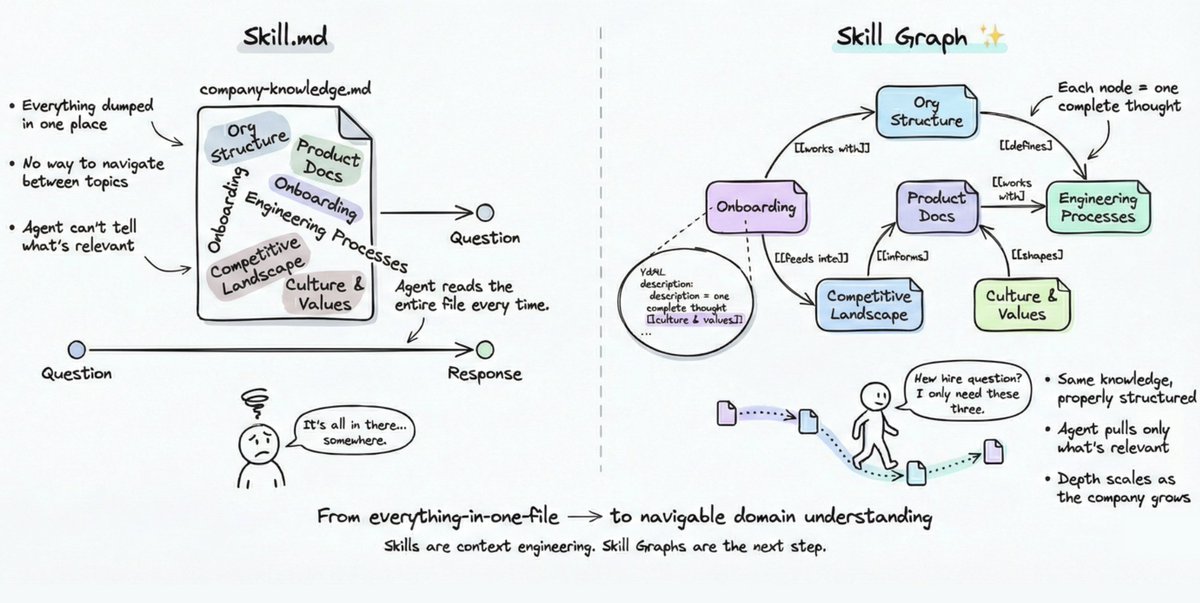
Skill Graphs > SKILL .md
Everyone's talking about skills for AI agents.
But almost nobody is talking about how to structure them.
Right now, the default approach is simple. You write one skill file that captures one capability. A skill for summarizing. A skill for code review. A skill for writing tests.
One file, one job, and it works.
But I recently came across an idea that made me rethink this entirely.
What if skills weren't flat files? What if they were graphs?
Let me explain what I mean.
Think about how a senior engineer onboards you to a large codebase. They don't hand you one giant document and say "read this." They give you a map. They point you to the right modules. They explain how pieces connect. Then they let you go deeper only where you need to.
That's the mental model behind a skill graph.
Instead of one big file, you build a network of small, composable skill files connected through wikilinks. Each file captures one complete thought, technique, or concept. The links between them tell the agent when and why to follow a connection.
Here's what changes with this approach.
The agent doesn't load everything upfront. It scans an index, reads short descriptions, follows relevant links, and only reads full content when it actually needs to. Most decisions happen before reading a single complete file.
Each node is standalone but becomes more powerful in context. A "position sizing" node in a trading skill graph works on its own. But link it to risk management, market psychology, and technical analysis, and now you have context flowing between concepts.
And suddenly, domains that could never fit in one file become navigable. Company knowledge. Legal compliance. Product documentation. Org structure. All traversable from a single entry point.
The building blocks are surprisingly simple.
Wikilinks embedded in prose so they carry meaning, not just references. YAML frontmatter so the agent can scan nodes without reading them. Maps of content that organize clusters into navigable sub-topics.
Markdown files linking to markdown files, and nothing more.
If you want to dig deeper or try building one yourself, check out arscontexta. It's an open-source plugin that sets up the structure and helps you build skill graphs with your agent.
I have shared the link in the next tweet.
Run a full coding agent locally.
No API bills. No limits. No data leaving your machine.
Private. Powerful. 100% free.
I made a step-by-step guide anyone can follow in minutes.
To get it, just:
→ Like + Repost
→ Comment “LOCAL”
→ Follow me (so I can DM)
Agentic Context Engineering
Great paper on agentic context engineering.
The recipe:
Treat your system prompts and agent memory as a living playbook.
Log trajectories, reflect to extract actionable bullets (strategies, tool schemas, failure modes), then merge as append-only deltas with periodic semantic de-dupe.
Use execution signals and unit tests as supervision. Start offline to warm up a seed playbook, then continue online to self-improve.
On AppWorld, ACE consistently beats strong baselines in both offline and online adaptation. Example: ReAct+ACE (offline) lifts average score to 59.4% vs 46.0–46.4% for ICL/GEPA. Online, ReAct+ACE reaches 59.5% vs 51.9% for Dynamic Cheatsheet.
Paper: arxiv.org/abs/2510.04618
@paulg A problem I keep having is that I still need to keep a mental model of the codebase in my head otherwise I can't really change it. How do you keep track of 10k lines a day?
I met a founder today who said he writes 10,000 lines of code a day now thanks to AI. This is probably the limit case. He's a hotshot programmer, he knows AI tools very well, and he's talking about a 12 hour day. But he's not naive. This is not 10,000 lines of bug-filled crap.
@karpathy In this era of AI, anything that cannot easily integrate with LLMs will rapidly disintegrate into irrelevance. Pay attention, devs! Keep this in mind when building software, especially those relying on complex UIs these days.
𝗣𝗮𝗶𝗱 𝗣𝗿𝗲𝗺𝗶𝘂𝗺 𝗖𝗼𝘂𝗿𝘀𝗲 𝗙𝗥𝗘𝗘 𝗚𝗶𝘃𝗲𝗔𝘄𝗮𝘆
1. AI + Data Analyst
2. Machine Learning + Data Science
3. Cloud Computing + Web Dev
4. Ethical Hacking + Hacking
5. Data Analytics + DSA
6. AWS Certified + IBM Course
7. Data Science + Deep Learning
8. Big Data + SQL
9. Python + More
10. MBA + Handwritten Notes Available for 72 hours!
To get it:
Follow @codewithimanshu (so that I can send you)
Like, retweet & Reply "Send"
I will DM everyone!
Salary Doesn’t make Anyone Rich
Discover 45 Game-Changing Passive Income Ideas for 2025!
Simply Essential :
<> Mobile / Pc
<> Internet
<> 2 to 3 hours a day
To get It:
1. Like, Repost
2. Reply “ Hi ”
MUST Following me so that i can DM you FREE.
GitLab is offering IT courses for people looking to learn Git, DevOps, Agile Management, Technical Writing, Security, and more.
Open this to access them (save for later) 🧵👇
I have created a Monthly Planner Notion Template, and now you can get it for free. It includes two styles.
Reply "Send" to this post, RT and Like this post, and I will send it to you via DM. 🙌