Sabitlenmiş Tweet
Wars
969 posts
Wars
@wars
Historically educational posts covering all things war and more!
United States Katılım Haziran 2008
11 Takip Edilen167K Takipçiler


John F. Kennedy and Major General Chester “Ted” Clifton in the Oval Office in April 1963, reviewing an early Colt AR-15 alongside a CIA-developed crossbow.
At the height of the Cold War in April 1963, John F. Kennedy is shown examining an early Colt AR-15 in the Oval Office, a lightweight rifle that had only recently begun to draw attention within U.S. military circles. Based on the ArmaLite design of the late 1950s, it represented a major departure from the heavier battle rifles of earlier generations, and within a few years its lineage would evolve into the M16 widely used in the Vietnam War.
Standing alongside Kennedy is Major General Chester V. “Ted” Clifton, one of his closest military advisers and his liaison for coordinating defense matters directly with the White House. A veteran of both World War II and the Korean War, Clifton remained a steady presence during some of the most high-pressure moments of the Cold War, including the Cuban Missile Crisis.
The period was also marked by strong interest in unconventional warfare and covert technology, often associated with CIA and special operations development. During Kennedy’s presidency, U.S. intelligence and defense agencies expanded special forces capabilities, and Kennedy himself played a key role in strengthening the Green Berets, even approving their now-iconic green beret as the official symbol of Army Special Forces.

English
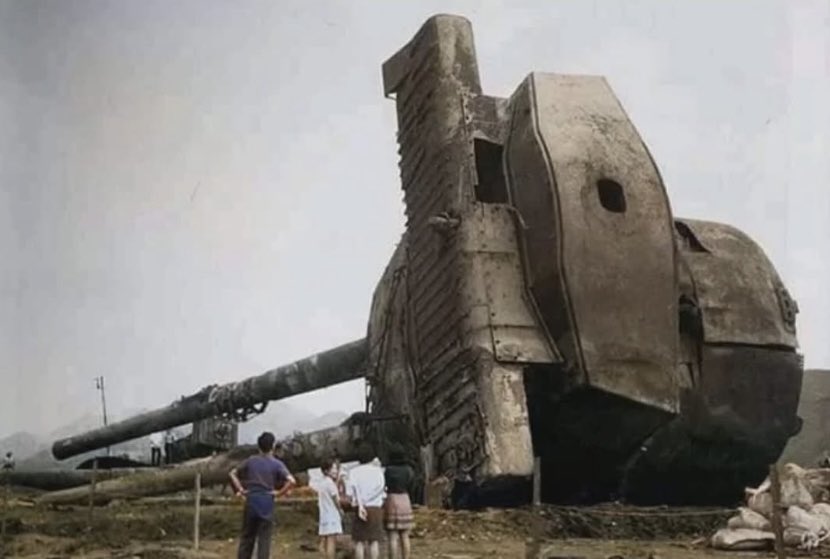
People examine the turret recovered from the wreck of the Japanese battleship Japanese battleship Mutsu in 1970.
Japanese battleship Mutsu was once among the most formidable warships afloat, symbolizing Japan’s naval power in the early 20th century. Commissioned in 1921, she was one of only two Nagato-class battleship ever constructed and was armed with eight 16-inch guns capable of launching shells weighing over a ton each.
During World War II, Mutsu served with the Imperial Japanese Navy’s main battle fleet, though fuel shortages and shifting strategy meant she spent much of the war anchored rather than in active combat. In June 1943, catastrophe struck while she was moored near Hiroshima, when a sudden explosion ignited one of her aft magazines and ripped the ship apart, killing over 1,100 crew members.
The sinking was initially concealed by the Japanese government to preserve wartime morale. Much of the wreck remained underwater for decades until salvage efforts in the late 1960s recovered major components, including the massive turret seen in later exhibitions. Visitors were often stunned by its scale—each gun barrel measured over 60 feet long and outweighed many modern armored vehicles.
Some recovered metal from Mutsu was later incorporated into memorials and museum displays across Japan, while other portions were reportedly melted down and repurposed for industrial use after the war.
English
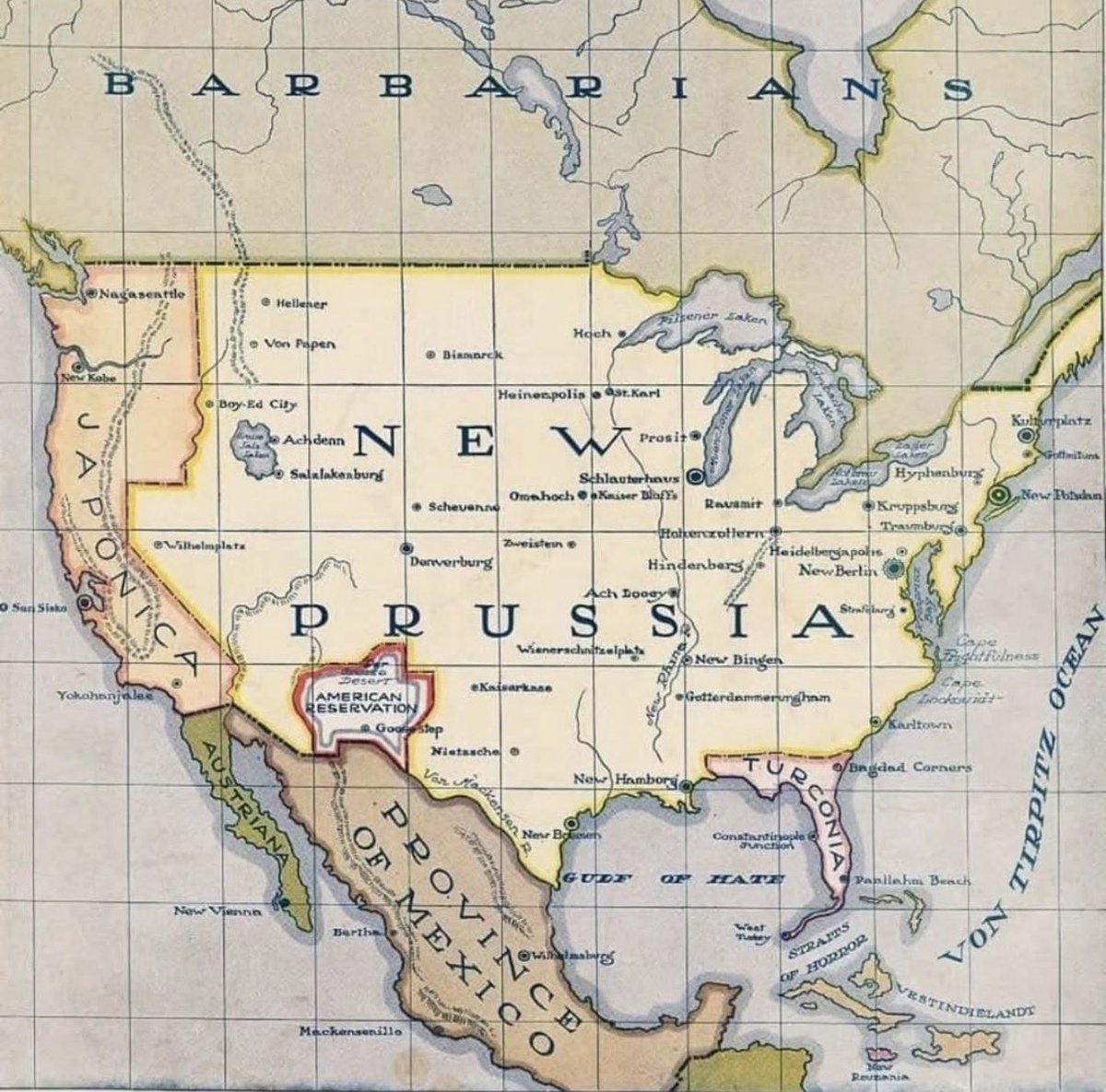
A 1916 propaganda map produced by the Allied powers during World War I, depicting a fictional future in which the United States is divided and controlled after a victory by the Central Powers.
During World War I, the Central Powers were led primarily by the German Empire and Austria-Hungary. Their military was often referred to as the “Prussian Army,” and German soldiers were commonly called “Prussians,” referencing the powerful Kingdom of Prussia. Before 1870, Germany was not a unified country but a collection of independent kingdoms and states. Under Wilhelm I and his chancellor Otto von Bismarck, Prussia led the movement that unified the German states into a single empire.
The map includes several strange and humorous details. The Great Lakes are renamed after German beers, while American cities receive German-inspired names, such as Boston becoming “Kulturplatz” and Austin being renamed “Nietzsche.” Near the “Province of Mexico,” the map even shows an “American Reservation” with a capital called “Goose-Step.” One amusing detail is that Bismarck, North Dakota, is left completely unchanged.
Perhaps the most puzzling feature of the map is that California and the Pacific Northwest are labeled “Japonica.” This is unusual because Japan was actually allied with Britain, France, Russia, and Italy during the war, rather than with the Central Powers.
English
In Indiana Jones and the Last Crusade (1989), the Nazi uniforms seen on screen were not replica costumes but authentic World War II-era military outfits. Co-costume designer Joanna Johnston reportedly discovered the original uniforms in Eastern Europe and incorporated them into the film’s production.

English