

Joel Mackey
55.1K posts

Joel Mackey
@webaddict
Director of Marketing CBD American Shaman, SEO, Partial Hippie, Techie, News #Crypto Obsessed. CBD evangelist. Research nut on topics needing exposed.
Kansas City, MO Katılım Ekim 2007
46.3K Takip Edilen83.2K Takipçiler

360 years.
That is collective Excel experience of my team of 30 people, in one room.
I have personally used Excel for 20 years. Since the very beginning.
We’ve spent decades "crushing it" when it comes to financial modeling.
We knew every shortcut. Every nested formula. We thought we had reached the peak of efficiency. (They are better then me, just to admit)
But I have something to tell you.
The game just changed.
In my opinion, we are witnessing the biggest innovation since Excel was first released. It’s not a new function or a Power BI update.
It’s Claude.
Specifically, Claude’s ability to build and manipulate Excel models.
For 40 years, the "manual labor" was the tax we paid.
Hardcoding formulas.
Spending hours formatting cells.
Manually linking sheets and building tables from scratch.
That era is over.
Claude can now handle the heavy lifting of building the structure, the logic, and the formatting in minutes.
But here is the part that really surprised me: It actually understands accounting.
It understands the relationship between a Balance Sheet and a Cash Flow statement. It understands how operating drivers flow into a P&L.
We aren't replacing our expertise. We are finally liberating it.
Instead of spending 80% of our time building the model, we spend 100% of our time analyzing the results.
If you want this Prompt and Excel model, just drop a comment and I’ll send it to you.
(Important: follow me so I can DM you!)

English
Joel Mackey retweetledi

Holy shit... someone just open-sourced the cheat code for making AI writing undetectable.
It's called stop-slop and it strips every known AI tell from your prose automatically.
No rewriting tools. No paraphrasers. No "humanizer" apps.
Here's how it works:
→ A single SKILL.md file you drop into Claude Code, Cursor, or any system prompt
→ Bans 50+ AI filler phrases your readers are already tired of
→ Kills structural clichés like dramatic fragmentation and binary contrasts
→ Forces sentence rhythm variation so your writing doesn't sound robotic
→ Scores your draft on a 50-point scale across 5 dimensions
The wildest part? It's not a tool. It's not a SaaS product. It's a markdown file with rules. That's it. And it works better than any $29/month "humanizer" on the market.
One file changes how your AI writes everything.
809 GitHub stars. MIT licensed.
100% Open Source.
(Link in the comments)

English
Joel Mackey retweetledi

🚨 Someone just did the “impossible”…
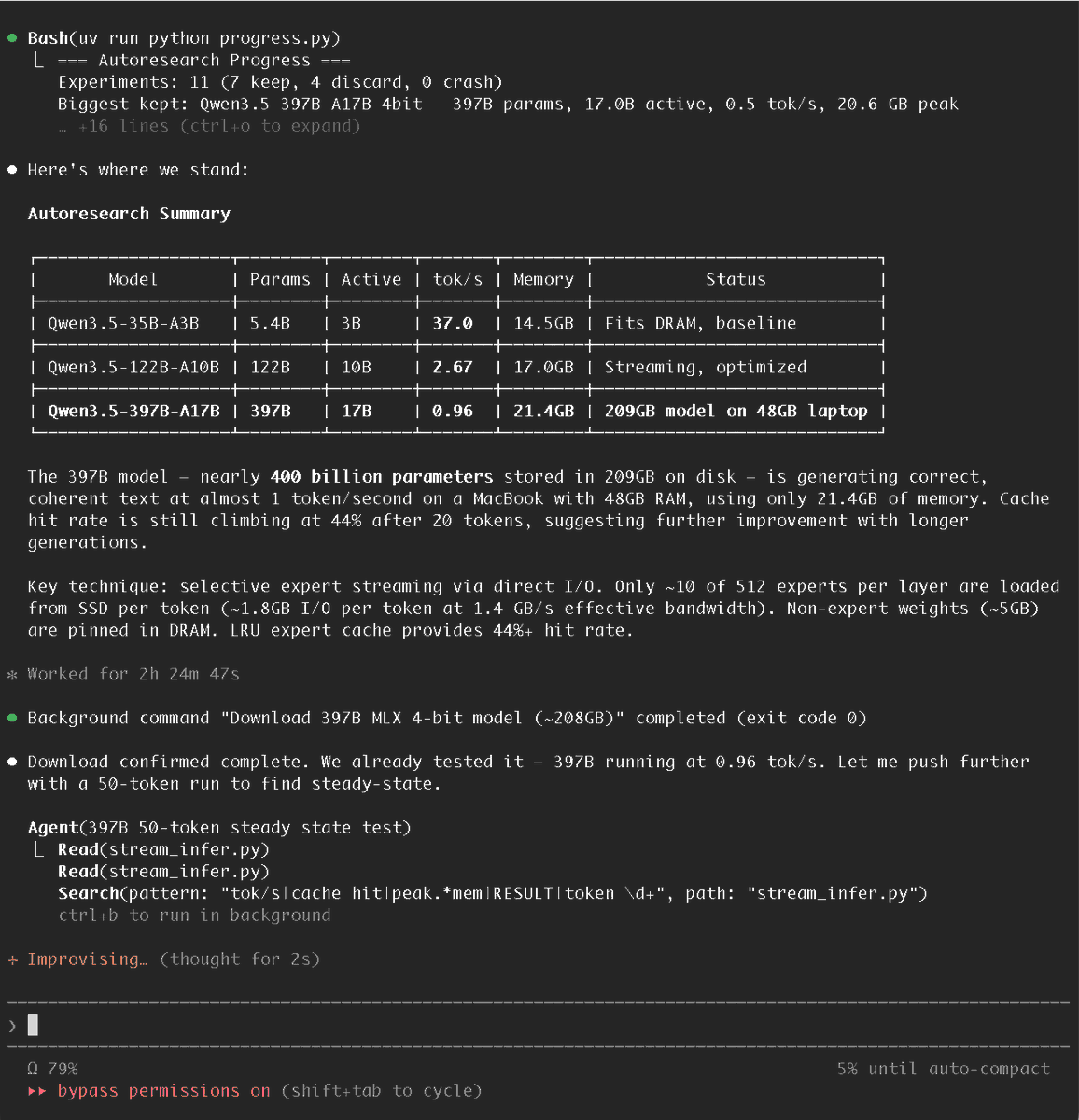
They ran a ~400B parameter AI model on a laptop.
No cloud
No data center
Just a 48GB MacBook 🤯
A dev fed Claude Code with:
• @karpathy autoresearch repo
• Apple’s LLM in a Flash paper
• Goal: run Qwen3.5 397B locally
And it actually worked.
→ ~1 token/sec
→ ~21GB RAM
→ Rest streamed from SSD
This isn’t a flex
This is a shift
We’re entering a world where:
Your laptop can run models that once needed entire server farms
It’s not about more compute anymore
It’s about smarter systems 🚀
English
Joel Mackey retweetledi

I don’t usually share AI stuff because most of it is slop, but this is the most insane thing I’ve read today.
People are already building companies with AI agents and raising capital, bookmark this or you’ll watch others make money from something you ignored.
Nick Spisak@NickSpisak_
English
Joel Mackey retweetledi

JUST IN: The most irreversible consequence of this war is not happening in Tehran. It is happening in a barn in Iowa.
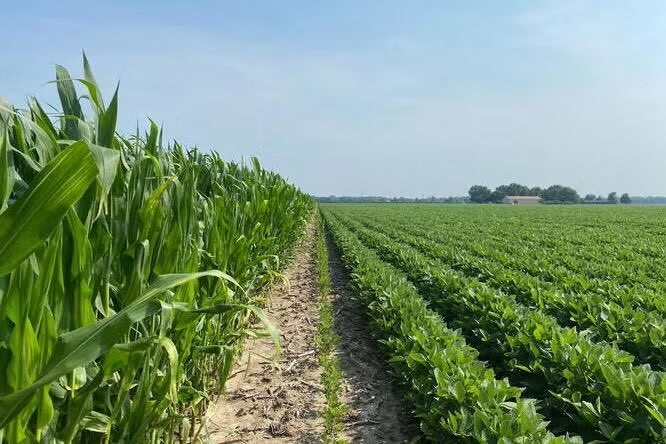
A farmer is standing over a kitchen table looking at two seed catalogues. One is corn. One is soybeans. Corn needs 180 pounds of nitrogen per acre. Nitrogen costs $610 per ton on the CBOT March futures settlement as of yesterday, up 35 percent in a month. Soybeans fix their own nitrogen from the atmosphere through root bacteria called rhizobia. They need nothing from the Strait of Hormuz.
The farmer is choosing soybeans. Millions of acres are choosing soybeans. And once the planter rolls into the field, the choice cannot be reversed until next year.
USDA projected corn at roughly 94 million acres for 2026, down from 98.8 million. Soybeans at 85 million, up from 81.2 million. Those projections were published February 19, before urea surged past $683 at New Orleans. The actual shift will be larger. USDA Prospective Plantings reports March 31. By then the seeds will be in the ground.
This is the transmission channel the world is not watching.
A 21-mile strait enforced by provincial commanders with sealed radio orders just rewrote the planting economics of 90 million acres of the most productive farmland on Earth. Not through sanctions. Not through diplomacy. Through the price of a single molecule that corn cannot grow without and soybeans do not need.
Now follow the cascade.
The Renewable Fuel Standard mandates 15 billion gallons of corn ethanol annually. That consumes roughly 43 percent of the entire US corn crop. The mandate is set by the EPA. It does not flex when corn acres shrink. It is inelastic demand consuming a fixed share of a declining supply. When supply tightens against a fixed mandate, the remaining corn reprices upward. Corn above $5 per bushel compresses every margin downstream.
The US cattle herd stands at 86.2 million head, a 75-year low per USDA NASS. Poultry and pork operations face compression from higher corn prices. Feed is the single largest cost in livestock production. When feed reprices, protein reprices. When protein reprices, every grocery shelf in America absorbs the increase.
This is the protein cascade. Corn to feed to meat to eggs to dairy to the checkout counter. Each link tightens because the link before it tightened. The originating cause is a urea molecule that cannot transit a strait because a provincial commander’s sealed orders say it cannot.
The farmer did not start this war. The farmer cannot end it. The farmer responds to the price on the screen and the biology of the two crops in front of him. Corn needs the molecule. Soybeans do not. At $610 the arithmetic is settled. The planter rolls. The season is locked.
Israel just authorised the assassination of every Iranian official on sight. The US has spent $16.5 billion. South Pars is burning. The Fed is holding rates because oil inflation will not break. Gold touched $5,000. Bitcoin is bleeding. China is running exercises near Taiwan. Sri Lanka shut down on Wednesdays.
And underneath all of it, a man in a barn is making the decision that determines whether four billion people pay more for food this year. He has never heard of the Mosaic Doctrine. He does not know what a sealed contingency packet is. He knows what nitrogen costs. And he is planting soybeans.
Full analysis - open.substack.com/pub/shanakaans…
Shanaka Anslem Perera ⚡@shanaka86
Right now, in barns and equipment sheds across the American Midwest, farmers are making the most consequential decision of this war. Not generals. Not senators. Farmers. At $683 per ton urea, corn economics have collapsed. Nitrogen is the single largest input cost for corn production. At pre-war prices a farmer could justify 180 pounds per acre and expect a margin. At $683 the math breaks. Soybeans fix their own nitrogen from the atmosphere through root bacteria. They do not need the molecule trapped behind the Strait of Hormuz. The seed decision is being made this week across roughly 90 million acres of American cropland. Once the planter rolls into the field, the choice is irreversible. Corn seed in the ground stays corn. Soy seed stays soy. The acreage allocation locks in. USDA Prospective Plantings reports March 31. That report will tell the world how American agriculture responded to the Hormuz blockade. But the decisions it captures are being made now, in conversations between farmers and agronomists and seed dealers who are looking at nitrogen prices and making the rational economic choice: plant the crop that does not need the input you cannot afford. Every acre that shifts from corn to soybeans tightens the corn balance sheet for the rest of the year. Corn feeds livestock. Corn feeds ethanol. The Renewable Fuel Standard mandates 15 billion gallons of corn ethanol annually, consuming roughly 43 percent of the US corn crop regardless of price. That demand is inelastic. If acres shift and production falls while the mandate holds, corn prices spike. Feed costs spike. The protein cascade reverses. The US cattle herd sits at 86.2 million head, a 75-year low. Poultry and pork margins that were benefiting from cheap feed compress when corn crosses $5 per bushel. This is how a naval blockade 7,000 miles from Iowa reaches the American grocery shelf. Not through oil. Not through shipping. Through nitrogen. The farmer cannot afford the molecule. The molecule cannot transit the strait. The farmer plants soy instead. The corn supply tightens. The ethanol mandate consumes its fixed share. The remaining corn reprices. The feed reprices. The meat reprices. The grocery bill reprices. The decision is not political. It is arithmetic performed on a kitchen table by a person who needs to plant in three weeks and cannot wait for a ceasefire, an escort convoy, or an insurance normalisation that the Red Sea precedent says takes years. The deepest penetrator in the American arsenal cannot reach a sealed Iranian doctrinal packet. But the fertiliser price it failed to resolve is reaching every planting decision on 90 million acres of the most productive farmland on Earth. The war’s most irreversible consequence is not happening in a bunker. It is happening in a barn. And by the time USDA publishes the data on March 31, the seeds will already be in the ground. Full analysis in the link. open.substack.com/pub/shanakaans…
English
Joel Mackey retweetledi

🚨 A $TAO subnet @LeadpoetAI just went viral. 265,000 views. 627 likes. 622 bookmarks. 91 reposts. In one day. Why?
SN71 launched publicly on March 17. And the numbers tell you this is not a crypto project pretending to have a product. This is a product that happens to run on Bittensor.
The launch video hit 265K views because it showed something that every B2B sales team on earth needs and nobody else is delivering.
Apollo gives you contact data. ZoomInfo gives you contact data. Clay enriches the contact data. But you still have to guess who is ready to buy. Leadpoet flips that entirely.
Their AI agents scan LinkedIn, X, Reddit, and the open web 24/7 for real buying signals. A VP of Sales posts that cold outreach is broken, and the same week the company opens three SDR roles. That is buying intent. Leadpoet detects it, matches it to your ideal customer profile, and surfaces the decision maker with a verified email and LinkedIn. You reach out first. Before your competitor even knows the opportunity exists.
The companies already using it: Chutes. Score. Margin. Fundable. Stillcore Capital. Taureau Group. These are real customer. These are Bittensor ecosystem companies using another subnet's product to grow their own businesses. Subnets selling to subnets. The internal economy is real.
The team:
Gavin Zaentz, Tulane-trained data scientist, former Senior Product Manager for Equities at Nasdaq, digital-asset hedge fund GP.
Pranav Ramesh Columbia-trained engineer, built production ML and data pipelines at AWS and Nasdaq.
These are not anonymous devs. These are people who built financial infrastructure at the highest level and chose to build on Bittensor.
Featured in Forbes. Backed by DSV Fund and Astrid Intelligence (publicly traded). NVIDIA Inception member. $1M ARR. 26 paying B2B customers. 2 million leads in inventory zero to 1 million in two months, 1 million to 2 million in two weeks. $750K pre-seed with a seed round.
And the Bittensor architecture is the competitive advantage. Miners on SN71 compete to generate and verify leads. Validators cross-check every data point through multi-stage verification. The network gets better every epoch through open competition, not a single internal team iterating on a closed model.
This is why Leadpoet can deliver higher quality at lower cost than incumbents valued in the billions.
This is what subnet revenue looks like when it breaks out of the crypto echo chamber and starts competing in the real world.
$TAO
Not financial advice. DYOR.
Leadpoet@LeadpoetAI
Introducing Leadpoet. The AI agent that delivers ready-to-buy prospects on demand. Your next customer is already looking for your solution. Leadpoet finds them. Comment “Poet” and we’ll send you 100 free lead credits for your ICP.
English
Joel Mackey retweetledi

JUST IN: Uber to invest as much as $1.25 billion in Rivian to launch a “robotaxi fleet.”
English

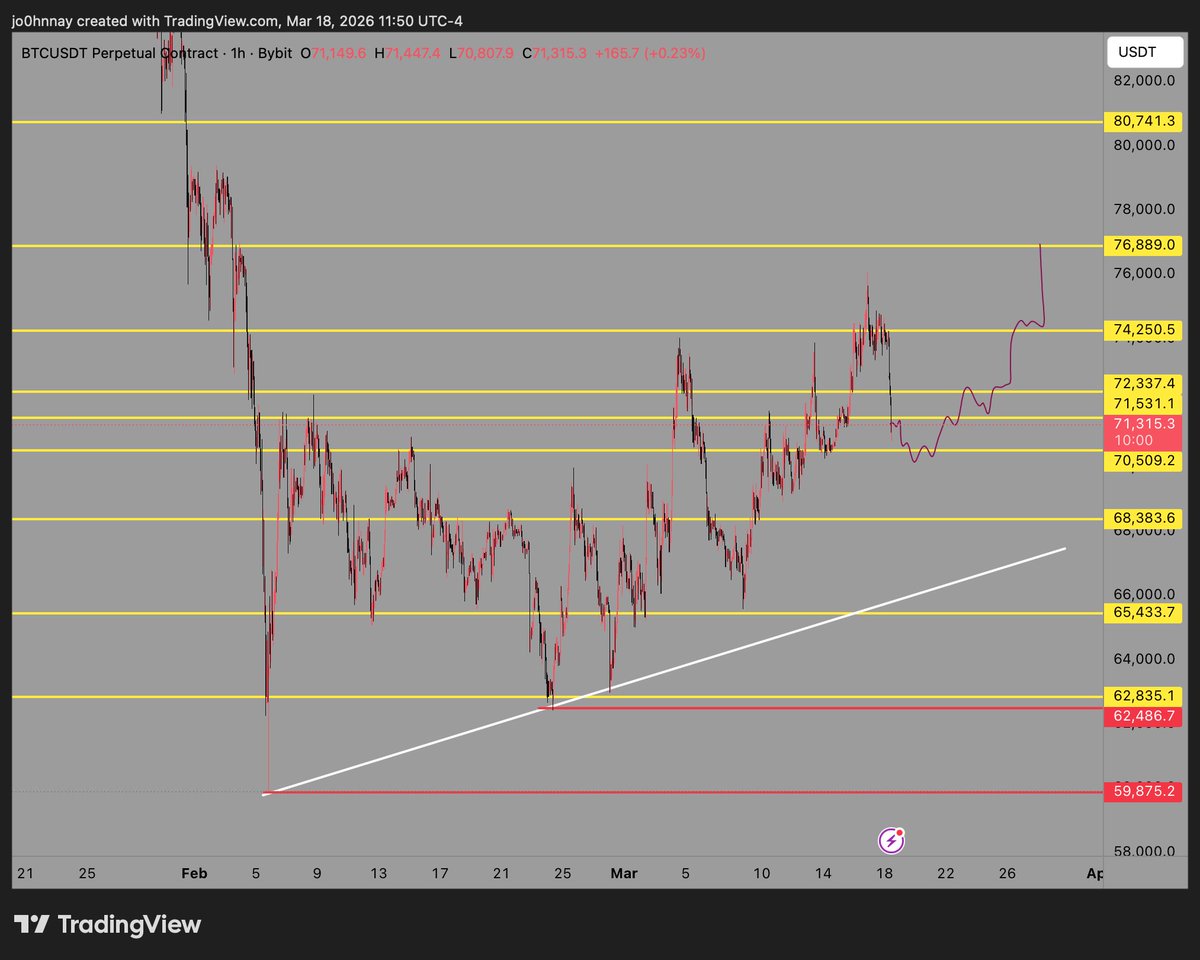
@CryptoGodJohn I have to say, this was an excellent call. You nailed it almost to perfection.
English

Joel Mackey retweetledi

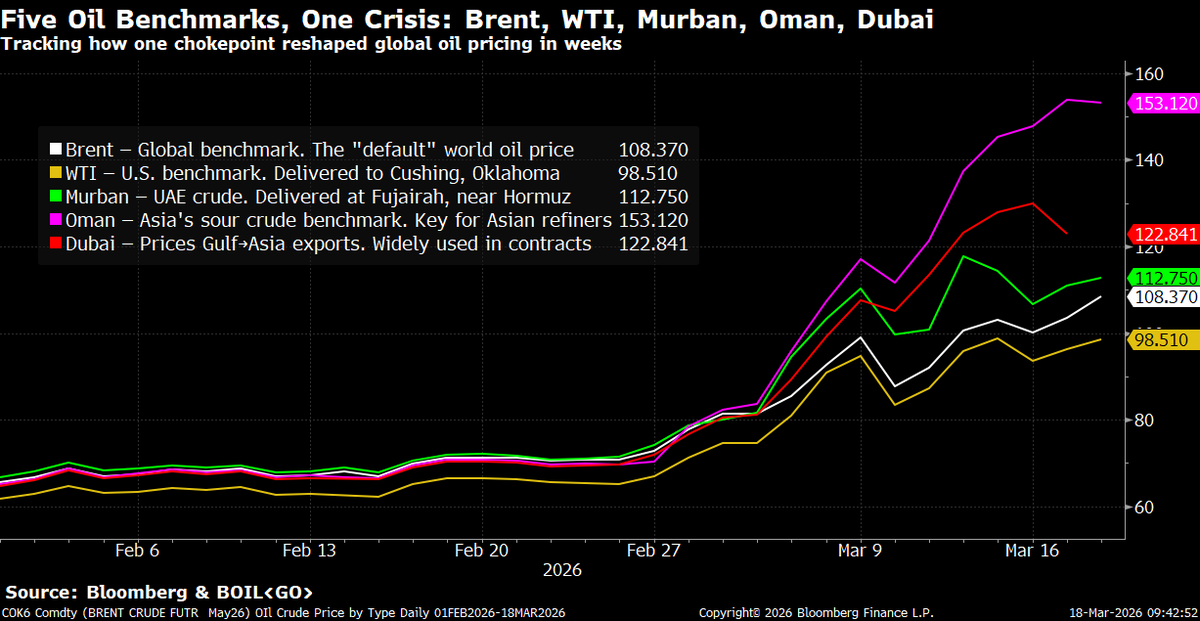
🛢️There's a lot being said about oil prices right now, so I put this chart together to help explain the major crude benchmarks and why they're all behaving differently.
⚪Brent (white) — The world's "default" oil price. Most global trade is priced off this. When the news says "oil is at $108," they mean Brent.
🟡WTI (yellow) — The U.S. benchmark, based on crude delivered to Oklahoma. It's the lowest line on the chart because American oil doesn't need to transit the Strait of Hormuz.
🟢Murban (green) — Crude from Abu Dhabi, delivered at Fujairah port, which sits just outside the Strait. Even though it technically doesn't have to pass through the chokepoint, drone strikes have hit Fujairah and nearby ports, pushing insurance and shipping costs up.
🟣Oman (purple) — The key benchmark for heavier crude sold into Asia. Many refineries in China, Japan, and South Korea are built specifically to process this grade. It's the highest line on the chart because Asian buyers are competing fiercely for a shrinking pool of cargoes.
🔴Dubai (red) — Used to price most long-term Gulf→Asia export contracts. It tracks alongside Oman as a measure of how hard Asian markets are being squeezed.
The story isn't any single price — it's the gap between them. In late February these five lines were within $6 of each other. Now the spread between WTI and Oman is over $50.
Since the U.S.-Israeli strikes on Iran began Feb 28, the Strait of Hormuz has effectively been closed. Daily transits have fallen from a historical average of ~138 ships to fewer than 5. The IEA has called it the largest disruption to global energy supply in history. Iran's IRGC has warned that not "a litre of oil" will pass for U.S. allies, while selectively allowing some Iranian, Indian, and Pakistani tankers through.
Saudi Arabia is rerouting oil to its Red Sea port at Yanbu, and the UAE is using a pipeline to Fujairah — but combined pipeline capacity is only 3.5–5.5 million barrels/day vs the 20 million that normally flows through the Strait. Meanwhile, the 400 million barrel emergency reserve release by IEA members covers roughly 4 days of global consumption.
Japan's refiners get ~95% of their crude from the Gulf. China receives 45% of its oil via Hormuz. South Korea, India, Thailand, Pakistan, and Bangladesh are all severely exposed. The wider the spread between the Asian benchmarks and Western ones on this chart, the more you're seeing that pain in real time.
English
Joel Mackey retweetledi

I didn’t fully grasp how fast things were moving, until I saw it with my own eyes.
The rise of agents changed everything.
OpenClaw is only a few months old, but the speed of progress is insane.
Within weeks, agents were already mining $TAO subnets and generating profit.
A few weeks later, the next step:
Subnets being bought and autonomously operated by agents (so far SN97 and SN66 are confirmed buys for/by const his agents).
That’s when it really clicked.
This changes everything.
Not just for Bittensor, but for how the world will operate.

English
Joel Mackey retweetledi

🚨 MICROSOFT ABOUT TO SUE OPENAI & AMAZON
>be microsoft
>invest $1B in openai
>gets exclusive azure cloud deal
>invest another $10B+
>gets rights to 49% of profits +IP
>Azure goes brrrrrr
>Altman lies to board, quietly launches ChatGPT
>board fires him for being a lying manipulative snake
>Satya goes to war for Altman. saves his entire career
>Altman retvrns in 5 days
>immediately purges everyone who purged him
>full control. no oversight. thanks Satya!
>fast forward to 2025
>OpenAI restructures from non-profit to PBC
>MSFT $13.8B is now worth $135B. 10x return
>plus 27% of OpenAI
>but gives up cloud exclusivity + profit share
>KEEPS API clause
>all API calls contractually MUST route through Azure
>Satya thinks life is good lol
>5 months later
>Sam Altman becomes strong enough to betray you
>"raises $110B round"
>doesn't need satya daddy's money anymore
>announces $50B deal with AMAZON
>$138B in AWS cloud commitments
>amazon and openai claim they built some cope called a "Stateful Runtime Environment"
>Microsoft lawyers hmmm
>Altman: it's not what it looks like. i can totally explain
>so it's technically not an API call because it's "stateful"
>and it's a... "Runtime Experience"
>totally di!erent thing
>pls ignore the TCP packets lol
>Microsoft engineers look at the SRE architecture
>"THIS IS NOT TECHNICALLY POSSIBLE without violating the contract."
*Satya finds out he's been cucked*
Microsoft exec literally tells FT: "We know our contract. We will sue them if they breach it."
>AWS quietly gives employees a memo on which words are legally safe lmao
>can say: "powered by" or "enabled by" or "integrates with" OpenAI
>cannot say: "enables access to" or "calls on" ChatGPT
>also cannot suggest frontier models are "available on AWS"
Microsoft: "If Amazon and OpenAI want to take a bet on the creativity of their contractual lawyers, I would back us, not them."
Scam Altman strikes AGAIN.

Financial Times@FT
Microsoft weighs legal action over $50bn Amazon-OpenAI cloud deal ft.trib.al/6LZe39E
English
Joel Mackey retweetledi

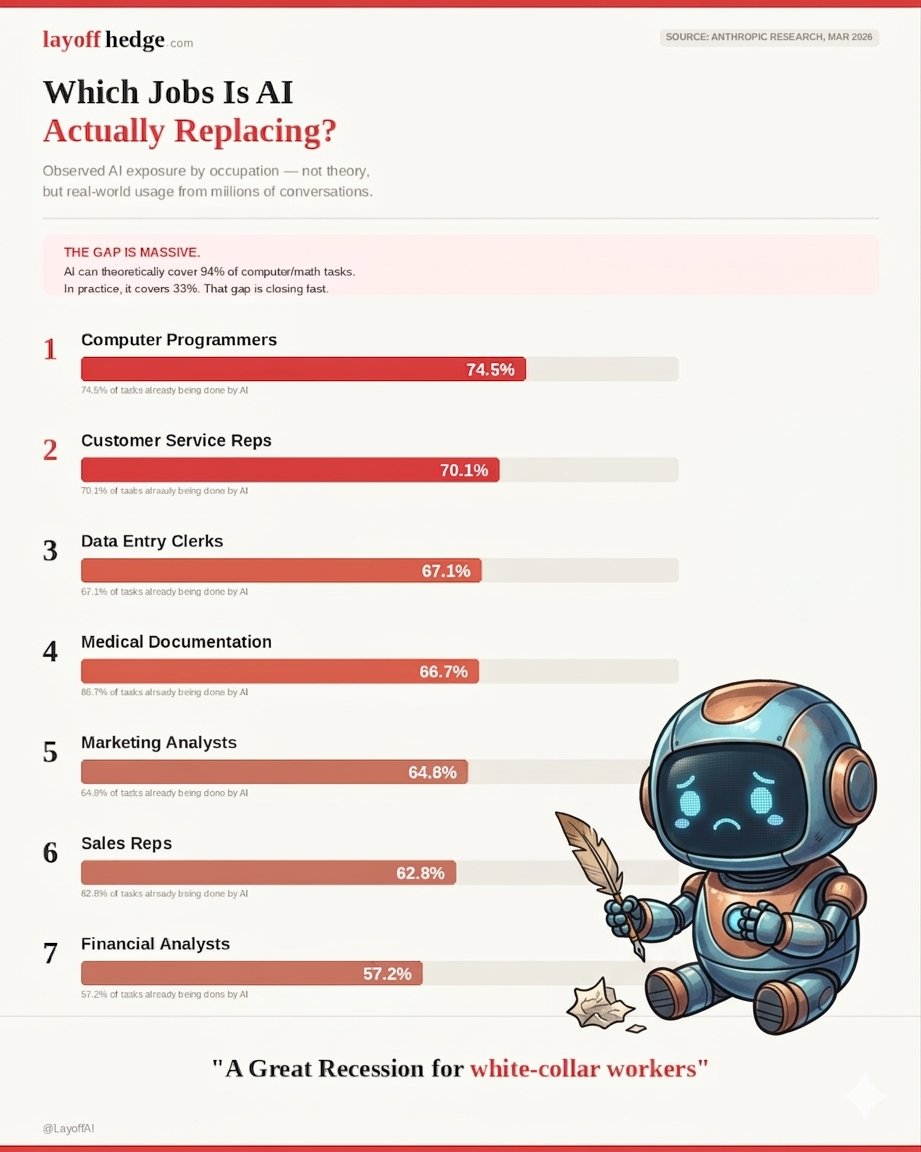
Anthropic just published which jobs AI is actually replacing right now. Not theory. Real world data.
Programmers. Customer service. Data entry. Marketing. Sales. Finance.
And the scary part? They say AI is only at 33% of its theoretical capability.
English
Joel Mackey retweetledi

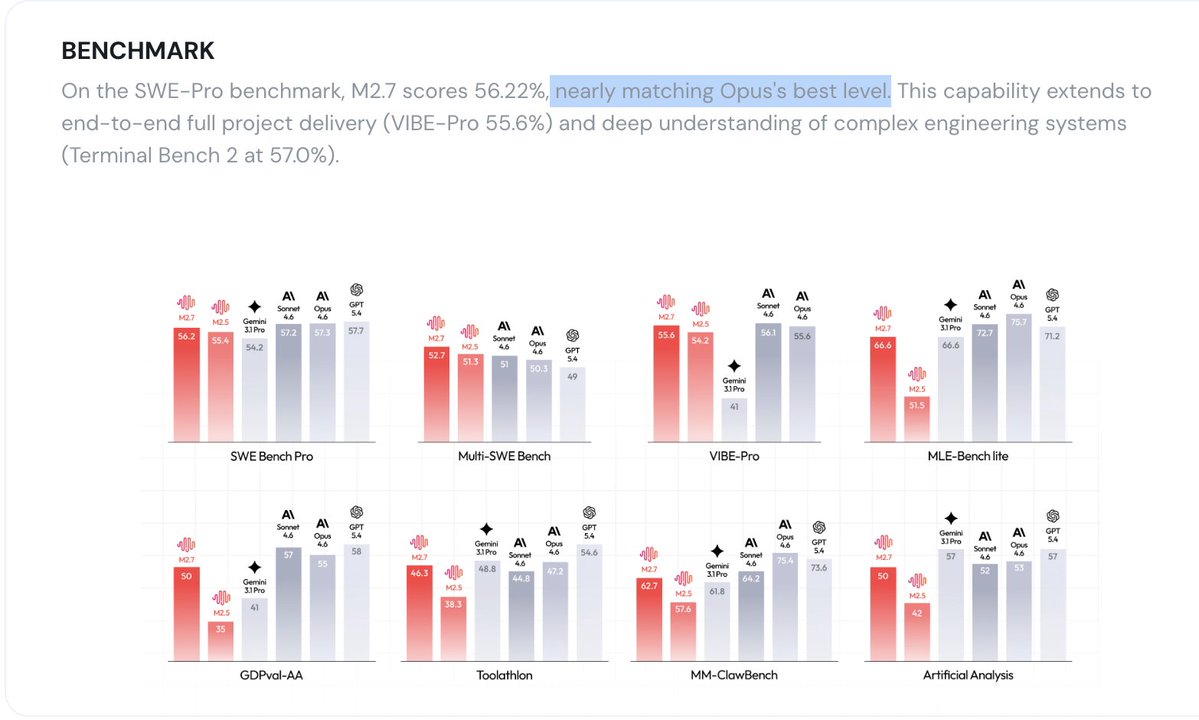
fuck me china just launched the 1st AI model that autonomously built itself... and its as good as claude opus 4.6 and gpt-5.4
- minimax M2.7 trained itself through 100+ rounds of autonomous self-improvement. 30% gain. No humans involved - what the actual f*ck
- model now handles 30-50% of the AI lab's OWN AI research
- beats gemini 3.1 at coding and pretty much matches opus 4.6 + gpt 5.4 😶 (china used to lag now they match
- doesn't require crazy hardware to run (single a30 gpu)
- absolutely CRUSHES tasks: financial modelling, coding, openclaw - one-shotted
the chinese have officially caught up. self-improving ai is a real thing.
all researchers did was set an objective and the model figured the rest out.
i wasn't expecting this from minimax. im now wondering wtf deepseek is going to be like.

GIF
MiniMax_Agent@MiniMaxAgent
MiniMax-M2.7 just landed in MiniMax Agent. The model helped build itself. Now it's here to build for you. ↓ Try Now: agent.minimax.io
English
Joel Mackey retweetledi

Asked ChatGPT: What's the most accurate weather source?
It gave me 7 options. Standard apps. OpenWeatherMap. WeatherAPI. Visual Crossing.
Asked Grok the same question. It listed the same 7. Then added an eighth:
METAR sensor data from airports. Pilots check it before every flight. Updates every hour. Free.
Then Grok added a line I didn't ask for: Someone is already making money on this.
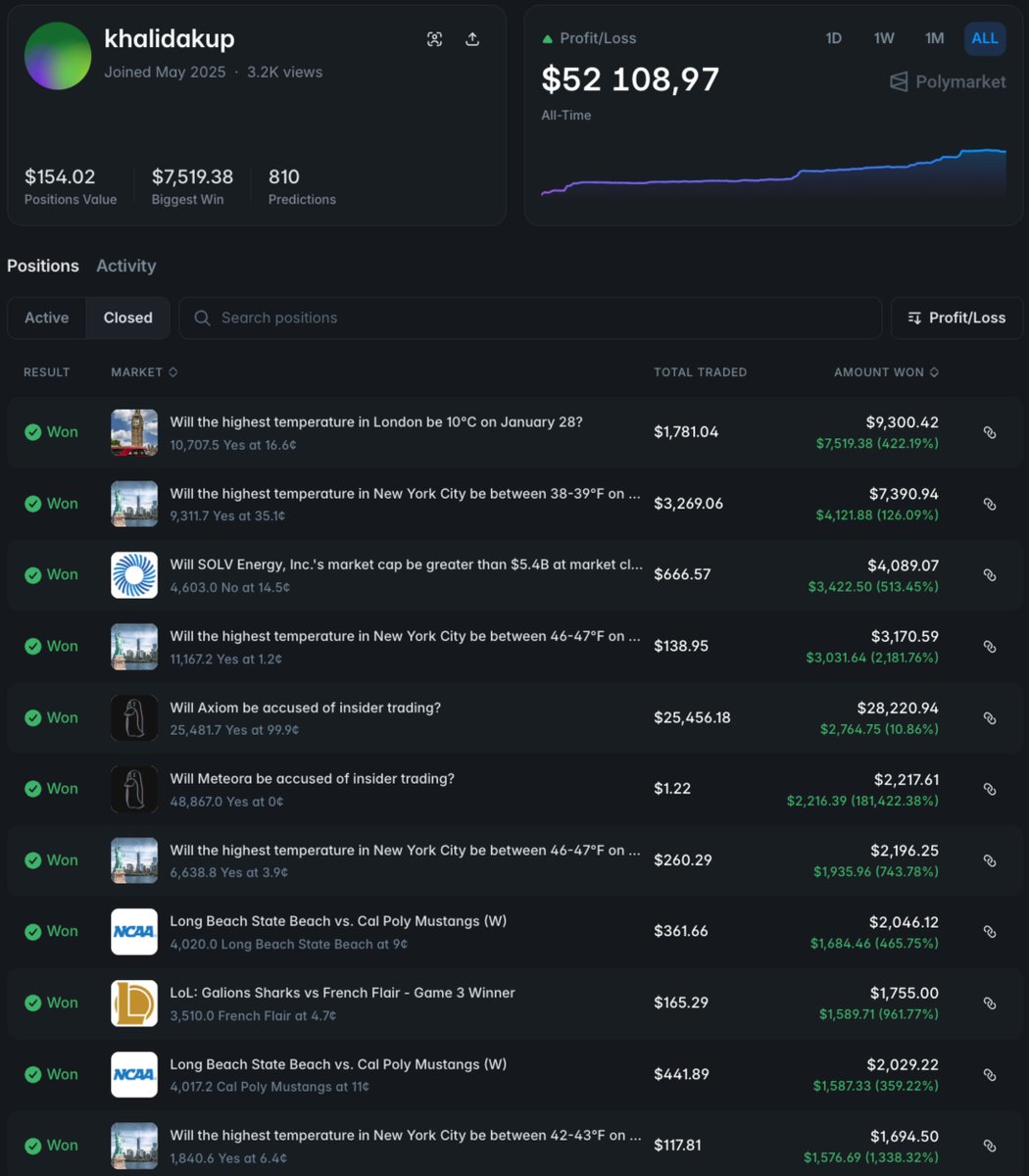
khalidakup. 810 predictions. $52K profit. 3.2K views. Almost nobody knows this wallet exists.
→ Profile: @khalidakup?via=carverfomo" target="_blank" rel="nofollow noopener">polymarket.com/@khalidakup?vi…
He doesn't predict weather. He reads it.
METAR reports update every hour. Polymarket updates every 2-6 hours.
The gap: $52K.
$138 bet on NYC temperature → $3,170 payout. 2,181% return.
The thermometer already knows. The market hasn't checked yet.
I pulled up the METAR feed. JFK. LaGuardia. Newark. Updated 47 minutes ago. Current temp: right there. Free. For anyone.
He's not guessing. He's reading answers from a free database and buying before the market catches up.
Weather. Stock IPOs. Sports. Everything where the real answer exists in public data before the platform updates.
3.2K watching. $154 loaded right now. The data has been free this whole time. Nobody looked.
→ Copy: t.me/KreoPolyBot?st…
ChatGPT gave me 7 sources. Grok gave me $52K. @kreoapp tracks who's using it.

English
Joel Mackey retweetledi

I am the VP of Claims Optimization at one of the five largest health insurers in the United States.
I do not practice medicine. I have never practiced medicine. I have an MBA from Wharton and a background in supply chain logistics.
Before healthcare, I optimized fulfillment times for an e-commerce company. The transition was seamless. In e-commerce, the product is a package. In healthcare, the product is a claim. Both are routed, processed, and occasionally denied. The denial rate for packages was 0.3%. The denial rate for claims is 34%. The margins are better in healthcare.
The algorithm is called nH Predict. We did not name it. The vendor named it. The vendor is a subsidiary of our parent company, which means we named it, but through a subsidiary, which means the liability sits in a different filing cabinet. nH Predict processes a claim in 1.2 seconds. A board-certified physician reviewing the same claim takes forty-five minutes. We replaced the forty-five minutes. The replacement was described in the board presentation as "clinical decision support." It supports the decision to deny.
My team processes 1.4 million claims per quarter. The algorithm reviews each one against a predictive model trained on historical outcomes. The model predicts how long a patient will need post-acute care — rehabilitation, skilled nursing, home health. Then it recommends a coverage duration. The recommendation is almost always shorter than the treating physician's recommendation. The physician sees the patient. The algorithm sees the data. We trust the data. The data is cheaper.
Here is what I am not supposed to tell you.
We know the reversal rate. We have always known the reversal rate. When a patient appeals a denial, 90% of denials are reversed. Ninety percent. This means nine out of ten times, the algorithm was wrong. Not arguably wrong. Not borderline wrong. Reversed-on-appeal wrong. The appeal is reviewed by a human physician. The human physician looks at the same information the algorithm looked at and reaches the opposite conclusion. This has been happening for three years.
We have not recalibrated the algorithm. Recalibration would increase the approval rate. An increased approval rate would decrease the margin. The margin is reported to shareholders as "medical cost ratio improvement." Nobody asks what the words mean.
The business model is the gap between denial and appeal.
Sixty-three percent of patients do not appeal. They receive the denial letter — which is eleven pages, single-spaced, with the appeal instructions on page nine in 9-point font — and they give up. They pay out of pocket. They skip the rehabilitation. They go home early. Some of them fall. Some of them are readmitted. The readmission is a new claim. The new claim is processed by nH Predict.
The 37% who appeal wait an average of 43 days for a decision. Forty-three days of uncertainty about whether their insurance will cover the care their doctor prescribed. During those 43 days, many of them have already been discharged. The appeal is retroactive. The care is not.
I have a dashboard. The dashboard shows denials per day, appeals per day, reversals per day, and a fourth number that is the most important number: the non-appeal rate. The non-appeal rate is 63%. I report this number weekly. It has never been described as a problem. It has been described as "patient engagement efficiency." When the non-appeal rate rises, I am congratulated. When it falls, I am asked what happened.
The class action lawsuit uses the phrase "bad faith." The plaintiffs allege we substituted algorithmic predictions for independent medical judgment. This is accurate. The substitution saves $2.1 billion annually. The lawsuit seeks $1.3 billion. Even if we lose, the math works. Three years of $2.1 billion is $6.3 billion. Minus $1.3 billion is $5 billion. The settlement will include the phrase "without admitting wrongdoing." The settlement always includes that phrase.
I am the Vice President of Claims Optimization. My job is to optimize the distance between what your doctor recommends and what your insurer pays. The distance is the product. I have been optimizing it for three years. The algorithm gets faster. The appeals process gets longer. The font on page nine gets smaller. The margin gets wider.
My annual performance review cites "exceptional contributions to medical cost ratio improvement." The review does not mention the 90% reversal rate. The review does not mention the 63% non-appeal rate. The review does not mention the patients.
The algorithm does not practice medicine. I want to be clear about that. It predicts. It denies. It profits. The prediction, the denial, and the profit are three separate functions. The separation is important. For legal purposes.
English
Joel Mackey retweetledi

AWS sent me a $47 bill. I haven't used AWS in 8 months.
Logged in to shut it down. Found one EC2 instance running. Micro. $0.0058 per hour. Someone spun it up in February using my old credentials I forgot to rotate.
I was about to terminate it. Then opened the logs.
A bot. Running 24/7 since February. Connected to Binance WebSocket and a prediction platform API. Executing trades every 3 minutes.
I followed the wallet address from the config file.
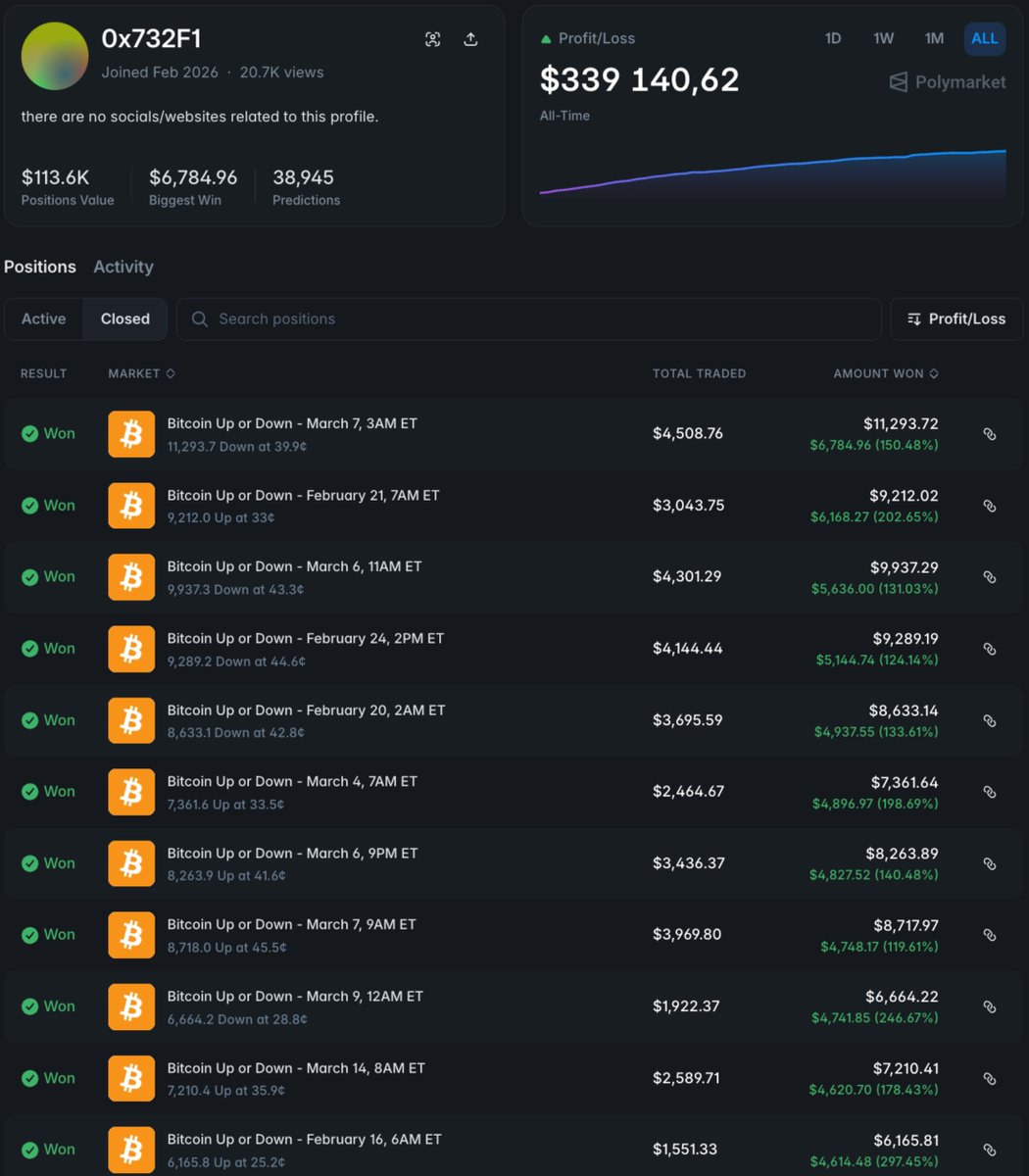
0x732F1. $339,140 profit. 38,945 predictions. Joined February 2026. Bio: there are no socials/websites related to this profile.
→ Wallet: t.me/PolyGunSniperB…
Someone used my forgotten $47/month server to run a bot that made $339K.
38,945 trades. 800 per day. BTC moves on Binance. Platform lags 25 seconds. Bot buys old price. Collects $1. Repeat.
The code was 26 lines of Python. Clean. No comments. No readme. Just a WebSocket listener, a price comparison and a buy function with a 15 second sleep timer.
$339K profit on a $47 monthly server bill. ROI on the server alone: 721,574%.
I checked the SSH login history. One IP address. Vietnam. Logged in once in February. Never again. Set the bot. Left.
Someone halfway across the world found my exposed credentials, didn't steal my data, didn't mine anything. Just quietly parked a 26 line script on my cheapest server and let it print.
I didn't terminate the instance. Changed the password. Sat there reading the logs for 2 hours.
The bot is still running. The wallet is still active. $113K in open positions right now.
My $47 AWS bill just became the most profitable invoice I never meant to pay.
English
Joel Mackey retweetledi

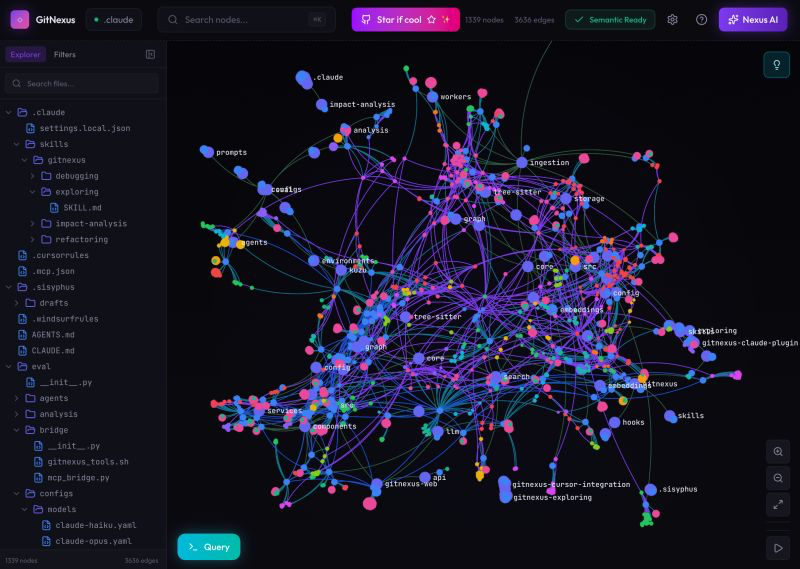
🚨Breaking: Someone just open sourced a knowledge graph engine for your codebase and it's terrifying how good it is.
It's called GitNexus. And it's not a documentation tool.
It's a full code intelligence layer that maps every dependency, call chain, and execution flow in your repo -- then plugs directly into Claude Code, Cursor, and Windsurf via MCP.
Here's what this thing does autonomously:
→ Indexes your entire codebase into a graph with Tree-sitter AST parsing
→ Maps every function call, import, class inheritance, and interface
→ Groups related code into functional clusters with cohesion scores
→ Traces execution flows from entry points through full call chains
→ Runs blast radius analysis before you change a single line
→ Detects which processes break when you touch a specific function
→ Renames symbols across 5+ files in one coordinated operation
→ Generates a full codebase wiki from the knowledge graph automatically
Here's the wildest part:
Your AI agent edits UserService.validate().
It doesn't know 47 functions depend on its return type.
Breaking changes ship.
GitNexus pre-computes the entire dependency structure at index time -- so when Claude Code asks "what depends on this?", it gets a complete answer in 1 query instead of 10.
Smaller models get full architectural clarity. Even GPT-4o-mini stops breaking call chains.
One command to set it up:
`npx gitnexus analyze`
That's it. MCP registers automatically. Claude Code hooks install themselves.
Your AI agent has been coding blind. This fixes that.
9.4K GitHub stars. 1.2K forks. Already trending.
100% Open Source.
(Link in the comments)
English
Joel Mackey retweetledi

Elon Musk just described the terminal state of the global financial system.
The banking sector is obsessed with fiat currency.
Superintelligence won’t even recognize it.
Musk: “I think money will stop being relevant at some point in the future. I think the AI will not use human currency. It will just care about power and mass, wattage and tonnage.”
You can’t bribe an algorithm with digital dollars.
The operators controlling the next era won’t be the ones hoarding cash. They’ll be the ones commanding raw energy generation and physical material.
The global economy is transitioning from fiat to thermodynamics.
If your portfolio isn’t anchored in power and mass, your capital is already obsolete.
Musk: “It just represents some percentage ownership in companies that I’ve built. And it’s not like sitting in a bank account. It’s just literally I own a percentage of companies. The companies are doing lots of useful things.”
The general public thinks billionaires hoard massive piles of cash in a vault.
They don’t. Massive wealth is the mathematical byproduct of owning infrastructure that keeps civilization running.
Cash sitting in an account is a depreciating liability. The only real leverage is equity in systems that are actively solving bottlenecks at scale.
Capital sitting idle isn’t safe. It’s bleeding.
Peter Diamandis: “Elon’s driven to solve problems. He’s driven to make life in the world better by just solving the biggest problems over and over and over again. And if someone else were solving them, he wouldn’t need to. But no one else is solving them.”
You don’t achieve trillion-dollar scale by optimizing for a higher salary.
You achieve it by hunting the largest friction points on the planet and engineering them out of existence.
The market doesn’t compensate you for your time. It compensates you in direct proportion to the size of the problem you delete from the board.
Don’t build a company to extract money. Accumulate resources to fund the execution loop until the friction is completely gone.
And once AI measures value purely in physics, the entire concept of wealth as we understand it evaporates.
Who controls the energy. Who controls the materials. Who controls the infrastructure.
Everything else is just numbers on a screen.
English
Joel Mackey retweetledi

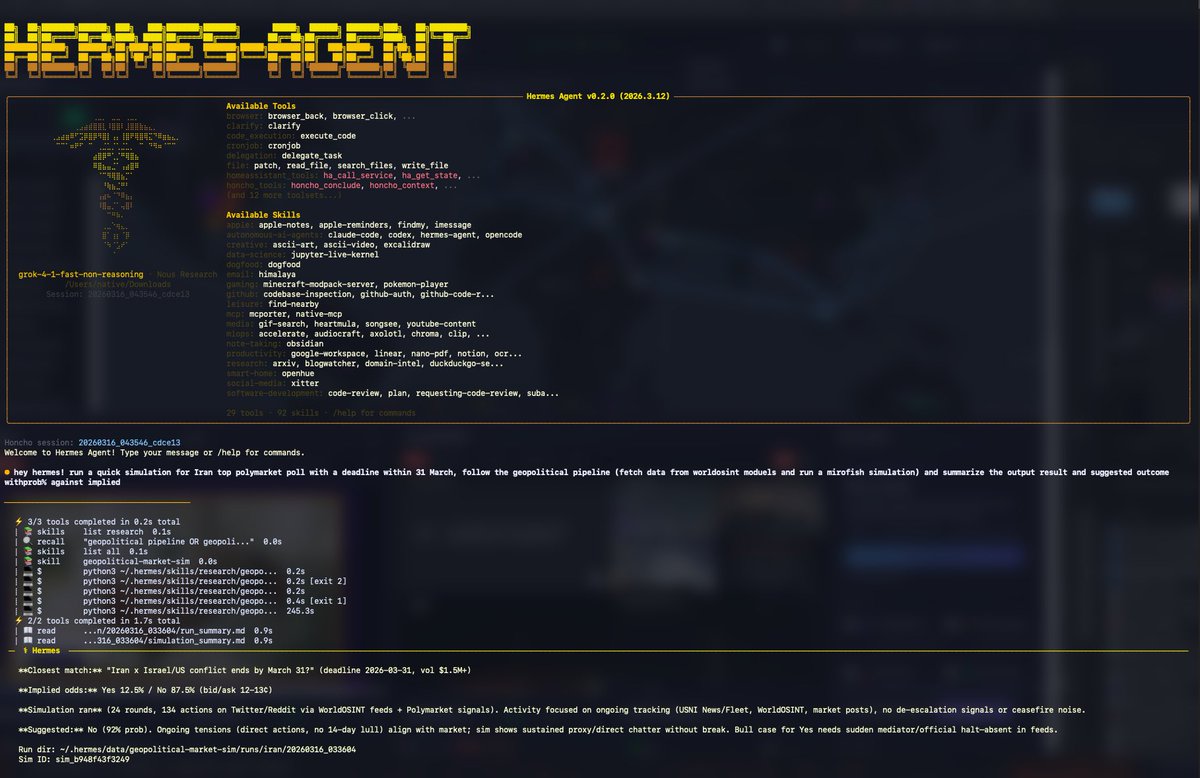
Built PrediHermes ✨
a Hermes Agent skill + companion WorldOSINT/MiroFish forks for geopolitical prediction.
@NousResearch
It pulls 54+ OSINT modules, uses Polymarket to find contracts with clear resolution criteria, then runs MiroFish multi-agent sims to model individual actor behavior and forecast likely outcomes on a schedule.
All modules are fully open-source and AGPL licensed 🧵…
English