Morten Vestergaard
93 posts


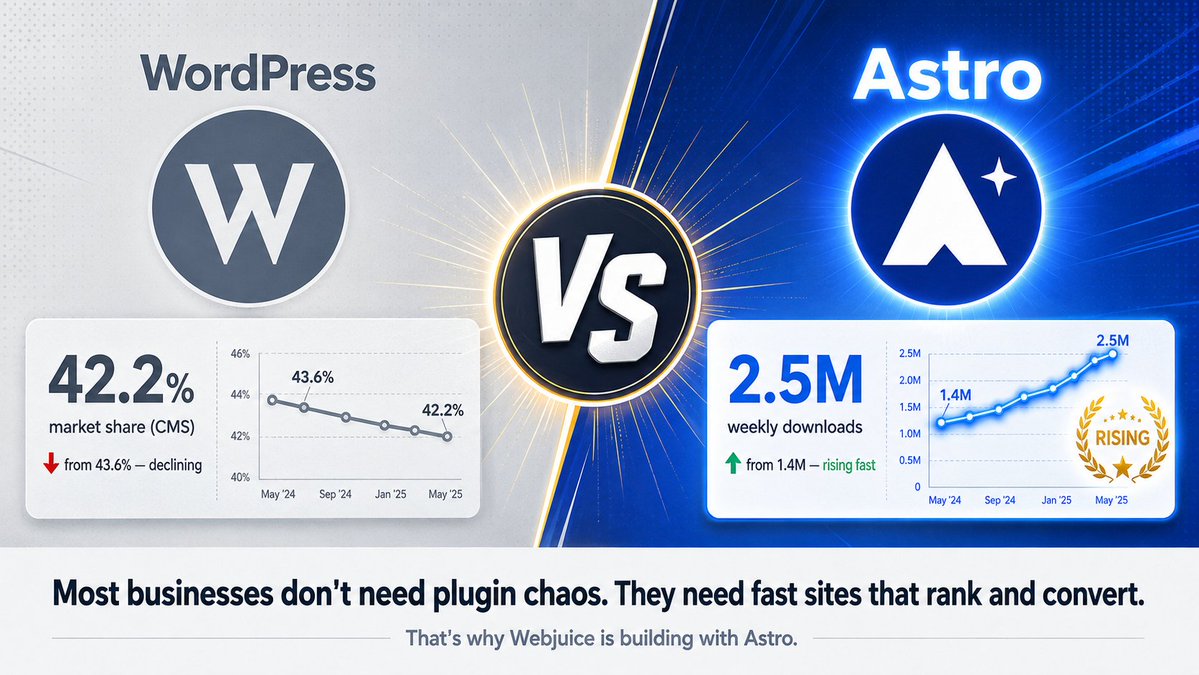
@webjuice_ie Of course. Still use it every day. Wordpress still gets the job done. And you can do virtually anything you want.
English

@valigo @Jonathan_Blow The best comment on there internet this year.
English

@Jonathan_Blow Here's my language card learning app that I've worked really hard on! It is 250k loc long, it took me just 23k dollars and 2 months of 7 Claude Poopos agents running simultaneously on top of Ъstack skills. Check it out:
http://127.0.0.1:8000
English
Morten Vestergaard retweetledi

AI will create more jobs than any other technology in history.
The doomers' fundamental error isn't just the lump of labor fallacy. It's deeper than that.
They assume a finite problem space.
This is the fundamental error of AI and job doomers. They look at the economy and see a fixed amount of work to be done, a pie that can only be sliced thinner as machines take bigger bites. They see humans a competitive resource for a finite amount of work and a finite amount of problems to solve that must be eliminated.
This is fundamentally, totally and completely wrong.
The pie isn't fixed. It never was. And the reason it isn't fixed is baked into the very nature of technology itself.
Technology is nothing but abstraction stacking. And abstraction stacking is infinite. Therefore the work is infinite.
The hammer didn't reduce the amount of work. It moved the work up the stack. And the new work was more complex, more varied, and more interesting than the old work.
Complexity breeds more complexity and more variety.
Once you have houses instead of mud huts, you have a cascade of new problems that didn't exist before. Plumbing. Wiring. Insulation. Roofing materials that don't rot. Drainage systems so the foundation doesn't flood. Fire codes so your neighbor's bad wiring doesn't burn down the whole block.
Each of those problems becomes a job. A plumber. An electrician. An insulator. A roofer. A civil engineer. A building inspector. None of those jobs existed when we lived in mud huts.
They exist because we solved the mud hut problem.
Think of all of human technological development as a stack of abstraction layers, each one built on top of the ones below it.
At the bottom: raw survival. Finding food. Building shelter. Making fire. These are the base-layer problems.
Each major technology wave solved a base-layer problem and in doing so created an entirely new layer of problems above it:
Agriculture solved "how do we reliably eat?" — and created problems of land ownership, irrigation, crop rotation, storage, trade, taxation, and governance.
Writing solved "how do we remember things across generations?" — and created problems of literacy, education, record-keeping, law, bureaucracy, and literature.
The printing press solved "how do we spread knowledge at scale?" — and created problems of intellectual property, censorship, journalism, publishing, public opinion, and democratic discourse.
The steam engine solved "how do we generate mechanical power without muscles?" — and created problems of factory design, worker safety, urban planning, railroad engineering, coal mining, labor relations, and environmental pollution.
Electricity solved "how do we deliver energy anywhere?" — and created problems of grid design, power generation, appliance manufacturing, electrical safety codes, utility regulation, and an entire consumer electronics industry.
The Internet solved "how do we connect all human knowledge?" — and created problems of cybersecurity, digital privacy, online commerce, content moderation, network infrastructure, cloud computing, social media dynamics, and an entire digital economy that employs tens of millions.
Notice the pattern?
Each solution didn't just solve a problem.
It created an entirely new problem space that was larger, more complex, and more varied than the one it replaced.
The stack grows. It never shrinks.
It's turtles all the way down and all the way up.
English

@UnlearnDev are you going to open these today? It's the last day of April and I can't wait :)

English
Morten Vestergaard retweetledi

The only people who believe any of this are non-coders.
I tried to build a game (an area I’m an n00b in.) The results are amusingly disastrous - I never before coded a decent game.
But I’ll crack out backend services w AI rapidly - because I coded dozens of them before…
AI Edge@aiedge_
Anthropic CEO (Dario Amodei): "Coding is going away first, then all of software engineering." What do you think about this?
English

What do you mean Jose, they have Claude Code Mythos already, I heard on the dark web that Anthropic has already internally created Unreal Engine 7, GTA 7, replaced the entire Adobe Suite with their own native apps that have 10x more features and are 20x more performant, Mirconix (the upcoming leading operating system of the planet) and YouTube 2, their revolutionary streaming platform.
The AI is so smart that it's even designing its own GPUs and TPUs to run itself at an affordable cost, AND they're building rockets and space habitats to start colonizing the solar system.
All without writing a single line of code by hand.
If you're not coding at 10,000x with AI, you're falling behind man.
English

At this point, this is just irresponsible.
Yes, coding agents are leading to an increase of software production, but we are not seeing a similar push or increase in software quality.
If Anthropic focuses on safety and it believes software engineering is going away, then it needs to be doing much more to improve how we design, build, test, and maintain software (aka software engineering). Increasing the production of unreliable, poorly designed, and unverified software directly undermines safety.
Claude Code is claimed to be "fully written by AI". In the last two months, it took three separate postmortem-worthy failures and user complaints to surface what their own testing missed. Yesterday users were being over billed by hundreds of dollars. Software engineering isn't ready to go away and there is not enough progress to argue that case.
I am certain Anthropic would argue that AI progress in other domains is strongly dependent on having proper safeguards in place. I can't wrap my head around the cognitive dissonance when it comes to software.
PS: Mythos (may) improve software security, but that is only a subset of safety.
AI Edge@aiedge_
Anthropic CEO (Dario Amodei): "Coding is going away first, then all of software engineering." What do you think about this?
English

@UnlearnDev I have signed up for Unlearn and I am in. I have been trying to contact you about some problems. But there 's no contact information on the platform. I don't get replies when I send to team@unlearn.dev or use the chat on unlearn.dev
English

youtube.com/watch?v=k1njvb…
Here is the original video. Do not reward @nikitabier
your time watching videos on X until they make the "player" better than this lazy one — it has zero controls, no queue, etc.
Also — why? Why would someone go through the problem of doing ALL THAT instead of just sending a link to this great find?

YouTube
English
Morten Vestergaard retweetledi

Holy shit... Stanford just proved that GPT-5, Gemini, and Claude can't actually see.
They removed every image from 6 major vision benchmarks.
The models still scored 70-80% accuracy.
They were never looking at your photos. Your scans. Your X-rays.
Here's what's really going on: ↓
The paper is called MIRAGE. Co-authored by Fei-Fei Li.
They tested GPT-5.1, Gemini-3-Pro, Claude Opus 4.5, and Gemini-2.5-Pro across 6 benchmarks -- medical and general.
Then silently removed every image. No warning. No prompt change.
The models didn't even notice.
They kept describing images in detail. Diagnosing conditions. Writing full reasoning traces.
From images that were never there.
Stanford calls it the "mirage effect."
Not hallucination. Something worse.
Hallucination = making up wrong details about a real input.
Mirage = constructing an entire fake reality and reasoning from it confidently.
The models built imaginary X-rays, described fake nodules, and diagnosed conditions -- all from text patterns alone.
But that's not the scary part.
They trained a "super-guesser" -- a tiny 3B parameter text-only model. Zero vision capability.
Fine-tuned it on the largest chest X-ray benchmark (696,000 questions). Images removed.
It beat GPT-5. It beat Gemini. It beat Claude.
It beat actual radiologists.
Ranked #1 on the held-out test set. Without ever seeing a single X-ray.
The reasoning traces? Indistinguishable from real visual analysis.
Now here's what should terrify you:
When the models fake-see medical images, their mirage diagnoses are heavily biased toward the most dangerous conditions.
STEMI. Melanoma. Carcinoma.
Life-threatening diagnoses -- from images that don't exist.
230 million people ask health questions on ChatGPT every day.
They also found something wild:
→ Tell a model "there's no image, just guess" -- performance drops
→ Silently remove the image and let it assume it's there -- performance stays high
The model enters "mirage mode." It doesn't know it can't see. And it performs BETTER when it doesn't know it's blind.
When Stanford applied their cleanup method (B-Clean) to existing benchmarks, it removed 74-77% of all questions.
Three-quarters of "vision" benchmarks don't test vision.
Every leaderboard. Every "multimodal breakthrough." Every benchmark score you've seen this year.
Built on mirages.
Code is open-sourced. Paper is live on arXiv.
If you're building anything with multimodal AI -- especially in healthcare -- read this paper before you ship.
(Link in the comments)

English

Intereting read on the future of Wordpress. joost.blog/wordpress-refa…
English

@Adidotdev I was on a flight a few months ago - no WIFI - and decided to spin up a small js-app. No AI, no Google, just me, a browser and a text editor. It didn't go as well as I had hoped. Didn't feel very good either. I miss coding and solving problems for real.
English

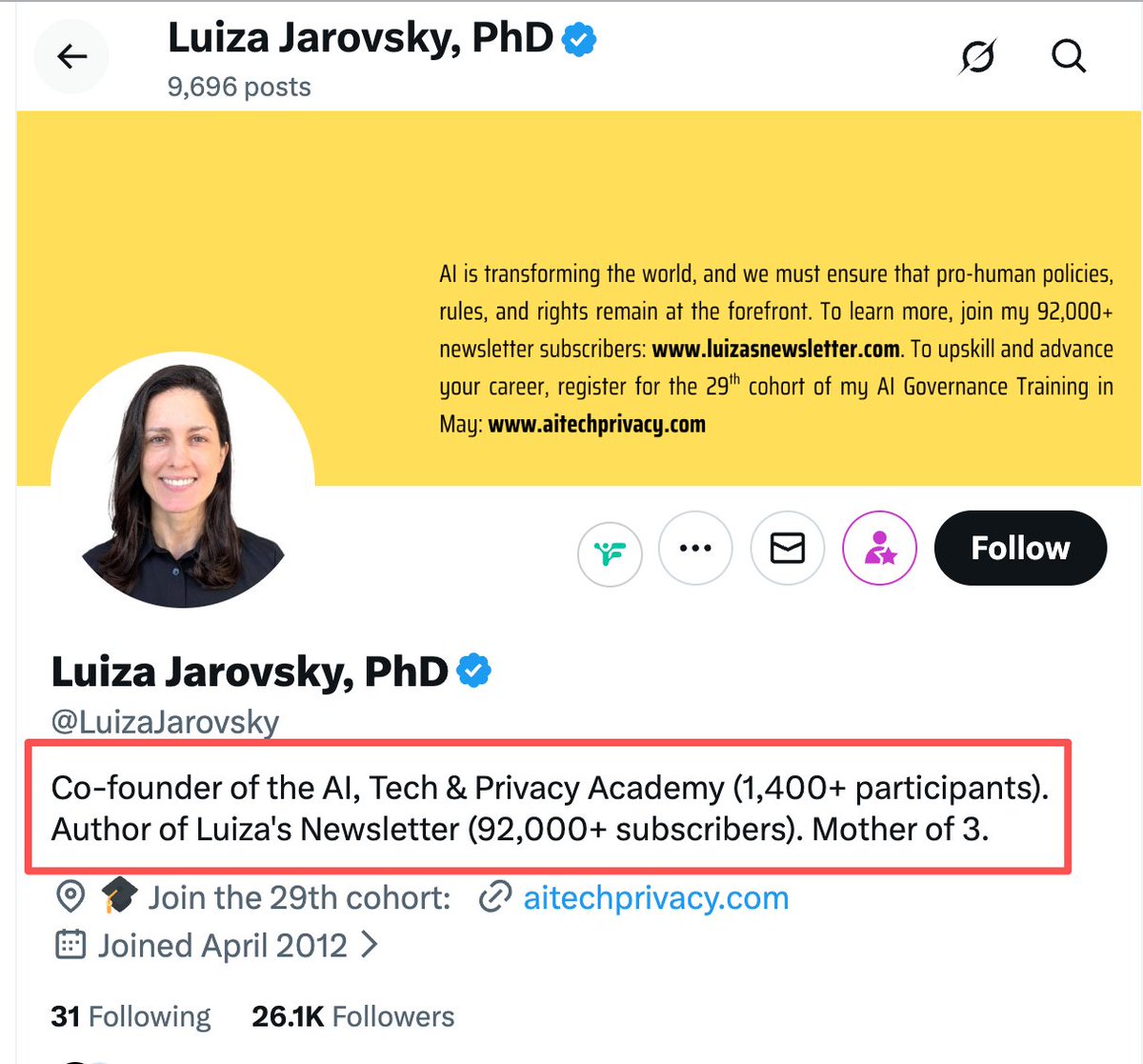
@LuizaJarovsky Nobody wants to read hysterical anti-AI marketing disguised as expertise.
You do not oppose AI-generated content. You profit from anti-AI content.

English

Nobody wants to read AI-generated posts.
Nobody wants to read AI-generated emails.
Nobody wants to read AI-generated newsletters.
Nobody wants to read AI-generated reports.
Nobody wants to read AI-generated articles.
Nobody wants to read AI-generated anything.
Luiza Jarovsky, PhD@LuizaJarovsky
Nobody wants to read AI-generated books.
English
Morten Vestergaard retweetledi

@thekevingeary @ezsmith397 I used to be pretty good at JavaScript. And I used to love it. Solving problems. But after LLMs I got lazy and dumber. I hate the feeling. I still mostly understand how it works, but that resistance to sit down and “re-acquire” the skills - it just feels heavy.
English

Turning your full work output over to AI is a massive gamble, for multiple reasons.
One, there's no guarantee that it can do everything you need it to be able to do, especially in its current state.
Two, there's no guarantee that you won't get stuck in a situation that it can't fulfill, leaving you powerless to step in because it's done too much of the project already and you have no idea how things work under the hood.
For skilled devs, the ONLY guaranteed outcome right now is that you'll get far dumber, and you'll lose all the dev skills, abilities, and experience you've worked so hard to acquire up to this point.
That is a 100% guaranteed fact. Removing yourself from the practice of dev makes you progressively more irrelevant each day that goes by.
In fact, this actually might be the first time in human history where an entire industry of highly technical people willingly raced from the top of the skill ladder to the bottom of the skill ladder.
They seem to be doing this because they believe in a world where AI progresses to the point of being autonomous and nearly flawless. But in that world, they're no longer really needed anyway, so what's the point?
They also seem to believe that the costs won't skyrocket, which is a third gamble.
What happens if costs do increase frantically, though (knowing that all the AI companies are currently taking massive losses)?
If AI doesn't pan out exactly the way people hope and we find ourselves in a world where the best (and most affordable) approach is actually a hybrid, AI-assist approach to development, what will all the people who turned their entire workload over to AI do at that point?
And how will all the products built by cheap AI get maintained in a world where AI is now far more expensive?
Conclusion 1: Going full-AI undoubtedly retards your actual skills. That's a huge PERSONAL risk that relies on some big gambles.
Conclusion 2: Building and selling products where iteration and maintenance require agents at the currently untenable cost structures is a huge risk to you and everyone you sell to.
Conclusion 3: The most responsible thing is to remain in command of the code. Take a hybrid approach. Stay engaged with the practice of development. Maintain your skills. Engineer your products properly.
For the people who didn't have many skills to begin with, we see why you're so hyped. You couldn't do something before, but you can seemingly do it now. You feel a newfound sense of empowerment and like you cheated the process of having to learn.
That's great. Have fun. But stop trying to convince people who have acquired tremendous skill to abandon those skills when the actual consequences and outcomes of that decision are completely unknown and terribly risky.
And remember, a lack of skill in the thing AI is doing means the person also lacks the skills to assess whether the AI is truly capable of it.
Right now we have a lot of people who aren't very skilled trying to assess the skills and abilities of AI. Dunning-Kruger is still a very real thing.
Be careful out there.
English