The Wizard Of Ops

10.6K posts

The Wizard Of Ops banner
The Wizard Of Ops

The Wizard Of Ops

@WizOfOps

Behind the option dealer positioning curtain 🧙‍♂️ Options, vol, bat flips, dad jokes 🪄 Join us: https://t.co/RBtTsngLeP 🧙‍♂️ Disclaimer: https://t.co/TfWPx8wnhb

United States Katılım Kasım 2017
181 Takip Edilen10.8K Takipçiler
Sabitlenmiş Tweet
The Wizard Of Ops
The Wizard Of Ops@WizOfOps·
Part 1 refresher: I occasionally read through social media, and I come across two different classes of faux dealer positioning services: 1. Services that are technical in nature about dealer positioning dynamics around delta, gamma, and other movement-based greeks; and 2. Services for “traditional” volatility traders, who see the world through a volatility lens and measure their trades against dynamics in the vol curve. These two classes of traders ignore each other at best, and scoff at each other at worst. Last week, in part 1 (x.com/WizOfOps/statu…) , I wrote about the first faux dealer positioning class: those services that use open/close data to make trading decisions. I exposed the top-level issues of why these services miss the mark. I also dismissed the reductive #GEX and midpoint services, as their data are products of quickie formulas that are fraught with terrible assumptions that are not even remotely true. Not all puts are bought, and not all calls are sold. It was a good assumption when SqueezeMetrics wrote his white paper many years ago, but there is more data availability now. Analyzing based on the midpoint of a bid/ask spread implies perfect market balance, which is also rarely true. Especially on illiquid issuances, you will find bid-ask prices fade strongly away from their fair value, making midpoints a poor read of fair value. The Volatility Services The second category of dealer positioning services is the volatility services. These services use changes in implied volatility to assume changes in dealer positioning. It is a fair assumption, since dealers can reprice their options based on how they want to incentivize option flows. This category includes Dealer Directional Open Interest (DDOI) proposed by SqueezeMetrics in his paper “Implied Order Flows” and the skew/vol dynamics that are pervasive among academic literature. The way the vol surface works is: 1. It is initially built using realized volatility methodologies like the Generalized Autoregressive Conditional Heteroskedasticity (GARCH) or Stochastic Alpha, Beta, Rho (SABR). 2. It then adjusts slightly as positioning comes in. 2a. If the net dealer position of aggregate vega is strongly negative, IV and skew will trend down. 2b. If the net dealer position of aggregate vega is positive, skew and IV increase. These are the assumptions surrounding both #DDOI and vol dynamics, and they are generally accurate and observable. You can track fixed-price volatility across the curve and observe its movement. However, those dynamics shows the present state of things. What the vol trader is missing is the trade-level dealer imbalance to anticipate how skew and IV will change based on movement in any of the variables involved with options, including movement of the underlying, IV, time, or interest rates. Many vol traders intuitively recognize warning signs of mispricing based on realized volatility or historical implied volatility planes, but that is an incomplete picture. Every disclaimer says “Past performance does not imply future results”, but for some reason that is what market making pricing relies on. DDOI attempts to assign these dynamics to individual trades. It is a bold attempt, but it doesn’t quite work due to the smoothing of the vol curve in liquid products. For instance, $SPY is one of the most liquid underlying options out there. If someone buys 1000 puts at 685, and someone else sells 200 puts at 684 at the same time, the whole vol curve will shift and the 200 puts would be classified as a “buy” in the DDOI system. You cannot rely on knots in the vol surface to happen due to the smoothing that market makers employ. It is a good attempt, but it runs into assumption problems. Volland Sees The Complete Picture 🖼️ The volatility traders explained above don’t pay attention to #dealerpositioning, and the dealer positioning traders don’t pay attention to the volatility traders. They need to pay attention to each other to generate true alpha. Here at Volland, we synergize both of these concepts and add in data analysis and novel uses of available datasets to get an accurate trade level view of the dealer book. Along with deep research into dealer methodologies and data analysis, we develop forecasts of dealer hedging flows. Volland (vol.land) is where all of these concepts come together to show unmatched market edge.
The Wizard Of Ops tweet media
English
1
3
20
4.6K
The Wizard Of Ops retweetledi
FinancialJuice
FinancialJuice@financialjuice·
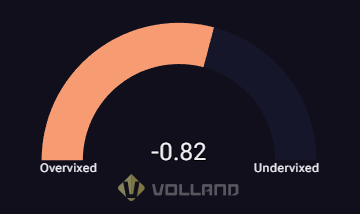
SPX Spot-Vol Beta: -0.82 This gauge measures how implied volatility (via the VIX) is reacting relative to the S&P 500’s price move. A reading of -0.82 suggests volatility is under-reacting, meaning options traders are not aggressively bidding up protection despite the underlying market move. This points to a relatively muted demand for hedging compared to the price action. Spot-vol beta reflects how much volatility is over- or under-reacting to changes in the S&P 500’s spot price. Source: vol.land
FinancialJuice tweet media
English
2
6
16
15.8K
The Wizard Of Ops retweetledi
FinancialJuice
FinancialJuice@financialjuice·
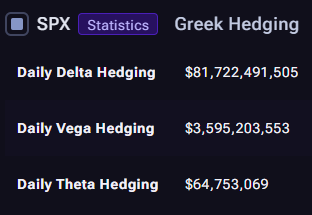
SPX Greek Hedging Greek Hedging (SPX) estimates the day’s dealer rebalancing flows implied by the current options book  essentially how much trading may be required for dealers to remain hedged as prices and volatility move. Here the dominant signal is Delta hedging ($81.7B), pointing to extremely large price-linked hedging activity that may require dealers to buy underlying exposure as prices move, reinforcing directional momentum. Vega hedging ($3.60B) indicates meaningful sensitivity to changes in implied volatility, suggesting volatility shifts could also drive additional hedging flows. Theta ($64.8M) represents the steady impact from time decay, modest relative to the larger delta and vega dynamics. Source - Vol.land
FinancialJuice tweet media
English
2
5
15
12.6K
The Wizard Of Ops retweetledi
FinancialJuice
FinancialJuice@financialjuice·
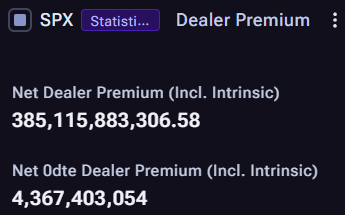
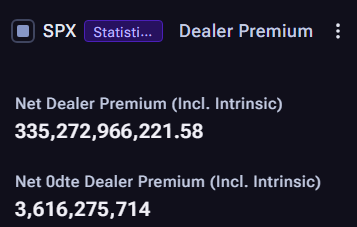
Volland SPX Dealer Premium: $385.12B This widget shows the total option premium dealers have collected from open positions. Net dealer premium stands at roughly $385.12B, marking an exceptionally large premium cushion embedded across SPX options positioning. 0DTE premium is about $4.37B today, reflecting elevated same-day options activity that can increase intraday market sensitivity and flow-driven volatility. Net premiums collected by dealers from all open positions / 0DTE premiums represent the total premiums collected by dealers today @wizofops Source: vol.land
FinancialJuice tweet media
English
1
3
14
14K
The Wizard Of Ops
The Wizard Of Ops@WizOfOps·
Good Morning! VIX crossed 30 as SPX dropped another -1.7%. SPX is now down -7% on the year. VIX has also crossed 30, but it seems as orderly as VIX 30 can be. Going into Friday, there weren’t even any vol events, and now the BoJ is very likely to hike soon. Was Friday a vol event? Read more on today's 𝑺 𝒖 𝒃 𝒔 𝒕 𝒂 𝒄 𝒌 post at wizardofops. s u b s t a c k. com
The Wizard Of Ops tweet media
English
1
0
4
718
The Wizard Of Ops retweetledi
FinancialJuice
FinancialJuice@financialjuice·
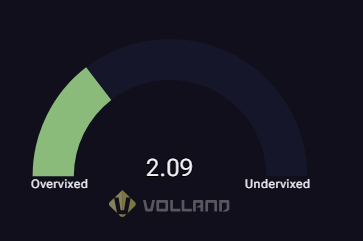
Volland SPX Spot-Vol Beta: 2.09 This gauge measures how much the VIX is reacting relative to the S&P 500’s price move. A reading of 2.09 suggests volatility is strongly over-reacting, meaning options traders are aggressively pricing in protection compared to the actual move in the index. In simple terms, fear pricing appears elevated relative to price action. Spot-vol beta: how much VIX is over- or under-reacting to spot move. Vol Event study by @wizofops Source: vol.land
FinancialJuice tweet media
English
1
7
26
15.5K
The Wizard Of Ops retweetledi
FinancialJuice
FinancialJuice@financialjuice·
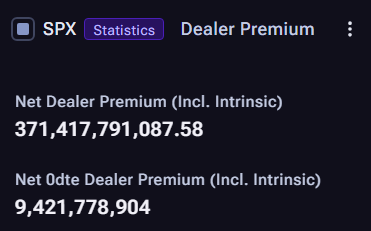
Volland SPX Dealer Premium: $371.42B This widget shows the total option premium dealers have collected from open positions. Net dealer premium stands at roughly $371.42B, signaling an exceptionally large premium cushion embedded across SPX options positioning. 0DTE premium is about $9.42B today, reflecting very heavy same-day options activity that can significantly amplify intraday market sensitivity and flow-driven moves. Net premiums collected by dealers from all open positions / 0DTE premiums represent the total premiums collected by dealers today @wizofops Source: vol.land
FinancialJuice tweet media
English
4
2
10
11.1K
The Wizard Of Ops
The Wizard Of Ops@WizOfOps·
Good Morning! As the markets get wise to fog of diplomacy, SPX dropped -1.5% The slow grind has SPX down -5.38% on the year. I had stated that I can’t get bullish without a vol event, and we are still not there. Even “positive” Iran news can only get an initial breakout before the economic reality becomes the market reality. Many on X are saying that Iran is winning. “Winning” is a subjective measure. Trump sees almost no American casualties and a generally destroyed Iranian military and thinks he is winning while the IRGC sees the economic catastrophe that they are causing by shooting at ships in the Strait of Hormuz and think they are winning. This is evident in the demands both sides are giving each other. One thing is for sure; America has a much lower threshold for pain than Iran. How are participants positioned? Read more on today's 𝑺 𝒖 𝒃 𝒔 𝒕 𝒂 𝒄 𝒌 post at wizardofops. s u b s t a c k. com
The Wizard Of Ops tweet media
English
0
0
6
887
The Wizard Of Ops retweetledi
FinancialJuice
FinancialJuice@financialjuice·
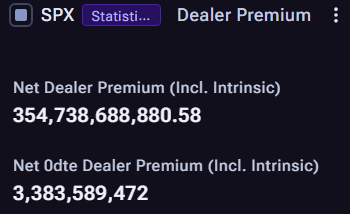
Volland SPX Dealer Premium: $354.74B This widget shows the total option premium dealers have collected from open positions. Net dealer premium stands at roughly $354.74B, underscoring a very large premium cushion embedded across SPX options positioning. 0DTE premium is about $3.38B today, reflecting active same-day options trading that can increase intraday sensitivity and short-term flow-driven moves. Net premiums collected by dealers from all open positions / 0DTE premiums represent the total premiums collected by dealers today @wizofops Source: vol.land
FinancialJuice tweet media
English
3
3
14
16.4K
The Wizard Of Ops
The Wizard Of Ops@WizOfOps·
Good Morning! Another bear market-type bounce of .55% Conflicting headlines cross the newswires about the diplomacy efforts between Iran and the US/Israel alliance. Iran has demands and the US has demands, with neither side acknowledging what they need to give. I read about the demands of both sides, and this seems far apart. I think the IRGC is in charge in Iran and as long as both sides do not respect each other’s human dignity, the war continues. Has anyone started hedging yet going into April?
The Wizard Of Ops tweet media
English
1
0
4
831
The Wizard Of Ops retweetledi
FinancialJuice
FinancialJuice@financialjuice·
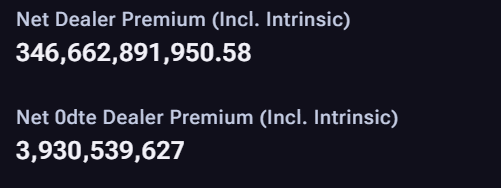
SPX Dealer Premium - Volland Dealer Premium (SPX) is a snapshot of the net option premium exposure dealers are carrying across SPX options (including intrinsic value) — a rough sense of how much option inventory/obligation sits on dealer books. The 0DTE Dealer Premium (same-day expiry) isolates the slice most linked to today’s intraday hedging flows. With a relatively small 0DTE number here (~$3.93B), it suggests less same-day options “gravity” than on big 0DTE-heavy sessions, but it’s still best read versus a recent average/trend. Source: vol.land
FinancialJuice tweet media
English
1
4
13
12.9K
The Wizard Of Ops
The Wizard Of Ops@WizOfOps·
@Bluedeerc We combine dealer positioning with vol analytics. It is predictive on more facets than direction.
English
0
0
0
75
Blue Deer
Blue Deer@Bluedeerc·
@WizOfOps You guys still using IV with dealer model or did land on something more predictive in nature?
English
1
0
1
131
The Wizard Of Ops
The Wizard Of Ops@WizOfOps·
Part 1 refresher: I occasionally read through social media, and I come across two different classes of faux dealer positioning services: 1. Services that are technical in nature about dealer positioning dynamics around delta, gamma, and other movement-based greeks; and 2. Services for “traditional” volatility traders, who see the world through a volatility lens and measure their trades against dynamics in the vol curve. These two classes of traders ignore each other at best, and scoff at each other at worst. Last week, in part 1 (x.com/WizOfOps/statu…) , I wrote about the first faux dealer positioning class: those services that use open/close data to make trading decisions. I exposed the top-level issues of why these services miss the mark. I also dismissed the reductive #GEX and midpoint services, as their data are products of quickie formulas that are fraught with terrible assumptions that are not even remotely true. Not all puts are bought, and not all calls are sold. It was a good assumption when SqueezeMetrics wrote his white paper many years ago, but there is more data availability now. Analyzing based on the midpoint of a bid/ask spread implies perfect market balance, which is also rarely true. Especially on illiquid issuances, you will find bid-ask prices fade strongly away from their fair value, making midpoints a poor read of fair value. The Volatility Services The second category of dealer positioning services is the volatility services. These services use changes in implied volatility to assume changes in dealer positioning. It is a fair assumption, since dealers can reprice their options based on how they want to incentivize option flows. This category includes Dealer Directional Open Interest (DDOI) proposed by SqueezeMetrics in his paper “Implied Order Flows” and the skew/vol dynamics that are pervasive among academic literature. The way the vol surface works is: 1. It is initially built using realized volatility methodologies like the Generalized Autoregressive Conditional Heteroskedasticity (GARCH) or Stochastic Alpha, Beta, Rho (SABR). 2. It then adjusts slightly as positioning comes in. 2a. If the net dealer position of aggregate vega is strongly negative, IV and skew will trend down. 2b. If the net dealer position of aggregate vega is positive, skew and IV increase. These are the assumptions surrounding both #DDOI and vol dynamics, and they are generally accurate and observable. You can track fixed-price volatility across the curve and observe its movement. However, those dynamics shows the present state of things. What the vol trader is missing is the trade-level dealer imbalance to anticipate how skew and IV will change based on movement in any of the variables involved with options, including movement of the underlying, IV, time, or interest rates. Many vol traders intuitively recognize warning signs of mispricing based on realized volatility or historical implied volatility planes, but that is an incomplete picture. Every disclaimer says “Past performance does not imply future results”, but for some reason that is what market making pricing relies on. DDOI attempts to assign these dynamics to individual trades. It is a bold attempt, but it doesn’t quite work due to the smoothing of the vol curve in liquid products. For instance, $SPY is one of the most liquid underlying options out there. If someone buys 1000 puts at 685, and someone else sells 200 puts at 684 at the same time, the whole vol curve will shift and the 200 puts would be classified as a “buy” in the DDOI system. You cannot rely on knots in the vol surface to happen due to the smoothing that market makers employ. It is a good attempt, but it runs into assumption problems. Volland Sees The Complete Picture 🖼️ The volatility traders explained above don’t pay attention to #dealerpositioning, and the dealer positioning traders don’t pay attention to the volatility traders. They need to pay attention to each other to generate true alpha. Here at Volland, we synergize both of these concepts and add in data analysis and novel uses of available datasets to get an accurate trade level view of the dealer book. Along with deep research into dealer methodologies and data analysis, we develop forecasts of dealer hedging flows. Volland (vol.land) is where all of these concepts come together to show unmatched market edge.
The Wizard Of Ops tweet media
English
1
3
20
4.6K
The Wizard Of Ops retweetledi
FinancialJuice
FinancialJuice@financialjuice·
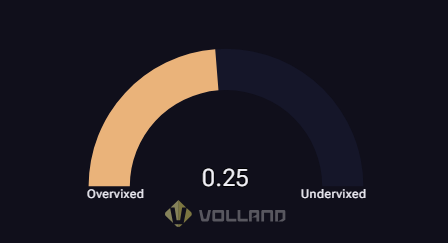
Volland SPX Spot-Vol Beta: 0.25 This gauge measures how much the VIX is reacting relative to the S&P 500’s price move. A reading of 0.25 suggests volatility is only slightly under-reacting, meaning options markets are relatively calm compared to the recent move in the index. Overall, implied volatility response appears modest and contained. Spot-vol beta: how much VIX is over- or under-reacting to spot move. Vol Event study by @wizofops Source: vol.land
FinancialJuice tweet media
English
4
3
10
17.4K
The Wizard Of Ops
The Wizard Of Ops@WizOfOps·
Good Morning! With confusing headlines about an Iranian ceasefire, SPX dropped -.4%. The volley of headlines is confusing, but it is driving immediate market moves. From an economic and options standpoint, we need to look past the headlines and trade for a timeframe beyond them, anticipating next steps. For daytraders, it is best to lower your risk and trade level to level as Dark Matter says. What do the options say for the next month? Read more on today's 𝑺 𝒖 𝒃 𝒔 𝒕 𝒂 𝒄 𝒌 post at wizardofops. s u b s t a c k. com
English
0
0
3
809
The Wizard Of Ops retweetledi
FinancialJuice
FinancialJuice@financialjuice·
Volland SPX Dealer Premium: $327.05B This widget shows the total option premium dealers have collected from open positions. Net dealer premium stands at roughly $327.05B, signaling a very large premium cushion embedded across SPX options positioning. 0DTE premium is about $4.40B today, reflecting elevated same-day options activity that can increase intraday sensitivity to market moves. Net premiums collected by dealers from all open positions / 0DTE premiums represent the total premiums collected by dealers today @wizofops Source: vol.land
FinancialJuice tweet media
English
1
4
11
15.3K
The Wizard Of Ops
The Wizard Of Ops@WizOfOps·
Good Morning! SPX advanced 1.15% as ceasefire headlines flew. The Iranian military is pretty much squashed at this point, but their hold on the Strait of Hormuz is holding the world hostage. It was clearly a strategic mistake to ignore Iran’s ability to control the strait. Despite the casualty and military disparity favoring the US/Israel alliance, Iran holds the trump card (zing). How are options positioned for this?
The Wizard Of Ops tweet media
English
1
0
6
875
The Wizard Of Ops retweetledi
FinancialJuice
FinancialJuice@financialjuice·
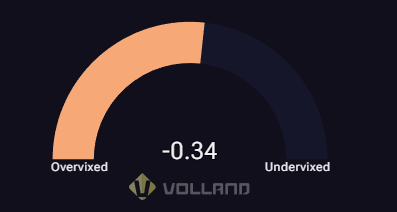
SPX Spot-Vol Beta: -0.34 This gauge measures how implied volatility (via the VIX) is reacting relative to the S&P 500’s price move. A reading of -0.34 suggests volatility is under-reacting slightly, meaning options traders are not aggressively bidding up protection relative to the market move. The response in volatility appears somewhat muted compared to the underlying price action. Spot-vol beta reflects how much volatility is over- or under-reacting to changes in the S&P 500’s spot price. Source - vol.land
FinancialJuice tweet media
English
2
5
20
16.7K
The Wizard Of Ops retweetledi
FinancialJuice
FinancialJuice@financialjuice·
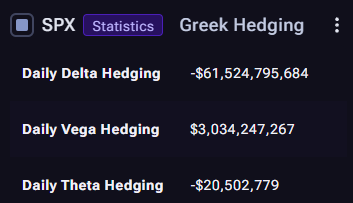
Volland SPX Greek Hedging Greek Hedging (SPX) estimates the direction and size of daily dealer rebalancing flows implied by the options market. Delta hedging (~-$61.52B): suggests dealers may need to sell underlying (or futures) to stay hedged against price moves; a very large figure implies significant potential flow impact. Vega hedging (~$3.03B): exposure to changes in implied volatility; typically managed through repricing options, with the positive figure indicating increased sensitivity to volatility shifts. Theta hedging (~-$20.50M): the impact of one day passing on the dealer book; like vega, this is largely handled through option repricing, with time decay slightly reducing overall hedging needs. Greek hedging: net notional dealer hedging that needs to be applied by the end of the day @wizofops Source: vol.land
FinancialJuice tweet media
English
4
5
14
17K