
🌐 Interoperability as the Default State
Infrastructure doesn’t win through noise. It wins through absence of friction. When the foundation works perfectly, it disappears, and what remains is everything built upon it.
That’s the future of @LayerZero_Core: to make interoperability so seamless that no one talks about “chains” anymore, we'll talk about applications.
🔹The Victory of Infrastructure
Five years after LayerZero’s quiet persistence, the concept of “bridging” is extinct. The word feels anachronistic — something from the pre-interoperable era, like buffering on early internet videos.
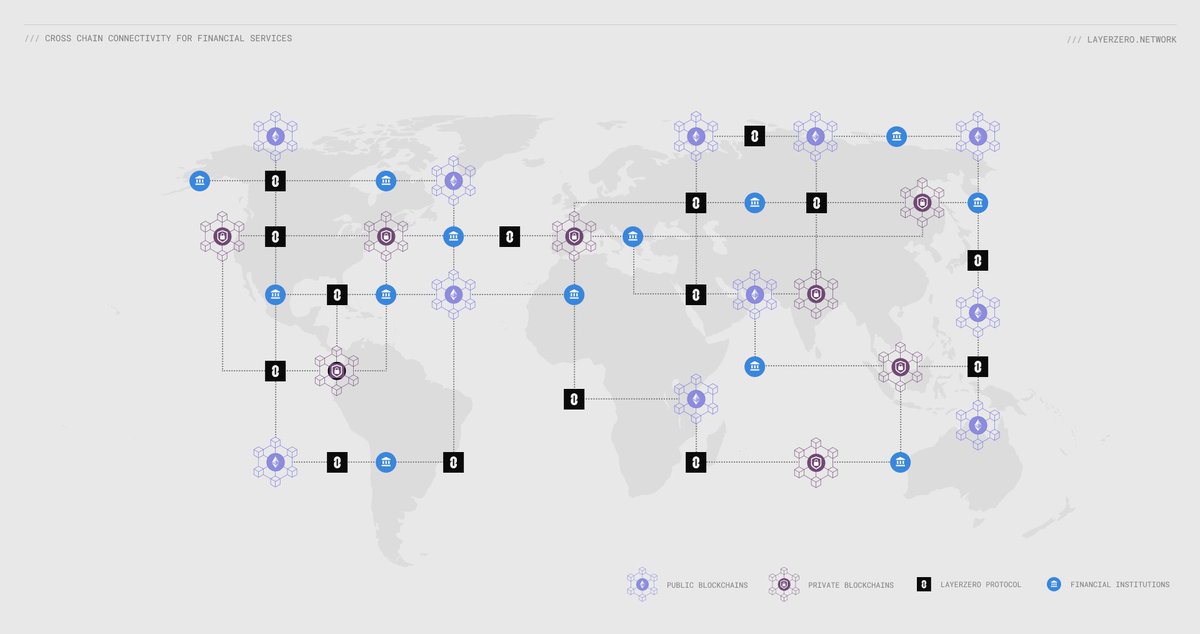
Chains still exist, but they are no longer borders. A transaction on Ethereum, a trade on Solana, a game asset on Avalanche — these are not separate events. They are atomic actions within a single, connected execution space. That unity isn’t enforced by centralized routing or federated intermediaries, it’s powered by verifiable, permissionless messaging that simply works.
The result: Infrastructure that no longer demands belief, it earns trust by design, through cryptographic proof, protocol simplicity, and time-tested reliability.
🔹Interop as Default
We are living in the “post-chain” world. The distinctions between networks have dissolved into functions. Developers no longer ask, “Which chain should I deploy on?” They ask, “Where does my logic live?” The idea of being “multi-chain” becomes redundant because interoperability isn’t an add-on, it’s ambient.
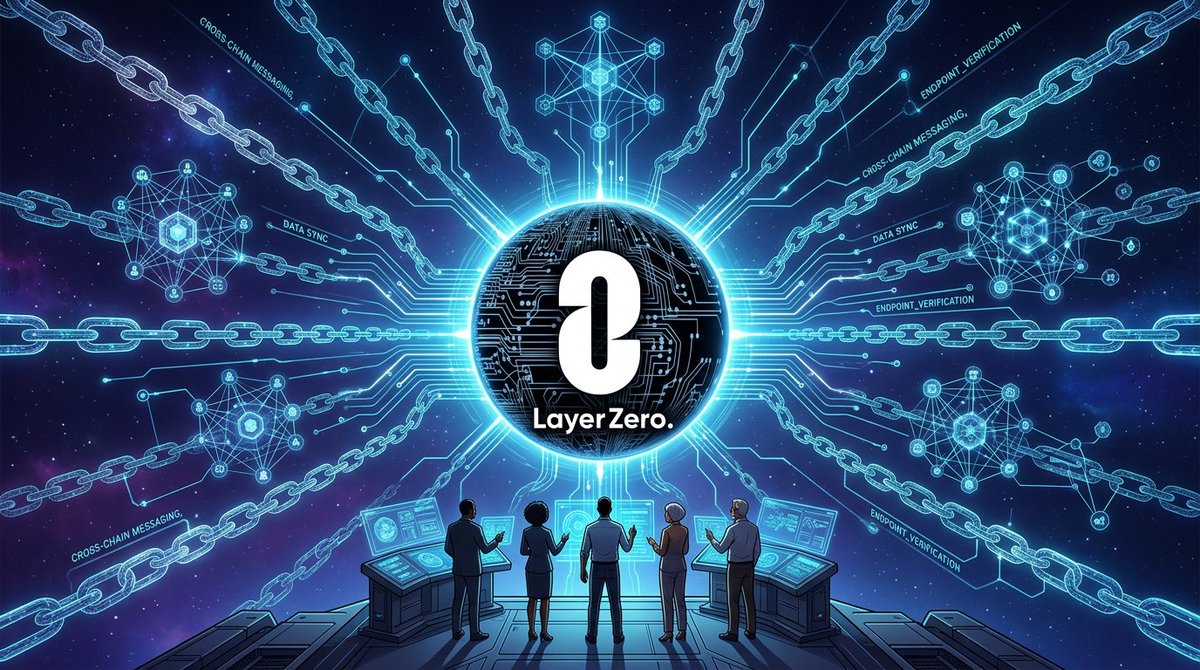
LayerZero doesn’t compete with blockchains, it completes them, it gives every network an unspoken language to communicate securely, transforming every isolated system into part of an expansive, composable internet of contracts.
Like TCP/IP abstracted hardware diversity into one global web, LZero abstracts blockchain diversity into a single programmable plane and becomes the connective tissue of Web3 — INVISIBLE BUT INDISPENSABLE.
🔹Infinite Surface Area, Minimal Overhead
When LZero succeeds, developer friction (deploying on multiple chains, syncing liquidity, managing state) collapses into one elegant layer of logic and messaging.
Instead of cloning contracts across ecosystems, builders architect experiences that flow where users are. Every chain adds capacity, user base, and edge compute, without fragmenting the core.
In this future, startups in DeFi, gaming, identity, and AI agents deploy systems that scale horizontally across the entire blockchain space. A new definition of leverage emerges: one where protocol reach is no longer gated by network choice.
🔹Proof Over Promise
Trust, in the LZero era, is redesigned. Not projected by brand, validator set, or marketing, but proven by process.
Five years in, LayerZero’s security has matured into a culture of verifiability: independent oracles, decentralized executors, modular security assumptions. The protocol no longer relies on the reputation of its builders, but on the resilience of its mechanism.
This shift echoes a broader truth about infrastructure: longevity isn’t won through hype-cycles but through trust compounding over time. Each audited message, each immutable proof or verified state transition, adds another brick to the cathedral of credibility.
🔹The World That Emerges
In a world where LayerZero succeeds, users no longer manage assets per chain. A wallet is not “multi-chain”, it’s just a wallet. Liquidity isn’t siloed, composability isn’t conditional, and developers aren’t constrained by tribal network loyalties.
Cross-chain lending protocols serve borrowers and lenders without custody bridges. Onchain games evolve across execution layers without migration pain. AI agents use blockchains the way humans use cloud APIs — effortlessly.
And just as the early internet faded the boundaries between LANs and ISPs, LayerZero erases the notion of “webs” within Web3. There is, once again, only the web.
Infrastructure wins quietly;
But its impact speaks forever ♾
English