Śrêyāśḥ Dësḥmùkḥ 🚀

7.4K posts

Śrêyāśḥ Dësḥmùkḥ 🚀 banner
Śrêyāśḥ Dësḥmùkḥ 🚀

Śrêyāśḥ Dësḥmùkḥ 🚀

@xegression

Quantifying Uncertainty 🎯 Stats · Econometrics · Demography PhD Fellow ·Decision Sciences

Katılım Kasım 2023
736 Takip Edilen370 Takipçiler
Śrêyāśḥ Dësḥmùkḥ 🚀 retweetledi
Richard McElreath 🐈‍⬛
Statistical Rethinking 2026 is done: 20 new lectures emphasizing logical & critical statistical workflow, from basics of probability to causal inference to reliable computation to sensitivity. It's all free, made just for you. Lecture list & links: #calendar--topical-outline" target="_blank" rel="nofollow noopener">github.com/rmcelreath/sta…
English
9
186
982
50.8K
Śrêyāśḥ Dësḥmùkḥ 🚀 retweetledi
Parimal
Parimal@Fintech03·
Most people do not know that Venki’s Nobel-winning career was built on a complete collapse & restart. Let me point out to the "dog that did not bark" in his CV: He did not study Chemistry. Venki has a PhD in Physics. After finishing it, he realized he did not know enough about the living world to solve the problems he cared about. Instead of pushing through a career he felt disconnected from, he did the unthinkable: He started over as a student. He went back to graduate school at UC San Diego to study biology from scratch after already having a PhD. When Venki talks about work life balance, he is mostly talking about Cognitive Rot. Anyway, imo, burnout happens when we stop learning & start performing our expertise. Our balance is the courage to be a beginner again.
The Nobel Prize@NobelPrize

"If you're working non-stop all the time you will burn out." How do you keep a healthy work-life balance as a scientist? Hear 2009 chemistry laureate Venki Ramakrishnan share his best advice on how to achieve a good work-life balance. #NobelPrize

English
9
121
835
65.8K
Śrêyāśḥ Dësḥmùkḥ 🚀 retweetledi
Talia Ringer 🕊
Talia Ringer 🕊@TaliaRinger·
The math community is not angry about the fact that this was formalized, but rather the way in which it was formalized without respecting norms for mathematical collaboration. Something I hope to talk to Jesse more about
Mario Krenn@MarioKrenn6240

After the apparently amazing announcement by @mathematics_inc on the formalization of a major recent Fields-medal winning theorem, i had no idea how pissed the math-formalization community is. Very worrying discussions by some of the leaders/founders of Lean's mathlib. cc @ChrSzegedy

English
6
18
241
31.4K
Śrêyāśḥ Dësḥmùkḥ 🚀 retweetledi
The Nobel Prize
The Nobel Prize@NobelPrize·
"If you're working non-stop all the time you will burn out." How do you keep a healthy work-life balance as a scientist? Hear 2009 chemistry laureate Venki Ramakrishnan share his best advice on how to achieve a good work-life balance. #NobelPrize
English
9
202
869
117.7K
Mumbai Heritage
Mumbai Heritage@mumbaiheritage·
Hit me with the craziest Mumbai history facts you know.
Mumbai Heritage tweet media
English
130
56
389
2.4M
Śrêyāśḥ Dësḥmùkḥ 🚀 retweetledi
Stat.ML Papers
Stat.ML Papers@StatMLPapers·
Kolmogorov-Arnold causal generative models ift.tt/BbwgakT
Slovenščina
0
28
149
8.2K
Śrêyāśḥ Dësḥmùkḥ 🚀 retweetledi
Abhinav Upadhyay
Abhinav Upadhyay@abhi9u·
I've been looking into autograd internals of Pytorch. While I was aware of how backward mode autodiff works, I didn't know there was also forward mode autodiff. I had to read up on that. There is a very comprehensive article from an MIT course on that, I highly recommend it.
Abhinav Upadhyay tweet media
English
7
37
430
18.6K
Śrêyāśḥ Dësḥmùkḥ 🚀 retweetledi
Mathelirium
Mathelirium@mathelirium·
If you work in Physics, Machine Learning, Engineering, or any field with a serious mathematical component, Space Mapping is one of those ideas worth adding to your toolkit.
English
7
73
562
25.2K
Śrêyāśḥ Dësḥmùkḥ 🚀 retweetledi
Muratcan Koylan
Muratcan Koylan@koylanai·
If you're building anything in AI, the best skill you need to be using right now is hugging-face-paper-pages Whatever problem you're facing, someone has probably already published a paper about it. HF's Papers API gives a hybrid semantic search over AI papers. I wrote an internal skill, context-research, that orchestrates the HF Papers API into a research pipeline. It runs five parallel searches with keyword variants, triages by relevance and recency, fetches full paper content as markdown, then reads the actual methodology and results sections. The skill also chains into a deep research API that crawls the broader web to complement the academic findings. The gap between "a paper was published" and "a practitioner applies the insight" is shrinking, and I think this is a practical way to provide relevant context to coding agents. So you should write a skill on top of the HF Paper skill that teaches the model how to think about research, not just what to search for.
Muratcan Koylan tweet media
English
36
91
1.1K
59.8K
Śrêyāśḥ Dësḥmùkḥ 🚀 retweetledi
dax
dax@thdxr·
you're probably underestimating how crazy things are
dax tweet media
English
261
771
9.2K
1M
Śrêyāśḥ Dësḥmùkḥ 🚀 retweetledi
Khoa Vu
Khoa Vu@KhoaVuUmn·
Before AI, I can only have about 5 unfinished papers and 1 polished paper. AI boosted my productivity so much that I now have 136 unfinished papers and 1 polished paper.
English
20
61
1K
35.1K
Śrêyāśḥ Dësḥmùkḥ 🚀 retweetledi
Nirmalya Kajuri
Nirmalya Kajuri@Kaju_Nut·
If you are a theoretical physics grad student right now, you might feel tempted to outsource all your work to LLMs. This may feel beneficial in the short term, but it can be harmful in the long term. A PhD is a training period where you develop your knowledge of the subject. You learn to recognize good ideas and promising research directions and spot errors and unpromising avenues. These skills, which are going to remain important in the near future, can't be learned except by doing. More broadly, the ability to think, problem-solve and communicate are going to be your selling points in the job market, whether in academia or industry, at least till the time everyone starts carrying pocket-Wittens. The ability to write prompts won't get you hired. This is not to say you should not use gen ai in your work, but that you should prioritize your development as a researcher over the temptation to optimize quantitative metrics like number of publications.
English
20
31
244
14.7K
Śrêyāśḥ Dësḥmùkḥ 🚀 retweetledi
Mario Krenn
Mario Krenn@MarioKrenn6240·
After the apparently amazing announcement by @mathematics_inc on the formalization of a major recent Fields-medal winning theorem, i had no idea how pissed the math-formalization community is. Very worrying discussions by some of the leaders/founders of Lean's mathlib. cc @ChrSzegedy
Mario Krenn tweet media
English
21
43
531
175.5K
Śrêyāśḥ Dësḥmùkḥ 🚀 retweetledi
The Rocket Media
The Rocket Media@TheRocketMediaX·
He quit his PhD at IIT Kanpur... (To build drones for Indian Army) Meet Rama Krishna, Founder & CEO of Endureair > Dropped out to solve actual battlefield problems > Crafting long-endurance UAVs that serve the Indian Army in toughest terrains > SABAL for heavy-lift & VIBHRAM for surveillance Not everyone plays it safe. Some build for the nation
English
9
177
997
35.9K
Śrêyāśḥ Dësḥmùkḥ 🚀 retweetledi
Dwarkesh Patel
Dwarkesh Patel@dwarkesh_sp·
Terence Tao spent a year at the Institute for Advanced Study - no teaching, no random events of committees, just unlimited time to think. But after a few months, he ran out of ideas. Terence thinks that mathematicians and scientists need a certain level of randomness and inefficiency to come up with new ideas.
English
119
575
5.6K
837.7K
Śrêyāśḥ Dësḥmùkḥ 🚀 retweetledi
Mayank Pratap Singh
Mayank Pratap Singh@Mayank_022·
𝐕𝐢𝐬𝐮𝐚𝐥 𝐛𝐥𝐨𝐠 on Vision Transformers is live. vizuaranewsletter.com/p/vision-trans… Learn how ViT works from the ground up, and fine-tune one on a real classification dataset. CNNs process images through small sliding filters. Each filter only sees a tiny local region, and the model has to stack many layers before distant parts of an image can even talk to each other. Vision Transformers threw that whole approach out. ViT chops an image into patches, treats each patch like a token, and runs self-attention across the full sequence. Every patch can attend to every other patch from the very first layer. No stacking required. That global view from layer one is what made ViT surpass CNNs on large-scale benchmarks. 𝐖𝐡𝐚𝐭 𝐭𝐡𝐞 𝐛𝐥𝐨𝐠 𝐜𝐨𝐯𝐞𝐫𝐬: - Introduction to Vision Transformers and comparison with CNNs - Adapting transformers to images: patch embeddings and flattening - Positional encodings in Vision Transformers - Encoder-only structure for classification - Benefits and drawbacks of ViT - Real-world applications of Vision Transformers - Hands-on: fine-tuning ViT for image classification The Image below shows Self-attention connects every pixel to every other pixel at once. Convolution only sees a small local window. That's why ViT captures things CNNs miss, like the optical illusion painting where distant patches form a hidden face. The architecture is simple. Split image into patches, flatten them into embeddings (like words in a sentence), run them through a Transformer encoder, and the class token collects info from all patches for the final prediction. Patch in, class out. Inside attention: each patch (query) compares itself to all other patches (keys), softmax gives attention weights, and the weighted sum of values produces a new representation aware of the full image, visualizes what the CLS token actually attends to through attention heatmaps. The second half of the blog is hands-on code. I fine-tuned ViT-Base from google (86M params) on the Oxford-IIIT Pet dataset, 37 breeds, ~7,400 images. 𝐁𝐥𝐨𝐠 𝐋𝐢𝐧𝐤 vizuaranewsletter.com/p/vision-trans… 𝐒𝐨𝐦𝐞 𝐑𝐞𝐬𝐨𝐮𝐫𝐜𝐞𝐬 Dr @sreedathpanat Videos on ViT ViT paper dissection youtube.com/watch?v=U_sdod… Build ViT from Scratch youtube.com/watch?v=ZRo74x… Original Paper arxiv.org/abs/2010.11929 Next up: demystifying Low-Rank Adaptation (LoRA) in PEFT! Follow me @Mayank_022 along for more deep learning insights, cool fine-tuning projects, and updates from the upcoming blog posts.
YouTube video
YouTube
YouTube video
YouTube
GIF
English
12
334
2.1K
77.5K
Śrêyāśḥ Dësḥmùkḥ 🚀 retweetledi
Chao Ma
Chao Ma@ickma2311·
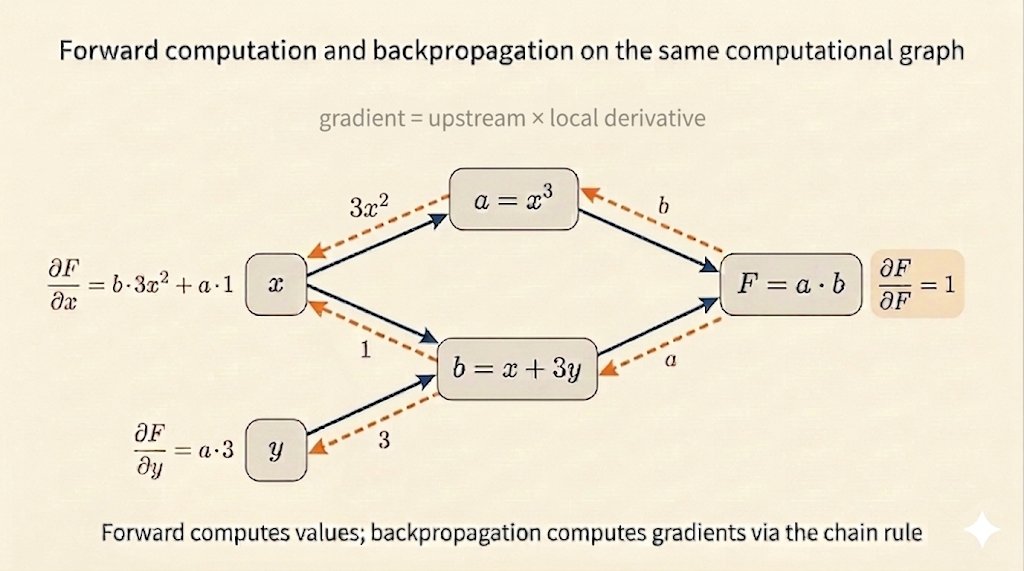
MIT 18.065 Lecture 27 made backprop feel much clearer. A neural network is a chain of functions, so backpropagation is just the chain rule applied efficiently; each parameter’s gradient is not isolated, it is shaped by every layer that comes after it. My note: ickma2311.github.io/Math/MIT18.065…
Chao Ma tweet media
English
5
126
1K
36.2K