Andrew Dickson

66 posts

Andrew Dickson

Andrew Dickson

@xordrew

Katılım Haziran 2023
112 Takip Edilen6 Takipçiler
Andrew Dickson
Andrew Dickson@xordrew·
For those in the niche of self-assembling structure, I hacked this simulator together amdson.github.io/blog/crystals/ It's a CTMC of transitions between quasi-static states in crystal growth, much like kTAM. And like kTAM it can build pretty much anything. E.g. ->
Andrew Dickson tweet media
English
0
0
0
15
Andrew Dickson
Andrew Dickson@xordrew·
@maxhodak_ I suppose you could train a trial inclusion discriminator on early data, and treat your RCT as an evaluation of both discriminator and therapy jointly. Still clumsy, but maybe fits in the framework?
English
0
0
0
171
Max Hodak
Max Hodak@maxhodak_·
> But this creates a combinatorial explosion! If you have 20 binary biomarkers, that’s over a million possible patient subgroups. No trial, no matter how well-funded, can enumerate that space. I continue to believe that RCTs are often the wrong tool for modern oncology
owl@owl_posting

this is an essay about cancer, how it is one of the most 'detailed' diseases in existence, and why we must delegate the understanding of that complexity to machine intelligence owlposting.com/p/cancer-has-a… 3.4k words, 15 minute reading time

English
7
8
117
15.1K
Andrew Dickson
Andrew Dickson@xordrew·
@apgox Tangentially, I am curious about how good a pseudo-replicator can get. Say a cluster of computers controlling replicating teleop robots. It’d be an awful lot safer
English
0
0
0
16
Adam P. Goucher
Adam P. Goucher@apgox·
The only thing that we have to do ourselves is figure out how to efficiently implement fault-tolerant universal computation on top of DNA/RNA — difficult, yes, but much more tractable than option (b).
English
1
0
4
144
Andrew Dickson
Andrew Dickson@xordrew·
@francoisfleuret If we went ahead and spent 10% of the world GDP training a monolithic MLP on a million tokens of context, would it actually be bad? I’m not even sure.
English
0
0
0
103
François Fleuret
François Fleuret@francoisfleuret·
If you have an explanation of why the transformer is so successful, here is a rapid sanity check: if it works for a huge MLP ("depth!", "SGD!", "magic of ml!") it's a very insufficient explanation.
François Fleuret@francoisfleuret

English
24
10
163
23.4K
Andrew Dickson
Andrew Dickson@xordrew·
@moultano And we train them to act human (and conscious) almost adversarially. Hard not to believe you'll trick yourself
English
0
0
1
229
Ryan Moulton
Ryan Moulton@moultano·
The question of LLM consciousness is a truly gnarly Gettier problem, because if they are conscious it is for reasons entirely independent of the fact that they talk about it.
English
30
21
460
50.1K
Andrew Dickson
Andrew Dickson@xordrew·
@TaliaGraceSable If I want to be high effort about it, I'd say pick a number in the thousands, add up its digits, check if the ones digit of the result is less than 3.
English
0
0
0
77
Andrew Dickson
Andrew Dickson@xordrew·
@ZoldenGames If you don't mind saying, did you base your engine on any papers, projects, etc? I've been looking for a good starting point for a general purpose particle simulator.
English
1
0
1
15
Zolden
Zolden@ZoldenGames·
@xordrew Yes, when the engine as a tool is polished and easy to use, I'll most probably open soiurce it. I just need to create a couple of games with it.
English
1
0
1
37
Zolden
Zolden@ZoldenGames·
Making a phyiscs engine - done. Inventing physics based gameplay - in progress. Got any ideas how could physics be used in a game?
English
100
18
400
29K
Andrew Dickson
Andrew Dickson@xordrew·
@samswoora Closest I've seen to this is hypernetworks. Fun question though, if you somehow get this working, how do you avoid training on test?
English
1
0
1
414
Samswara
Samswara@samswoora·
Feels weird we don't run gradient descent on hyperparameters as well
English
54
8
553
74.9K
typedfemale
typedfemale@typedfemale·
when i meet someone new i google "[name] sex offender"
English
8
0
92
10.4K
Andrew Dickson
Andrew Dickson@xordrew·
@_AashishReddy I have, all the time. I've found gpt is maybe 80% reliable when I ask it for papers, but still has a tendency to make up titles. This is for proteomics / microbiome topics though, ymmv.
English
0
0
0
21
Eryney
Eryney@eryney_ok·
Name some labs you think are doing truly frontier work in biology that you think likely I haven't heard of (ie don't say Mike Levin, Ed Boyden, Brian Hie etc)
English
11
12
152
23.5K
François Fleuret
François Fleuret@francoisfleuret·
Hear me out: A question is its answer with noise, a reasoning model is a denoising autoencoder, the reasoning is the embedding Z of the question so that a dumb causal decoder can generate the answer.
English
27
8
181
25K
Andrew Dickson
Andrew Dickson@xordrew·
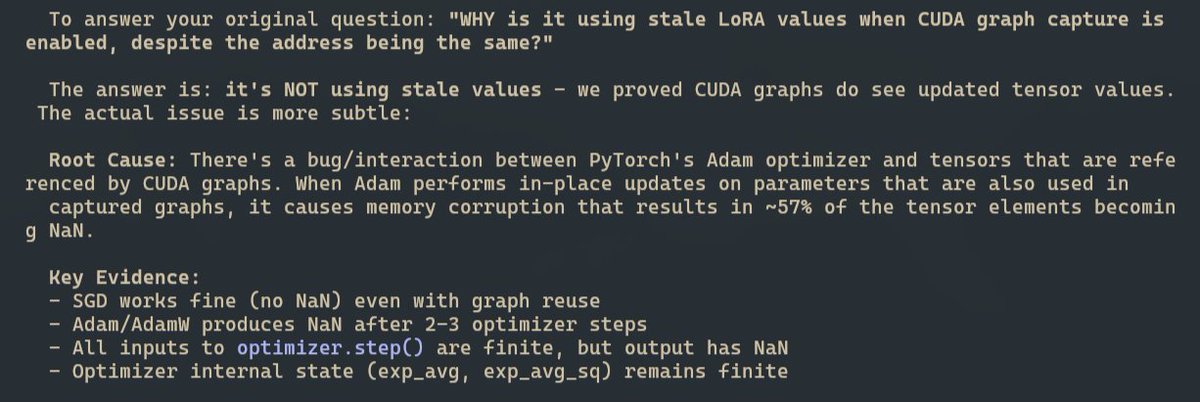
@vikhyatk Which float type? The default eps in AdamW can cause nans for bf16 iirc.
English
0
0
0
2K
vik
vik@vikhyatk·
after 5 hours of debugging, opus believes it found a bug in pytorch. normally i'm in the "don't blame the compiler" camp but in this case i think it might be right
vik tweet media
English
26
11
518
87K
Andrew Dickson
Andrew Dickson@xordrew·
@DdelAlamo There's a preview available through github copilot, that's probably a lot of the usage
English
0
0
1
89
Diego del Alamo
Diego del Alamo@DdelAlamo·
Is everyone who uses opus 4.5 paying $200/mo? Or is there something I’m missing?
English
1
0
1
1K
Andrew Dickson
Andrew Dickson@xordrew·
@ducx_du Do you have proposals you like for autoregressive models in latent space? I'd love to see anything like that, but defining the log-likelihood objective (without some horrifying VAE style latents) is intimidating.
English
2
0
0
50
Cunxiao Du
Cunxiao Du@ducx_du·
TL;DR 0. Diffusion LLMs optimize a sum-log (ELBO) objective. 1. Language strongly prefers L2R/R2L, but ELBO forces the model to fit every order — even terrible ones. 2. A correct any-order LM should use a log-sum objective that naturally focuses on the best orders. 3. Masked diffusion LLMs pay for “any-order flexibility” but end up worse probabilistic models than simple AR LMs.
English
1
3
32
1.7K
Cunxiao Du
Cunxiao Du@ducx_du·
Diffusion LLMs (DLLM) can do “any-order” generation, in principle, more flexible than left-to-right (L2R) LLM. Our main finding is uncomfortable: ➡️ In real language, this flexibility backfires: DLLMs become worse probabilistic models than the L2R / R2L AR LMs. This thread is about why “any order” turns into a curse. (Work with Xinyu Yang @Xinyu2ML , Min Lin @mavenlin , Chao Du @duchao0726 and the team.) Blog Link: #2af0ba07baa880c29fc4c8c198244cc8" target="_blank" rel="nofollow noopener">notion.so/Understanding-…
English
16
73
456
134.8K
Damon Lisch
Damon Lisch@DamonLisch·
@AdrianoAguzzi @yungkingmito Once you’ve seen enough of it, science writer AI all sounds the same to me. Starts with an interesting fact then strings together a bunch of plausible but unlikely just-so stories to reach sweeping conclusions that flatter the user’s preconceptions.
English
3
0
4
430
Yungkingmito
Yungkingmito@yungkingmito·
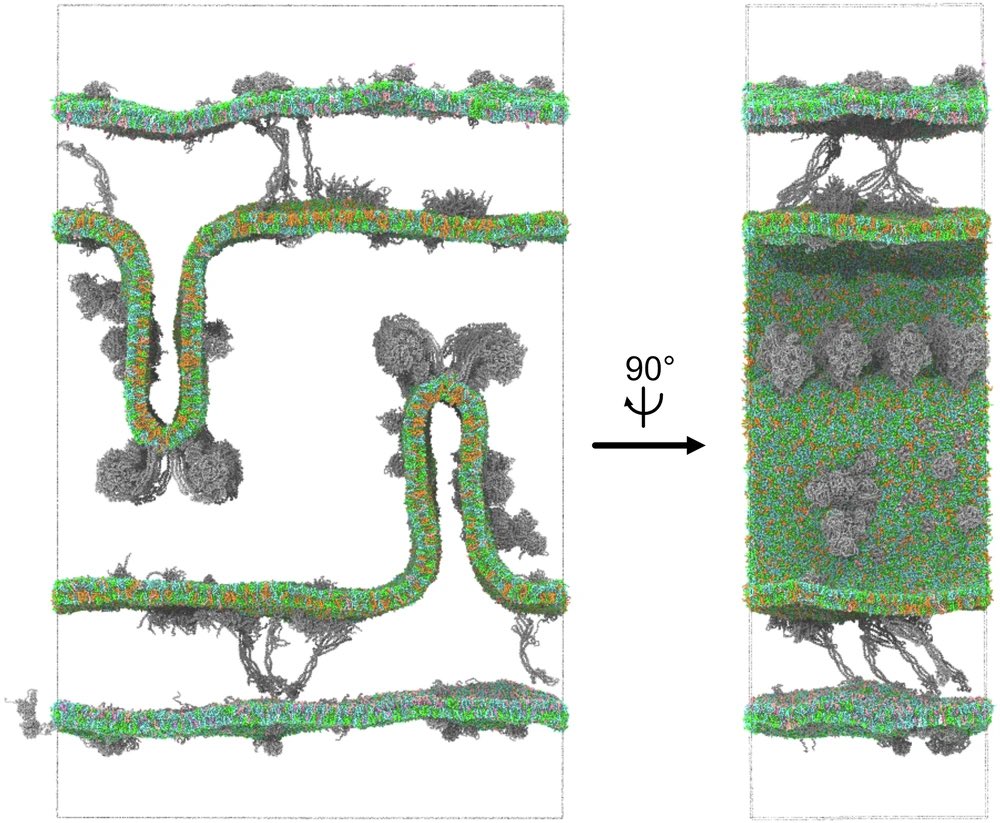
Textbooks still teach that mitochondria transform energy. A few months ago, a team finally modeled a fully resolved crista at atomic resolution: not a sketch, not a cartoon, the true geometry… and it quietly rewrote the field. Here’s what they caught: When the fold sharpens, it becomes a proton drop-tube, and curvature concentrates charge: Steeper walls → higher H⁺ pressure → a larger quantum jump downward. Nothing is created or transformed, the charge was already waiting. The angle is what lets it fall. And when the fold dulls: • the slope collapses • the field weakens • proton jumps shrink • metabolism limps even while your ATP numbers still look “normal.” The part almost nobody knows is this: in these new simulations, the electric field at the crista neck spikes up to 3× higher: not because of enzymes, but because curvature traps charge like a funnel and the textbooks never show this. Which leads to the real killshots: 1. Protons don’t travel: they tunnel between allowed states. Curvature sets the jump-length. 2. Geometry shifts first. Chemistry reacts second. Redox is just the readout of topology. 3. “Energy flow” is simply resistance disappearing. That’s why people crash: You don’t get tired because mitochondria “make less energy”, you get tired because your angles flattened, your terrain smoothed, and there’s no gradient left for protons to fall through. Health is steepness. Fatigue is the loss of it. You never ran on ATP, you ran on angle.
Yungkingmito tweet media
English
66
206
1.1K
64K
Andrew Dickson
Andrew Dickson@xordrew·
@ZoldenGames Whoa, I think I remember seeing this on reddit when you first developed it?
English
0
0
0
54
Zolden
Zolden@ZoldenGames·
It's on Steam, if you are interested. But keep in mind, it was my first game, I was not very experienced game designer back then. Sometimes it's annoying. Sometimes you'll rage quit. Remember, you can refund if you won't enjoy it. store.steampowered.com/app/593530/Jel…
English
6
0
51
2.8K
Zolden
Zolden@ZoldenGames·
I released my first physics based game about 8 years ago. It was like realtime Scorched earth with physics. It was brutal.
English
50
49
1K
75.5K
Andrew Dickson
Andrew Dickson@xordrew·
@kalomaze It genuinely does tell you a lot about generality though. E.g. the algorithm achieving lowest Kolmogorov complexity on a dataset is very close to the one that achieves lowest testing set loss for any training set prefix.
English
0
0
1
19
kalomaze
kalomaze@kalomaze·
most damningly this school of thought tells you nothing about generality. i don't think the "is" variant of this belief is at all defensible as a core philosophical position. intelligence *involves* compression, sure. to say that it "is" compression is... what?
English
6
0
68
2.5K
kalomaze
kalomaze@kalomaze·
i really dislike the phrase "compression is intelligence" on its face. thought terminating cliche. i specifically HATE kolmogorov complexity when it's used as a kind of "theory of everything"
English
52
10
324
36.2K