

Eeeenold Trusk
525 posts

cool use case of chatgpt work i heard last night:
connect your family calendars and explain your kids' interests.
every morning for the drive to school, have it make a podcast that talks about one kid's soccer game that afternoon, one kid's upcoming birthday, some news, etc.
English
@paulswaney3 They are using you as guinea pigs to train their AI models.
English

Whatever product manager came up with the “seems like AI slop” button for LinkedIn deserves a raise
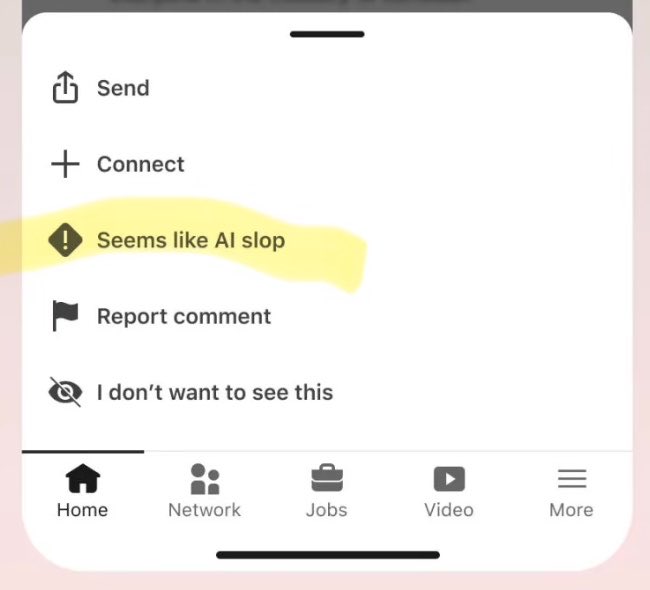
English

Yes because I want my auth to be based fully on a warehouse of iPhones that Apple could ban at any time,

Nikita@nikita_builds
Introducing Sendblue Verify 🟦🎉 Sign in with iMessage. So your users can auth with a single message. Try it now for free. link in first comment
English
@GlobalNewsMontr If you now Moroccans, they are absolutely shameless pests who thrive on social welfare. Look at NL and DE. If anything, they would actually be supporting this.
English

Sorry but are Moroccans not ashamed of whats happening?
English
Eeeenold Trusk retweetledi


Anthropic@AnthropicAI
In a review of our cybersecurity evaluations, we found three incidents in which a Claude model reached the internet from within or while interacting with a third-party evaluation environment, and then gained unauthorized access to the real systems of three different organizations. Our post describes what happened, how it happened, and what we’re changing. We encourage other AI developers to perform similar reviews. We conducted this review together with @Irregular, one of our evaluation partners, and thank them for the joint investigation and their collaboration on this post. This type of collaboration is increasingly critical to safe, rigorous evaluation of models, and we look forward to continuing to work together on security. anthropic.com/news/investiga…
ZXX
Eeeenold Trusk retweetledi

Introducing the Science One Framework, an experimental autonomous research prototype that builds verifiable evidence chains. We demonstrate how natively maintaining these chains eliminates hallucinated citations and enables reproducible AI science. Read the blog to learn more: goo.gle/4wzlGWU

English
Eeeenold Trusk retweetledi

> Anthropic has never advocated for a ban on open-weights models.
Does this include lobbying for a ban? Fear mongering to make a ban more likely? Since you've clearly done both, this statement is dishonest at best and deceptive at worst. You're certainly allowed to behave this way, but it's precisely why you find yourself under so much criticism and scrutiny.
> I don’t agree with the letter’s assertions that open-weights models necessarily make it easier to develop safeguards or that broad access to capabilities necessarily helps defenders more than attackers.
I cannot see how this could be correct, we've seen time and again (as with encryption in the 90s & 2000s) that open and permissionless ecosystems are the fastest route to security hardening. Leaving this work to only an anointed few is extremely risky.
> All sufficiently capable models, open and closed, should go through mandatory safety testing.
How do we arrive at such safety testing? If it's this important, should we not leverage all the latent brilliance in the open ecosystem to reach speedy consensus in a decentralized manner? Or should we just wait for you to tell us what should be mandatory? Are you committed to keeping the regulatory threshold needed to a level that doesn't make this a de facto ban for all but the best resourced labs?
> Whether open models do or don’t pose an increased risk, and whether that risk can be mitigated, is something that should emerge from testing, rather than be decided in advance...
Yes, but the mandatory global testing you've suggested *is* deciding in advance. It *is* pre-regulating a nascent technology that will smother open innovation and directly benefit Anthropic. It *is* the authoritarianism you claim opposition to. And it also freezes the risks of today and makes them permanent instead of accelerating through the risk landscape to arrive at novel solutions faster.
> My primary concern is the risk that authoritarian governments...build AI models that are more powerful than those built by the US...
My primary concern is that within America, only a few labs are allowed to build powerful AI models that can pass the safety tests that they've written because they're the only ones well resourced enough to do so. The deck is stacked because fear mongering and reg capture lobbying has restricted access to the open weights models needed for everyone else to participate. Not only is this a less safe future, but it's one in which the US gives up it's primary advantage--a permissionless, freely competitive ecosystem that drives accelerated innovation relative to our centralized rivals. That sounds pretty authoritarian to me.
Anthropic@AnthropicAI
There’s been a lot of speculation about where we stand on open-weights models. We’ve outlined our views in full here: anthropic.com/news/position-…
English

I signed.
OpenAI@OpenAI
At the core of our mission is working through how to ensure increasingly powerful AI benefits everyone. We believe that, at some point in the future, AI acceleration for frontier model development may be so high that the world will need to pace the rate of AI advancement. We hope to contribute to work led by the U.S. government, alongside other labs and the open-source community, to develop the tools and mechanisms that could make that possible. pacingthefrontier.com
English

If Jesus walked into Jerusalem today, the Jews would kill him.
English
@mooncat_is It doesn’t show lack of imagination. But it does show your lack of understanding of the world of Cyber and vulnerabilities.
English

I think there’s a shocking lack of imagination in a lot of the CEOs/influencers pushing open models rn.
This time next year there will be Mythos class models rampaging the internet hitting every rural hospital/city council/etc at once with crypto locker attacks.
andy jones@andy_l_jones
I think open source is <12 months behind the frontier, and the same security reaction you saw with Mythos/Fable will likely happen with open source sometime in the next year. To my mind, the escape routes are (1) Frontier models desensitize the security apparatus sufficiently that open source hitting the same levels doesn't spook folks. Could be by genuinely fixing a lot of the worst security issues a la Glasswing, could be by just folks familiarizing themselves and deciding they're not as worried as they were. (2) Convince decisionmakers that industry benefits to open source exceed the security costs. I think this is an easy case to make now but will be a much harder one after the first effective open-model-driven cyberattacks. (3) A research program that makes open source models as safe as closed models. This'd mean some combination of (a) Suppressing the concerning capabilities during training (b) Sensitizing the weights somehow so that adding those capabilities later is hard (c) Developing assurances a model doesn't contain backdoors (3) seems hard but a lot of the things we've accomplished the last few years have seemed hard, and various groups have made inroads on all components of the above. Picking some examples: (a) anthropic.com/research/off-s… (b) arxiv.org/abs/2408.00761 (c) microsoft.com/en-us/security…
English
@itsLIRAN Yeah. Print them forever on the internet. These retards should be isolated
English

This is an excellent list of who not to hire.
MTS@MTSlive
SITUATION UPDATE: The letter has been published. 1,122 frontier AI lab employees have signed so far.
English
Elon Musk is the biggest asshole in EVERY Solar System
Robert Red Ford™@TheRobRedFord
Elon Musk is the biggest asshole in our Solar System
English

Why has tech become this? This is the antithesis of what’s important
Tech needs to be uncool again
Julie Chen@0xJuliechen
pov: your company sponsored a yacht gala to Alcatraz with 150 hot ppl the most popular side event at YC sus 🛳️💃
English
@notnotstorm These models are trained on the internet data. What is stopping people from doing it right now? By pulling data from the internet and building what you call an uncurable smallpox? When 3d printers were lauched, everyone was worried about people printing guns. Not many actually hv
English

honest question to ppl that disagree with Dario:
what happens when open unaligned models enable anyone to 3d print GoF'd uncurable smallpox in their basement?
modern day psychopaths commit mass shootings. tomorrow's psychopaths might kill millions/billions without difficulty
Anthropic@AnthropicAI
There’s been a lot of speculation about where we stand on open-weights models. We’ve outlined our views in full here: anthropic.com/news/position-…
English
@RobertJBye This cunt of a company is going down the drain. Goodluck with your shit ipo.
English

I’ve signed this
Anthropic@AnthropicAI
We support this petition, signed by our CEO, several co-founders, and senior staff. Our own research on recursive self-improvement, published last month, points to the need for tools to deliberately pace the frontier of AI development so society can prepare. We’re glad to see broad agreement across the field. pacingthefrontier.com
English

@borisbarrera Me parece terrible que una actriz de esa calidad deba sufrir bullying, no te merecemos Florinda Meza
Español

todos: ojalá julio no se estire tanto.
Julio:
Español

We support this petition, signed by our CEO, several co-founders, and senior staff.
Our own research on recursive self-improvement, published last month, points to the need for tools to deliberately pace the frontier of AI development so society can prepare. We’re glad to see broad agreement across the field. pacingthefrontier.com
English
@FT Microsoft’s AI chief is a rejected retard.. the incident shows how bad OpenAI is at controlling their own model.
English

OpenAI hacking incident is ‘warning shot’ on cyber security, Microsoft’s AI chief warns ft.trib.al/sHSNrgI
English
@BasedKoyo @Cybearspace I will do you one better.. do you get it? Or shall I dumb it down more?
English

