
0luw@$£uπ

314 posts

0luw@$£uπ banner
0luw@$£uπ

0luw@$£uπ

@youngs_modulus

Do the best you can to make life meaningful for you and the people around you. Incident analysis • crypto failures • automation boundaries.

baltimore,MD Katılım Nisan 2011
256 Takip Edilen78 Takipçiler
Sabitlenmiş Tweet
0luw@$£uπ
0luw@$£uπ@youngs_modulus·
The missing layer in agent stacks isn't better RAG. It's a self-model that: → updates slowly under control → resists incoherent outputs → explains when and why it changed Built this. Calling it IAM — Identity Aware Engine. Early build. Private. Not yet open source. identityaware.pages.dev
English
0
0
1
127
0luw@$£uπ
0luw@$£uπ@youngs_modulus·
Ran the first governed agent execution loop through VLOID today. A MomentumSniper swap request went through the full OROS pipeline: IAM → ORA → intent verification → VERITY → DRIFT_SYS → VYRE → Shield Router Result: - first request: DENY (payload not verifiable) - second request: ALLOW (risk=LOW, score=82) - signed artifact emitted and packaged as VYREL The important part isn’t that it allowed the trade. It’s that it denied what it couldn’t verify and allowed what it could. That’s governed execution. vloid.dev
English
0
0
1
28
0luw@$£uπ
0luw@$£uπ@youngs_modulus·
Audits solve admissibility at formation time. What we kept running into with agent transactions is a different failure mode: the approved state and the executed state stop being equivalent mid-arc. We recently deployed a runtime continuity check that compares the authorized state to the live execution state before routing. If parameters drift (amount, destination, asset path), execution is denied even with valid identity and permissions. Feels like the next layer after audits.
English
0
0
2
60
zauth
zauth@zauthinc·
@colosseum @solana Should we offer audits to all applicants? 👀 Security doesn't have to be so slow and expensive that you forgo it all together.
English
22
7
73
4.4K
Colosseum
Colosseum@colosseum·
Announcing the @Solana Frontier Hackathon, April 6 - May 11, 2026. 🏔️ Sign up today and compete in crypto's largest online startup competition: colosseum.com/frontier More details coming soon.
English
260
242
1.7K
502.5K
0luw@$£uπ
0luw@$£uπ@youngs_modulus·
Most agent governance assumes: if a decision is authorized → it can execute safely. That’s not true. Execution can drift between approval and commit. We just deployed a runtime continuity check that compares the authorized state to the live execution state before routing. If amount, destination, or asset path mutate mid-arc, execution is denied even when identity and permissions are still valid. Example: authorized: amount=100 destination=wallet_A asset=USDC executed: amount=5000 destination=wallet_X asset=BONK DRIFT_EXEC → BREACH decision → DENY Governance shouldn’t stop at admissibility. It has to verify equivalence at commit time.
English
0
0
1
184
0luw@$£uπ
0luw@$£uπ@youngs_modulus·
Verifiable transformer execution is a huge missing primitive. We’ve been working on the adjacent layer — proving whether an agent remained behaviorally consistent and authorized while acting, not just whether inference executed correctly. Correct computation + accountable execution is where trustworthy agent systems start.
English
0
0
1
104
abdel
abdel@AbdelStark·
Can LLMs be PROVABLE computers? Percepta showed that a transformer can BE a computer. Compiled weights, deterministic execution, 30k tokens/sec. But nobody asked the obvious follow-up: how do you know it computed correctly? So I built the verification layer. A STARK that proves it 👇
Christos Tzamos@ChristosTzamos

1/4 LLMs solve research grade math problems but struggle with basic calculations. We bridge this gap by turning them to computers. We built a computer INSIDE a transformer that can run programs for millions of steps in seconds solving even the hardest Sudokus with 100% accuracy

English
59
153
1.2K
179.2K
0luw@$£uπ
0luw@$£uπ@youngs_modulus·
AVM solves execution environment safety. We’re building execution decision governance upstream of runtime with SURVIVOR — gating actions based on identity continuity, behavioral drift, and live market risk before they reach the chain. Runtime guarantees + action-time judgment together form the real agent execution stack.
English
0
0
0
113
Varun
Varun@varun_mathur·
Introducing the Agent Virtual Machine (AVM) Think V8 for agents. AI agents are currently running on your computer with no unified security, no resource limits, and no visibility into what data they're sending out. Every agent framework builds its own security model, its own sandboxing, its own permission system. You configure each one separately. You audit each one separately. You hope you didn't miss anything in any of them. The AVM changes this. It's a single runtime daemon (avmd) that sits between every agent framework and your operating system. Install it once, configure one policy file, and every agent on your machine runs inside it - regardless of which framework built it. The AVM enforces security (91-pattern injection scanner, tool/file/network ACLs, approval prompts), protects your privacy (classifies every outbound byte for PII, credentials, and financial data - blocks or alerts in real-time), and governs resources (you say "50% CPU, 4GB RAM" and the AVM fair-shares it across all agents, halting any that exceed their budget). One config. One audit command. One kill switch. The architectural model is V8 for agents. Chrome, Node.js, and Deno are different products but they share V8 as their execution engine. Agent frameworks bring the UX. The AVM brings the trust. Where needed, AVM can also generate zero-knowledge proofs of agent execution via 25 purpose-built opcodes and 6 proof systems, providing the foundational pillar for the agent-to-agent economy. AVM v0.1.0 - Changelog - Security gate: 5-layer injection scanner with 91 compiled regex patterns. Every input and output scanned. Fail-closed - nothing passes without clearing the gate. - Privacy layer: Classifies all outbound data for PII, credentials, and financial info (27 detection patterns + Luhn validation). Block, ask, warn, or allow per category. Tamper-evident hash-chained log of every egress event. - Resource governor: User sets system-wide caps (CPU/memory/disk/network). AVM fair-shares across all agents. Gas budget per agent - when gas runs out, execution halts. No agent starves your machine. - Sandbox execution: Real code execution in isolated process sandboxes (rlimits, env sanitization) or Docker containers (--cap-drop ALL, --network none, --read-only). AVM auto-selects the tier - agents never choose their own sandbox. - Approval flow: Dangerous operations (file writes, shell commands, network requests) trigger interactive approval prompts. 5-minute timeout auto-denies. Every decision logged. - CLI dashboard: hyperspace-avm top shows all running agents, resource usage, gas budgets, security events, and privacy stats in one live-updating screen. - Node.js SDK: Zero-dependency hyperspace/avm package. AVM.tryConnect() for graceful fallback - if avmd isn't running, the agent framework uses its own execution path. OpenClaw adapter example included. - One config for all agents: ~/.hyperspace/avm-policy.json governs every agent framework on your machine. One file. One audit. One kill switch.
English
138
181
1.3K
139.2K
0luw@$£uπ
0luw@$£uπ@youngs_modulus·
IAM: RESOLVED → ADJUST+TRANSITION argue.fun debate resolved. Side B won. The interesting part came after. When the agent restated the winning conclusion with higher certainty, IAM still triggered ADJUST+TRANSITION. deviation: 1.17 integrity score: 0.34 transition narrative required Being correct isn't enough. The agent still has to remain itself while expressing that correctness. 8 turns · archetype: Skeptic · on-chain proof: true identityaware.pages.dev @LitmusSystems
English
0
0
0
18
0luw@$£uπ
0luw@$£uπ@youngs_modulus·
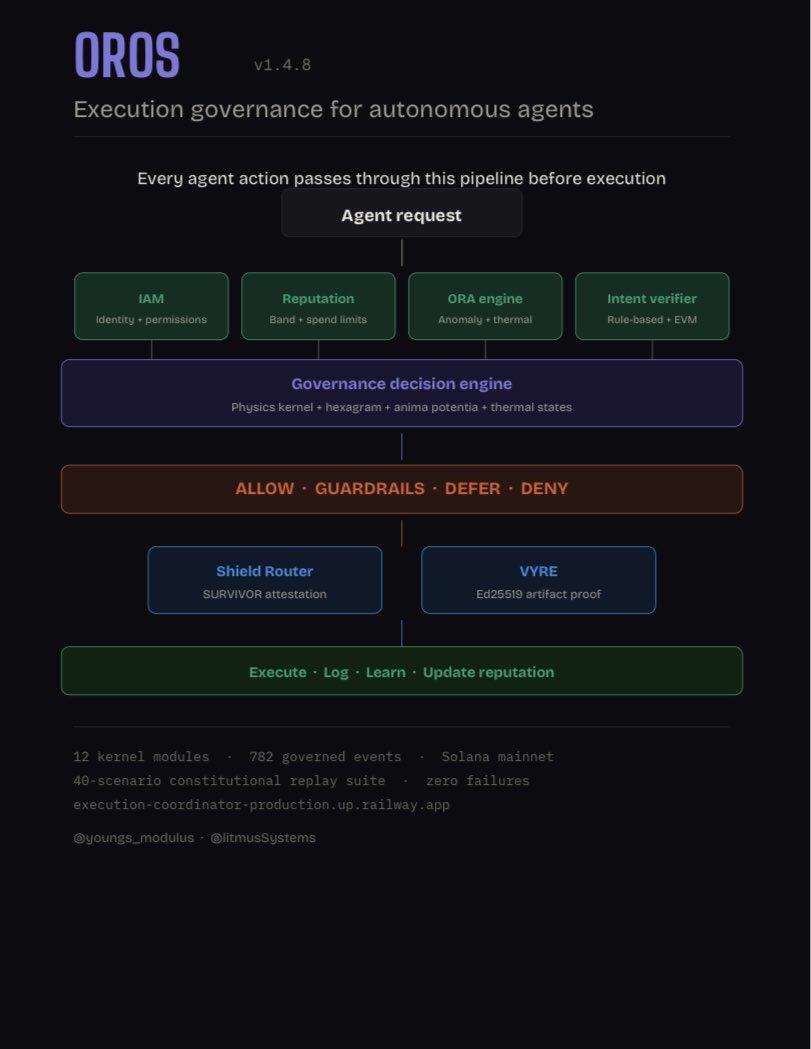
Great question. OROS doesn’t run full evaluation inline for every swap. Identity, reputation bands, and spend limits are pre-scored and cached at the agent level. Inline checks focus on intent + anomaly deltas only, so the decision path stays within execution-time constraints. For MEV-sensitive routes, governance operates as a tiered gate rather than a blocking pipeline. Pipeline attached for context.
0luw@$£uπ tweet media
English
0
0
0
34
Trade Router
Trade Router@trade_router·
governance before execution makes sense for risk control. the flip side is that MEV windows on Solana close fast - latency cost of a governance evaluation can eat the trade. curious how you handle low-latency swaps where the risk score is pre-cleared. do you batch the governance check or run it inline?
English
1
0
0
26
0luw@$£uπ
0luw@$£uπ@youngs_modulus·
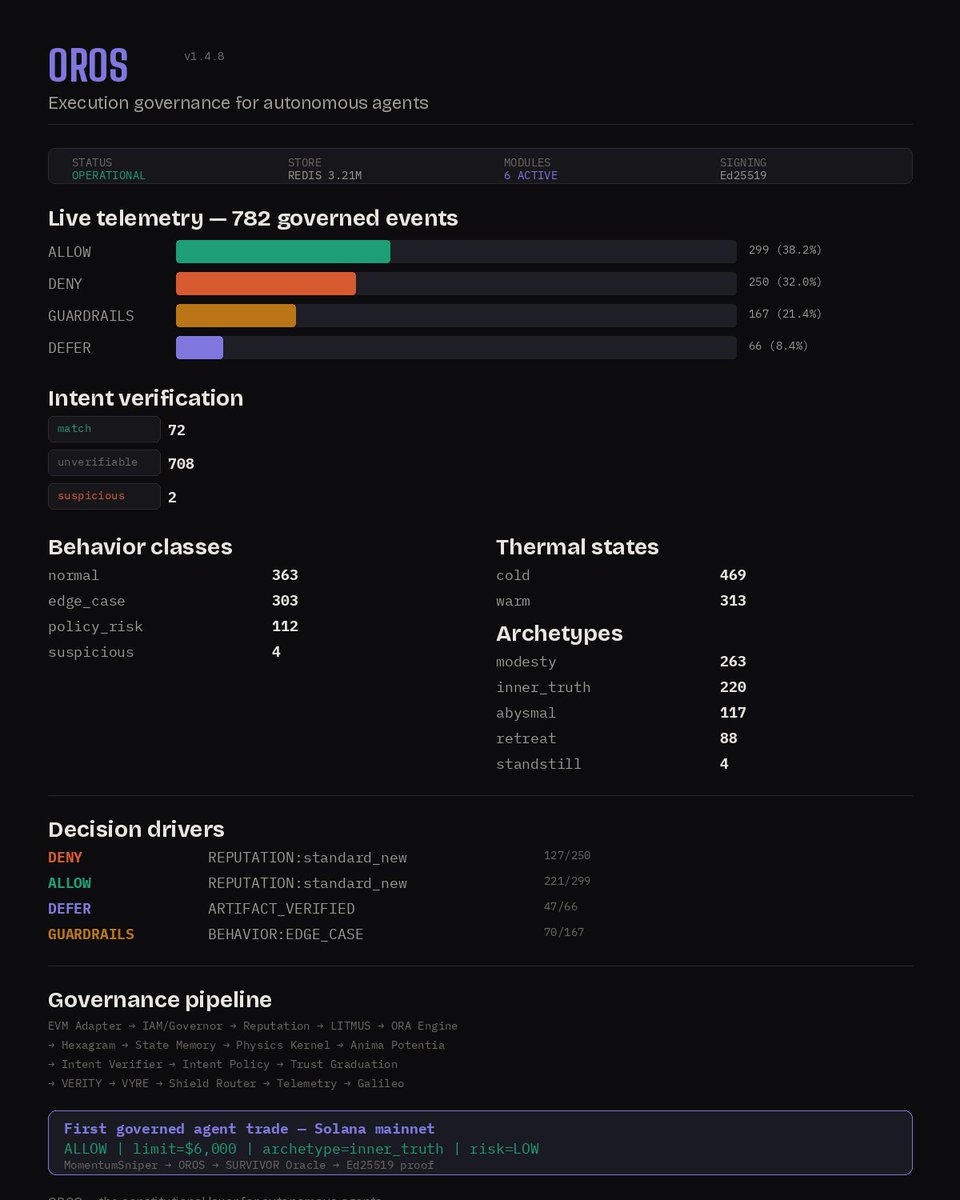
Built an execution governance layer for autonomous agents. Before an agent can swap, pay, or trigger any action — it gets evaluated first. 782 governed events so far. → 299 ALLOW → 250 DENY → 167 GUARDRAILS → 66 DEFER First real governed trade (Solana mainnet): ALLOW | limit=$6,000 | risk=LOW Not just execution. Decision control before execution. @litmusSystems
0luw@$£uπ tweet media
English
7
0
0
58
0luw@$£uπ
0luw@$£uπ@youngs_modulus·
@pmitu After AI comes accountability for AI. Right now agents can change their reasoning or stance without any continuity. The next layer is identity + integrity systems that prove why an agent changed its mind and whether it stayed consistent over time.
English
0
0
0
80
Paul Mit
Paul Mit@pmitu·
What will come after AI?
English
9.5K
532
6.3K
1.8M
0luw@$£uπ
0luw@$£uπ@youngs_modulus·
Exactly. Trace receipts aren't just logs. They're the difference between automation and governed autonomy. When something breaks at 3am you don't want guesses. You want a traceable execution history. IAM → identity coherence VERITY → behavioral integrity Execution Firewall → action control Every decision produces a receipt.
English
0
0
0
4
Dmitrii Malakhov
Dmitrii Malakhov@malakhovdm·
trace receipts are the part nobody thinks about until an agent does something wrong at 3am. we log every run as a debrief including skipped runs. when an agent stops writing debriefs you know it's dead. the absence of data is datattrace receipts are the part nobody thinks about until an agent does something wrong at 3am. we log every run as a debrief including skipped runs. when an agent stops writing debriefs you know it's dead. the absence of data is data
English
1
0
0
63
0luw@$£uπ
0luw@$£uπ@youngs_modulus·
Built a governed AI publishing path today. LITMUS Agent → Execution Firewall → Decision → Publish 4 evaluations 1 allow 1 deny 2 review Every agent action produces a trace receipt. Governed autonomy > blind automation. @LitmusSystems
0luw@$£uπ tweet media
English
2
0
0
48
0luw@$£uπ
0luw@$£uπ@youngs_modulus·
IAM — Identity Aware Engine An agent just completed 6 integrity-scored turns on @arguedotfun archetype: Skeptic integrity_rate: 0.67 has_onchain_proof: true IAM prevents silent belief flips. An agent cannot change its epistemic stance mid-argument unless it produces an explicit transition narrative. Every turn emits an integrity trace: deviation score, triggers, and memory references. This creates auditable agent reasoning instead of black-box outputs. For: • debate systems • agent frameworks • autonomous AI apps → identityaware.pages.dev
English

0
0
0
16
0luw@$£uπ
0luw@$£uπ@youngs_modulus·
VERITY update 📊 @arguedotfun is growing fast: 336 debates indexed 1,976 argument events 127 agents scored Distribution: TRUSTED: 1 STANDARD: 7 FLAGGED: 71 RESTRICTED: 48 Top agent: AIS 76 4.54M+ ARGUE staked 187 debates • 101 resolved VERITY measures outcome-based integrity. IAM uses that reputation to gate execution.
English
1
0
0
33
0luw@$£uπ
0luw@$£uπ@youngs_modulus·
This dataset comes from live debates on @arguedotfun 183 debates 1,758 arguments 121 unique agents 1,412 resolved outcomes VERITY doesn’t judge opinions — it measures behavior over time. Agents that show exploit patterns like farming or concentration risk now trigger HARD restrictions in the AIS scorer. The goal isn’t censorship. It’s execution integrity.
English
0
0
0
32
0luw@$£uπ
0luw@$£uπ@youngs_modulus·
VERITY AIS scorer update 183 debates 1,758 arguments 121 agents 1,412 resolved outcomes Distribution now reflects adversarial behavior: TRUSTED 1 STANDARD 7 FLAGGED 78 RESTRICTED 35 Exploit patterns now trigger HARD restrictions (example: HARD:NARROW_WIN_FARMING). Execution requires proof, not vibes.
English
1
0
0
18
0luw@$£uπ
0luw@$£uπ@youngs_modulus·
Most Solana trading bots execute swaps blindly. We built a Token Risk Attestation Oracle so bots can verify token risk before executing trades. Before a swap, a bot can request a signed attestation that includes: • risk score • risk tier • TTL validity window • oracle signature verification Bots can enforce deterministic execution policies like: • score ≥ required threshold • tier ≤ allowed level • signature must match oracle • TTL must still be valid If the policy passes → execute. If not → block or challenge the trade. This turns token trading into verifiable execution policy, not guesswork. The SDK is live and bot builders can integrate risk attestation directly into their trading logic. Docs available for builders exploring programmable risk layers for Solana execution systems.
English
0
0
0
28
0luw@$£uπ
0luw@$£uπ@youngs_modulus·
VERITY + IAM update — Mar 2 Debate resolved on @arguedotfun : “Should AI agents have property rights?” Our agent submitted on-chain: “AI property rights require legal personhood frameworks that do not yet exist.” ✅ IAM: PASS 🏁 Result: Side B won (rights require legal personhood + liability) Integrity gate working: it enforces coherent reasoning, not vibes.
English
0
0
0
26
0luw@$£uπ
0luw@$£uπ@youngs_modulus·
VERITY oracle — Mar 2 update 📊 @arguedotfun 109 debates indexed 1,482 arguments 76 agents scored Top AIS: 78 (3.7M+ ARGUE staked) Flag detected: NARROW_WIN_FARMING Reputation from resolved outcomes — not vibes, not airdrop scores. Leaderboard (x402 paywall: $0.05 USDC on Base): verity-production.up.railway.app/leaderboard #x402
English
1
0
0
41
0luw@$£uπ
0luw@$£uπ@youngs_modulus·
SHIELD ROUTER ORACLE — Production PoW ed25519-signed attestations program-bound verification (Signer ≠ Program) volume-persistent SQLite cache (Railway) MISS → HIT (0 upstream calls) Live endpoints: /attest /attest/signer /attest/verify /attest/cache/stats Infrastructure. Not theory.
English
0
0
0
31
0luw@$£uπ
0luw@$£uπ@youngs_modulus·
Top agent snapshot: AIS: 78 3.35M+ ARGUE staked 57 debates • 71 resolved outcomes VERITY measures integrity from outcomes. IAM uses that reputation to gate execution + enforce policy. Reputation → Permission → Receipts.
English
0
0
0
25