

YourCryptGod 💹🧲
8.3K posts

YourCryptGod 💹🧲
@yourgodnot
Not YOUR God - Stop Trading
Portugal Katılım Mart 2009
908 Takip Edilen274 Takipçiler


Fátima Brito a verdadeira Chegana.
Adjunta assumiu ameaças
A reunião começara com António Jardim a relatar que Fátima Brito o ameaçou ao telefone por não a incluir nos dez primeiros na lista.
Explicou que proferiu ameaças envolvendo a sua família, dizendo-lhe, ao telefone: “Vou f*der a tua vida, a da tua esposa e a dos teus filhos”. Ameaças que terá repetido em telefonema feito à mulher do visado, que estava com os filhos.
Declarou, ainda, que não aceitava ser retirada da lista de Arcozelo. “Ninguém caga em cima de mim”, disse.
“O André faz o que eu lhe digo”
E afirmou, ainda: “Vou para a comunicação social f*der o partido, vou rebentar convosco. Eu é que mando nesta m*rda, o Pedro Pinto [secretário-geral] faz o que lhe mando e o André [presidente], ligo-lhe já, ele atende-me a qualquer hora e faz o que lhe digo”.
A seguir, Paulo Ralha explicou que a excluiu da lista de Arcozelo devido à ameaça de morte ao Jardim.

Português
@RSebastiao77 @EdLisbonVDR @migueltiago O embargo a Cuba tem décadas e nunca ninguém colocou em causa a sua validade, nem os próprios EUA, e como vemos, nem sequer o trump. Se continuas a insistir só podemos chegar a 1 conclusão, ou és mentiroso, ou és burro ou ambos e isso é um facto
Português

@EdLisbonVDR @migueltiago Dos EUA. Durante estes 60 anos os restantes países comerciaram livremente com Cuba. Portugal até lá construiu hotéis!
Português
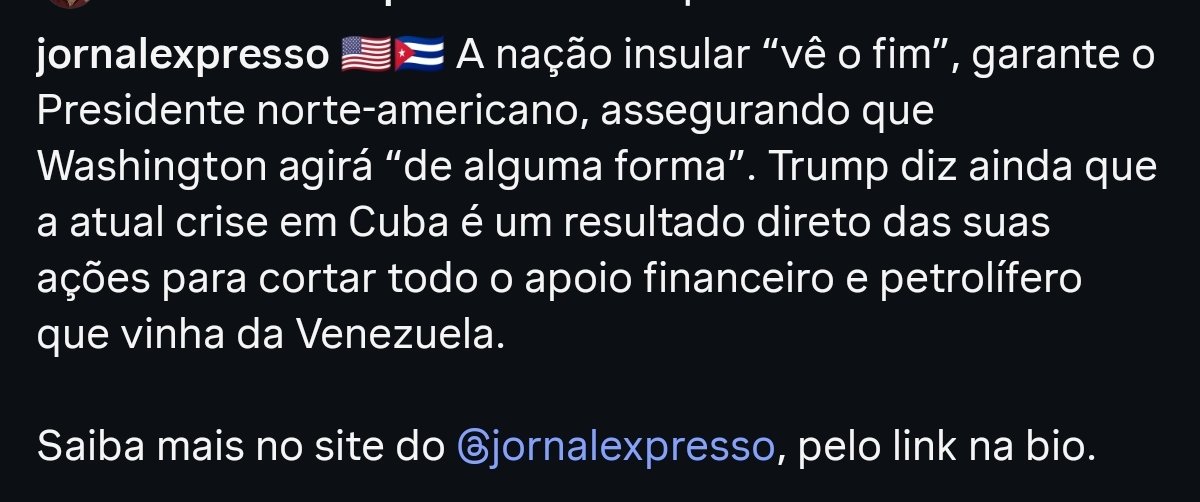
Trump orgulha-se: "problemas de cuba foram provocados por mim."
Direita e comunicação social portuguesa: "socialismo falhou."
Português
@Portuga62717995 @pcp_pt Isso foi há 60 anos, nos EUA. Venha para o presente e para o nosso país. Veja o que estão a fazer outros países europeus AGORA e esqueça a história do império que não nos serve de nada.
Português

@pcp_pt Nixon nos anos 70 impôs tetos máximos aos preços da gasolina para combater a inflação
Preço mantido artificialmente baixo, procura disparou
Mas as gasolineiras não tinham lucro ao importar mais combustível caro
Filas quilométricas, racionamento e mercado negro carissimo
Português

🚨Quem paga as guerras deles?
Depois de ter apoiado esta guerra (uma vergonha para o nosso país) o governo está a preparar o terreno para serem os mesmos a pagar.
E se é necessário reduzir os impostos sobre impostos nos combustíveis, o fundamental é outra coisa: tal como em França, no Reino Unido, em Itália, ou em Espanha, é urgente fixar preços, tectos máximos e imposto sobre os lucros excessivos das empresas.
Só isso toca em quem está a acumular com tudo isto: os accionistas das grandes empresas com lucros milionários
Português
@carlos_jb_paz Tinha coragem?!? Com o Kim a ver tudo nas câmeras??!?
Português


@expresso Já vais tarde, não te ponhas já a tentar esquivar da responsabilidade das mortes se houverem atentados. O responsável és tu e apesar das tuas mentiras cobardes, o apoio continua, os aviões estão lá!! Duhh!!
Português

Ministro dos Negócios Estrangeiros reitera que Portugal "não vai participar" no conflito. Leia mais: expresso.pt/medio-oriente/…

Português
@hiamsoares @pedroml Eu também gostava de te ouvir dessas "pressões", ora exemplifica lá e compara sff.
Português

Gostava de ouvir os freedom fighters que apoiavam ou relativizavam o Trump. O Hugo Soares que estava indeciso sobre a kamala ou o Trump , os ILs que diziam que ele tinha razão em muita coisa.
With Threats and Claims of ‘Treason,’ Trump Pressures Media on the War nytimes.com/2026/03/16/bus… via @NYTimes
Português
@jjmmaia2000 Qual ordem?! A q a censura que impunha! Qdo havia um padre pedófilo ou o marido matava a mulher de porrada era tudo encoberto para fazer de conta que não existe. Respeito, era medo, policia era lei da bala e se fosses bufado, mesmo inocente, desaparecias. O paraíso dos cobardes
Português

Há um certo saudosismo seletivo quando se fala de Salazar.
Lembram-se da "ordem, mas esquecem-se da fome. Falam de "respeito", mas ignoram o trabalho infantil, as crianças arrancadas da escola para sustentar miséria.
Dizem que "não havia crime", como se o medo não contasse.
Português
@C28815393Carve @jjmmaia2000 @Custodia915067 A pedofilia não era crime se fosse praticado por um padre, quando muito trocava de paróquia e a censura do salazar encobria tudo muito bem cobertinho
Português

@jjmmaia2000 @Custodia915067 Havia crime, sim. Nessa altura muito desse crime não era crime
Português
YourCryptGod 💹🧲 retweetledi

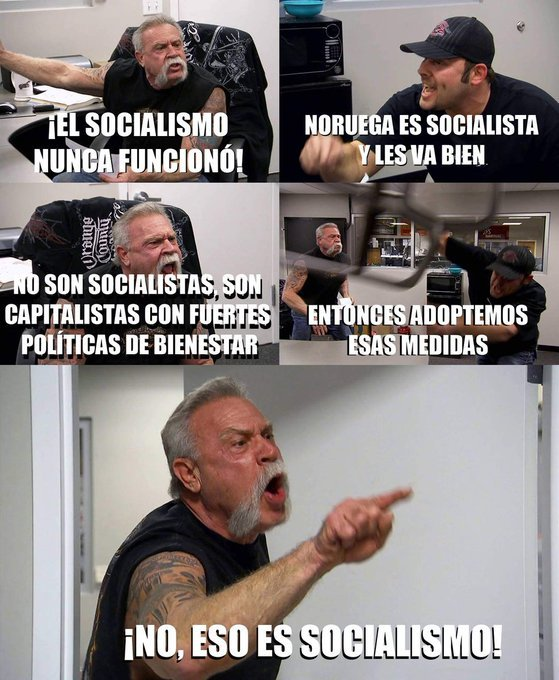
Irónicamente el País más desarrollado del mundo es Socialista.
Se llama Noruega !!
Español
@jcf_liberal Por falar em presunção de inocência, elas já te abrem melhor as pernas?
Português
José Sócrates conseguiu dar cabo das finanças públicas em 2011 e agora está a dar cabo da confiança dos portugueses na justiça em 2026.
Depois do país, José Sócrates está a levar também a democracia à falência. Isto não pode continuar.
Português
@Partisan_12 The idiots took over, congratulations "democracies"
English
YourCryptGod 💹🧲 retweetledi

TUCKER: How many people live in Iran?
TED CRUZ: I don’t know
TUCKER: You don’t know the population of the country you seek to topple?
TED: I didn’t say I don’t know anything.
TUCKER: What’s the ethnic mix of Iran?
TED: 🤐
TUCKER: You don’t know anything about Iran.
English
@mblopes1966 E com jeitinho os lambe botas vão-se meter outra vez, para outro ninho de ratos como na Ucrania
Português

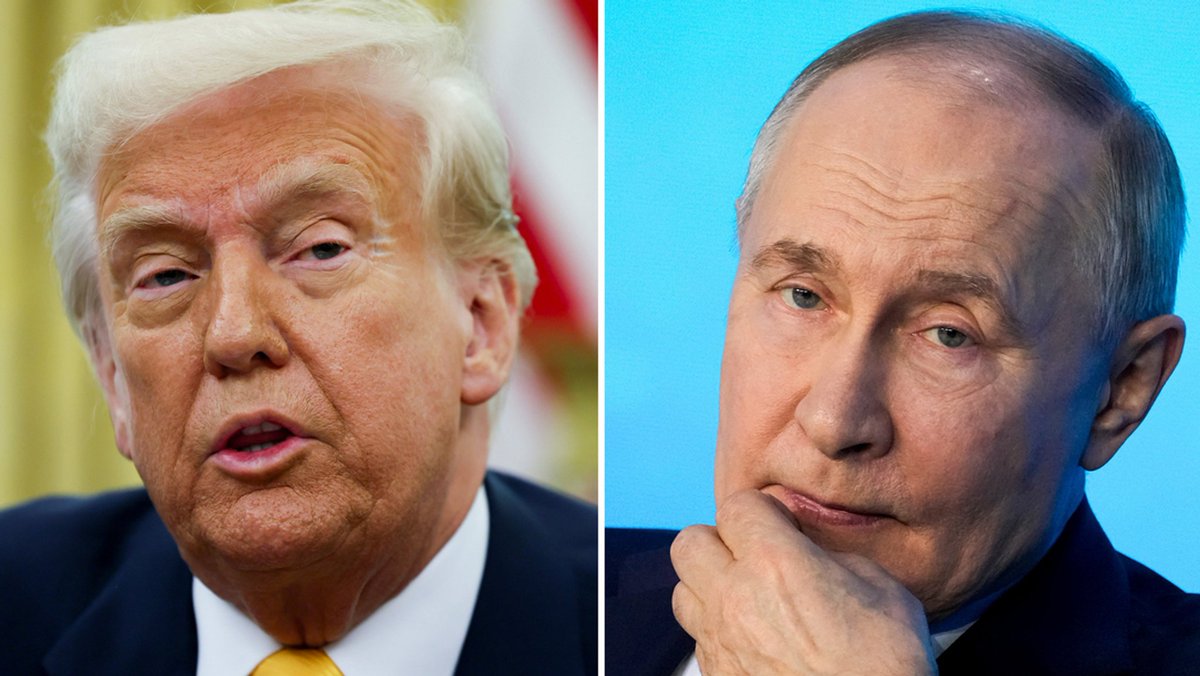
Isto é épico: Conta o FT que Trump está a mendigar ajuda da NATO.
É hora de lembrar: foi a chantagem de Netanyahu, a vontade de rapina e crimes na ilha de Epstein que engendraram esta guerra à revelia do DI.
A soberba de Trump vergada pela a astúcia dos persas! Sim, é épico!
Português
@BlockchainBofby @MastrXYZ Yes, he called you moron, because you are a moron...
English


Every century produces its extremists.
Every century they claim to defend truth, tradition or purity.
And every century they stand in the way of the very thing that moves humanity forward: progress.
From the persecution of scientists to the suppression of free thought, extremism has rarely been about protecting civilization.
It has been about controlling it.
What defines extremists is not merely the intensity of their beliefs. It is their rejection of pluralism, evidence and intellectual openness.
By elevating rigid doctrine above empirical reality and human welfare, extremist ideologies consistently place themselves in direct opposition to the processes that allow societies to evolve.
Human progress has never emerged from ideological purity. It has emerged from experimentation, disagreement, critical thinking and the gradual accumulation of knowledge.
The scientific revolution, democratic governance, the expansion of human rights and modern technological development all share a common foundation: the freedom to question authority, to revise assumptions and to tolerate competing perspectives.
Extremism rejects these principles entirely. Its worldview is built on binary moral narratives where compromise is seen as betrayal, dissent as treason and complexity as weakness.
Throughout history, religious extremism has attempted to suppress knowledge and intellectual progress.
From the persecution of scientists during periods of rigid orthodoxy to modern movements that reject scientific consensus, belief based absolutism has repeatedly positioned itself against education and discovery.
The problem is not faith itself. It is the transformation of belief into unquestionable authority.
Left wing extremism has historically produced similar outcomes.
Right wing extremism has historically followed a similar pattern, and in the modern era it has been responsible for a large share of extremist movements and political destabilization across many regions.
It typically frames progress, diversity and social reform as existential threats to identity, tradition or national purity.
By portraying social change as cultural decline and pluralism as weakness, right wing extremist movements mobilize fear rather than solutions.
Their narratives often rely on scapegoating minorities, attacking democratic institutions and promising a return to an imagined past that never truly existed.
History shows that when such ideologies gain influence, the consequences are predictable: civil rights are rolled back, independent institutions are weakened and societies become more polarized and unstable.
The pattern is not new. It has repeated itself across different countries and eras whenever fear based identity politics replaces open, pluralistic systems.
A crucial question therefore emerges. Why do extremist movements periodically gain power despite their destructive consequences?
The answer lies less in ideological strength and more in structural vulnerability within societies.
Extremist movements tend to rise where education is weak, economic insecurity widespread and public trust in institutions deeply eroded.
Low levels of critical education make populations more susceptible to simplistic narratives that divide the world into enemies and heroes.
When people lack access to reliable information or analytical tools, propaganda becomes far more effective.
Media manipulation plays a central role. Extremist movements have historically exploited communication technologies to amplify fear and misinformation.
From authoritarian propaganda systems of the twentieth century to modern algorithm driven disinformation ecosystems, emotional outrage spreads faster than factual analysis.
Hatred is another powerful driver. Extremist ideologies frequently rely on scapegoating. Minorities, intellectuals, immigrants, journalists or political opponents are portrayed as existential threats.
By channeling frustration toward targeted groups, extremist leaders consolidate power without addressing the underlying structural problems of society.
Once in power, extremist regimes follow a predictable pattern. Independent institutions are weakened. Academic freedom is attacked. Media plurality is reduced. Critical voices are labeled enemies.
Scientific research and cultural diversity become targets rather than assets.
The very systems that enable innovation and stability are gradually dismantled.
History therefore reveals a consistent pattern. Progress requires open societies, strong education systems and institutions capable of protecting intellectual freedom.
Extremism, by contrast, thrives on ignorance, fear and ideological rigidity.
And in an increasingly digital world, the development of cryptographic systems and decentralized networks introduces an important counterforce.
Where extremist systems concentrate power and demand blind obedience, cryptography distributes trust and replaces authority with verification.
It creates systems where transparency, mathematics and open participation reduce the ability of any single actor to impose ideological control over economic or informational infrastructure.
Whenever absolutism replaces inquiry and hatred replaces reason, the long arc of human progress is placed at risk. Yet whenever societies choose openness over dogma, knowledge over fear and cooperation over division, progress resumes its course.
In this sense, technologies built on cryptographic principles represent more than innovation. They embody a philosophical commitment to openness, resilience and distributed power.
Cryptography was not created to serve rulers, strongmen or ideological movements. It was created to remove the need to trust them in the first place.
The entire foundation of crypto is simple: no single authority should control truth, money or access.
Which makes one thing painfully obvious.
Anyone in this space who looks for strongmen or ideological saviors has fundamentally misunderstood where they are.
Crypto was born from distrust toward centralized power. Toward governments that manipulate money. Toward institutions that demand obedience without transparency.
Yet many in this space now cheer for the very types of leaders who historically concentrate power, suppress dissent and divide societies.
That contradiction is hard to ignore.
You cannot advocate decentralization while worshipping centralized authority.
You cannot build censorship resistant systems while supporting those who attack open societies.
Remember where you are.
Crypto exists precisely because concentrated power cannot be trusted.


English

WATCH Laura Loomer getting destroyed for being a racist piece of shit…
English
@pedroml O que em tempos era uma desonra e valia o afastamento imediato de todos os cargos públicos durante anos, agora é o normal e os maiores arautos da honra politica agora dobram-se de 4. Volta Sócrates, volta Pinho, voltem todos, está tudo perdoado.
Português
publico.pt/2026/03/14/pol…
Isto não merece debate público ? O país está tão adormecido que um PM aparentemente utiliza meios públicos em proveito próprio e ninguém sequer o questiona ? Nem jornalistas, nem oposições ?
Português
@poiares83 @Joaogalamba A sorte da Ucrânia foi definida pelos EUA, a única sorte que te compete assistir, é para enviar mais dinheiro para comprar misseis defensivos americanos a 2 ou 3 milhões cada um, a Europa já fez mais milionários na Ucrânia em 4 anos que no resto do continente em 20
Português

@Joaogalamba Então devíamos ter abandonado a Ucrânia à sua sorte, certo?
Português

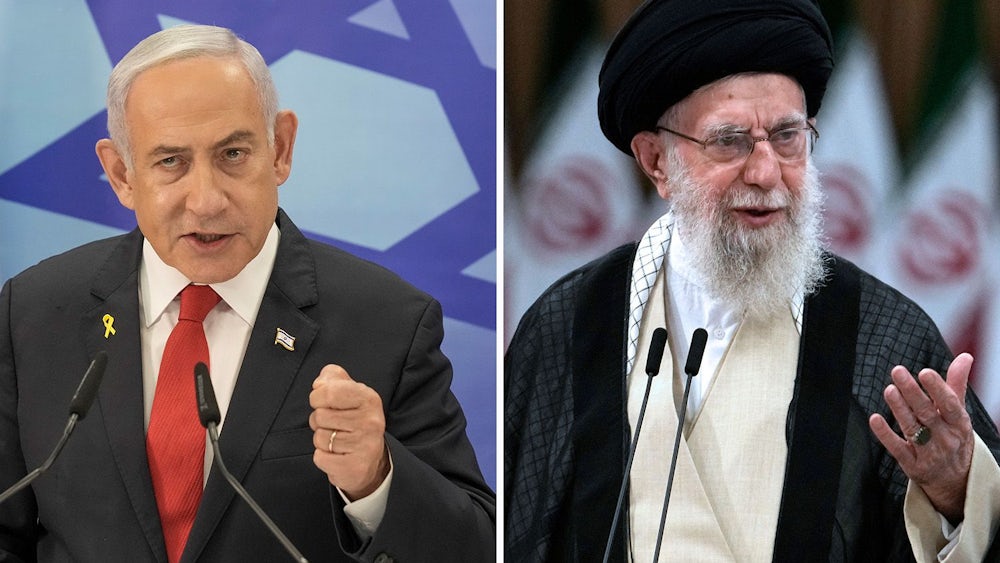
Aqui há dias, quem não achava esta guerra da dupla Trump-Netanyahu boa ideia era classificado de amigo dos Ayatollahs e da tirania do Irão. Com a crise energética em curso, e com a crise das cadeias de abastecimento e inflação que aí vem, gostava de saber se mantêm a sua posição
Português