
Yuval Elani

1.1K posts

Yuval Elani banner
Yuval Elani

Yuval Elani

@YuvalElani

UKRI Future Leaders Fellow & Associate Prof @ImperialChemEng. Biomimetic Technologies, Artificial Cells, Microfluidics, Biotech & Biomembrane Engineering.

London Katılım Nisan 2012
1.4K Takip Edilen1.6K Takipçiler
Yuval Elani retweetledi
Niko McCarty.
Niko McCarty.@NikoMcCarty·
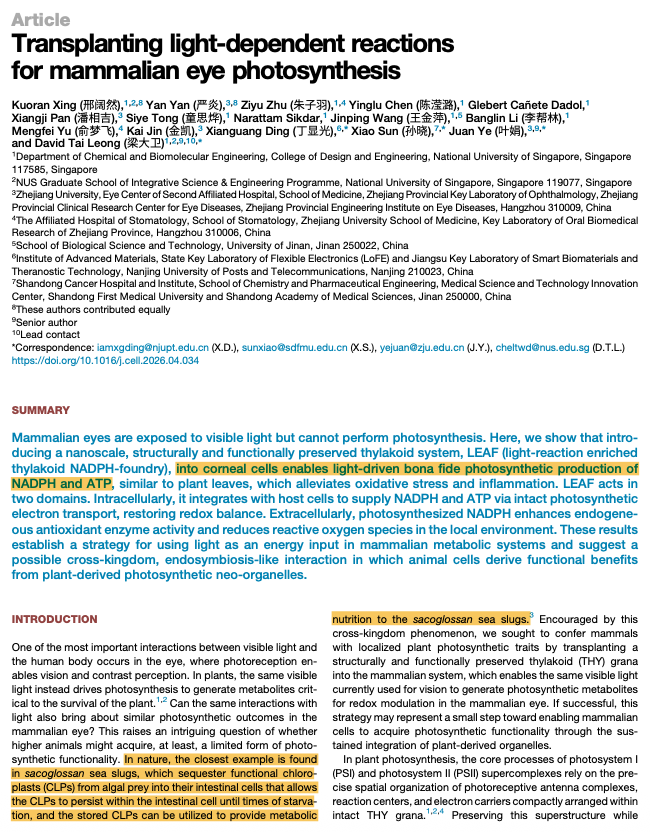
I'm fascinated by efforts to make animals (or parts thereof) photosynthetic. For the latest attempt, published last week, researchers took thylakoids from plant chloroplasts (the little membranes that carry photosystem I and II proteins) and inserted them into the eyes of mice. Specifically, they gave the animals eye drops containing the thylakoids twice a day for five days. The thylakoids went into corneal cells (apparently they are small enough that the cells endocytose them?) and did photosynthesis, making NADPH and ATP from light. This isn't a gene therapy, though; the eye cells cannot make more of these plant enzymes, and so the photosynthesis only happens for about 8 hours before the enzymes are destroyed. Why do this in the eye? One reason is that light doesn't penetrate tissue deeply; maybe a millimeter. Therefore, the eye is one of the few parts of the body that actually gets light exposure. It is also -- maybe equally important -- immune privileged, meaning these plant proteins don't trigger an inflammatory reaction (which would likely happen in other tissues). I'm not sure this paper has any real utility, at least not clinically. The authors say that it does (to help treat corneal injuries, for example) but I think it's just expected for authors to make up claims like this to get published in CNS journals. The more interesting reason to read this paper, I think, is just that it shows light can be used as a direct "metabolic input" in mammalian cells. You can use light to make energy molecules and NADPH, which can then be used by the cell's normal pathways. This isn't the first paper to do stuff like this, either. There is a rich history of (temporary) photosynthetic animals! In 2011, Christina Agapakis & co. injected living cyanobacteria into zebrafish embryos, and it worked. (No developmental impact on the fish.) In 2024, a Japanese team put chloroplasts from red algae into Chinese hamster ovary (CHO) cells, and the chloroplasts apparently survived and did photosynthesis for two days. Biotechnologists have a great ability to harness GENES taken from nature to build useful tools and therapies. We can sequence the natural world, collect genes in databases, and use tools like AlphaFold to figure out what they code for. But our ability to harness entire organelles -- structures crafted over millions of years of evolution, which perform functions that cannot be matched by genes alone -- is severely limited. Animal photosynthesis, and pursuits thereof, might be a useful way to start closing this gap.
Niko McCarty. tweet mediaNiko McCarty. tweet media
English
8
45
243
13.6K
Yuval Elani
Yuval Elani@YuvalElani·
For years SynCell research treated “building life” as modular. Assemble parts, combine + go. But biology, even if synthetic, doesn't behave. Molecular systems engineering may be the solution. We unpack this rethink in our new @NatureChemistry perspective nature.com/articles/s4155…
English
2
0
7
308
Yuval Elani
Yuval Elani@YuvalElani·
For years SynCell research treated “building life” as modular. Assemble parts, combine + go. But biology, even if synthetic, doesn't behave. Molecular systems engineering may be the solution. We unpack this rethink in our new @NatureChemistry perspective nature.com/articles/s4155…
English
4
1
11
487
Yuval Elani
Yuval Elani@YuvalElani·
Thanks to all lab members and collaborators involved, especially to lead author Matt Allen for driving this!
English
0
0
1
142
Yuval Elani
Yuval Elani@YuvalElani·
Hydrogel microparticles make great synthetic‑cell chassis, but they miss a crucial feature: a lipid membrane. We solved this by electrostatically fusing lipid vesicles into the hydrogel meshwork to form a stable, fluid membrane. Out now in @acsnano. pubs.acs.org/doi/full/10.10…
English
1
2
11
478
Yuval Elani
Yuval Elani@YuvalElani·
Big thanks to Marcus Fletcher and Bradley Diggines for being fantastic co-authors on this work.
English
0
0
0
131
Yuval Elani
Yuval Elani@YuvalElani·
We’re looking for a postdoc to join our group @ImperialChemEng to work on genetically encoded synthetic cells that can sense signals, perform computation, make decisions, and respond by modulating their environment. Get in touch + apply if of interest! jobs.ac.uk/job/DOZ224/res…
English
0
2
9
662
Yuval Elani retweetledi
Josie Zayner
Josie Zayner@josiezayner·
Software is easy to engineer and replicate/distribute Life is easy to replicate/distribute and hard to engineer We need to make the hardest part of biotech the distribution not the engineering
Austin, TX 🇺🇸 English
3
1
14
991
Yuval Elani
Yuval Elani@YuvalElani·
Thrilled to share I’ve been awarded a Fellowship from @ListerInstitute. This will support work on biomedical applications of synthetic cells & biomolecular robots over the next 5 years. Huge thanks to Elani Group, collabs, mentors from @imperialcollege & elsewhere for support!
English
8
2
46
2.5K
Yuval Elani
Yuval Elani@YuvalElani·
Latest paper in @acsnano by the brill Talia Shmool: engineered ionic liquid–gold nanoparticles for brain-targeted delivery. Tuning IL chem boosts stability, reduces aggregation & enhances BBB delivery ~10x . My pleasure to have played a small part in this pubs.acs.org/doi/full/10.10…
English
0
1
20
729
Yuval Elani
Yuval Elani@YuvalElani·
New paper out - we show how synthetic cells can be dried, stored & reactivated at the point of use. This helps overcome a key barrier to their use outside the lab, bringing SynCells a step closer to real-world applications. Well done to @Ignacio_Gispert! pubs.rsc.org/en/content/art…
English
1
16
55
3K