Zan Csónakos

2.6K posts

Zan Csónakos banner
Zan Csónakos

Zan Csónakos

@zan_csonakos

Keç û xortên şoreşvan

Katılım Ocak 2018
770 Takip Edilen72 Takipçiler
Zan Csónakos retweetledi
The National Context
The National Context@NatlContext·
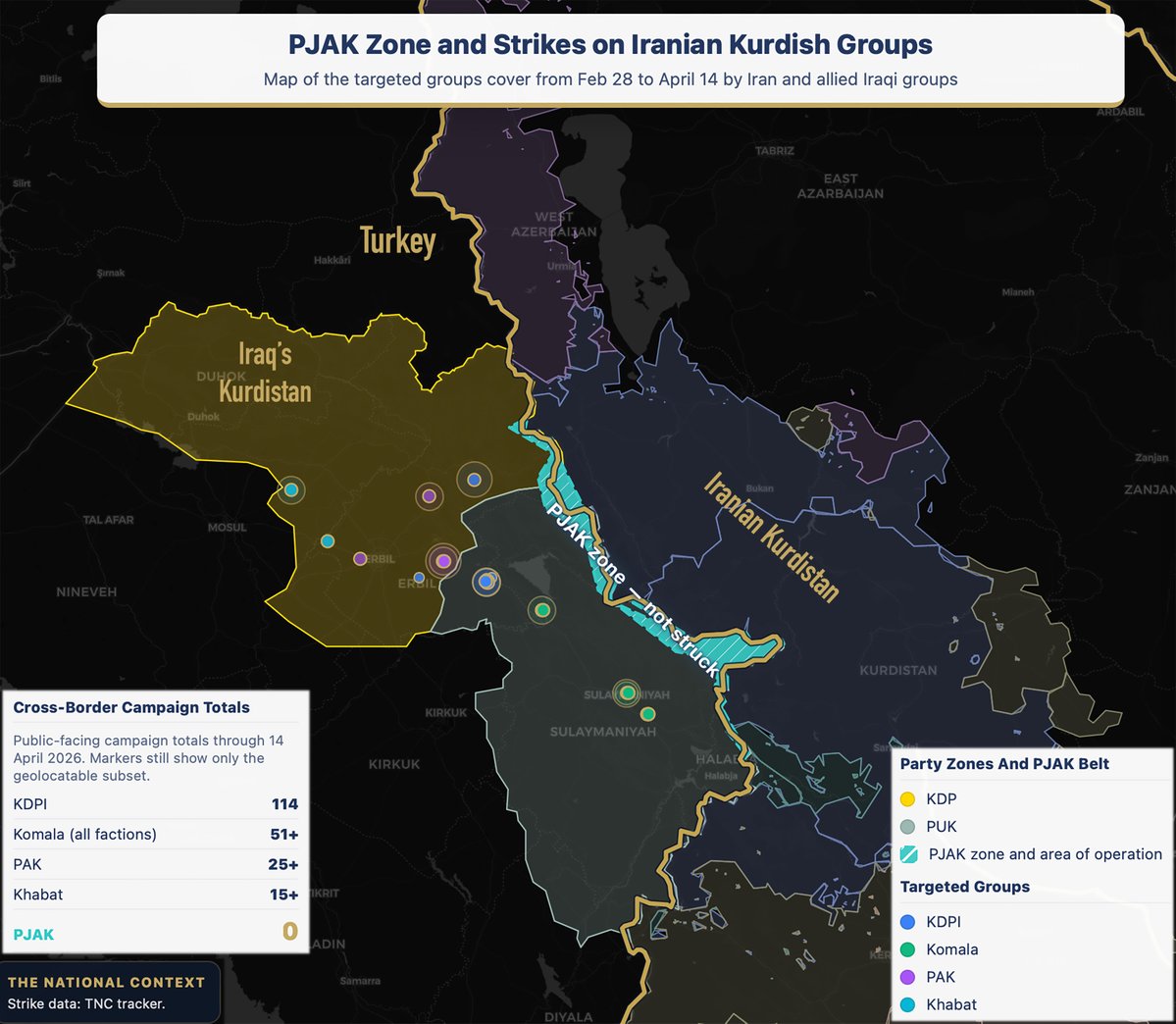
Iran persistently struck the other Iranian Kurdish groups based in the Kurdistan Region, including those whose main presence is now much farther from the border in urban areas such as Erbil and Sulaimani. PJAK, by contrast, remained the one exception. That asymmetry matters. It is one of the clearest indications that the PKK-PJAK file is still governed by a different strategic logic. *** The PKK emerged from an explicitly anti-imperialist, anti-Israel revolutionary tradition in a way that sets it apart from the other Kurdish groups. That does not mean the PKK is ideologically aligned with Iran. It does, however, mean that the two share elements of an anti-imperialist revolutionary ethos and certain overlapping instincts, even if they diverge in ideology, structure, and long-term aims. As a result, the PKK’s political reflexes, strategic grammar, and sense of legitimacy have long differed from those of Kurdish actors more easily drawn into an anti-Iranian alignment backed by outside powers. *** This matters because it shows that the relationship between the PKK and Iran was never simply about avoiding conflict. It produced strategic returns. The rise of Rojava cannot be separated from the broader regional environment in which the PKK had deprioritized confrontation with Iran and, in return, found space opening elsewhere. There was clearly more than mere non-aggression. A durable strategic exception emerged under which both sides found reason, at key moments, to preserve the relationship rather than destroy it, with their shared revolutionary heritage also helping shape a degree of mutual intelligibility between them. *** The relationship also developed material depth over time. This is where the Syrian file becomes crucial. PJAK’s unilateral ceasefire in 2011, just as the Syrian war began, was not a minor tactical coincidence. It coincided with a regional opening in which Iran and the Assad regime effectively allowed Kurdish-majority areas in Syria to pass into the hands of the PKK-aligned YPG in return for YPG neutrality. That was the beginning of Rojava. For the PKK, this was not a marginal gain. It was a historic breakthrough. For the first time since its founding, it was able to consolidate meaningful territorial control through its Syrian arm. So, PJAK is not simply another Iranian Kurdish insurgent group. It sits within a much wider PKK strategic universe whose calculations stretch across Turkey, Syria, Iraq, and Iran. *** That distinction is essential. PJAK does not make decisions on the Iranian file as a standalone actor. Its behavior is filtered through Qandil’s broader priorities, and those priorities now include another major variable: the peace track with Turkey. In other words, the PKK did not stay out of this front for one reason, but for two+. Entering the war would have detonated both of the strategic frameworks that currently sustain its room for maneuver: the Iranian exception and the Turkish peace track. Here is more: thenationalcontext.com/pkk-pjak-iran-…
The National Context tweet media
English
3
8
34
7.3K
Zan Csónakos retweetledi
The National Context
The National Context@NatlContext·
Has the Kurdish moment in Iran passed? As the prospect of using Iranian Kurdish groups as a ground force has receded, so have airstrikes in the Kurdish belt. Kurdish areas accounted for 51.2% of all active strike locations in Week 1 of the war (not all individual airstrikes but all areas bombed at least once within that week). By Week 4, that figure had collapsed to 5.9%, with just 3 locations hit out of 51 nationwide. Capital and Central Iran absorbed the shift: from 22.6% of locations in Week 1 to 60.8% in Week 4. The campaign concentrated on the Tehran belt, Isfahan, Qom, and Yazd. The targeting logic changed with it. IRGC/Basij targets fell from 41 locations to 18. Police from 29 to 12. Intelligence from 17 to 3. Infrastructure and industrial targeting rose from 8 to 14, expanding to steel plants, petrochemical complexes, and fuel depots. New theaters opened late. Khuzestan surged from 2 locations in Week 1 to 14 in Week 5. The Caspian coast went from zero in Week 2 to 7 by Week 5. Two factors likely explain the collapse of airstrike intensity in the Kurdish belt. First, most recognisable and targetable security and regime-linked sites have already been flattened; even though the regime had evacuated most facilities and dispersed personnel beforehand, the physical infrastructure is largely destroyed. Second, the plan to use Kurdish ground forces, which Israel pushed for, appears to have been shelved or at least deprioritised. The airstrikes in the Kurdish regions have largely been attributed to Israel rather than the United States, and as the prospect of regime collapse receded in Israeli assessments, the rationale for clearing internal-security infrastructure in Kurdish areas receded with it. The pivot toward economic and strategic infrastructure targeting, visible in the data from Week 3 onward, reflects that recalibration. More details: thenationalcontext.com/has-the-kurdis…
English
1
4
18
2.4K
Zan Csónakos retweetledi
WarRoom Archives
WarRoom Archives@WarRoomArchives·
Full Go Pro footage of 19 year old Australian Volunteer with the call sign “LUPO” fighting in Ukraine x.com/WarRoomArchive…
English
1K
2.6K
48.3K
2.3M
Zan Csónakos retweetledi
The National Context
The National Context@NatlContext·
Why Iran's Kurds Are the Most Divided Kurdish Population, and Why That Matters Now They speak at least four major dialect groups. They are split along sectarian lines far more deeply than Kurds elsewhere. Kurdish and Persian are both Iranian languages with no sharp linguistic wall between them. And they have lived inside an Iranian state for five centuries. In Iraq, Syria, and Turkey, Kurdish identity confronts Arabic or Turkish across a clear frontier. In Iran, it sits inside a graded continuum of dialect, sect, and civilisation that the state has always found easier to segment and absorb. Linguistically, they are not a compact Sorani-Kurmanji bloc. They are a mosaic. Central Kurdish (Sorani) accounts for roughly 35 to 40% of Iran's Kurds. Southern Kurdish and Laki together make up another 35 to 40%. Kurmanji accounts for about 22 to 27%. Gorani and Hawrami make up a smaller but historically significant remainder. Kurmanji itself is split across radically different settings. The Kurmanji speakers of Khorasan in the northeast are mostly Shia and long integrated into the Iranian state. The Kurmanji speakers of the Urmia belt are overwhelmingly Sunni and tied into the borderland world shaped by proximity to Turkey. Religiously, Iranian Kurds are not overwhelmingly Sunni the way Kurds in Iraq, Syria, and Turkey are. The best estimate is roughly half Sunni, around two-fifths Twelver Shia, and about a tenth Yarsani. The Sunni core is concentrated in the northwest. Kermanshah, Ilam, and Khorasan pull heavily in the other direction. The deepest difference is linguistic. In Iraq, Syria, and Turkey, Kurdish confronts Arabic or Turkish across a sharp civilisational wall: Indo-European versus Semitic or Turkic. In Iran, Kurdish and Persian are both Western Iranian languages with a common origin. The boundary is not a wall but a slope. Lori forms a continuum between Kurdish and Persian. Laki sits near that transition. As you move south through the Zagros, speech forms become less like northern Kurdish and more entangled with neighbouring Iranian varieties. Iranian Kurds have also lived inside an Iranian state framework for roughly five centuries since the Safavid consolidation, not inside a new nation-state barely a century old like Iraq or Syria. Iran is closer to a civilisational state than a standard nation-state, and Kurdish identity inside that frame is old, layered, and in many parts of the country deeply woven into the wider Iranian fabric. All of this is why Kurdish cohesion is structurally weakest in Iran. The divisions are not just multiple but mutually reinforcing: dialect, sect, geography, linguistic proximity to Persian, and centuries of state absorption. In the other three countries, Kurdish identity confronts the state-bearing identity across a sharper frontier. In Iran, it sits inside a graded continuum that the state has always found easier to segment, absorb, and contain. More details: thenationalcontext.com/why-irans-kurd…
English
84
159
695
94.6K
Zan Csónakos retweetledi
Scharo Bajalan
Scharo Bajalan@ScharoBajalan·
Horrible news from Syria - Syrian Government forces have set up flying checkpoints on the Afrin-Aleppo road, asking residents if they are Kurdish and beating them. In Afrin, Tal Rifaat and Al Bab - a manhunt is underway for Kurds celebrating Newroz and carrying the flag of Kurdistan. Kurds are being beaten by mobs of Syrians. Flags are being confiscated and burned. Another Newroz Disaster in Syria - this time by the Government led by Jolani who has been praised for allowing Kurds to have rights in Syria. Eyes on Aleppo, Sheikh Maqsoud - the last Video shows that convoys of Syrians are en route to Sheikh Maqsoud to attack the Kurds whom are currently celebrating Newroz.
English
19
236
470
38.8K
Zan Csónakos retweetledi
Rojhelat Info
Rojhelat Info@RojhelatInfo_En·
One attack every six hours; IRGC increasing strikes on Kurdish parties under the shadow of Iran-Israel war After 21 days from the start of the conflict between Iran and Israel, attacks by Iranian forces and their affiliated proxy groups against bases of Iranian Kurdish parties in the Kurdistan Region have increased. During the first 20 days of this war, at least 120 drone and missile attacks were carried out on these party centers. According to these reports, in the past week, in average, one of these bases was targeted every six hours. As result of these attacks, at least five members of Kurdish parties have been killed. This comes while the IRGC yesterday published a statement asking residents of the Kurdistan Region of Iraq to immediately stay away from several specific areas. According to them, these places are said to be locations of Iranian Kurdish opposition groups. These developments are happening at a time when regional tensions are rising because of the Iran-Israel war, and concerns are growing about the conflict spreading to other areas, including the Kurdistan Region of Iraq.
Rojhelat Info tweet media
English
1
35
93
9.3K
Zan Csónakos retweetledi
ChrisO_wiki
ChrisO_wiki@ChrisO_wiki·
1/ Denmark was reportedly preparing for full-scale war with the US over Greenland in January, with military support from France, Germany, and Nordic nations. Elite troops and F-35 jets with live ammunition were sent, and runways were to be blown up to prevent an invasion. ⬇️
ChrisO_wiki tweet media
English
992
2.7K
12.3K
1.8M
Zan Csónakos retweetledi
The National Context
The National Context@NatlContext·
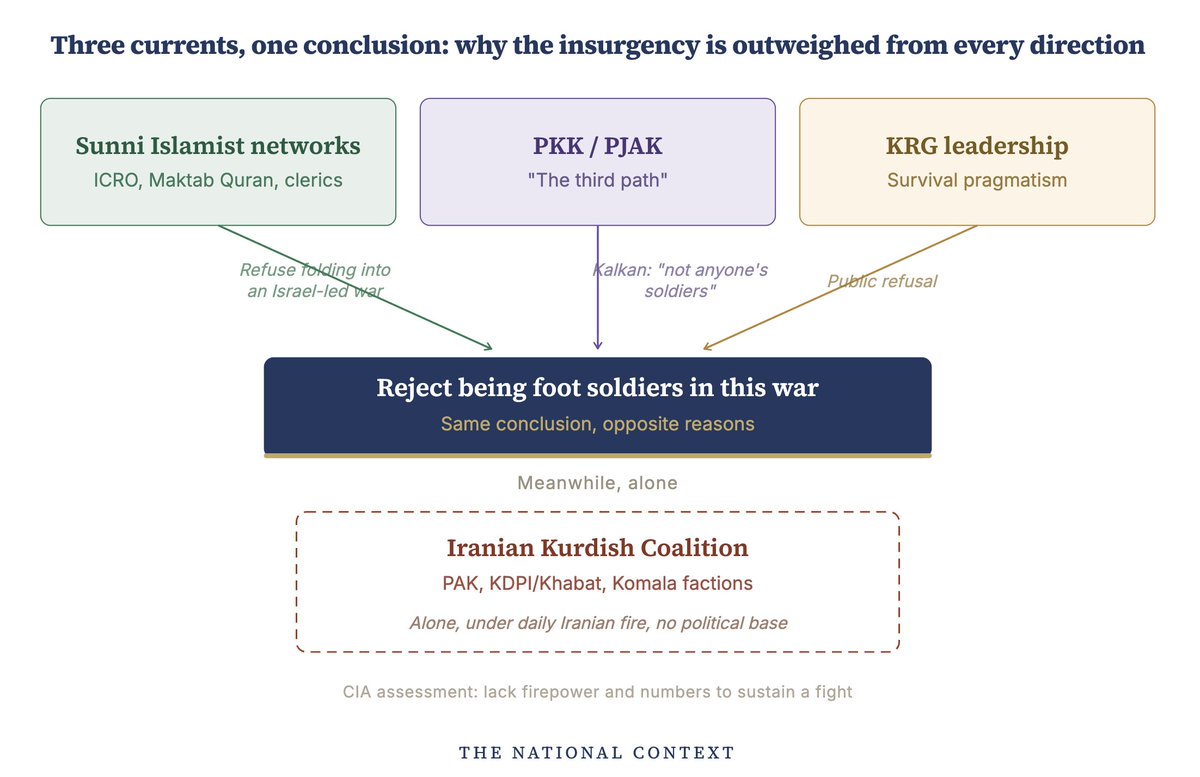
The Iranian Kurdish groups’ push to find relevance amid the US-Israel war on Iran has been running into major structural and demographic hurdles: To the north, Iranian Kurds live next to Azerbaijani Turks, who are a key pillar of power in Iran. To the south, they face more integrated Shia Kurdish communities, where Kurdish nationalist movements have historically had little penetration. What remains is the central belt that forms Kurdistan province, which is largely Sunni and Kurdish. But even there the demographic picture is complicated, because even the usual anti-regime Sunni Kurdish Islamists are now against a war seen as being led by Israel, given the strong anti-Zionist ideology within those Islamist currents. At the same time, the PKK, which operates in its own ideological and operational universe, has described the war as one between an “oppressive Islamist regime” and a wider hegemonic clash. It has told Kurds to stay out of it and follow what it calls “the third path.” Meanwhile, the KRG does not want to serve as a launching pad for these groups and invite even more pressure than it already faces. Here is more on the position of Sunni Islamist Kurds on the war: thenationalcontext.com/why-irans-sunn…
The National Context tweet media
English
5
6
21
2.2K
Zan Csónakos retweetledi
Rojhelat Info
Rojhelat Info@RojhelatInfo_En·
PJAK: The Only Militarily Capable Iranian Kurdish Opposition Force According to a recent analysis published by Foreign Policy (@ForeignPolicy) and written by Denise Natali, director of the Institute for National Strategic Studies at the National Defense University, while various Iranian Kurdish opposition groups have announced their readiness to fight the Islamic Republic and formed new political coalitions, in practice only the Kurdistan Free Life Party (PJAK) has real military capability and modern warfare experience. Natali notes that other Iranian Kurdish groups have not fought in a full-scale conflict since the Iran-Iraq War. Besides limited equipment, they lack strong leadership—many leaders have been assassinated by the Iranian regime—and effective political institutions to provide strategy, build capacity, and sustain efforts. The report emphasizes that Iranian Kurdish opposition is not a cohesive force. The six groups forming the new "Alliance of the Iranian Kurdistan Political Parties" are politically and militarily divided. Against this fragmentation, PJAK stands out as the most active and capable fighting force. Since 2014, about 70 percent of confirmed attacks by Iranian Kurdish opposition groups against the regime have been carried out by PJAK. Natali concludes that while PJAK is only one organization and Kurdish opposition overall lacks unity, in practical military terms, it bears the main responsibility for striking at the Iranian regime’s forces. foreignpolicy.com/2026/03/17/ira…
Rojhelat Info tweet media
English
6
17
69
2.4K
Zan Csónakos retweetledi
The National Context
The National Context@NatlContext·
More Than 50 Confirmed Strikes on Iranian Kurdish Parties in the Kurdistan Region Across at Least Ten Different Sites At least five Iranian Kurdish fighters have been killed. Notably, three of them, one from each of PAK, Khabat, and Komala, are from the town of Saqqez, accounting for 60% of the deaths despite Saqqez being a small city of roughly 200,000 people. Demographically, with the other two from Sanandaj and Ravansar, 100% of those killed are from Sorani-speaking, Sunni cultural backgrounds. Given that this is effectively a randomised sample, it offers a revealing window into the demographics that make up these Iranian Kurdish groups and where their core bases of support lie. The National Context has reported before that the leaders of these parties are also drawn from this same small cluster of towns: thenationalcontext.com/irans-kurdish-… Who has been hit - KDPI has absorbed the most sustained bombardment, with at least a dozen confirmed strikes. The Koya district cluster accounts for the bulk. Azadi Camp alone, which houses KDPI members and families alongside a hospital and weapons depot, has been hit on at least five confirmed occasions: March 1, 3, 5, 6, and 13. Other confirmed KDPI targets include Amiriya camp, where the hospital was hit on March 4 after evacuation; the Harmota training facility, struck on March 6; the Zawi Spi refugee camp, struck on March 12 and wounding three civilians; and positions in the Akoyan Valley and Saraw area, both hit on March 13. No KDPI members have been confirmed killed. At least four have been wounded. - PAK bases have been under repeated attack since the first night of the war. Two bases at Pirde and a facility at Gomaspan were struck on March 2. The Degala base was hit on March 4, killing Jalal Rashidi and wounding three. A further strike on March 6 wounded four at an unspecified PAK base. PAK itself stated its bases had been targeted at least seven times by that point. The confirmed toll is one killed and seven wounded. - Khabat was struck at its Rizgari headquarters on March 5, lightly wounding two. The March 13 drone strike on Bashik killed two and wounded four. The confirmed toll is two killed and six wounded. - Komala factions have been struck at least four times. Komala CPI (Reza Kaabi faction)'s Surdash camp in Dukan was hit on March 6 with no casualties. A separate IRGC missile strike on a Komala CPI headquarters near Sulaimani was reported on March 5, with at least five missiles fired but no casualties. The Komala Party of Iranian Kurdistan (Abdullah Mohtadi)'s Zrgwezala camp was struck by missiles on March 7, killing Ismail Rahimi, and by explosive drones on March 11, killing Omid Feysi. The confirmed toll is two killed and at least two wounded. More and an interactive map: thenationalcontext.com/portal/more-th…
The National Context tweet media
English
6
9
44
4.6K
Zan Csónakos retweetledi
Farhad Shami
Farhad Shami@farhad_shami·
الكرد لا ينتظرون شهادة ميلاد مِمَّن يجهل التاريخ أو يقرؤه بانتقائية. وجودهم في هذه المنطقة حقيقة تاريخية راسخة، ودورهم في حاضرها ومستقبلها لا يُقاس بالافتراضات أو الروايات المزوّرة. وما ورد في تصريحات المبعوث الرئاسي أحمد هلالي يعكس رؤية إقصائية قاصرة لا تنم عن وعي بالتاريخ ولا بروح الوطنية، ولا تسهم في بناء خطاب وطني جامع. المطلوب اليوم ليس إعادة اختراع التاريخ أو تزويره، بل العمل على بناء كيان سوري متماسك يضم جميع أبنائه على أساس الانتماء الفعلي للمنطقة والمواطنة المشتركة، كما كان الكرد في مسار بناء سوريا الحديثة منذ بداياتها وصولاً إلى انتمائهم الفعلي في محاربة كافة قوى الشر كداعش وأخواتها. أما الخطاب القائم على التشكيك في مكوّنات أصيلة من نسيج المنطقة، فهو خطاب عنصري لا يخدم أي مشروع وطني حقيقي، ويقود فقط إلى إضعاف النسيج الوطني بدل حمايته.
العربية
0
138
885
54.7K
Zan Csónakos retweetledi
Rojhelat Info
Rojhelat Info@RojhelatInfo_En·
PJAK Leader Denies Claims of Links with U.S. Intelligence Jiyar Gol @jiyargol, a BBC journalist, interviewed Rêwar Abdanan, a member of the leadership council of the Kurdistan Free Life Party (PJAK), about rumors claiming that Kurdish parties have connections with U.S. intelligence agencies. Abdanan rejected these claims and described them as false. He said that PJAK is a political party and explained that if there were any communication, it would be with governments and official political institutions, not intelligence organizations. He stated, “If there is going to be any relationship, it would be with the U.S. government or other governments in a political framework.” According to him, all communication channels of the party are open for contact with political institutions. Abdanan also expressed concern about the current situation in the region. He said that the lack of a clear plan from the United States to end the war and tensions has created worries among the people of Kurdistan. He also emphasized that any change in Iran must come from the people of Iran themselves, not from a foreign country or external force. The interview took place inside one of PJAK’s long tunnels. According to party members, these tunnels were built to protect their forces from Iranian missile and drone attacks, and so far they have successfully provided protection. x.com/bbcpersian/sta…
Rojhelat Info tweet media
English
1
36
120
6.7K
Zan Csónakos retweetledi
The National Context
The National Context@NatlContext·
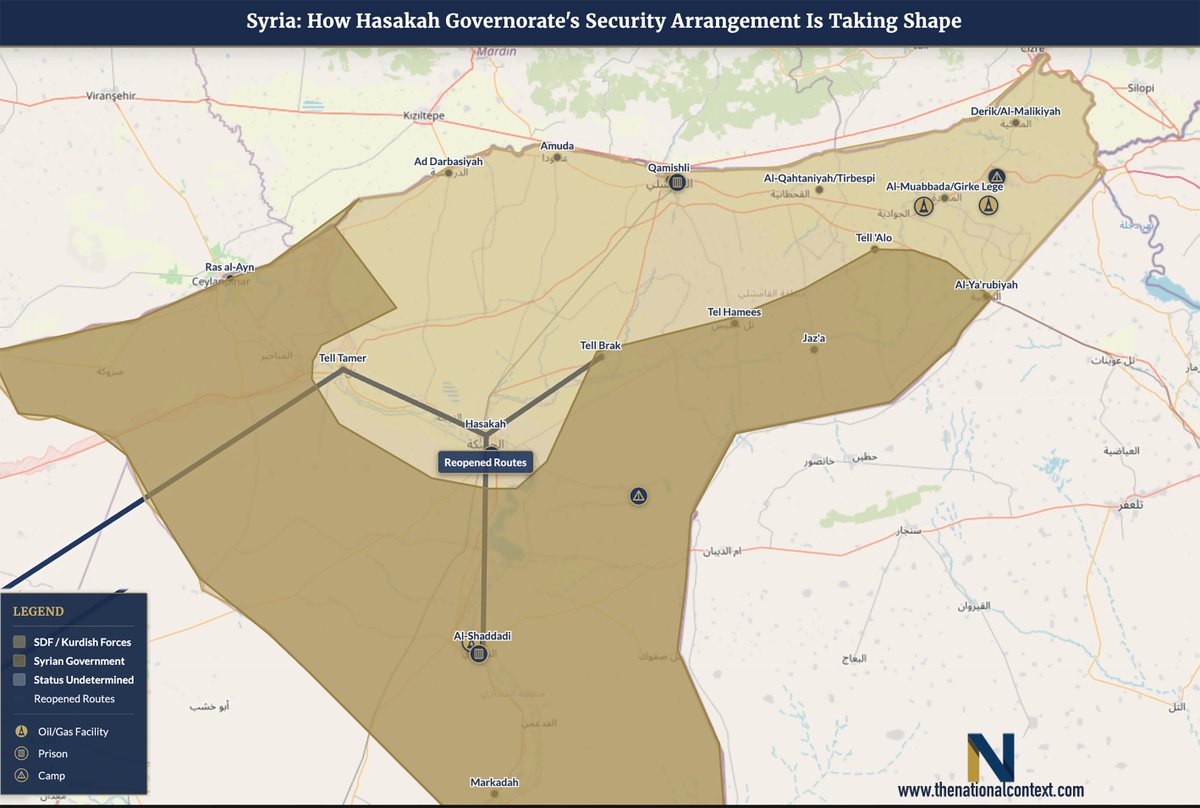
On SDF-Damascus front: Several important developments in recent weeks have made the direction of the SDF-Damascus integration agreement much clearer, even if implementation remains gradual and incomplete. The broad contours of the deal are now becoming visible, and they point in one direction: the SDF may gain influence, positions, and cultural recognition, but from within the Syrian state, not through a parallel structure outside it. The central red line for Damascus appears to be that there will be no separate entity. Any authority the SDF or its affiliated actors receive as part of the agreement is increasingly being framed as authority exercised within the institutions of the Syrian government apparatus, not through an autonomous political or administrative order of its own. That is the key principle now emerging. This is visible in the growing number of SDF-linked officials moving into formal state roles. The SDF side has secured the Hasakah governorship, today gained the position of assistant to the defence minister (given to YPG commander Sipan Hemo), and is expected to receive additional positions in other state institutions, likely including the deputy or assistant to the foreign minister. The pattern is clear: representation is being offered, but only within the Syrian government apparatus. This is also likely the beginning of a broader template. One apparent reason the Syrian government has shown some leniency on this file, beyond the pressure from Washington, is that it may see the arrangement as a model for integrating other minorities as well, especially the Druze. In that sense, what is being worked out in the northeast is not an isolated case but the outline of a wider state approach to post-war minority incorporation. The clearest sign that hard autonomy is being hollowed out, however, lies not in appointments or symbolism but in the fate of the northeast’s core sovereign files. Ilham Ahmed, one of the most senior SDF-linked political figures, recently told Rudaw that the remaining oil fields, the border crossings including Semalka, and Qamishli Airport would all fall under central government control. This is not merely administrative authority but physical control as well. The model she described is one in which people from the region may still be incorporated into these institutions, but as civil servants and employees working within a state-run structure. In other words, locals may remain present, but the authority itself would belong to Damascus. The Syrian government has already deployed its own interior ministry personnel to staff the Qamishli airport, as reported by the official news agency SANA. That distinction is crucial. If the airport, the oil fields, and the border crossings are all physically controlled by the Syrian government, then the basis for any separate hard-autonomy structure is largely gone. Whatever remains would be local influence and representation within the Syrian state, not a separate region with its own sovereign levers. The question is no longer whether the SDF will retain influence. It probably will. The real question is whether it will retain any separate sovereign structure of its own. Control over the border, oil, and airport suggests the answer is increasingly no. The education file points in the same direction. Recent moves by the Syrian education ministry suggest that Kurdish will be introduced as a school subject, not as the language of instruction. That distinction matters. The circular in question refers specifically to preparing curricula for the Kurdish language subject across educational stages, not to teaching the wider curriculum in Kurdish. The emerging model appears to be one in which students in these areas would continue studying in Arabic, like the rest of Syria, while taking Kurdish as an additional class in all grades. That falls well short of the broader Kurdish-medium educational structure the SDF had sought, and instead points to Kurdish language recognition within the Syrian state system rather than a separate educational order. Other developments point toward deeper integration as well. Some of the roads between Hasakah and the rest of Syria have gradually reopened, and similar steps are expected around Qamishli. What remains unclear is who will man these routes and whether residents will still face the restrictions and permit requirements that previously reflected the area’s separate administrative status. If such barriers continue to fall, that would be another significant signal that these areas are being fully reintegrated into Syria proper and that free movement is returning under a single state framework. The same pattern can be seen in the symbolic and institutional sphere. As integration advances, official buildings in Hasakah are increasingly displaying bilingual Arabic-Kurdish signage. In Kobani, the official name endorsed and displayed on municipal and government buildings is now Kobani rather than Ayn al-Arab. These are important cultural and symbolic concessions. They show that the state is willing to absorb some Kurdish identity markers into the new order. But they remain concessions in recognition, not markers of parallel sovereignty. The security file is more complex, but even there the direction appears similar. Kurdish security structures are likely to continue in Kurdish areas, but as forces integrated into the Syrian state rather than operating as an independent apparatus. Taken together, the trajectory is becoming much clearer. The SDF is not simply disappearing, but it is increasingly being transformed from a standalone authority into a bloc operating within the Syrian state. Kurdish actors are gaining positions, cultural recognition, and some local role, but the structure being built does not point to an autonomous entity existing alongside Damascus. It points instead to incorporation into a unitary state framework. One important set of unresolved questions remains: who controls arrests, whether the courts are folded into the Syrian judicial system, and how the chain of command on the ground is ultimately defined. Those issues will determine how deep this integration really goes. Another important development is the start of returns by displaced Afrin residents from Hasakah to their home areas. The first batch, around 400 families, began returning today, with more expected to follow. For Kurds, this is highly symbolic. Families uprooted from their native areas are finally going home. But it also fits the broader logic of the emerging settlement. As Kurdish cultural and linguistic rights are increasingly absorbed into the Syrian state framework, the return of displaced Kurds to places such as Afrin reduces the wartime concentration of Kurdish populations in Hasakah and diffuses them back across their original localities. That does not diminish Kurdish presence in Syria, but it does make the idea of a territorially concentrated separate entity harder to sustain. The overall trajectory, then, is not one of preserved hard autonomy under a different label. It is one of gradual state reabsorption. Kurdish actors may still hold influence, and in some areas meaningful influence, but the decisive levers of sovereignty are returning to Damascus. The border, oil, and airport are the heart of the story. Once those return to central state control, what remains is not autonomy in the classic sense but Kurdish participation within the Syrian state. Within the standards and history of Syria, these are unprecedented gains for Kurds, even if the recent territorial setbacks make them appear otherwise. In a sense, the SDF’s high initial expectations served it well: had it not controlled such a wide territory, the scale of its losses would not have been so dramatic, and the leverage to extract what it has now secured would not have existed. What the SDF has gained is significant in context, even if it falls far short of what it once envisioned. More: thenationalcontext.com/kurdish-gains-…
The National Context tweet media
English
1
33
97
15.7K
Zan Csónakos retweetledi
asli aydintasbas
asli aydintasbas@asliaydintasbas·
An incredibly important interview with Bafel Talabani, a prominent Kurdish leader and son of legendary Jalal Talabani. He says he doesn’t not see signs of regime change in Iran and opposes the idea of pushing Iranian Kurds to fight the regime.
English
68
515
1.7K
256.9K
Zan Csónakos retweetledi
Momen Zellmi
Momen Zellmi@momenzellmii·
Three Factions of #Komala in Iranian #Kurdistan Although they share a similar historical origin and logo, #Komala is currently divided into three distinct political entities with different ideologies and leaderships: 1. Komala Party of Iranian Kurdistan (Abdullah Mohtadi Faction) Commonly known as the "Mohtadi Faction," this is the largest branch of Komala. In 2026, it operates as a national social-democratic force. Under the leadership of Abdullah Mohtadi, their political vision is centered on establishing a federal and democratic system within Iran. They are strong proponents of forming alliances with the liberal and social-democratic Iranian opposition to achieve regime change. Their sphere of influence is primarily among the middle class, intellectuals, and the Kurdish diaspora. They maintain a robust civil organizational network in cities such as Sanandaj, Bukan, and Mahabad. 2. Komala of the Toilers of #Kurdistan (Reza Kaabi Faction) Led by Reza Kaabi, this faction is identified as a national-leftist and socialist wing that emphasizes preserving the independence of Komala’s original discourse. Their vision leans toward the right to self-determination and social justice. Compared to the Mohtadi faction, they are more conservative regarding alliances with right-wing Iranian opposition groups. Their influence is most prominent among laborers, farmers, and those in marginalized rural areas. They hold significant sway in cities like Mariwan and Paveh, as well as border regions, positioning themselves as a centrist force between classical leftism and social democracy. 3. Komala – #Kurdistan Organization of the Communist Party of Iran (Ibrahim Alizadeh Faction) Known as the "Alizadeh Faction," this organization represents the worker-communist and Marxist trend. Under the leadership of Ibrahim Alizadeh, their perspective is strictly class-based. They believe in a "socialist revolution" and the governance of "Soviets" (Councils), while vehemently opposing "bourgeois nationalism" and alliances with non-communist parties. Their influence is mainly concentrated within labor unions, women's movements, and radical student groups. They maintain a deep intellectual impact in industrial hubs and densely populated centers like Sanandaj and Saqqez, as well as within leftist civil organizations, where they are viewed as a radical leftist opposition. #Iran #Kurdistan #Israel #IranWar
Momen Zellmi tweet media
English
6
30
84
14.3K
Zan Csónakos retweetledi
The National Context
The National Context@NatlContext·
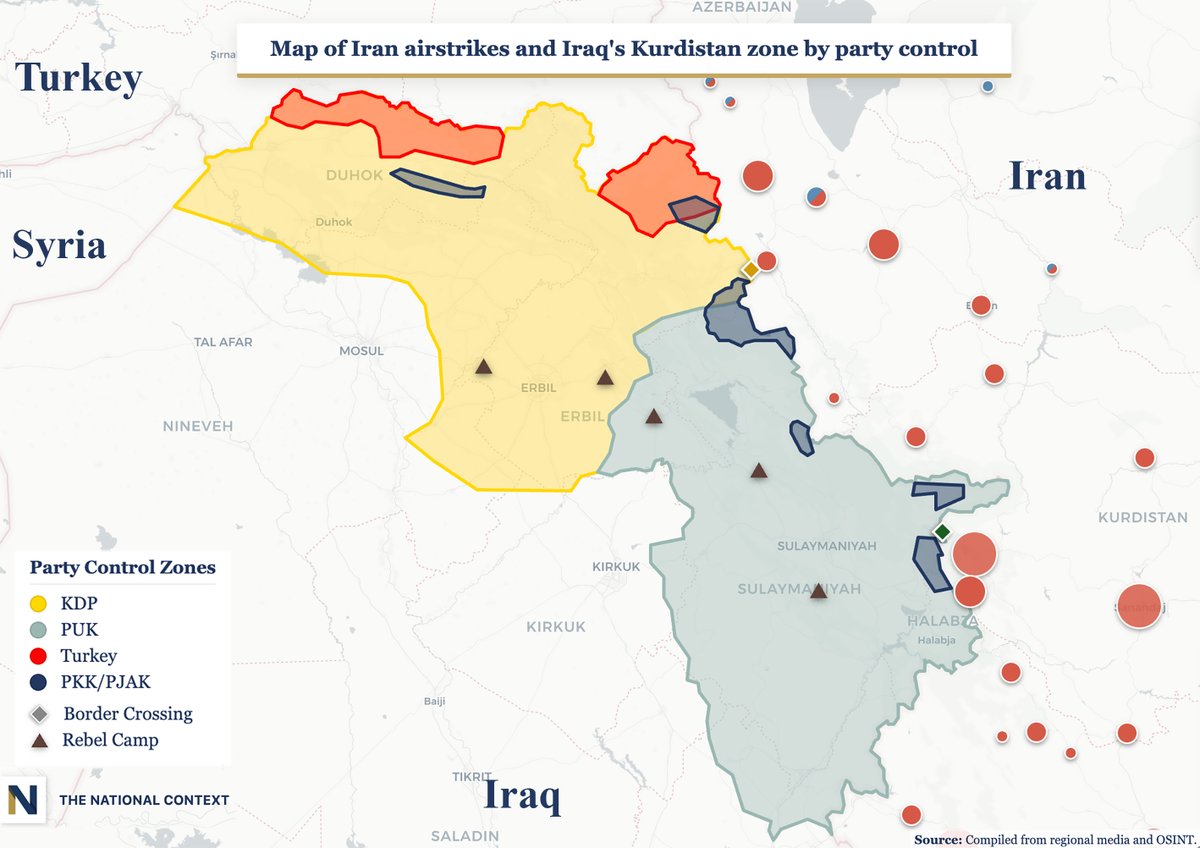
Caught Between Trump and Tehran, the PUK Has Nowhere to Hide The PUK has emerged as a central player in the U.S.-Israel push to arm Iranian Kurdish groups and allow them to use the Kurdistan Region as a launching pad for a ground assault into Iran, but that role also makes it the most exposed actor in the Kurdistan Region and complicates the broader Kurdish landscape. Context: The Kurdistan Region is divided into two zones, each controlled militarily by one of the two ruling parties. While the KDP’s zone shares a stretch of border with Iran, the vast majority of the KRG-controlled border with Iran falls under PUK control. The KDP’s border with Iran, already limited, has been shrinking. A portion in the Sidakan area, in the Iraq-Turkey-Iran triangle, is now controlled by Turkey. Another portion in the Choman district in the Qandil Mountains is controlled by the PKK. What remains is a narrow strip of KDP-held territory bordering Iran, including the Haji Omaran border crossing and a short stretch of land on either side. The PUK, by contrast, shares a vast border with Iran, one that is topographically more suitable for infiltration and for Kurdish guerrilla forces to establish control over a strip of land inside Iranian territory. The PKK is equally important in this equation. It controls its own strip of land in the Kurdistan Region bordering Iran, including territory in the Qandil Mountains, the Penjwen area in Sulaimani province, and the Asos Mountains in between. Together, the PUK and the PKK control the vast majority of the KRG’s border with Iran. The two are politically aligned. Although they have divergent interests and have clashed at times historically, over the past decades they have maintained a close alliance. This is also why the pressure on the PUK is heavier. Trump’s reported message to Kurdish leaders, that they are either with Washington or with Iran and that neutrality is not really an option, hits the PUK harder than the KDP. The KDP has more room to preserve a semi-neutral posture. It is less exposed on the Iran front, hosts two U.S. bases at Erbil airport and Harir, and benefits from stronger air defence coverage. That gives it more plausible cover to argue that it cannot realistically constrain U.S. activity in its areas. The PUK has far less room for that. Complicating matters further, the PUK has forged close political alliances with certain pro-Iran Shia militias in Iraq to help balance against the KDP domestically. Its plan to secure the Iraqi presidency in parliament, for example, relied in part on support from pro-Iran factions. Cooperating with the U.S. push against Iran risks unravelling those alliances. The PUK is also more geographically exposed. Its only international border is with Iran; it borders no other country. The KDP, by contrast, has a much larger border with Turkey and a smaller stretch with Syria, with a shrinking strip facing Iran. PUK-controlled areas are physically much closer to Iran, raising the stakes of any confrontation. Sulaimani’s relationship with Iran, moreover, predates both the PUK and the Islamic Republic. The city’s proximity and longstanding cultural ties make it more integrated into Iranian networks than any other part of the Kurdistan Region. This also means there are likely more Iranian sympathisers in Sulaimani, a dynamic visible on social media. More: thenationalcontext.com/caught-between…
The National Context tweet media
English
2
19
81
17K
Zan Csónakos retweetledi
PJAK MEDIA CENTER مرکز رسانەای پژاک
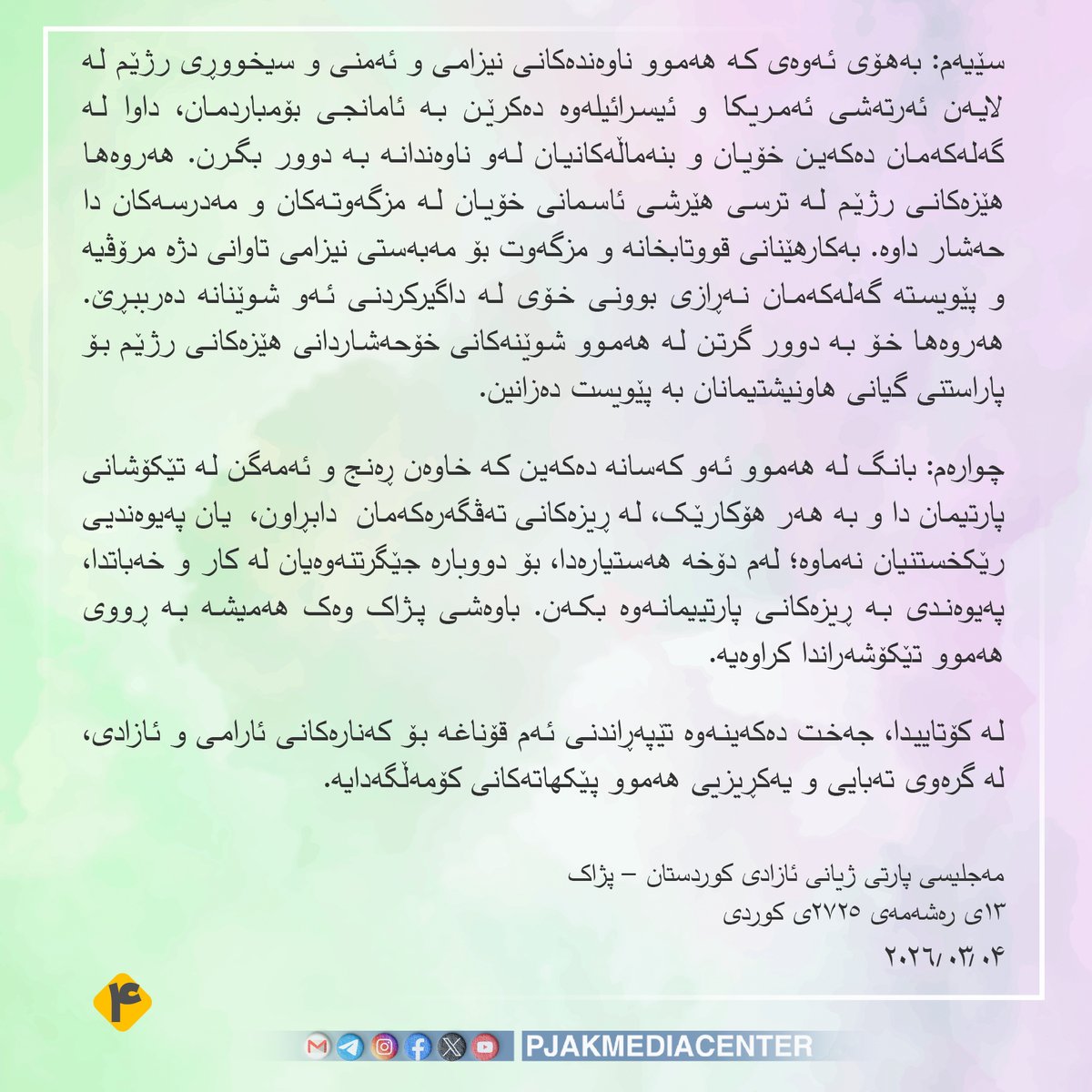
🔸بانگەوازی مەجلیسی پژاک بۆ خەڵکی نیشتمانپەروەری ڕۆژهەڵاتی کوردستان: ▫️گەلی نیشتیمانپەروەری کورد و هەموو گەلانی زاگرۆس ڕۆژهەڵاتی کوردستان و ئێران بووە بە مەیدانی شەڕێکی دژوار کە دەرەنجامی سیاسەتە چەوت و دزێوەکانی کۆماری ئیسلامییە. ئەم ڕژیمە لە لایەکەوە، ماوەی ٤٧ ساڵە مافی ژیانی ئازاد و دیموکراتیکی لە گەلانی نێوخۆی ئێران زەوت کردووە، لە لایەکی دیکەشەوە بووەتە سەرچاوەی پشێوی لە ڕۆژهەڵاتی ناوەڕاست و هەروەها مەترسیی بۆ سەر ئاسایشی جیهان. لە ئاکامی ئەم جۆرە سیاسەتانەدا، ئەمڕۆ شەڕێک بەرۆکی حکومەتی ئێرانی گرتووە، کە لە سەرژیان و هەروەها چارەنووسی گەلەکەمان لە ڕۆژهەڵاتی کوردستان کاریگەری ڕاستەوخۆی هەیە. بەپێچەوانەی چاوەڕوانیەکان پێدەچێت کە ئەو شەڕە مەودایەکی درێژتر بخایەنێت هەربۆیەش نرخاندنی کاریگەریەکانی شەڕ و بەپێی ئەوەش ئامادەکاری چڕوپڕ پێویستە.دۆخێک لە ئارادیە کە هەڵگری کۆمەڵێک هەڕەشەی جیدی و لەهەمان کاتیشدا، دەرفەتی مێژووییە. لەو باوەڕەداین بە خۆ بەرپرسیار دیتن و پێکهێنانی ئەرکەکانمان دەتوانین دەرفەتەکان بقۆزینەوە، هەڕشەکان پووچەڵ بکەینەوە و هەروەها کاریگەری شەڕ لە سەر ژیانی کۆمەلگەکەمان کەمتر بکەینەوە. بۆ ئەمەش ئەم خاڵانە دیار دەکەین: ..... پژاک؛ صدای آزادی، اتحـاد و عدالت بـرای آیندەای روشن #pjakmediacenter
PJAK MEDIA CENTER مرکز رسانەای پژاک tweet mediaPJAK MEDIA CENTER مرکز رسانەای پژاک tweet mediaPJAK MEDIA CENTER مرکز رسانەای پژاک tweet mediaPJAK MEDIA CENTER مرکز رسانەای پژاک tweet media
CKB
11
42
118
39K
Zan Csónakos retweetledi
Wladimir van Wilgenburg
Wladimir van Wilgenburg@vvanwilgenburg·
I spoke to senior PJAK official, who denied this. "I think they are wrong when they say that we have already started the war now, but we are preparing for the right opportunity."
i24NEWS English@i24NEWS_EN

EXCLUSIVE: Kurdish official tells @Y_Pobegailova that Kurdish forces in Iraq have launched a ground offensive into Iran @ariel_oseran breaks down the latest with @benitalevin 👇For more news and updates, visit our official website👇bit.ly/i24NEWSEN

English
22
185
555
164.3K
Zan Csónakos retweetledi
Scharo Bajalan
Scharo Bajalan@ScharoBajalan·
The most pressing issue for the Kurds is the US wishes for the Kurds to become active participants in the war against the Iranian regime and its proxies in Iraq. What must be said first: the Kurdish factions shall make their decisions; they know the regime and its capabilities. We as the Kurdish community should not pressure our forces to partake in a war that we can’t win. The Kurds are being offered what the USA has always offered the Kurds: A transactional alliance. Kurdish forces will be armed, *trained* and they will be given the opportunity to call in air support when possible/needed. It is very similar to the war against the Islamic State - this similarity however may become the reason for why the Kurdish factions will not partake in this war like the USA wishes - even as we will inevitably become part of this war. 1. The war against the Islamic State taught us that the partners in the war will seek to work with a different partner as soon as a different partner becomes feasible. In Iraq, the USA prioritised arming the PMF over arming the Peshmerga - in Syria they prioritised arming the *FSA* over arming the YPG Especially in regards to arming military factions it must be highlighted that both the SDF/YPG and the Peshmerga received less arms and less modern equipment as the other factions in the conflict-region - even as the other factions declared their hostility towards the USA/EU before forging the alliance. 2. As conditions on the ground change, so do the conditions of the alliance. Guarantees become non-binding agreements only under ideal conditions. 3. Blame will be sought within the Kurdish factions to not uphold pre-agreed upon terms. The Kurds received extraordinary backlash for liberating Raqqah and Deirezzor from the Islamic state or for defending Kirkuk against the Islamic State - as soon as another potential partner emerged or more valuable regional powers interfered, Kurds were dropped without a second thought. In short: It will not matter what the USA promises or guarantees to the Kurds every transactional alliance with them has proven to be binding for us but non-binding for them. Or as US envoy Tom Barrack has said *The Kurds served their purpose, it was a transactional alliance and the USA didn’t promise the Kurds anything* The big miscalculation of the USA and other actors was to believe that the events involving Kurds in the KRG and Rojava will not have direct consequences on how the Kurds perceive the USA in other parts of Kurdistan, such as Rojhelat. However, every Kurd must acknowledge the reality that the war - in which we sit right in the middle of - will inevitably pull us in; even if we were to stay neutral. So the question should move away from “should we enter the war” and instead we must raise the question of “when would the conditions be ideal to enter the war” Kurds are faced with the choices A) Fight the Iranian regime now while its military capabilities are evidently still intact B) Fight the Iranian regime at its weakest point in the future In both cases we will end up with the same outcome - and the USA has proven to us that there will be no *rewards* for being overly committed to aiding the USA in achieving their objectives.
English
27
76
254
27.2K