zoiroff

244 posts

zoiroff banner
zoiroff

zoiroff

@zoiroff77

Proposals are killing agencies. Your client is already gone. While you spent 3 days writing — they signed with someone who sent it in an 60 sec https://t.co/GyZiAEgofS

usa Katılım Ekim 2025
25 Takip Edilen27 Takipçiler
Sabitlenmiş Tweet
zoiroff
zoiroff@zoiroff77·
Hot take: most agencies lose deals not because of price — but because their proposal took 3 days. Client went with whoever sent something first. I'm building Lumaqore. to fix this. Paste the client's email → get a full proposal in minutes. Would love brutally honest feedback from anyone who sends proposals regularly
zoiroff tweet media
English
0
0
5
187
zoiroff
zoiroff@zoiroff77·
@Byron_Ventry Writing — yes, but I'd narrow it: speed of writing. Most people can write a good email, but two days later. A good email sent right after the call beats a great email a week later.
English
0
0
0
0
Byron
Byron@Byron_Ventry·
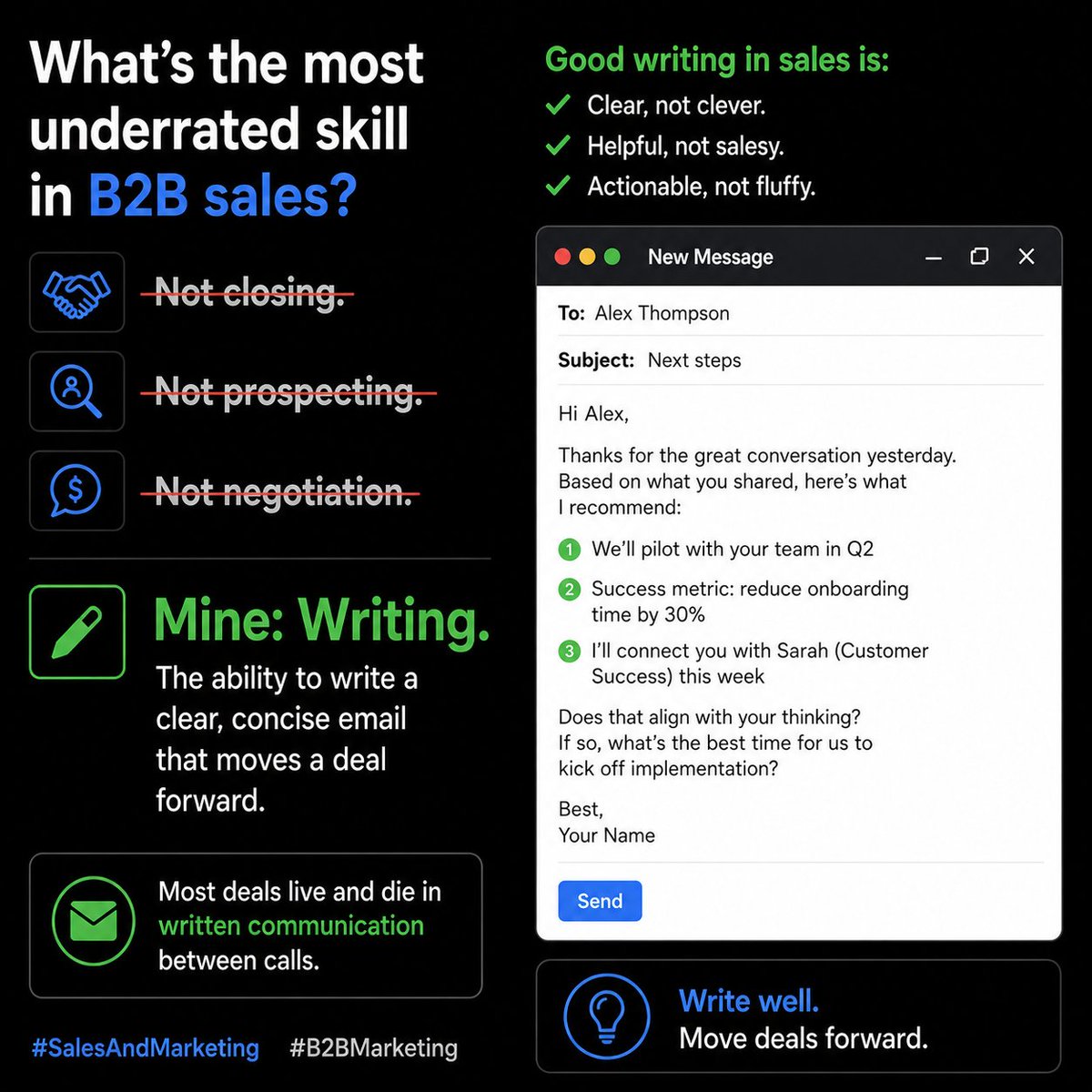
What's the most underrated skill in B2B sales? Not closing. Not prospecting. Not negotiation. Mine: writing. The ability to write a clear, concise email that moves a deal forward. Most deals live and die in written communication between calls. Your pick? 👇 #SalesAndMarketing #B2BMarketing
Byron tweet media
English
0
0
0
3
Alex Hormozi
Alex Hormozi@AlexHormozi·
You get rich by betting on things other people are wrong about. Because most "good" investments have their "goodness" priced into them, making them "mediocre" or "bad" investments in reality. The key is to find something that looks bad but is actually good. Which means you gotta be willing to have people tell you why you're dumb (then wait). Then get called lucky. Then do it a few more times. Then have people say you're finally good. But by the time they say you're good it already stopped mattering to you what they thought because why would you respect someone's judgment who was so repeatedly bad? They now only say you're good because everyone else does and not because they could ever make up their minds on their own.
English
131
91
1.1K
25.7K
Santosh
Santosh@santoshstack·
@zoiroff77 Yeah, strong marketing is usually a balance between consistency in direction and flexibility in execution ✌🏻
English
1
0
1
17
Santosh
Santosh@santoshstack·
If marketing feels slow, it’s often because you’re switching strategies too early. Most systems fail from lack of patience, not lack of potential.
English
43
2
53
769
zoiroff
zoiroff@zoiroff77·
@Ike_Ads Would love to continue this in DMs — lots to unpack on the "time to proposal" angle. Drop me a message when you're free.
English
0
0
1
8
Ike D. Nwankpa 👨🏾‍💻
Every lead you lose to slow follow-up was a sale. The lead moved on. Not because your offer was bad but because someone else was faster. Studies show businesses that respond to enquiries within 5 minutes are 100x more likely to close than those who respond in an hour.
Ike D. Nwankpa 👨🏾‍💻 tweet mediaIke D. Nwankpa 👨🏾‍💻 tweet mediaIke D. Nwankpa 👨🏾‍💻 tweet mediaIke D. Nwankpa 👨🏾‍💻 tweet media
English
2
0
1
34
zoiroff
zoiroff@zoiroff77·
@Ike_Ads Yes, send it over when it's ready! Meanwhile — I actually built this already. lumaqore.store: paste a client email, get a full proposal draft in under 5 min. Would love your take on it as someone who gets why "time to proposal" matters.
English
1
0
1
17
Ike D. Nwankpa 👨🏾‍💻
@zoiroff77 I definitely agree a proposal in under an hour would most likely close the deal. “time to proposal” is a real metric to track… This gives me a lot of ideas on how to go about building this system for B2B services… Can I show you the build when I get it done?
English
2
0
0
16
Alex Hormozi
Alex Hormozi@AlexHormozi·
I overheard a successful business man talking to a younger one that was saying his advice was boring. The older replied “you know what’s exciting? Poverty! Extremely exciting. Never a dull moment!” Always remembered that.
English
189
309
3.7K
74.1K
zoiroff
zoiroff@zoiroff77·
@reallytherhino "During the call, not after" — that's the next level. Most teams still think "I'll send it in an hour." An hour is already too late — the client closed the tab and moved on. Real win = proposal in the inbox before the client hangs up.
English
0
0
0
5
Ryan Romero | RHINO
Ryan Romero | RHINO@reallytherhino·
Send the proposal during the call, not after. The longer it takes, the colder the deal gets
English
1
0
0
7
zoiroff
zoiroff@zoiroff77·
"Lazy-explosive" describes more than M&A — it's the pattern for every B2B deal. Agency sales work the same way in miniature: client goes silent for two weeks, then one morning emails "when can we start?" Whoever shows up with a ready proposal in an hour wins. Whoever's still drinking their coffee loses, exactly like you wrote. Almost nothing matters until it matters all at once, and then speed is the only currency. Saving this — it's the clearest description of how deals actually work.
English
0
0
0
1
Josh Li
Josh Li@thejoshli·
Most people think M&A is some high octane game of constant motion and intensity. It is not. It is ninety percent hemorrhoid sit and ten percent move fast or lose everything. Most of the deal is just waiting. You send the NDA. You wait. You get the financials. You wait for the accountant to stop calling you. You submit the LOI. You wait. Due diligence opens. You wait for documents that were promised Tuesday and arrive the following Tuesday if you are lucky. You wait for your lawyer to stop billing for thinking about the deal and actually draft something. You wait for the bank to schedule the credit committee meeting two weeks from now. Hemorrhoid sit. The whole way through. The trap is either panicking during the slow parts and killing your own deal with impatience, or falling asleep during the slow parts and missing the moment the whole thing moves at once. Because when it moves it moves fast. Seller gets another offer. You have 48 hours to sharpen your terms or lose the deal entirely. Bank comes back with a condition. You have a week to restructure. Seller gets cold feet. You have one phone call to bring them back or it dies on the table. The whole game is lazy explosive. You sit there in complete stillness for weeks and the moment it accelerates you are moving with full conviction or you are watching someone else close it while you were still finishing your coffee. Almost means nothing. Signed means everything. Move at all times like the deal is one conversation away from falling apart. Because it is.
English
1
0
0
34
zoiroff
zoiroff@zoiroff77·
ICP clarity breaks at two levels. The first is breadth ("agency owners" is too abstract). The second — most founders never reach — is the moment. Not "agency owner who sends proposals," but "agency owner who just lost a deal because the proposal took 2 days." When the ICP overlaps with a trigger moment, the message writes itself. Without the moment, even a narrow ICP sounds like everyone else.
English
0
0
0
9
Nev Santana
Nev Santana@nevsantana7·
Most early-stage founders don't have a sales problem. You have a clarity problem. You’re not closing because you haven't figured out who you’re actually selling to — and why that person should care right now. When the ICP is fuzzy, everything downstream suffers. The messaging is vague. The outreach is generic. The pitch tries to appeal to everyone. And "everyone" always converts to no one. Before you scale a sales process, answer these questions: Who is the one person most likely to buy in the next 30 days? What makes this problem urgent for them right now? What’s the exact problem you solve? (In their words, not yours) What proof do you have that helps them believe you’re a viable solution? Simple, but useful framework that’ll help you 1. get in front of the right buyer and 2. speak to them clearly with the solution to their pain point. Everything else follows from that.
Nev Santana tweet media
English
1
0
1
22
zoiroff
zoiroff@zoiroff77·
"Decision window handed to someone else" — that's the hidden cost of "let me polish it a bit more." Most founders assume quality compensates for the delay. It doesn't. The decision is made by whoever showed up first in the inbox with a concrete offer. Everyone else becomes reference material for price comparison.
English
0
0
0
10
James Edison
James Edison@JamesEdisonHQ·
@emailwabhishek Waiting too long to present the offer often feels safe. But in reality it just hands the decision window to someone else who’s willing to ask for the sale sooner.
English
2
0
1
17
Abhishek Soni
Abhishek Soni@emailwabhishek·
The "nurture first, sell later" advice bankrupted more coaches than bad offers ever did. You know what happens when you wait too long to present your solution? Someone else solves their problem. It’s not that your offer was bad. You were just too scared to present it at the right time.
English
13
0
18
170
zoiroff
zoiroff@zoiroff77·
The 10-second version is the header. Price, timeline, outcome. Everything else is reference material in case the client wants to dig deeper. Most agencies build proposals backwards: 4 pages of methodology, price at the end. Client closes the PDF on page 2. Flip the order → win-rate goes up faster than any copy improvement.
English
0
0
0
7
Nicholas Tomich
Nicholas Tomich@NicholasTo1654·
If your offer takes 10 minutes to explain, it's not an offer—it's a pitch. Good offers are understood in 30 seconds. Great offers are irresistible in 10.
English
1
0
0
10
zoiroff
zoiroff@zoiroff77·
"Speed and certainty" is exactly what most teams break at the very first touch. Client emails → "interesting, tell me more" → agency sends a proposal 2 days later. Speed: killed. Certainty: diluted ("let's hop on a discovery call first..."). By the time the proposal lands, the client is already talking to three others and comparing on price. The same proposal sent in 30 minutes wins not because of quality, but because it caught the window of hot interest🙂
English
0
0
0
0
Tom Bilyeu
Tom Bilyeu@TomBilyeu·
5. Plot the Quick Win Can you get your buyer a result they can see, feel, or measure inside a week? People don't buy value. They buy speed and certainty. If your offer takes 3 months to show progress, they're gone before they ever see it work. Write down the one sentence that finishes this: "7 days after they buy, my customer will _______." If you can't fill in that blank with something concrete, your offer's not ready.
English
2
0
1
159
Tom Bilyeu
Tom Bilyeu@TomBilyeu·
42% of startups build something nobody wants. (I've been in that 42%.) Most founders find out 18 months and a few hundred grand too late. I run 5 questions before I commit a dollar to any new idea.
English
9
2
27
4.5K
zoiroff
zoiroff@zoiroff77·
Agreed 100% — no email sequence replaces being in the room. But there's a nuance: what should be automated isn't the closing, it's what frees up time for closing. If the founder spends 2 hours writing the proposal after the call, there's less of them in the next meeting. Automating the draft → more presence in the room. Different layers, not competitors.
English
0
0
0
2
Connor Curran
Connor Curran@curranconnor·
A proposal is just text on a screen until you show up in the room. Most business owners think that follow up is something that should be automated through an email sequence. They are wrong. Automation is a tool for scale but presence is the tool for closing. I just walked out of
English
1
0
0
12
zoiroff
zoiroff@zoiroff77·
42 hours is already a lost deal — it just doesn't know it yet. The window of intent on an inbound lead is 24 hours max, after that inertia kicks in and the buyer starts comparing. The bottleneck is almost never the "slow sales rep" — it's the proposal. Sales responds in 10 minutes, then spends 2 days writing the proposal "when Slack calms down." By the time it lands, the client has cooled off. Speed-to-proposal IS the system that catches the lead before it leaks.
English
0
0
0
10
CryptoD₿S
CryptoD₿S@DbsCrypto·
42 hours to answer an inbound lead isn’t a marketing problem. It’s a broken sales system. By then the buyer has compared options, lost urgency, or paid someone faster. Attention decays. Demand does too. Distribution only matters if your system can catch it before it leaks out.
English
2
0
0
30