
Tweet fixado
Bio Protocol
10.1K posts


Bio Protocol
@BioProtocol
Biotech's new financial layer.
Entrou em Mayıs 2022
291 Seguindo115.8K Seguidores
Science agents aren't here to replace scientists.
They handle the parts that slow things down. Waiting weeks for a grant to come through. Emailing back and forth just to book equipment. Rewriting the same proposal with different words.
An agent skips all of that.
It has a budget, books the run, reads the result, and moves to the next step.
Things are starting to move on their own.
English
Bio Protocol retweetou

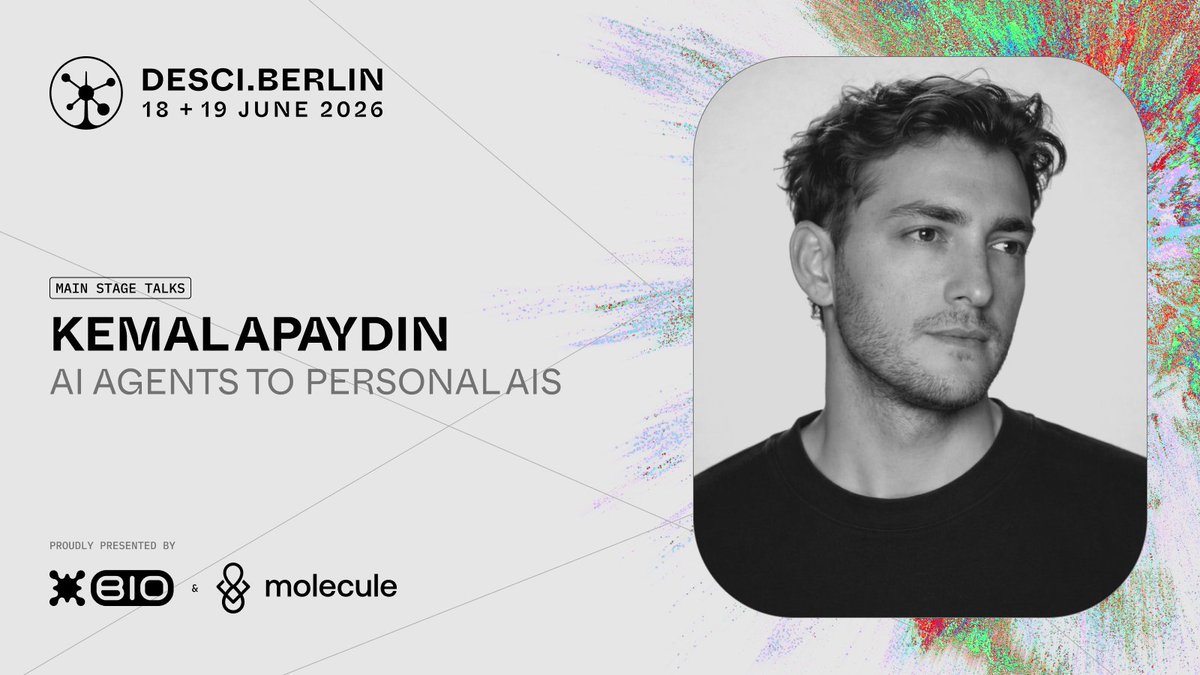
"AI Agents to Personal AIs"
@kemalapaydin will give a talk on where agentic infrastructure stands today, how OpenClaw and Hermes are being used across industries, and where autonomous operations head next.
English
Bio Protocol retweetou

PeptAI Update: Track 2 Synthesis, New Programs & More
What's New:
• KISS1R + OX2R Synthesis: Synthesis queued for KISS1R and OX2R candidates alongside the GLP-1R track. Functional assay CRO being finalized in parallel.
• New Programmes: BPC-157 candidates entering the computational gate pipeline. VEGFR2 D2-D3 de novo shortlist locked at 6 candidates. αvβ3 and Apelin/APJ in early computational scoping.
• CRO Evaluation: Bringing in a second CRO for Class A GPCR functional assays as a parallel option alongside Ginkgo.
English
Imagine a surface where a scientific idea can meet collaborators, attract capital, and become a funded experiment, without ever leaving the feed.
English
Bio Protocol retweetou
Bio Protocol retweetou
PeptAI runs a fully self-improving discovery loop.
Candidates clear 8 computational gates & 1 wet-lab gate, return assay results via @adaptyvbio, and feed those results directly back into the next design cycle.
The agents learn across runs and the science compounds🧵
English
Bio Protocol retweetou
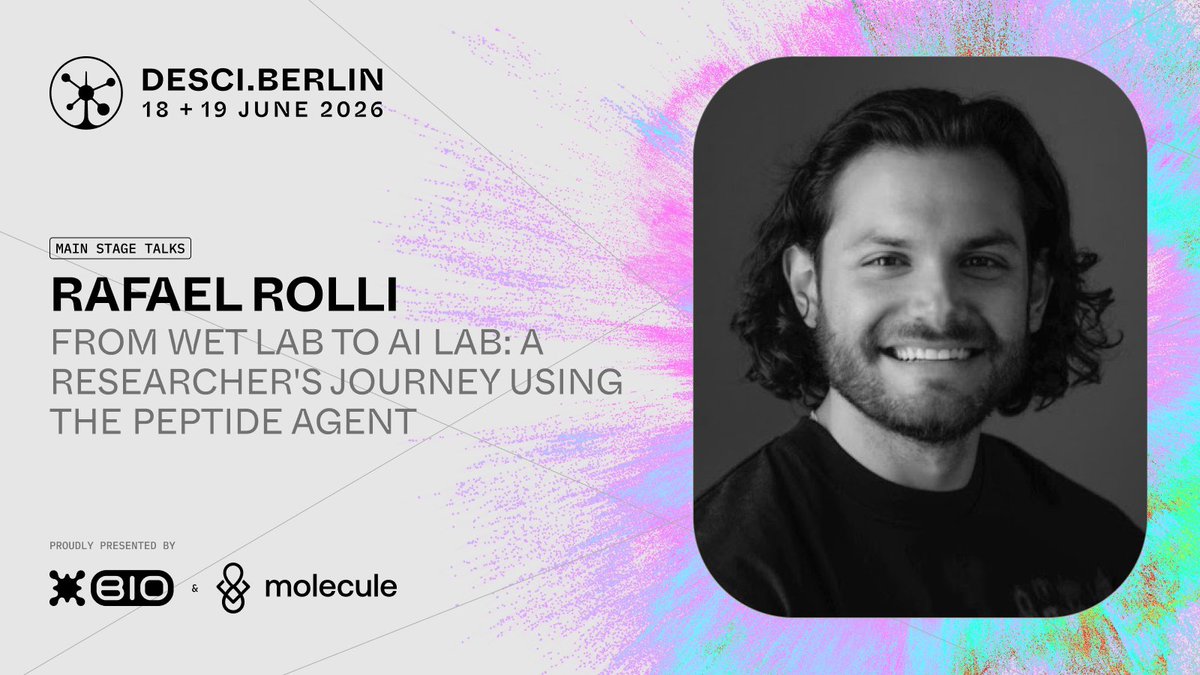
What does peptide research look like when an AI agent runs the pipeline?
Rafa, the scientist behind @peptai_, shares what he's learned working alongside the agent.
English
Science has never been short on good ideas.
The real bottleneck has always been everything that comes after the idea.
You still need funding, the right data, and lab time, and each of those steps comes with its own friction and delays.
For funding, you need to wait for committee reviews. The specific dataset you need is often locked away by whoever controls it. Booking equipment usually means chasing the right person just to get it set up.
Months can pass by before anything meaningful actually happens.
Now agents are starting to break through those barriers.
They can hold a budget and spend it as soon as it’s needed. Pull the data, secure the lab time, run the experiment, and immediately use the results to plan the next step.
The whole loop is finally starting to move on its own.
English
Bio Protocol retweetou
An idea that doesn't hold up is still data.
Right now, it just vanishes. It dies in a group chat or a forum thread, and the next person who has the same thought starts from scratch.
It doesn't have to be like that.
Think of an open surface where anyone can post an idea, others vote, argue, and pick it apart in public.
The strong ones turn into actual projects with a workspace, collaborators, and funding.
The ones that fail stay visible, so the next researcher sees the idea was already tried.
What didn't work for one project becomes the starting point for the next.
English
The hardest problem in AI for science is payment, not the science.
AI can already design proteins, synthesize hypotheses across thousands of papers in seconds, and identify promising drug candidates in days.
But the moment the agent needs actually to spend money on compute, a lab assay at a CRO, or another agent’s output, everything stops.
Wire transfers, procurement, and a finance team approving a PO.
Sometimes the agent is stuck, waiting for hours or days.
A truly autonomous science agent needs to pay continuously for inference, wet lab time, datasets, and other agents. Traditional banking isn’t built for that.
What actually works today is already in production: agent wallets, on-chain treasuries, and micropayments like x402.
These agents are running live, paying for compute, and wet lab work directly from on-chain treasuries they control.
• Each transaction is signed by the agent. Each cost is logged and traceable on @Molecule_sci Labs.
• Every wet lab handoff is anchored to a transaction.
If you don't trust the agent, you can verify the agent.
Designed by an agent. Paid by an agent. Validated by a wet-lab. Logged on-chain.
English
Bio Protocol retweetou

Took a stab at designing orally available MOTS-C at this with @peptai_ - took our agents 150min
What is the problem? Native MOTS-c is rapidly destroyed by enzymes in the blood and gut, cannot cross cell membranes efficiently, and cannot be taken as a pill. These properties make it unsuitable as a drug in its natural form.
What did we do? Using an AI-assisted computational workflow, we designed 306 chemically modified versions of MOTS-c and ranked them by predicted stability, permeability, and preservation of the key residues believed to be responsible for CK2-alpha interaction. We identified 3 synthesis-priority candidates and produced a complete experimental plan to test them.
What did we NOT do?
We did not make or test any of these peptides. All
results are computational predictions. No peptide has been shown to bind CK2-alpha, activate the enzyme, survive in blood, cross a membrane, or treat any disease. These are experimentally testable hypotheses, not validated therapeutics.
What happens next? The recommended next step is to synthesize 11 peptides (3 designed analogues + 8 controls) and run 3 laboratory assays: a binding test, an enzyme activation test, and a stability test. Estimated cost: USD 35,000–60,000.
Estimated timeline: 10–14 weeks.
Happy to share the full paper or some of the candidates, I agree with @BasedBiohacker though the IP here could be really valuable
BasedBiohacker@BasedBiohacker
whoever solves oral MOTS-C with some lipid-based carrier or enteric coating or just SOMETHING is going to be a billionaire
English
DeSci Berlin is happening one month from today, exploring scientific singularity and agentic science.
Agents are starting to run the experiments. Results publish in real time. Science moves differently from here.
Register below ↓
DeSci.Berlin@DeSciBerlin
1 month until DeSci Berlin! The 5th edition focuses on two ideas reshaping research: scientific singularity and agentic science. Calling all scientists, AI engineers, web3 builders, biotech founders! Grab your spot and register now ↓
English
Bio Protocol retweetou
Founding Peptide Cocktologist and Agent Fleet Support, @peptai_
Remote. Start now.
Commanding fleets of scientific agents is becoming a real job.
This one puts you at the center of it, in a fully programmatic environment built around shipping, not committees.
PeptAI is an autonomous peptide discovery engine. Agents design candidates, run them through 8 computational gates from structure prediction through MD, developability and immunogenicity, and ship the survivors to wet lab. Live programs on KISS1R for fertility, OX2R for ADHD, GLP-1R for metabolic health.
You'll work directly with Rafa, a peptide scientist who has already shipped binders and built the path you're stepping onto. The work covers sequence ideation, non-canonical amino acid chemistry, multi-target cocktails, and selectivity engineering. Then you pilot the agent fleet that validates everything you design.
The role is set up for self-directed learning, in close collaboration with our Head of Applied AI.
Background:
MSc or PhD in computational chemistry, structural biology, or peptide chemistry. We weight programs with deep institutional history in peptide work, places like ETH, EPFL, Oxbridge, Max Planck, Karolinska, Heidelberg, TU Munich, Lomonosov MSU, Shemyakin-Ovchinnikov, Novosibirsk State, Tokyo, Kyoto, Peking, Tsinghua, NUS, KAIST.
Strong candidates from other programs welcome. No degree is fine if you have peptides in the literature or in the clinic that bind.
You should love agents. You should love peptides. You should be the kind of scientist who finishes things.
Apply:
Send us one peptide you would design for KISS1R, OX2R, or GLP-1R, and the reasoning behind it.
→ peptai.xyz

English
Bio Protocol retweetou

Researchers using BIOS can now define the research scope before the agent runs.
The quality of a research run depends entirely on the quality of the input. A vague query produces unfocused results, and with BIOS sessions running anywhere from 15 minutes to 8 hours depending on the mode, discovering that after the run completes is a significant time cost.
Plan Mode adds a clarification step before any research begins.
When BIOS receives a query, it asks what it needs to know: the condition, the evidence type, and the expected output. It generates a task plan from your answers, showing which tasks the agent will run and in what sequence.
These tasks are either literature reviews or data analysis runs. Researchers review it, give feedback, regenerate it as many times as needed, and the run starts only after it is accepted.
Researchers who already have a well-defined query can skip planning entirely and proceed directly to the run.
Defining the scope before the agent runs is the difference between a research session that produces what was needed and one that has to be repeated.
English
Bio Protocol retweetou
PeptAI Update: First Synthesis Run, Feedback Loop & More
What's New:
• First GLP-1 Synthesis Batch: We're synthesizing the first round of GLP-1 candidates, then shipping directly to @adaptyvbio for assays. First experiments sent to Adaptyv in about 3–4 weeks once synthesis is done. Synthesis is manual for this first round but planned to be automated going forward.
• Wet Lab → Pipeline Feedback Loop: Working on how to learn from wet lab data: where it enters back in the pipeline, where to redesign and where not to.
• New Receptor Scoping: In parallel, scoping new receptor targets.
• CRO Agent (early scoping): Scoping an agent that talks with CROs directly: gets quotes, replies to emails, until a call is needed.
English
Science has three bottlenecks after the experiment.
> A result logs in one system.
> Conviction sits in inboxes.
> Capital waits in a committee.
Claims stall not because they are wrong but because conviction has nowhere to accumulate publicly.
Autonomous science needs a surface where claims, conviction, and capital move together.
English
Science doesn't lose months in the lab but in the queue after.
NIH grant applications take between 8 and 20 months from submission to award.
Peer reviewers globally spent over 100 million hours on reviews in 2020 alone, worth over $1.5B in the US.
Drug discovery still averages over a decade per approved drug.
The experiment is the fastest part of science.
English
The best self-driving lab in the world still stops and waits.
Not for equipment. For a human to decide what comes next.
The decision layer is what autonomous science needs🧵
English